
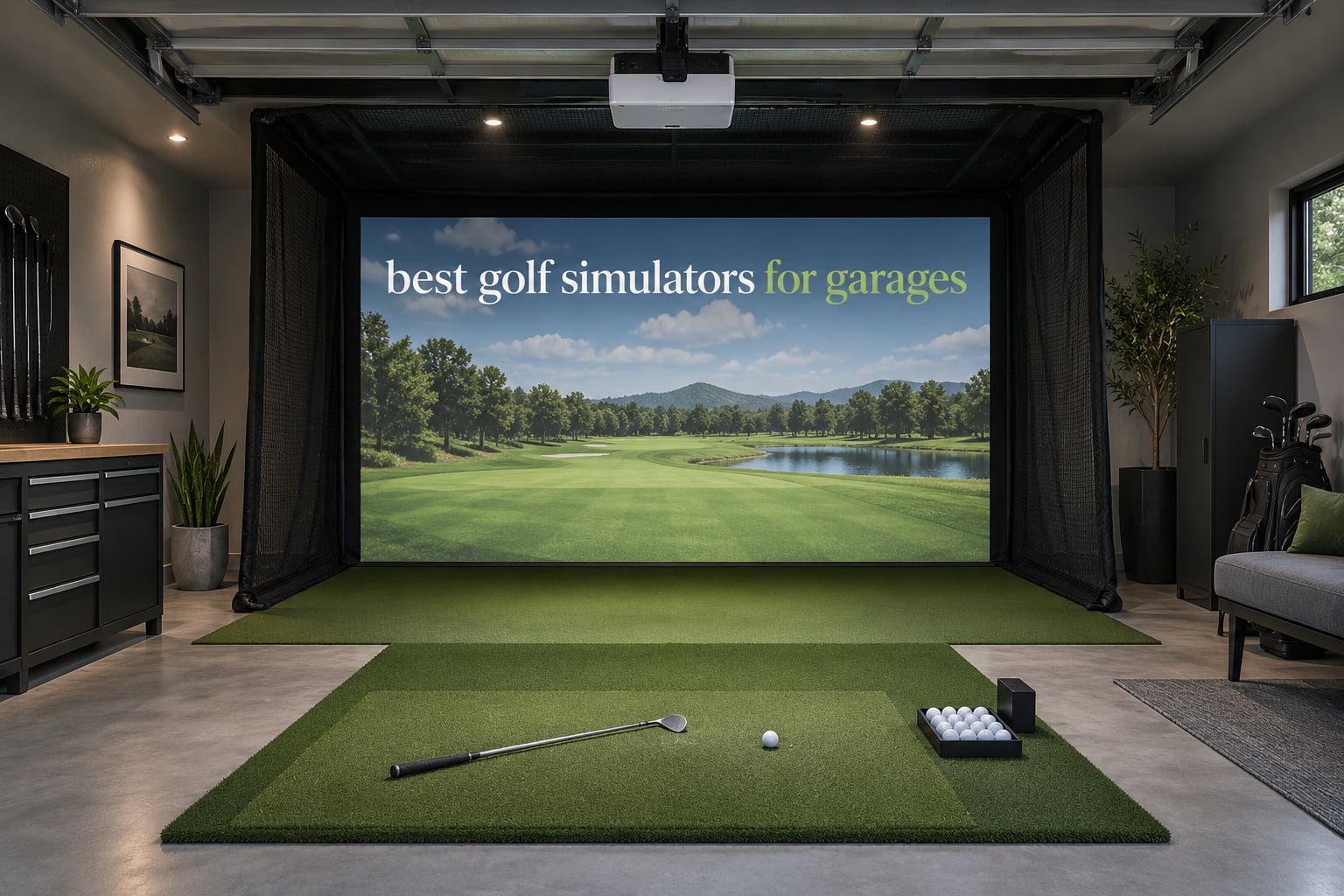
A garage golf simulator is an indoor golf setup built around four parts: a launch monitor that measures your shot, an impact screen or hitting net that stops the ball, a hitting mat, and simulation software that draws the shot on a virtual course. Some setups add a short throw projector and a blackout enclosure so the image looks like a television sport instead of a practice bay.
Most garage builds land in one of three camps. The first is the no-ball option, where a swing stick and a phone camera stand in for a club and a real ball. The second is the portable launch monitor plus a net, which gives you ball speed, launch angle and spin data with nothing bolted to the ceiling. The third is the fixed enclosure, where a framed impact screen, side netting and a projector turn one wall of the garage into a full simulator bay.
Garage constraints decide which camp fits, not the other way around. Ceiling height measured to the lowest obstruction, room depth, whether you still park a car under the setup, and whether the space is heated all decide the hardware. We compared the ten systems below on frame rigidity, screen durability, blackout performance, sound control, footprint and how much of the bay you can reclaim when practice is over.
Top 3 Picks for the Best Golf Simulators for Garages for October 2026
Quick Overview: Best Golf Simulators for Garages in October 2026
| PRODUCT MODEL | KEY SPECS | BEST PRICE |
|---|---|---|
 |
|
Check Latest Price |
 |
|
Check Latest Price |
 |
|
Check Latest Price |
 |
|
Check Latest Price |
 |
|
Check Latest Price |
 |
|
Check Latest Price |
 |
|
Check Latest Price |
 |
|
Check Latest Price |
 |
|
Check Latest Price |
 |
|
Check Latest Price |
Quick Picks by Budget for a Garage Golf Simulator
Most garage builders split into four budget tiers, and the tier you buy from decides how much gear you add yourself. Here is how the ten systems sort out.
Best for the tightest garage and zero installation: the PHIGOLF Home Golf Simulator. It needs no screen, no ball strike and barely any floor space, which makes it the only system on this list that works in a garage you still use for storage.
Best entry-level ball-striking setup: the GoSports Range Cage 10 x 8 ft and the Haokelball 10 x 8 x 6 ft cage. Both are open-frame nets with an impact screen and side containment, priced for buyers building a first bay on a budget.
Best mid-range blackout builds: the Diandian, HOMEVOL and ANYTHING SPORTS Complete Package enclosures. These add blackout fabric or wrap and foam padding, which is what a projector actually needs to look right.
Best serious-garage builds: the GoSports SimBay, the Durbles kit and the ANYTHING SPORTS Fold Up Enclosure. Triple-layer screens, full safety padding and folding frames cost more but survive daily driver work and shared parking.
If you are still deciding between a screen system and a plain net, our golf net reviews break down containment and footprint separately. Once a bay is running, mat choice matters more than most buyers expect, since mat quality drives how much feedback you get off the strike.
1. PHIGOLF Home Golf Simulator – Best Overall for the Tightest Garage
PHIGOLF Home Golf Simulator, Motion Sensor & 3D Analysis for Practice & Fun
Aluminum body
9-axis motion sensor
Android and iOS
1 Year Manufacturer
+ The Good
- No balls
- nets or ceiling clearance needed
- Works in a very small footprint
- AI swing coach with body pose tracking
- Family multiplayer supported
- The Bad
- App connection can drop or fail to detect the sensor
- Swing stick can disrupt natural swing mechanics
- No real ball striking so no ball speed data
I put this one at the top of the list because it solves the garage problem that the other nine cannot. The swing stick lives in an aluminum frame about 25 inches long, and the sensor attaches to the stick or to a real club, so there is no screen to position, no ball to strike and nothing hanging from your ceiling.
The system runs through the Phigolf app on Android or iOS and covers 38000-plus courses, with E6 Connect among the supported titles. A nine-axis motion sensor captures the swing movement and drives an on-screen avatar, which is a genuinely useful way to spot a cast in the downswing without any video analysis setup.
What you give up is real data. There is no ball speed, launch angle or spin axis, because no ball is struck. Reviewers report that distance and direction results feel inconsistent next to real ball striking, so treat it as a swing trainer that happens to play golf rather than the reverse.
The weak point is connection reliability. Owners mention slow app pairing, the sensor occasionally not being recognised, and battery charging that weakens over time. If your phone or tablet is on a shared Wi-Fi network, expect pairing friction. We covered the wider category in our complete golf simulator guide.
What to check before you buy this system
Confirm your device runs the current Phigolf app, because older tablets are the most common reason pairing fails. Also decide whether your goal is screen golf or ball striking, because this system does the first and not the second, and adding a net later doubles your footprint.
Who should skip it
Skip it if you want club data, ball speed or a projected course, since none of those exist here. It is also the wrong pick for anyone who already owns a launch monitor and simply needs somewhere safe to hit, because it adds no ball-striking capability to a garage that already has one.
2. GoSports Range Cage 10 x 8 ft – Best Value Enclosure
GoSports Range Cage 10 ft x 8 ft Golf Practice Hitting Net with Impact Screen
Fiberglass and polyester
10 ft x 8 ft screen
40 pounds
6 month warranty
+ The Good
- Side and top netting contain driver mishits
- Screen doubles as a projector backdrop
- Foam base cuts rebound and impact noise
- Packs into the included carry bag
- The Bad
- Lower screen section can tear with repeated real-ball strikes
- Assembly instructions are clearer with a video
- Seam quality varies between units
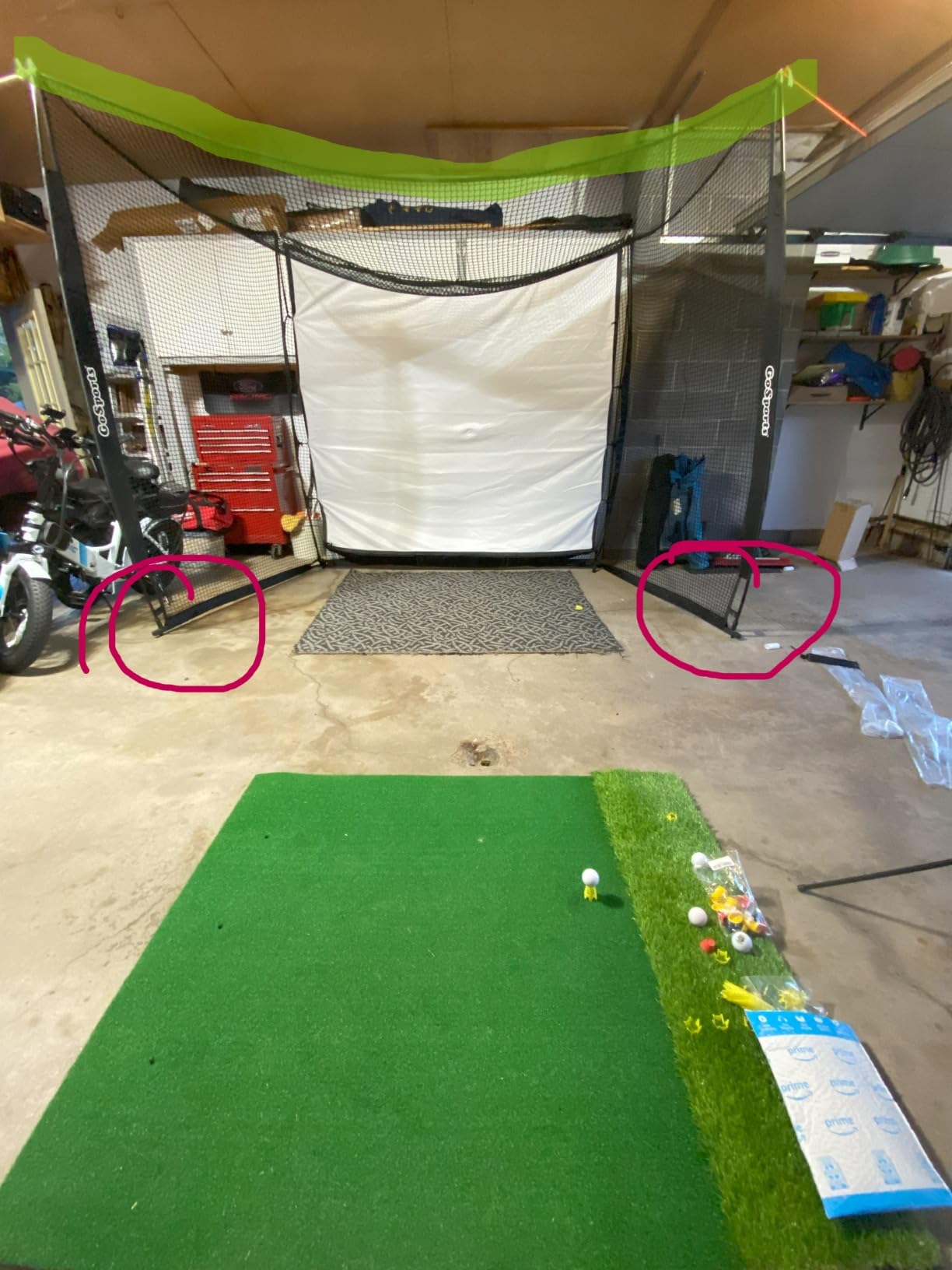
This is the cage most first-time garage builders end up with, and for good reason. The 10 ft by 8 ft hitting area sits inside a steel frame with fiberglass poles, side netting and a top net, so slices and pushed shots stay inside the footprint instead of finding your car.
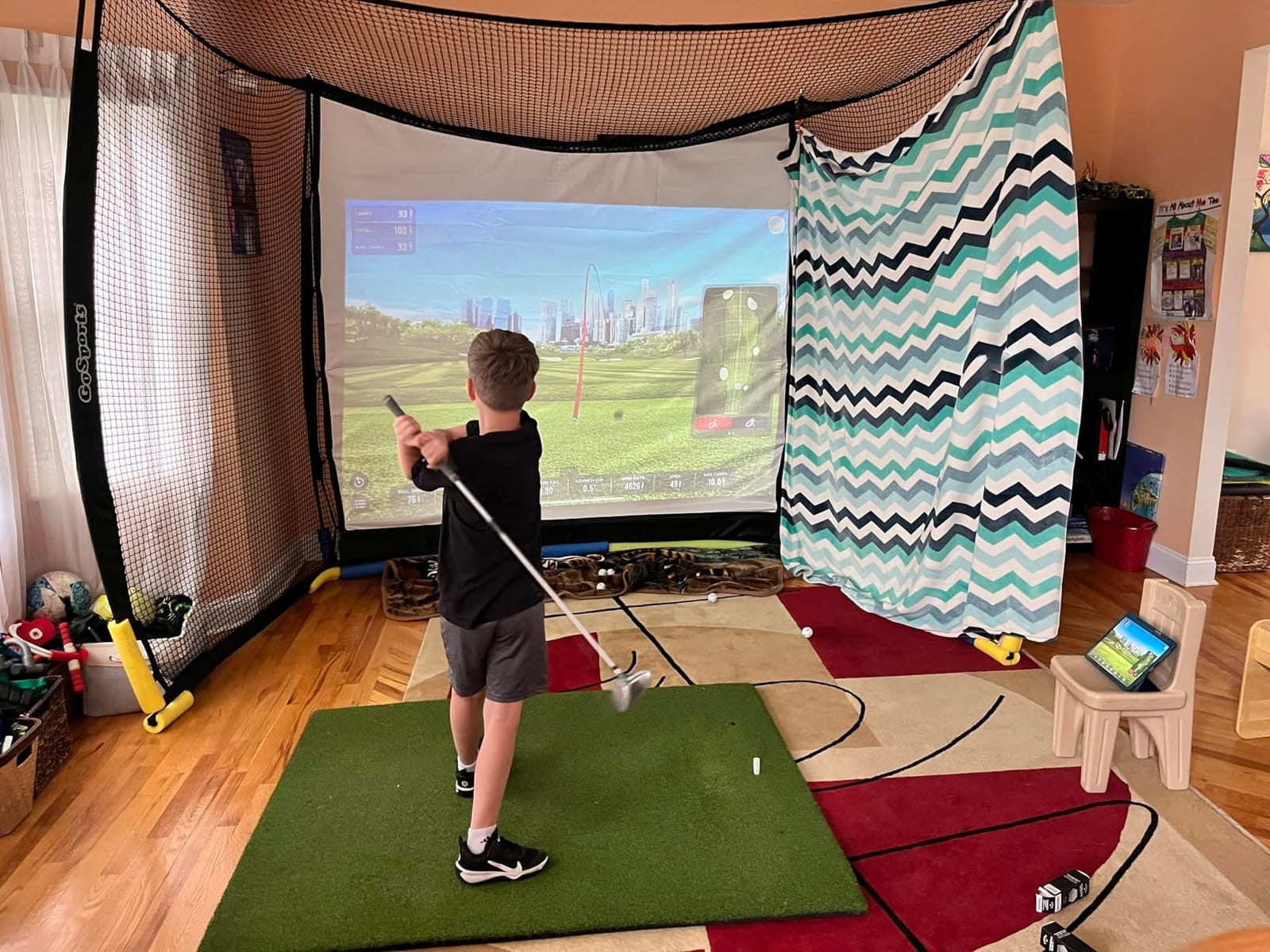
The included high-density polyester screen doubles as a projector surface, which turns a practice net into a simulator backstop for very little extra work. Pair it with a portable radar launch monitor and a short throw projector and you have a functional bay without a blackout enclosure.
Owners rate it at 4.1 stars across a few hundred reviews and roughly two thirds of ratings sit at five stars. It holds up for near-daily garage use, and the foam-padded base does more than comfort work, since it absorbs rebound that would otherwise rattle back at your shins.
The recurring complaint is wear at the bottom of the screen. Real ball strikes concentrate there, and a few owners report tearing after heavy driver work. Treat the lower edge as the part that eventually gets replaced, and consider a second mat position so you are not hitting the same six inches of fabric every session.
What to check before you buy this cage
Measure your bay against the 10 ft by 8 ft hitting area plus the frame, not just the screen. Because it packs into a carry bag, this is also one of the few systems that moves between a garage, a basement and a backyard without disassembly.
Who should skip it
Skip it if you need a dark image, since there is no blackout fabric here and ambient light will wash out projected contrast. It is also a poor match for a shared two-car bay where you need to reclaim the space daily, since it is a fixed cage rather than a folding frame.
3. GoSports Golf Simulator Enclosure Nets – Best Blackout Enclosure
GoSports 10 x 8 ft Golf Simulator Enclosure Net – Complete Set with Frame and HD Impact Screen Kit
Alloy steel and polyester
79 pounds
10 x 8 ft screen
6 month warranty
+ The Good
- Multi-layer screen survives high ball speeds
- True blackout design visibly improves image brightness
- Numbered parts make assembly close to an hour
- Padded frame absorbs abuse
- The Bad
- Screen and frame still rebound balls
- Included padding is thin so most owners add foam
- No hanging baffles to knock down wedge shots
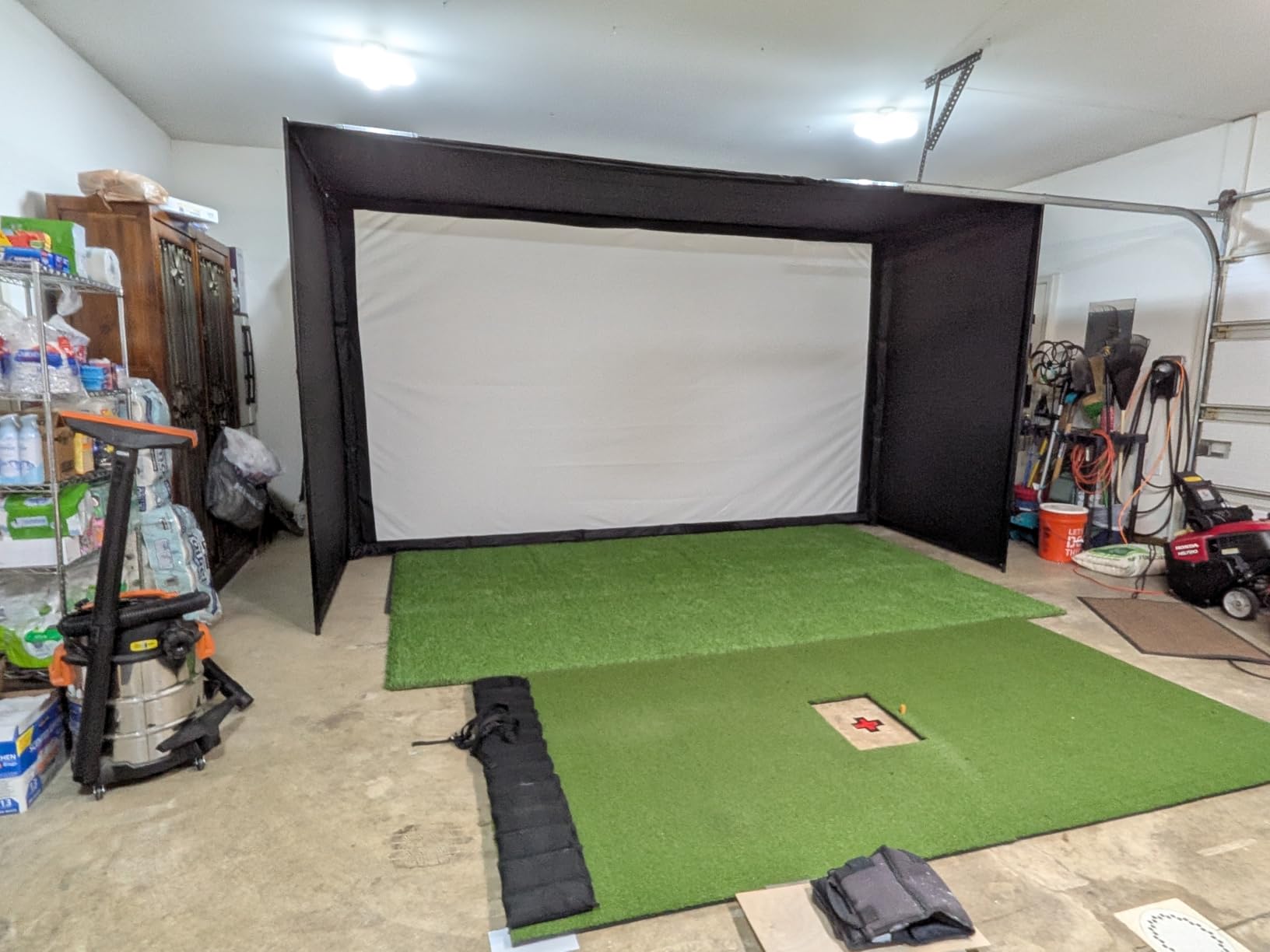
The multi-layer impact screen is the reason this enclosure holds together under driver work, and it is also the reason the projected image looks better than a net. The panels use a specialised dyeing process to block outside light, so a daylight garage still produces a dark enough image for a short throw projector.
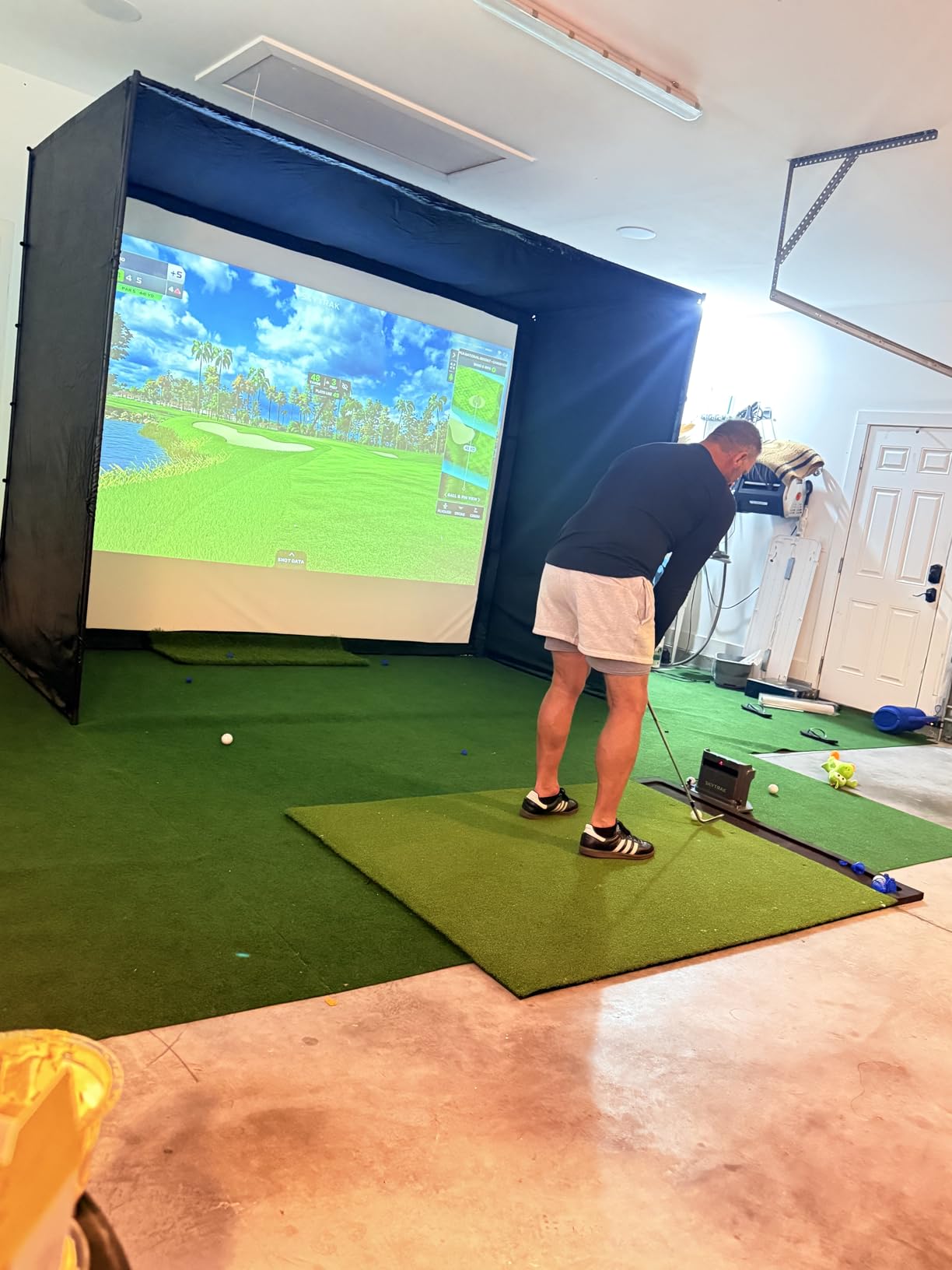
Assembly is the smoothest in this group. Poles are numbered and the hardware is labelled, and owners report finishing in roughly an hour without needing a second person. Screen durability draws the strongest praise, with several reviewers noting no tearing or sagging after repeated high-speed hits.
Two gaps stand out. There are no hanging baffles above the screen, so wedge shots can climb toward the top cover eyelets. And the supplied frame padding is thin enough that several owners added their own foam behind it, which is a two-hour job and a good idea anyway.
The 79-pound weight is real but manageable, and it is the one enclosure here that a single person can reposition if the layout changes. Shank nets are not included, so plan on a separate side-net solution if you shank mishits into the frame.
What to check before you buy this enclosure
Check the top-drop problem early, since a drooping top before tensioning is a known behaviour in the larger variants. Measure ceiling height to the lowest obstruction and leave room to walk behind the enclosure, because you will need access to tension the frame after the first few sessions.
Who should skip it
Skip it if your garage is hot or humid and unconditioned, since the fixed blackout fabric traps whatever moisture is in the air against the screen. It is also overkill if you only need somewhere to hit a few balls on a weeknight, where the simpler cage would do the same job.
4. ANYTHING SPORTS Complete Golf Simulator Enclosure Package – Best for Larger Garages
Complete Golf Simulator Enclosure Package – 4K-Ready Impact Screen with Blackout Cage, Projector Mount, Frame Poles, Side Shank Nets | Indoor & Garage Practice | Easy Setup | 12-Month Warranty
Metal pole frame
11 x 8-4 x 5 ft
39 kg
12 month warranty
+ The Good
- Projector mount included out of the box
- Impact screen holds up under repeated strikes
- Metal frame outlasts replaceable screen covers
- Responsive US-based support
- The Bad
- Written instructions frustrate first-time builders
- Included panels are thin covers rather than impact padding
- Upper rear crossbar can return wedge shots
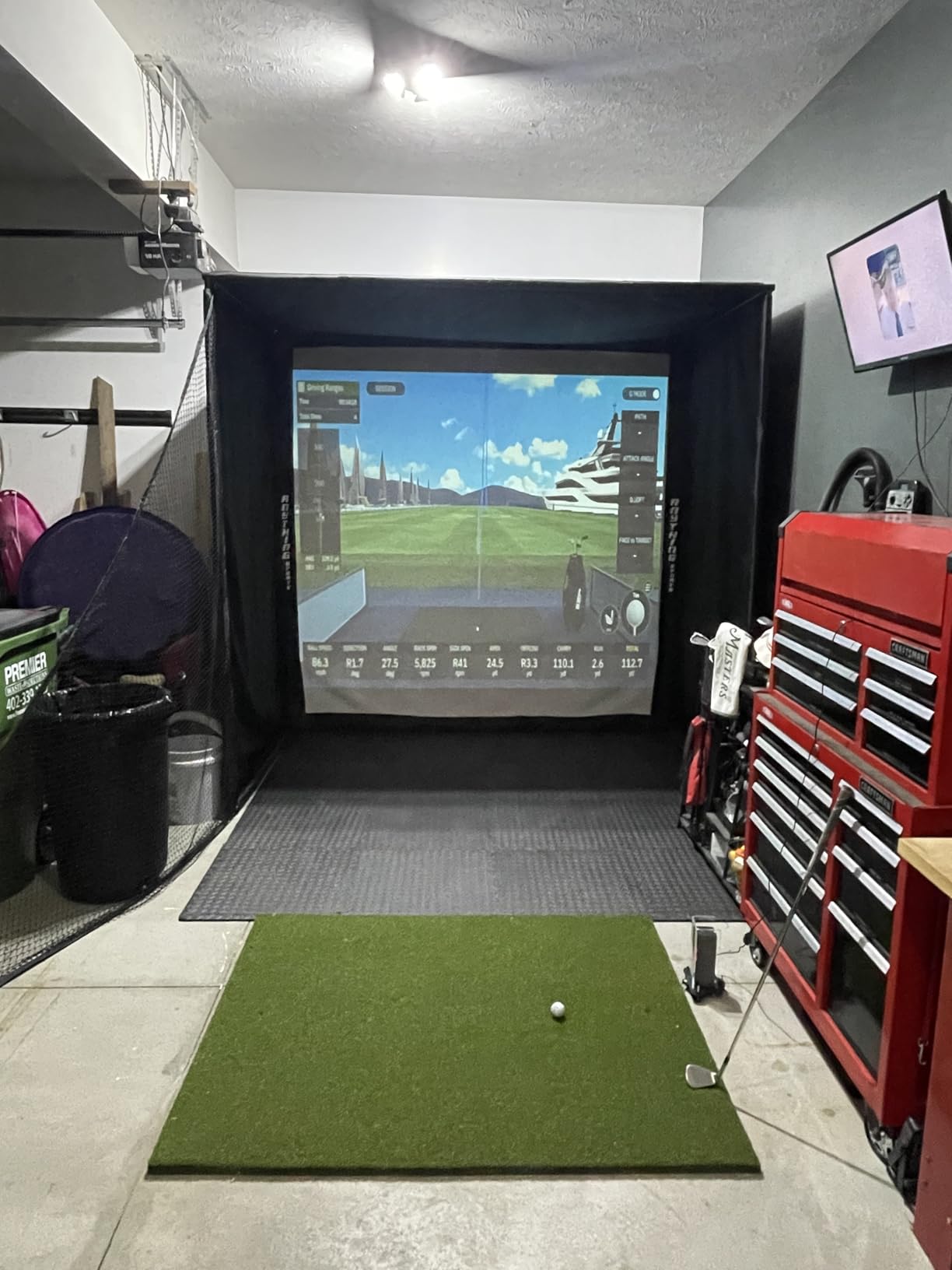
This package covers more ground than the others in the roundup, with an 11 ft by 8-4 ft screen inside a 5 ft deep cage. That footprint suits a two-car bay where one side is dedicated to the simulator rather than a single-car garage.
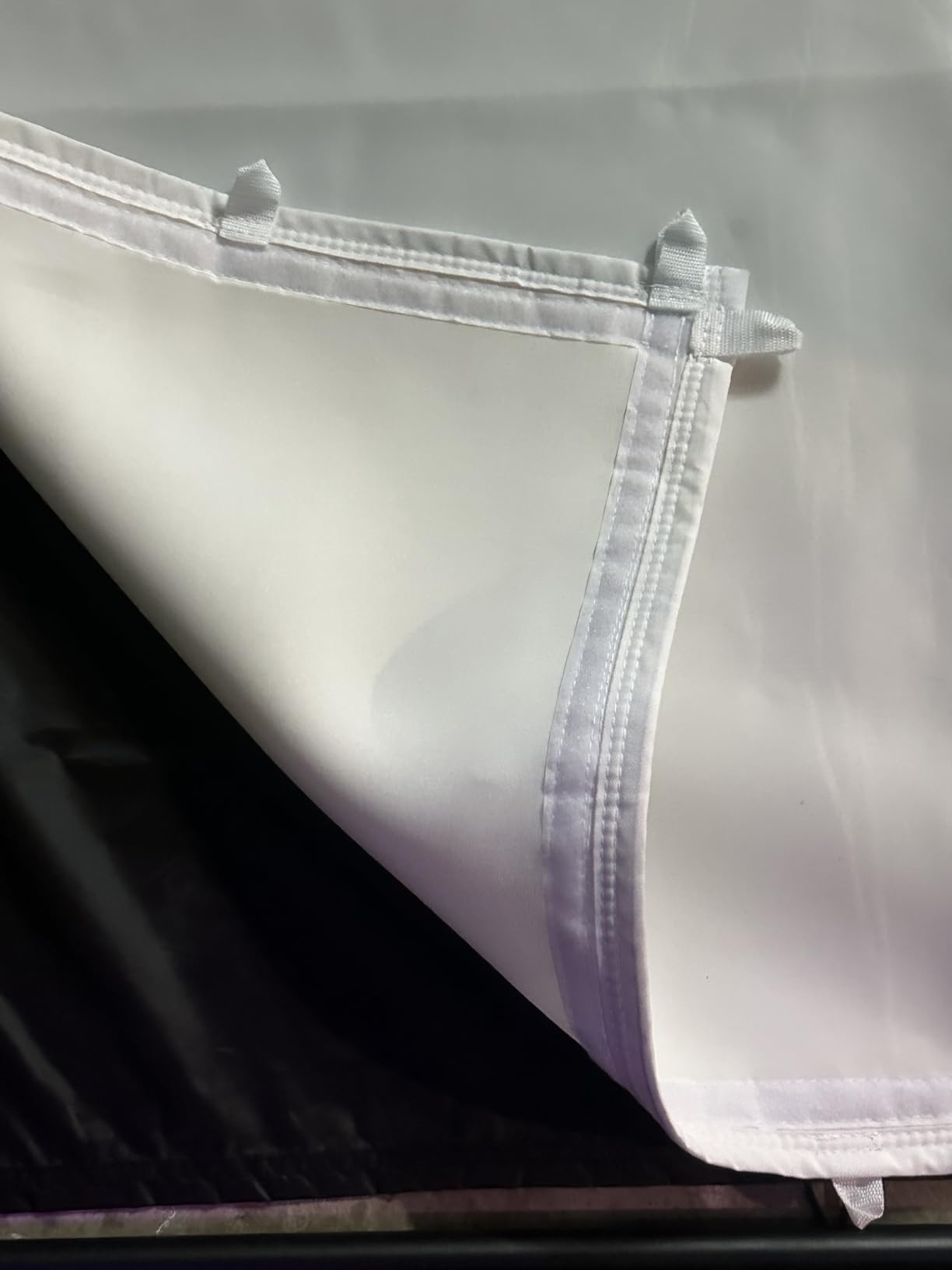
The projector mount and connecting poles are included in the box, which removes one of the most annoying add-on steps in a garage build. Screen quality holds up well against repeated strikes, and the metal pole frame should outlive several screen covers, so replacement parts rather than the whole structure are what you buy in three years.
Documentation is the weak spot. Owners repeatedly mention written instructions as a source of frustration that adds setup time, and a few report assembling from the parts list alone. The included panels are thin covers rather than impact-absorbing padding, and the upper rear crossbar can send wedge shots back at the hitter, so add baffles if you play a lot of high shots.
Budget roughly an hour for the first build and expect the blackout cover fabric to need re-tensioning after several months of use. Support is US-based by phone and email with a 12-month no-questions-asked warranty, which is better than the six-month coverage on some competing cages.
What to check before you buy this package
Confirm your ceiling clears the 5 ft deep cage with room to spare, since the depth is the part people underestimate. Also note that the turf and projector shown in listing photos are not included, so budget for both separately if you have not already bought them.
Who should skip it
Skip it in a single-car garage where depth is tight, since the 5 ft cage depth eats swing room. It is also the wrong choice for anyone unwilling to spend an evening with assembly instructions that need improvising.
5. Haokelball 10 x 8 x 6 ft Practice Net and Simulator Cage – Best Frame Rigidity
Haokelball Golf Simulator Cage, 10x8x6FT Net with Impact Screen for Home
Alloy steel frame
10 x 8 x 6 ft enclosure
5-ply netting
1 year warranty
+ The Good
- Square base resists frame flex better than two-pole designs
- Top support rod removes the deep dip that returns shanks
- Replacement nets sold separately to extend life
- Setup videos available from the seller
- The Bad
- Ball capture after impact is limited
- 10 ft frame needs clearance in tight rooms
- Bent assembly pipe reported on some units
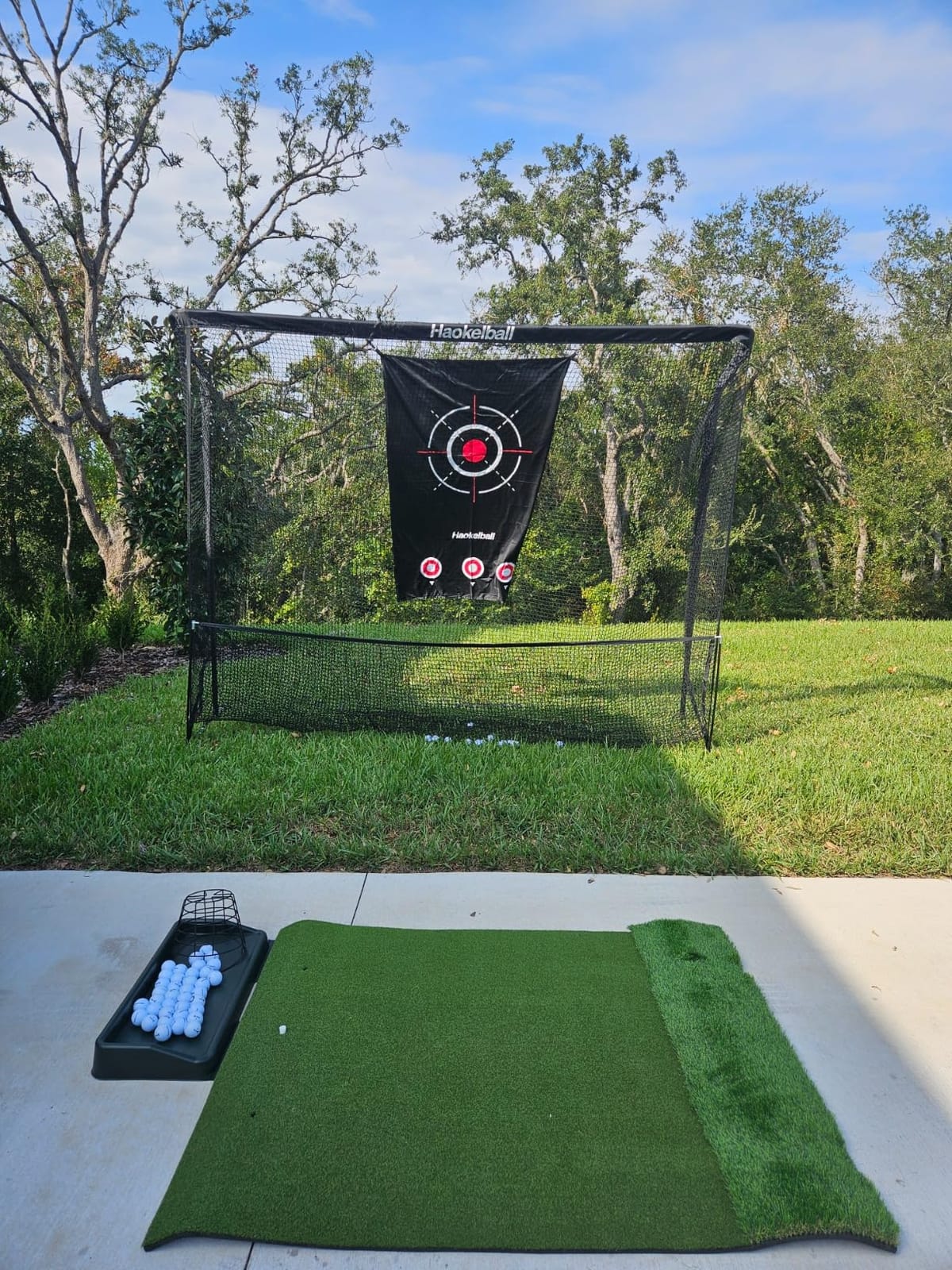
The square base is the story here. Most budget nets use two flexible poles that bow inward every time you hit, and that flex is what produces the wobble and the shanks coming back at you. This cage runs a reinforced steel frame with a 5-ply net and a top support rod, and owners credit that rigidity with noticeably better shot behaviour.
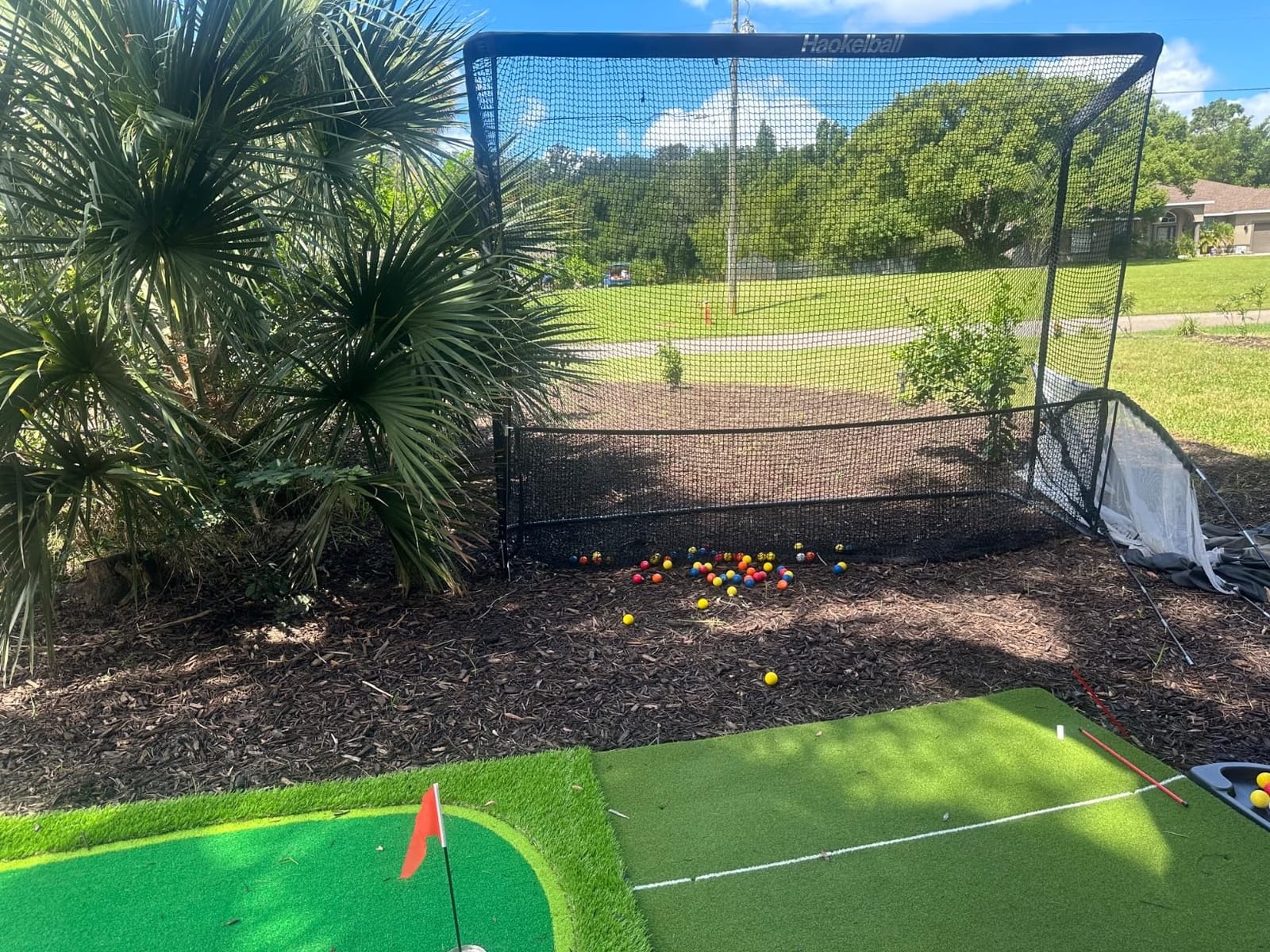
At 10 by 8 by 6 ft, it also has the deepest enclosure in the budget group, which gives more vertical room for high shots. The projection-compatible impact screen works with most projectors and launch monitors, so it slots into a build without special adapters.
Rating lands at 4.6 stars with about three quarters of ratings at five. Replacement nets are sold separately, so the frame can stay in place for years while the fabric is swapped as it wears, which is a cheaper ownership path than replacing a whole cage.
The honest drawbacks are modest. Ball capture after impact is not especially effective, so range balls will scatter. The 10 ft frame needs real clearance in a tight room, and a few buyers received a bent assembly pipe that had to be straightened before the build.
What to check before you buy this cage
Measure width carefully, because the frame uses its full stated dimension and there is no adjustment built in. Also plan where balls will land, since capture is limited and a garage floor will need a mat or turf patch under the hitting area.
Who should skip it
Skip it if your garage is under 9 ft of clearance to the lowest obstruction and you hit drivers, since the tall frame needs vertical room. It is also not the pick for buyers who want a dark screen, because there is no blackout fabric in this build.
6. HOMEVOL 2-in-1 Golf Simulator Net System – Best All-in-One Bundle
2 in 1 Golf Simulator Net System, 10 x 8ft Golf Practice Net Hitting Net with 4K-Ready Impact Screen, Target Cloth, Foam-Padded Steel Frame Cage, Hitting Mat and Balls for Indoor and Outdoor Practice
Steel and fiberglass cage
10 x 8 ft
2 year manufacturer warranty
Mat and balls included
+ The Good
- Hitting mat
- balls
- stakes
- side nets and carry bag included
- Switches between impact screen and target cloth
- Foam padding dampens noise and bounce-back
- 2-year warranty covers most rivals
- The Bad
- Target cloth mode needs no monitor and no mat
- Steel frame padding is light versus foam cages
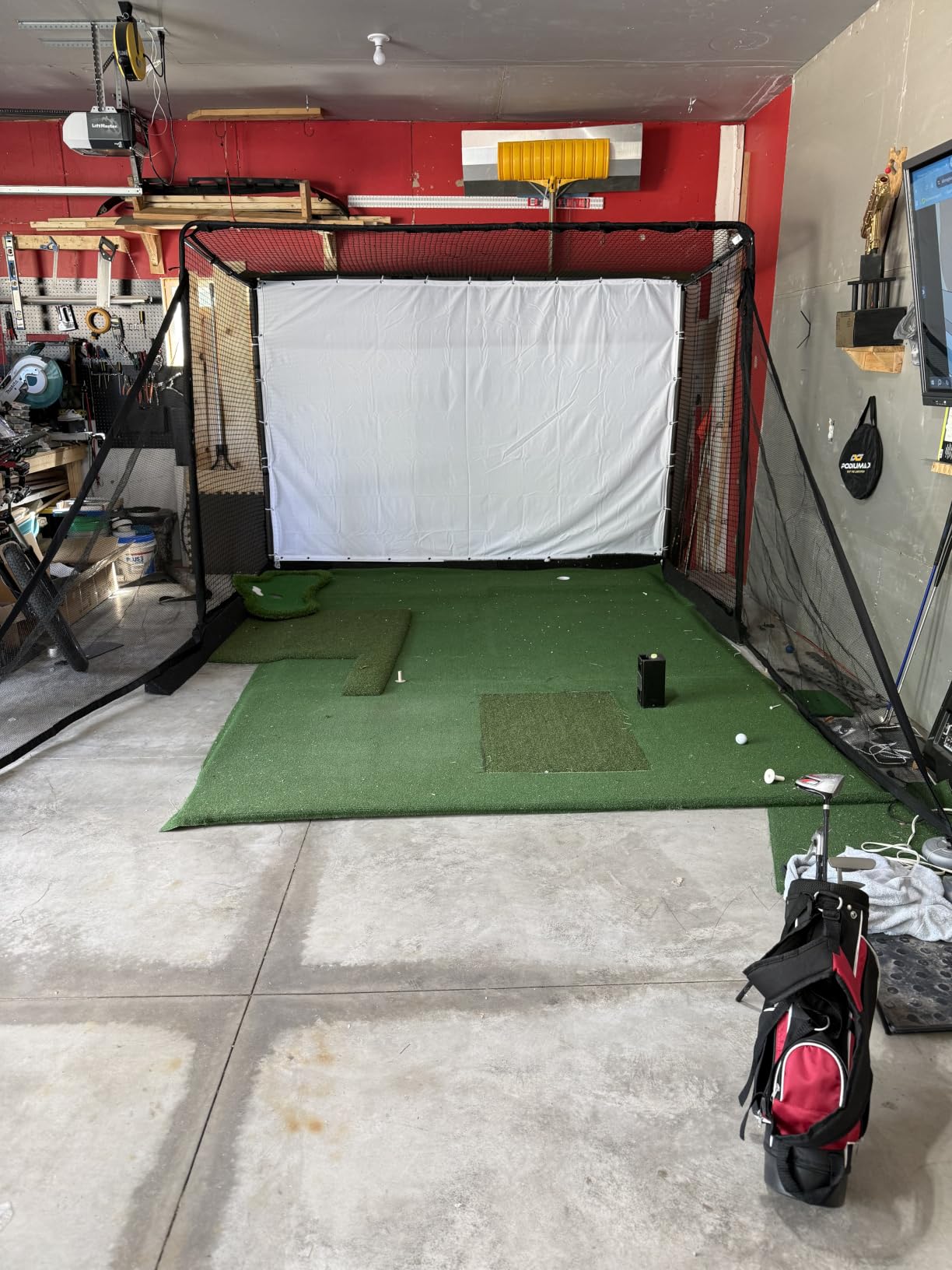
This is the only system in the roundup that arrives with a hitting mat, practice balls, ground stakes, side nets and a carry bag in the same box. For a buyer building a garage bay from nothing, that removes four separate purchases and the question of whether the mat matches the screen.
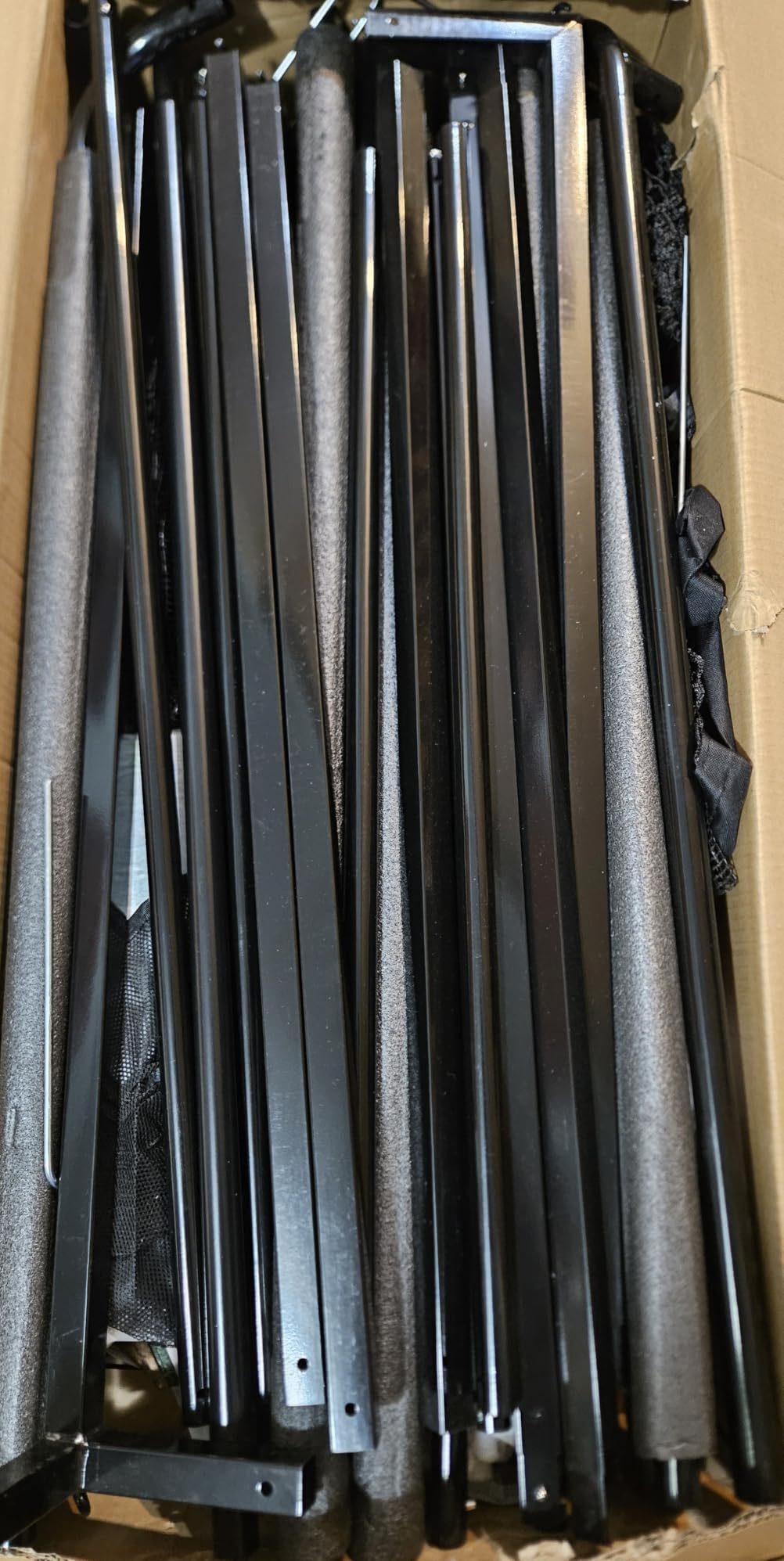
The two-in-one design is clever in a small way. A printed target cloth with multiple holes at different heights turns the cage into a short-game practice station, and swapping to the 4K-ready impact screen converts it to a projection backstop for simulator play. One cage, two jobs, no extra equipment.
At 4.6 stars it ties for the second-highest rating in this group, with roughly 79 percent of ratings at five stars and no 1-star reviews at all. The 2-year manufacturer warranty is longer than the six-month coverage most competing cages carry.
The frame is alloy steel with fiberglass poles and foam padding at contact points, which handles noise and bounce-back well but is not as rigid as a fully steel cage. Full-coverage mesh on top and both sides catches high shots and mishits, so containment is better than the open-frame designs in the same tier.
What to check before you buy this bundle
Decide early whether the mat and practice balls are enough or whether you plan to add real turf, since many owners replace both once they know their swing. Confirm the 10 by 8 ft footprint fits your bay with room to swing a driver.
Who should skip it
Skip it if you already own a mat, a bag of balls and side netting, because the extras add little to a build you have started. It is also the weaker pick for very heavy driver work, where a triple-layer screen holds up better than a single-layer one.
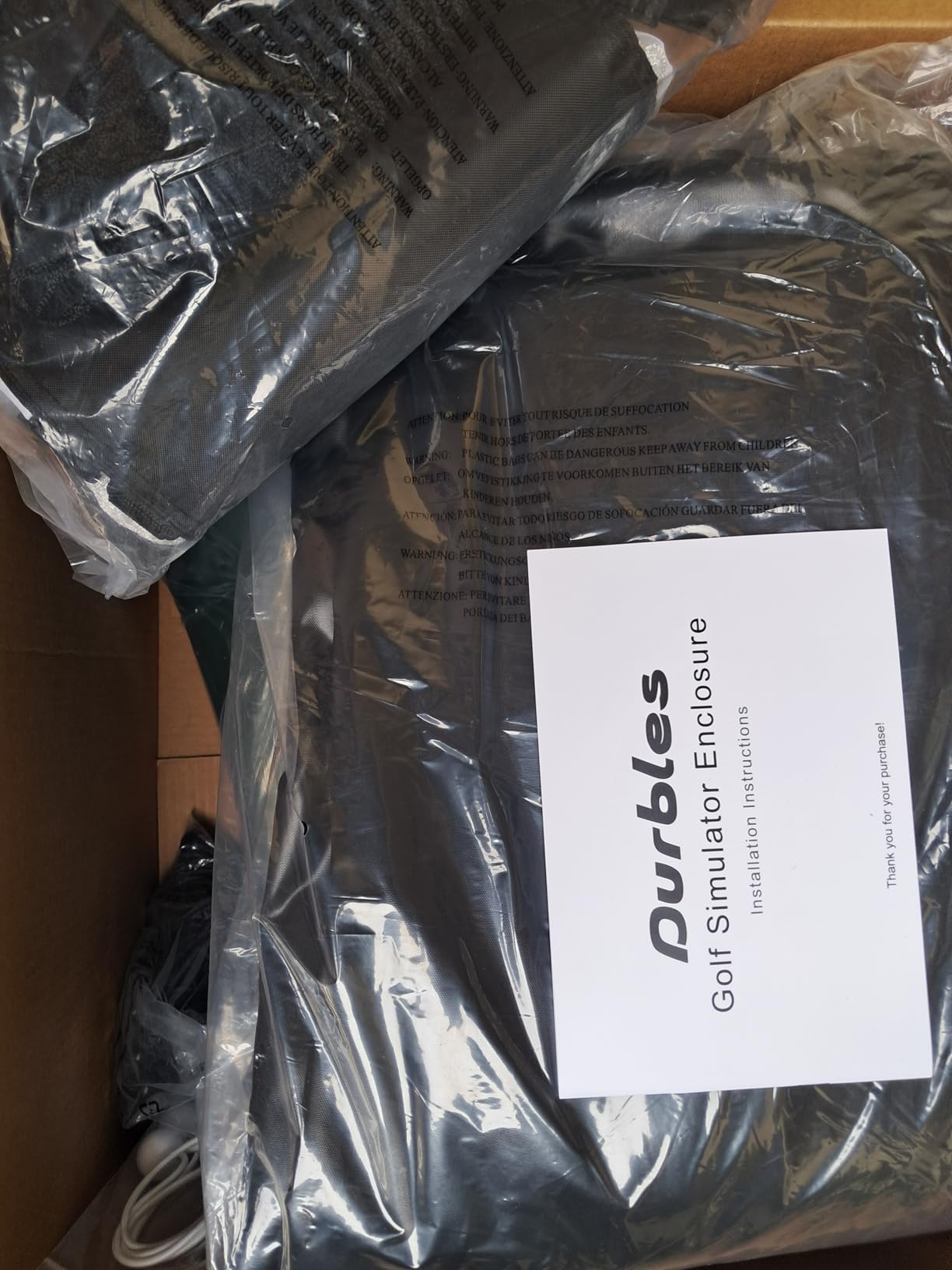
7. Durbles Golf Simulator Enclosure Kit – Best Sound Control
Golf Simulator Enclosure Kit with Premium HD Impact Screen, Full Safety Padding & Blackout Curtain, Home Golf Sim Setup Compatible with Launch Monitors, Indoor Cage Net Golfing Accessories (10 x 8 ft)
Alloy steel and polyester
10 x 8 ft
33.88 kg
Triple-layer screen
+ The Good
- Triple-layer screen noticeably mutes strike sound
- Blackout curtain darkens the screen from overhead lighting
- All poles arrive pre-wrapped in foam
- Solo setup in roughly 1.5 hours
- The Bad
- Instructions assume ceilings above 9.9 ft
- Some poles arrive without foam sleeves
- Frame uses the full 10 ft width with no slack
Sound is the reason this kit stands apart. The triple-layer commercial impact screen absorbs shock and dampens the strike noise far better than single-layer nets, and for a garage attached to a house that difference decides whether your evening practice stays a private matter.
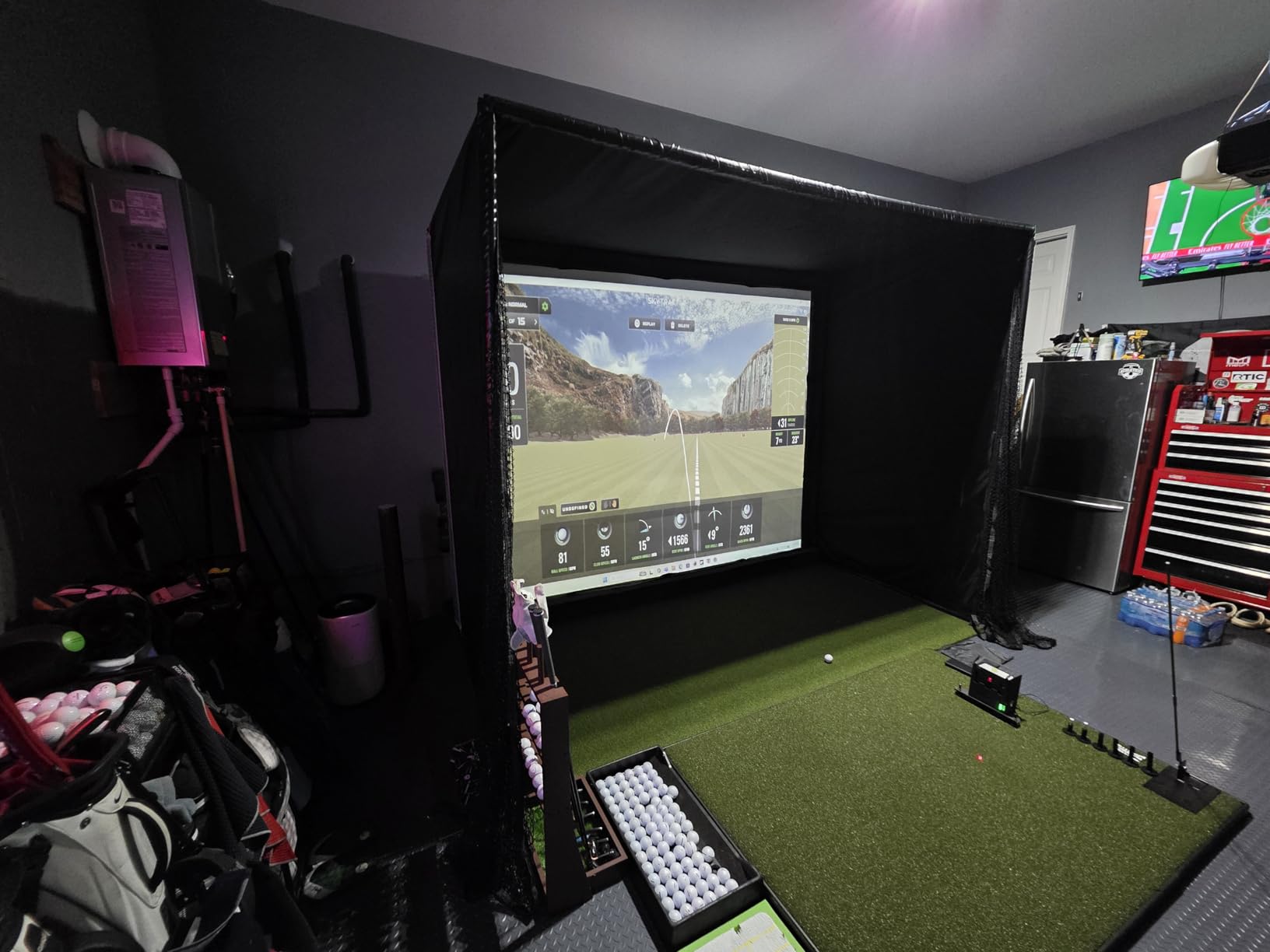
The blackout curtain handles the second problem in a bright garage. Owners report a visibly darker screen even with overhead room lighting on, which lets you use a cheaper projector and still get a readable image. All poles arrive pre-wrapped in foam, so you are not handling bare metal during the build.
Setup is achievable solo in roughly 1.5 hours. Several owners also note that it looks premium rather than like a DIY build, which matters if the garage doubles as a man cave.
The catch is documentation written for tall rooms. Instructions assume ceilings above 9.9 ft, which complicates assembly in a standard 9 ft garage, and a couple of units had poles that arrived without their foam sleeves. The frame also occupies the full 10 ft width, so there is no tolerance for a bay that measures a little under.
What to check before you buy this kit
Measure the width and the ceiling height to the lowest obstruction before ordering, because the kit has no dimensional slack and the manual assumes a taller room. If you have a shared wall with neighbours, ask about the noise rating before building.
Who should skip it
Skip it in a low-ceiling garage where the assembly instructions will fight you. It is also more system than needed if you only plan short game practice, since the sound engineering pays off on full driver strikes.
8. Diandian 10 x 8 ft Enclosure Kit – Best Blackout Value
Diandian Golf Simulator Enclosure Kit 10 x 8 ft with 4K-Ready Impact Screen
600D Oxford and carbon steel
120 inch W x 96 inch H
75 pounds
1 year warranty
+ The Good
- Spring-button click-lock frame assembles without tools
- One-piece blackout wrap with no light-leak gaps
- Foam on all interior areas stops balls returning
- Light enough to move alone once assembled
- The Bad
- Some boxes arrive without instructions
- Bottom screen stitching can separate after limited use
- Screen wrinkles and roof sag reported by some owners
The one-piece 600D Oxford cover is the reason projected images look clean here. It wraps the top, sides and back as a single piece, so there are no seam lines where daylight leaks through, and owners consistently rate the blackout tightness as excellent for the money.
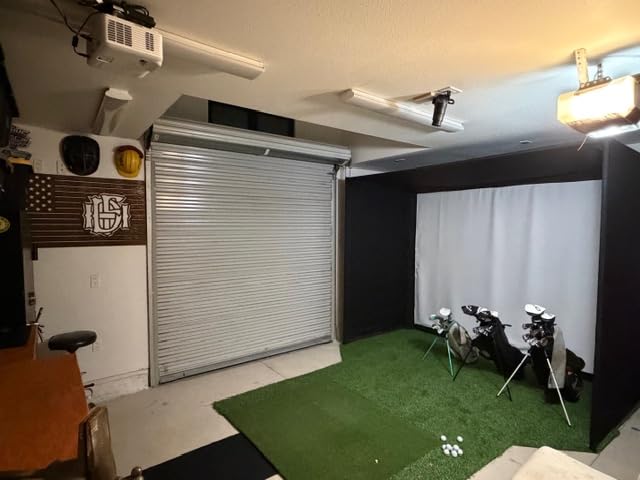
Assembly is the other strength. The spring-button click-lock design goes together without tools, and the frame uses carbon steel with foam edge padding and safety side nets throughout the interior. Fabric and mesh-backed screen materials run much quieter than tarp-style kits, which matters in an attached garage.
Foam covers all critical interior areas, and buyers note that it stops balls returning at the hitter. The matte dual-layer screen is sized 120 inches wide by 96 inches high inside a 10 by 8 by 5 ft enclosure, and it mounts as a floor unit that one person can shift once built.
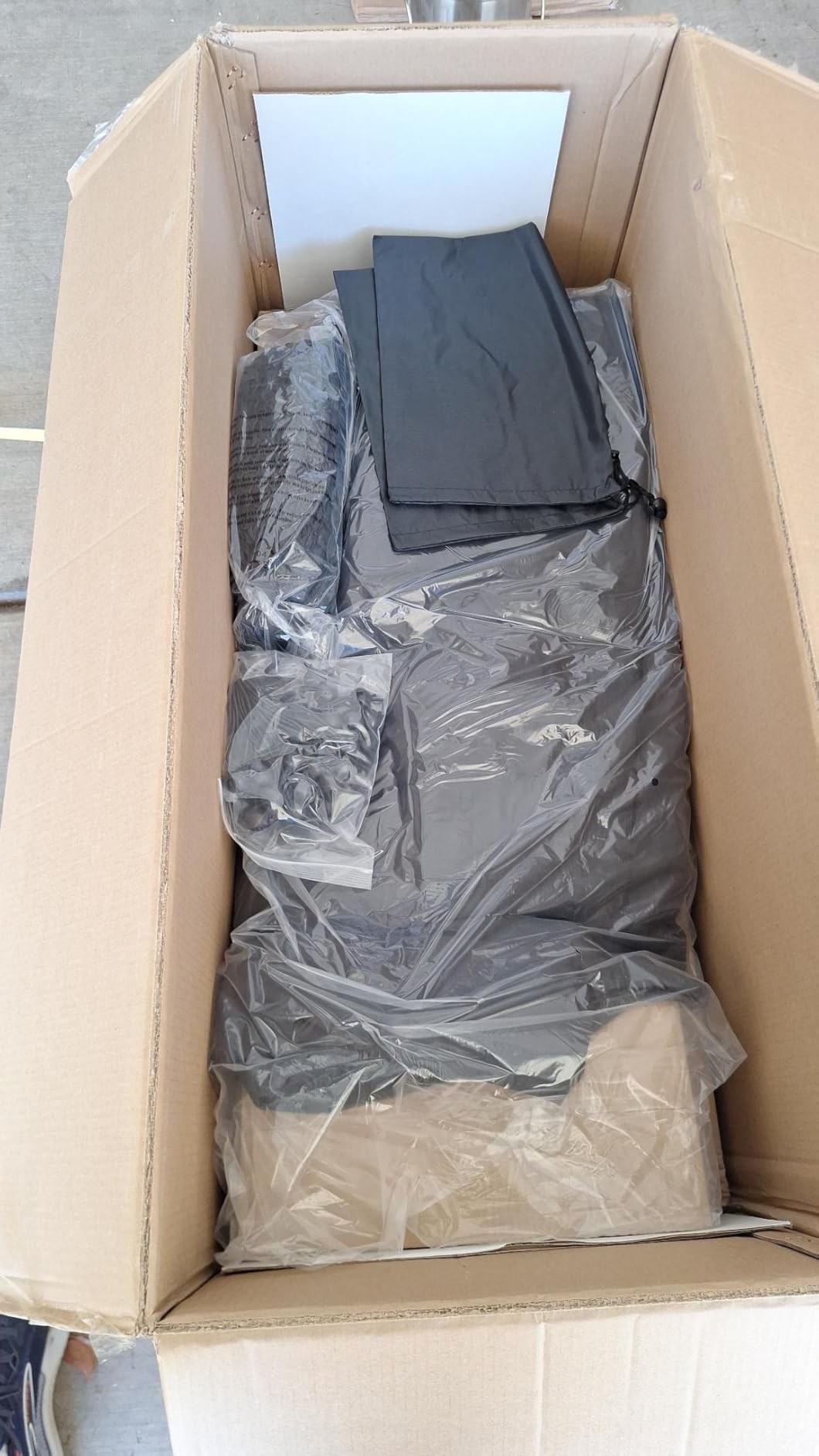
The complaints cluster around packaging and documentation. Some boxes arrive without instructions, seller contact through Amazon is difficult, and a few owners report the bottom screen stitching separating after limited use along with wrinkles and roof sag. No projector mount or sand bags are included at this level, so add them.
What to check before you buy this kit
Watch for the instruction booklet on arrival and photograph the labelled parts before assembly, since missing paperwork is the top complaint. Also plan for a separate projector mount and ballast, neither of which is in the box.
Who should skip it
Skip it if you are not comfortable with a puzzle-style assembly, because the instructions are not reliably included. Buyers who need very heavy driver volume should also look at a triple-layer screen instead.
9. ANYTHING SPORTS Fold Up Golf Simulator Enclosure – Best for Shared Garages
Fold Up Golf Simulator Enclosure (8’4 x 8’4 x 5′)
Wall-mounted metal frame
8-4 x 8-4 x 5 ft
91 x 91 inch matte screen
12 month warranty
+ The Good
- Folds flat in about a minute to free the garage
- Screen absorbs ball energy and projects sharply
- Side shank nets catch off-centre shots
- Repacks into the original box for storage
- The Bad
- Very heavy and needs a two-person lift
- Wall must be flush from top to bottom
- Projector
- mat and launch monitor sold separately
This is the only true retractable enclosure in the roundup, and for a shared two-car bay it solves a problem no fixed cage can. It folds flat against the wall in about a minute, so the same section of garage holds your simulator in November and your second vehicle in February.
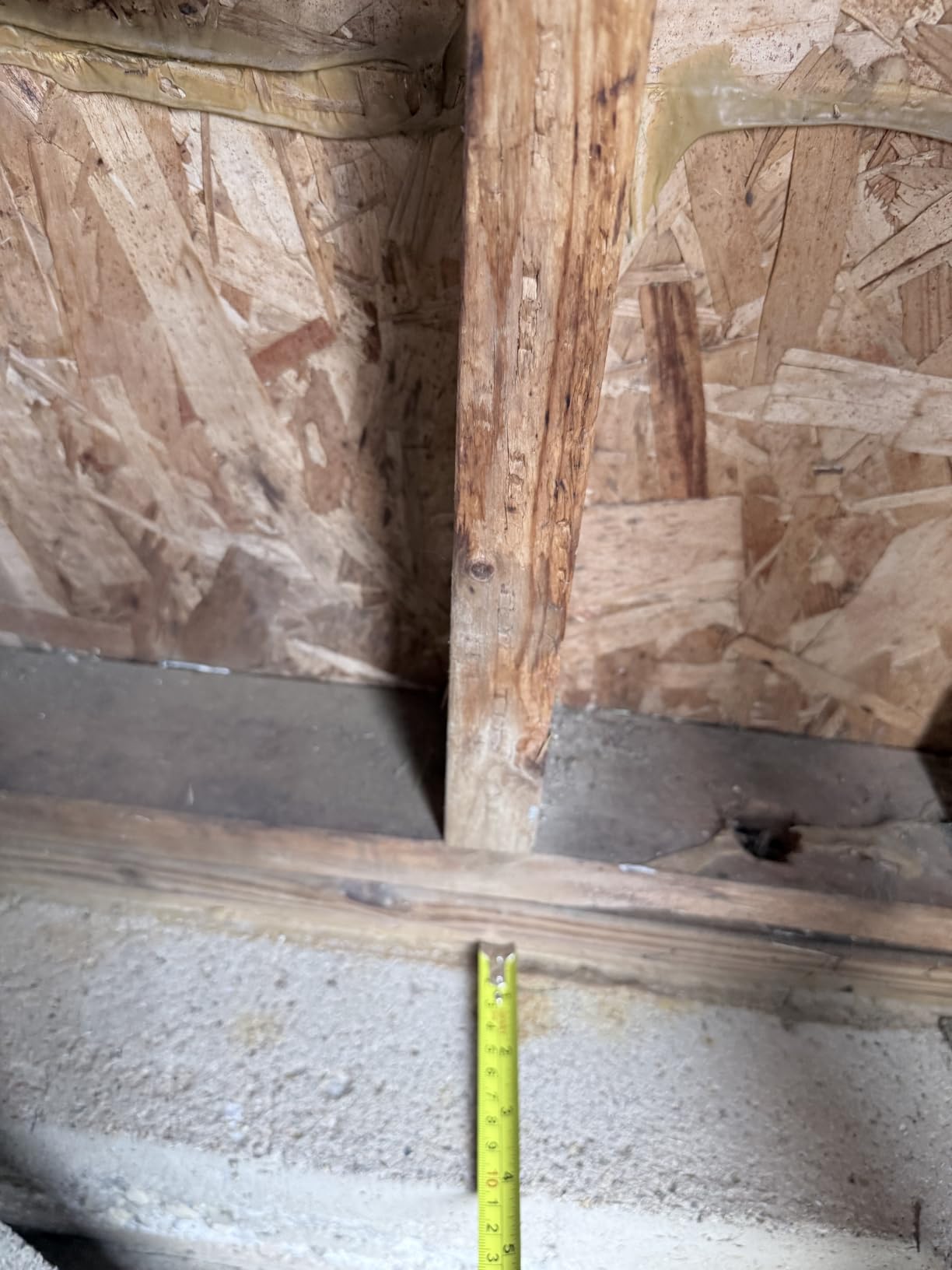
Despite the compact 8-4 by 8-4 ft footprint, the screen is a 91 by 91 inch matte panel that absorbs ball energy well and projects a sharp image. The kit is fully loaded with a double-stitched vinyl blackout enclosure, two shank nets, a projector mount, connecting poles and sand bags, so the only things still to buy are the projector, mat and launch monitor.
It carries the highest rating in this group at 4.7 stars, with no ratings below four, and owners consistently credit the fold-away design for making a full bay practical in a shared garage. It also repacks into the original box for seasonal storage.
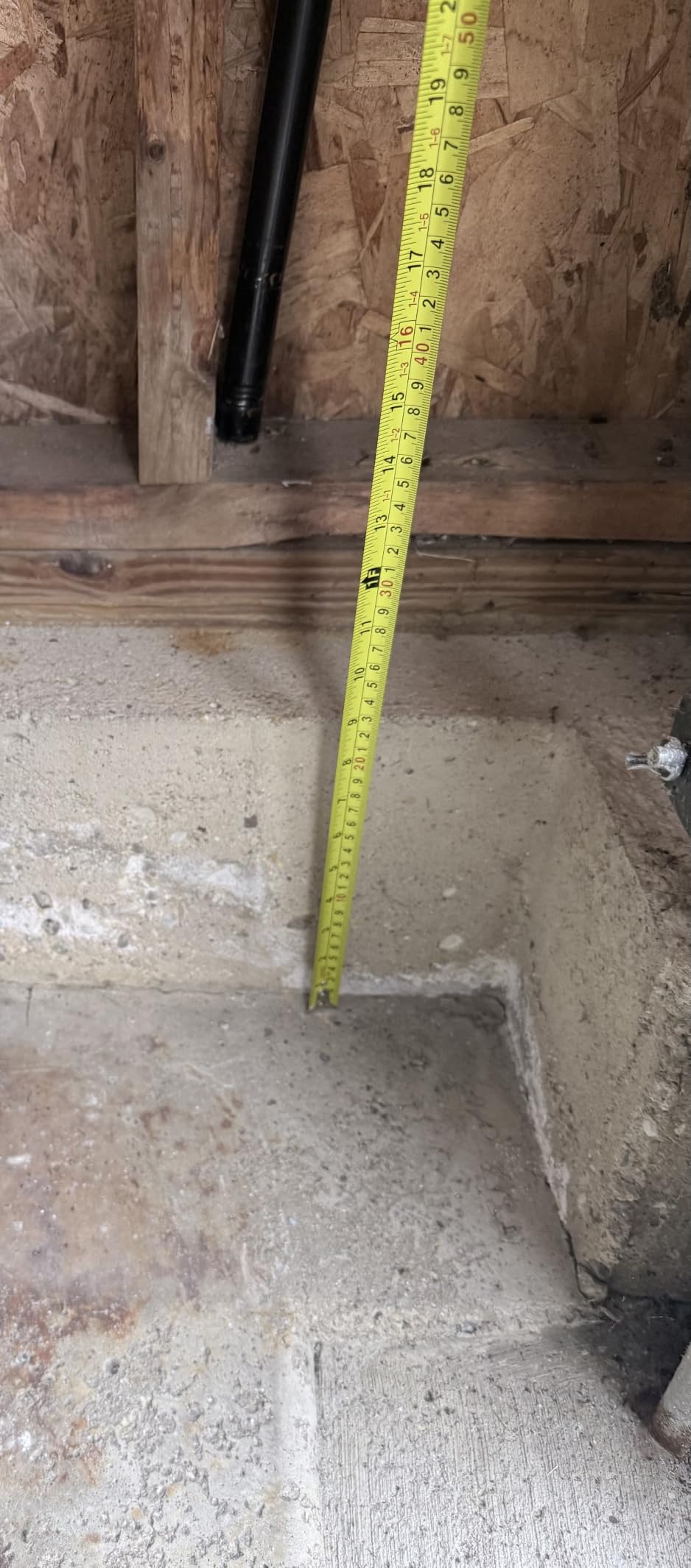
Weight is the main constraint. It is heavy enough that moving and wall-mounting needs two people, and the wall must be flush top to bottom, which is why protruding concrete foundations complicate installation. Instructions illustrate round poles while the kit comes with square ones, and the hardware bag contains many similar screw lengths to sort through.
What to check before you buy this folding enclosure
Inspect the wall before ordering, and check it is vertically straight and free of foundation ledges along its full height. Also measure the swing area in front of the folded position, because you need room to open the bay before you take a shot.
Who should skip it
Skip it if you are installing alone or if your garage wall has a foundation ledge running up it, since both block a wall mount. It is also the wrong pick for a roomier bay where a fixed enclosure gives you a larger screen for the same space.
10. GoSports Range Cage Elite 8 x 8 ft – Best for Small Garages
GoSports Range Cage Elite Golf Hitting Net – 8 x 8 ft Golf Simulator Enclosure with Impact Screen
Alloy steel and polyester
8 x 8 ft screen
10 L x 8.5 H x 5 D ft frame
6 month warranty
+ The Good
- Fixed cage frame prevents net sag
- Offset screen position reduces ricochets
- Top and side netting catch high-loft shots
- Works with all major launch monitors and projectors
- The Bad
- 8 x 8 ft screen is small for driver practice
- Frame footprint is deeper than the screen area
- 6-month warranty is the shortest here
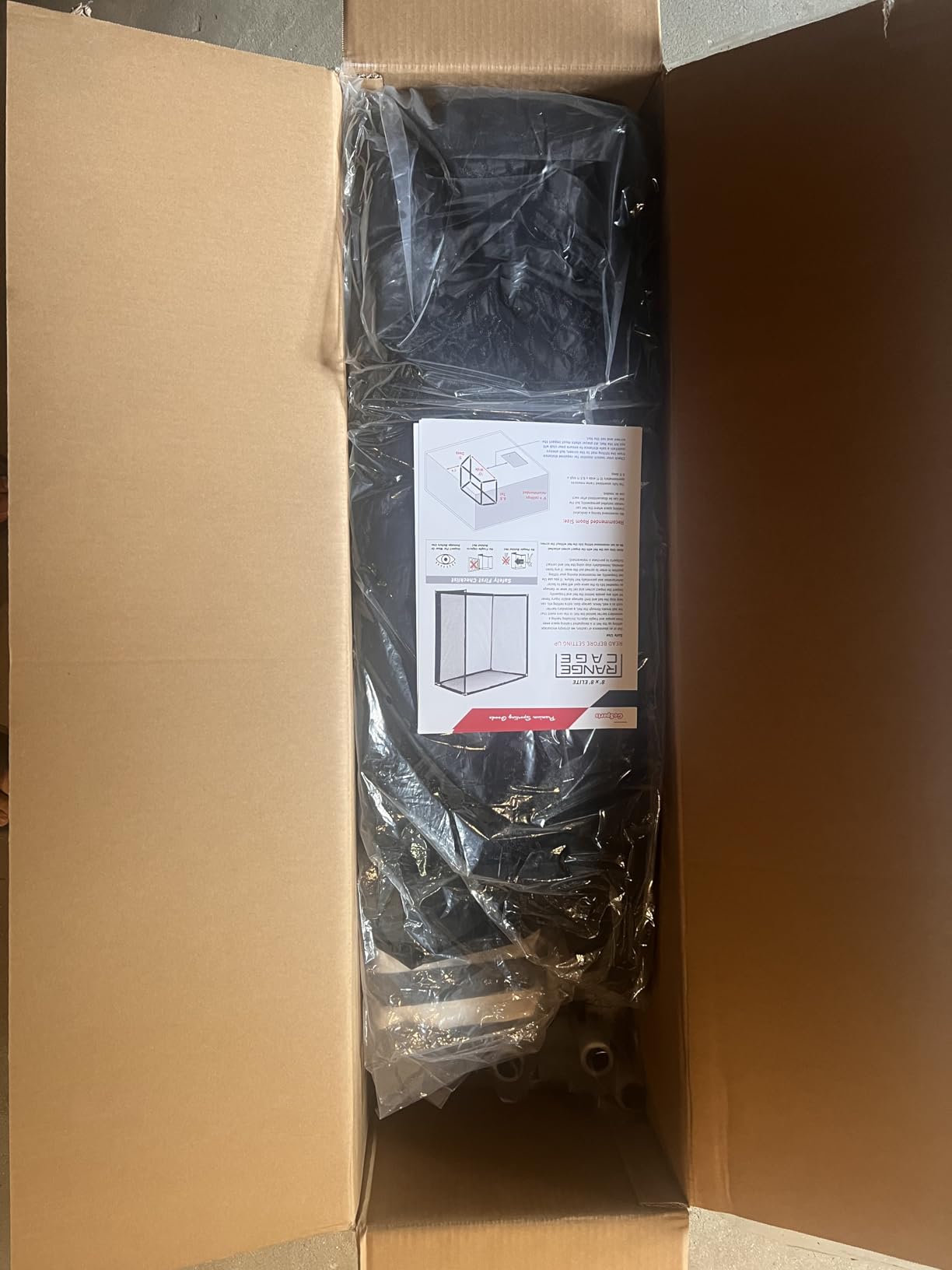
This is the pick when the garage is simply too small for a 10 ft cage. The screen area is 8 by 8 ft inside a 10 ft long by 8.5 ft high by 5 ft deep frame, and the fixed powder-coated cage design stops the net sagging the way pop-up nets do.
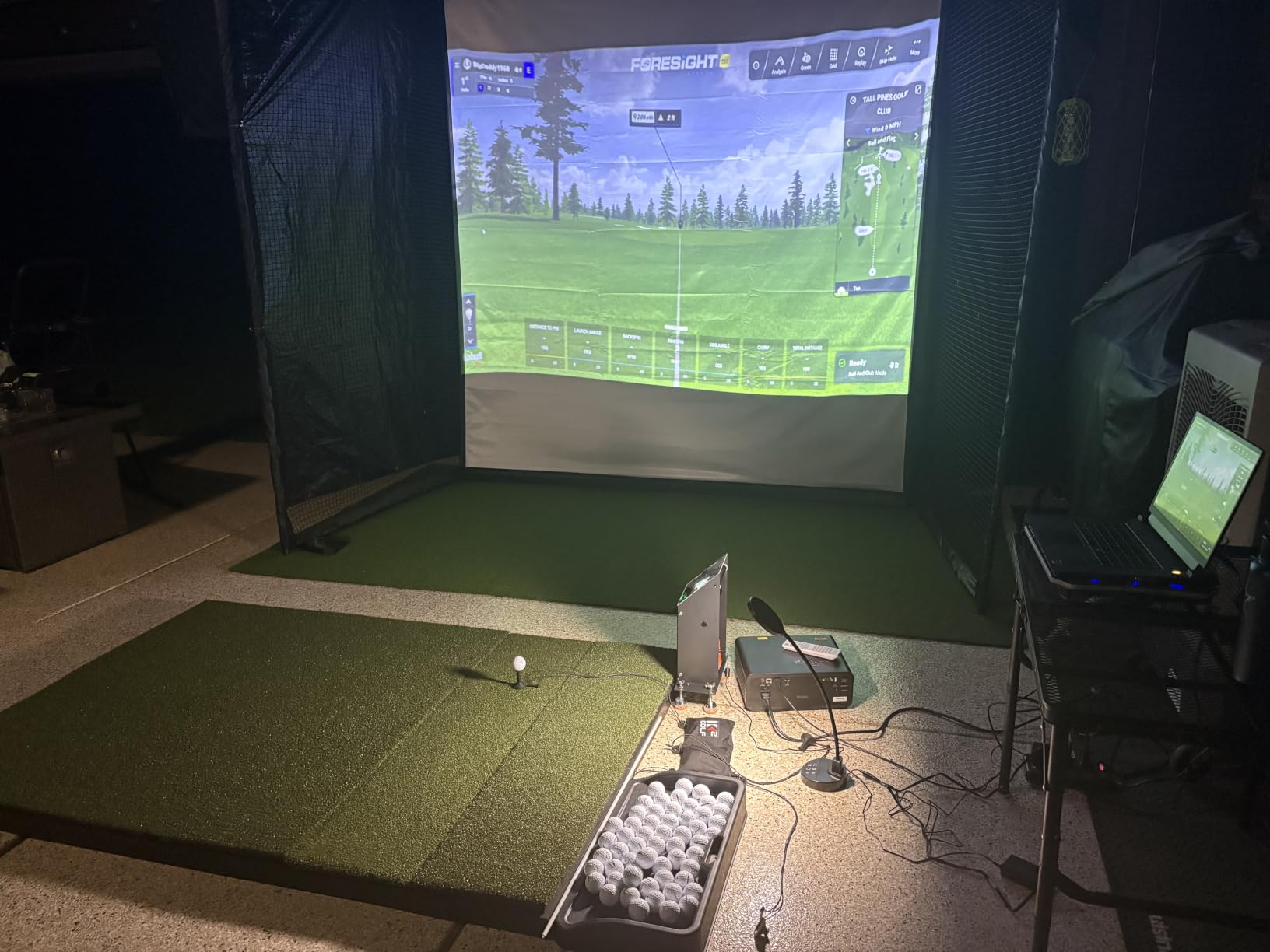
The offset impact screen is the detail that matters most. Mounting the screen in front of the netting instead of flush with it changes the angle of a mishit, and owners credit that with meaningfully fewer ricochets coming back at the hitter.
At 4.2 stars across a small review base with 74 percent of ratings at five and none below three, the feedback is positive but thin. It is listed as compatible with all major launch monitors and projectors, and it accommodates both right- and left-handed golfers in the same frame.
The trade-off is screen area. An 8 by 8 ft hitting surface is fine for irons and moderate driver work but feels tight once you start hitting long shots off the deck, and the frame depth eats into the swing room behind you. The 6-month warranty is also the shortest in this roundup.
What to check before you buy this cage
Measure your bay against the full frame footprint rather than the screen area, since the 5 ft depth is what constrains your swing. If you plan to add a projector, confirm your throw distance works within the 8 ft screen.
Who should skip it
Skip it if driver distance is your focus, since the smaller screen gives a cramped target. It is also a poor match for shared parking, because it is a fixed frame that never folds away.
Garage Golf Simulator Buying Guide
Most garage simulator regrets trace back to measurements taken from the wrong point. Before you compare screens, work through these factors in order.
1. Measure clearance to the lowest obstruction, not to the ceiling
Garage door tracks, opener rails and light fixtures routinely eat 6 to 12 inches from your usable height. Measure from the floor to the lowest object that sits over the hitting area, not to the ceiling joists. A 9 ft ceiling with tracks drops your real clearance closer to 8 ft, which is already marginal for full driver swings.
2. Depth decides which launch monitor technology you can use
Doppler radar units such as the Garmin Approach R10 and the Rapsodo MLM2PRO need roughly 16 ft or more of depth to read a ball reliably. Photometric camera systems such as the Foresight GC3, the Uneekor EYE MINI and the Garmin R50 work from about 12 to 14 ft because they measure the ball before it slows down. In a shallow single-car garage, camera-based tracking is the safer choice.
3. Retractability is about whether you still park a car
If you use the bay as a garage, a retractable screen that mounts to existing door tracks is the category that matters most. Fixed cages like most of the systems above claim the bay permanently. Only a fold-up or track-mounted design gives the space back. Owners with shared vehicle parking consistently prefer the retractable route.
4. Net versus screen and projector
A hitting net with no screen gives you shot data on a laptop or phone and nothing more. An impact screen plus a short throw projector turns the same bay into a course-playing setup, and it costs more and needs a dark room to look right. Many buyers start with a net and add a projector later.
5. Software and annual subscriptions
Most launch monitors bundle software but charge an annual fee for online play, live leaderboards and the full course library. Titles such as E6 CONNECT, GSPro, The Golf Club 2019, FSX Play and Uneekor VIEW all work differently, and none of them requires a subscription for offline range work. Budget for a recurring fee per year in your planning, because buyers on forums report it is the most commonly forgotten line in a garage build.
6. Temperature and humidity are a maintenance routine
Unconditioned garages are the biggest risk to screens, turf and electronics. A dehumidifier sized to the bay keeps condensation off impact screens, and a mini-split handles both summer heat and winter cold in climates with wide swings. Bring portable electronics indoors during humid months and leave the fabric up.
7. Hidden costs beyond the enclosure
The enclosure is rarely the largest line in a garage build. Budget separately for a gaming PC for camera-based monitors, a short throw projector and mount, a hitting mat or turf, floor protection tiles, climate control, a dedicated 20-amp circuit, and the first year of software. Buyers who skipped a prebuilt package often report spending less overall by assembling the list themselves.
8. Measure a retrofit honestly
Standard garages rarely arrive ready for a simulator on day one. Floor levelling, ceiling framing and dedicated power are the real work in a retrofit, and they are where most weekend builds stall. If your setup needs a projector run across the ceiling, price the electrical work before the screen.
Frequently Asked Questions
Which golf simulator can be attached to a garage door?
Retractable impact screens designed to mount on standard garage door tracks are the garage-specific answer. They roll up with the door and reclaim the bay when you park. Measure your track spacing and the height above the door before buying, since not every retractable screen fits a given track layout. Fixed cages like the GoSports Range Cage cannot be attached to a door and permanently occupy their footprint.
Can a golf simulator fit in a garage?
Most garages can host one, but the usable height is rarely the ceiling height. Door tracks, opener rails and light fixtures often reduce clearance by 6 to 12 inches. For a single-car bay, an 8 ft by 8 ft fixed cage works; for a two-car bay, a 10 by 8 ft enclosure or a folding wall-mounted unit gives you both screen size and reclaimable space.
How high does a garage need to be for a golf simulator?
Measure from the floor to the lowest obstruction above the hitting area, not to the ceiling. A 9 ft garage with door tracks often gives you closer to 8 ft of real clearance. Hitting a driver needs about 8 ft of clear height, and many enclosure manuals assume ceilings above 9.9 ft, so check the instruction requirements before ordering a full-height cage.
Do I need a projector for a garage golf simulator?
No. A launch monitor and an impact screen give you shot data and a practice target on a laptop or phone. A short throw projector is what turns the screen into projected virtual courses, and it needs a blackout surface and a dim room to look right. Many builders start with the screen and add a projector once they know how often they will use it.
Do garage golf simulators get ruined by humidity?
Condensation is the real risk, not heat alone. A dehumidifier sized to the bay keeps moisture off impact screens and turf, and a mini-split helps in climates with wide temperature swings. Bring portable launch monitors and other electronics indoors during humid months, and leave fabric enclosures up rather than folding them damp. Fixed blackout enclosures trap moisture against the screen if humidity is unmanaged.
Final Verdict for 2026
The best golf simulators for garages are not one product but three answers. In a garage you still park in, the ANYTHING SPORTS Fold Up Enclosure is the only design here that gives the bay back in about a minute. In a bay you have dedicated to practice, the GoSports SimBay and the Durbles kit build the most durable and quietest full setups. In a shared or storage garage with no room for a screen, the PHIGOLF system needs nothing but a floor and a phone.
Whichever route you take, measure clearance to the lowest obstruction first, then budget for the projector, mat, climate control and software that the enclosure does not include. Our wedge and short game picks pair well with a new bay once you can see your strike.