
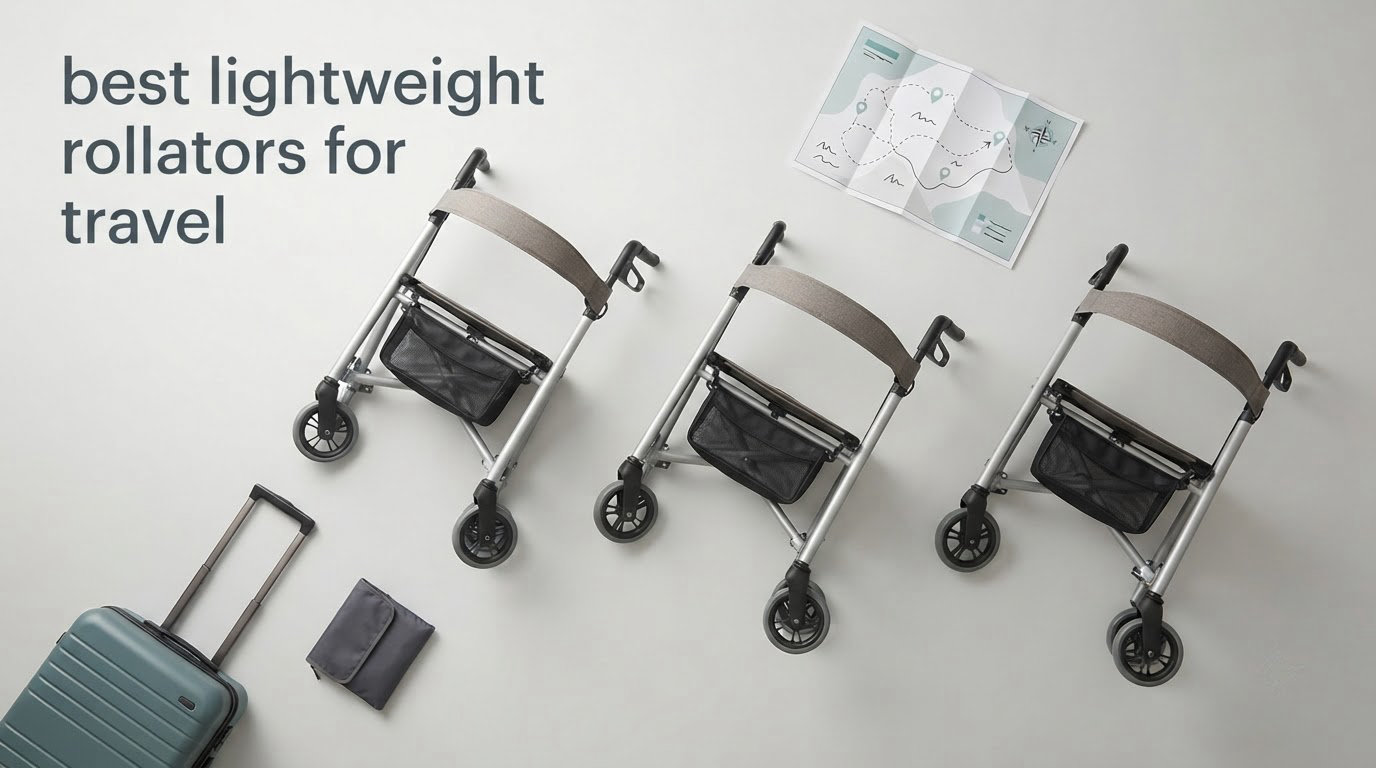
Most rollator walkers are too heavy to travel with. A standard four-wheel model often lands between 17 and 25 pounds, which is fine at home and hopeless when you have to lift it into a car trunk three times a week or carry it down a hotel staircase alone.
Our best overall pick is the Drive Medical Nitro Elite CF Rollator Walker, which weighs 14.5 pounds and folds with one hand. If your priority is the lowest possible weight, the soundfuse three-wheel model at 10.2 pounds is the lightest rollator in this group. If your priority is the smallest folded package, the Stander models collapse to a 10 by 11 inch footprint that you can stand upright in a closet.
This roundup covers 12 lightweight rollators for travel, ranked on the things that actually break down a trip: frame weight, folded dimensions, wheel size, seat and seat height, brake design, handle adjustment range and weight capacity. We published exact pound and inch figures for every pick so you can measure your trunk and your doorway before you order.
One note before we start. This is a gear comparison, not medical advice. If a rollator has been prescribed for you, or if you are recovering from surgery, a fall, or a stroke, talk to your doctor or your physical or occupational therapist before changing models. They will know your strength and balance profile in a way no spec sheet can.
Top 3 Lightweight Rollators for Travel in 2026
12 Best Lightweight Rollators for Travel (October 2026)
| PRODUCT MODEL | KEY SPECS | BEST PRICE |
|---|---|---|
 |
|
Check Latest Price |
 |
|
Check Latest Price |
 |
|
Check Latest Price |
 |
|
Check Latest Price |
 |
|
Check Latest Price |
 |
|
Check Latest Price |
 |
|
Check Latest Price |
 |
|
Check Latest Price |
 |
|
Check Latest Price |
 |
|
Check Latest Price |
 |
|
Check Latest Price |
 |
|
Check Latest Price |
Two things stand out immediately. First, the whole list sits between 10.2 and 17.64 pounds, which is the real definition of a travel rollator. Second, only four of the twelve have a weight capacity above 300 pounds, so anyone over 300 pounds should read the capacity line carefully before buying.
1. Drive Medical Nitro Elite CF Rollator – Best Overall for Travel
Drive Medical RTL10266CF Nitro Elite CF Rollator Walker with Seat, Black
14.5 lb frame
10 inch front casters
One-hand side fold
Padded seat and pouch
+ The Good
- Large 10 inch casters clear curbs and gravel
- Enclosed brake cables resist snagging
- Push-button height adjustment suits tall users
- Steers smoothly without wobble
- The Bad
- Mesh storage pouch tears easily
- Front wheels can cross while loading
- Handle reflectors sometimes arrive cracked
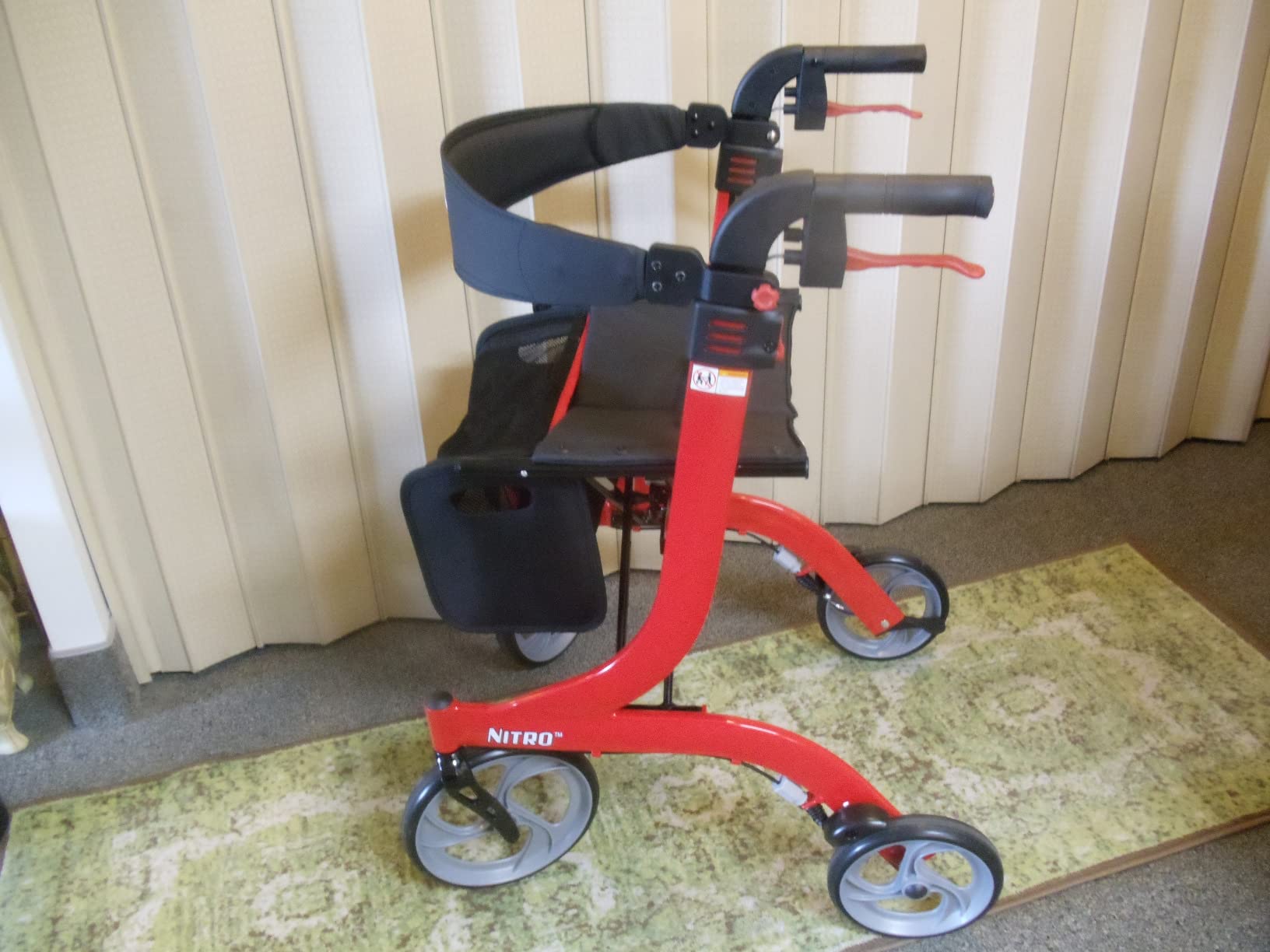
This is the one we kept coming back to. At 14.5 pounds it is not the lightest frame here, but it is the best balance of things that go wrong on a trip: wheel size, folding, cable routing and stability. The 10 inch front casters roll over a curb lip without the little hop you get from 6 inch wheels, which matters enormously in European cities and anywhere with a broken sidewalk.
The one-hand side-to-side fold is genuinely one-handed. You pull the cross-brace, the frame collapses toward the seat, and an under-seat clip locks it. Folded, it measures 34.1 by 28.7 by 10.2 inches, so it stands on edge rather than lying flat. That shape is far easier to slot behind a front seat or against a hotel closet wall than a wide flat fold.
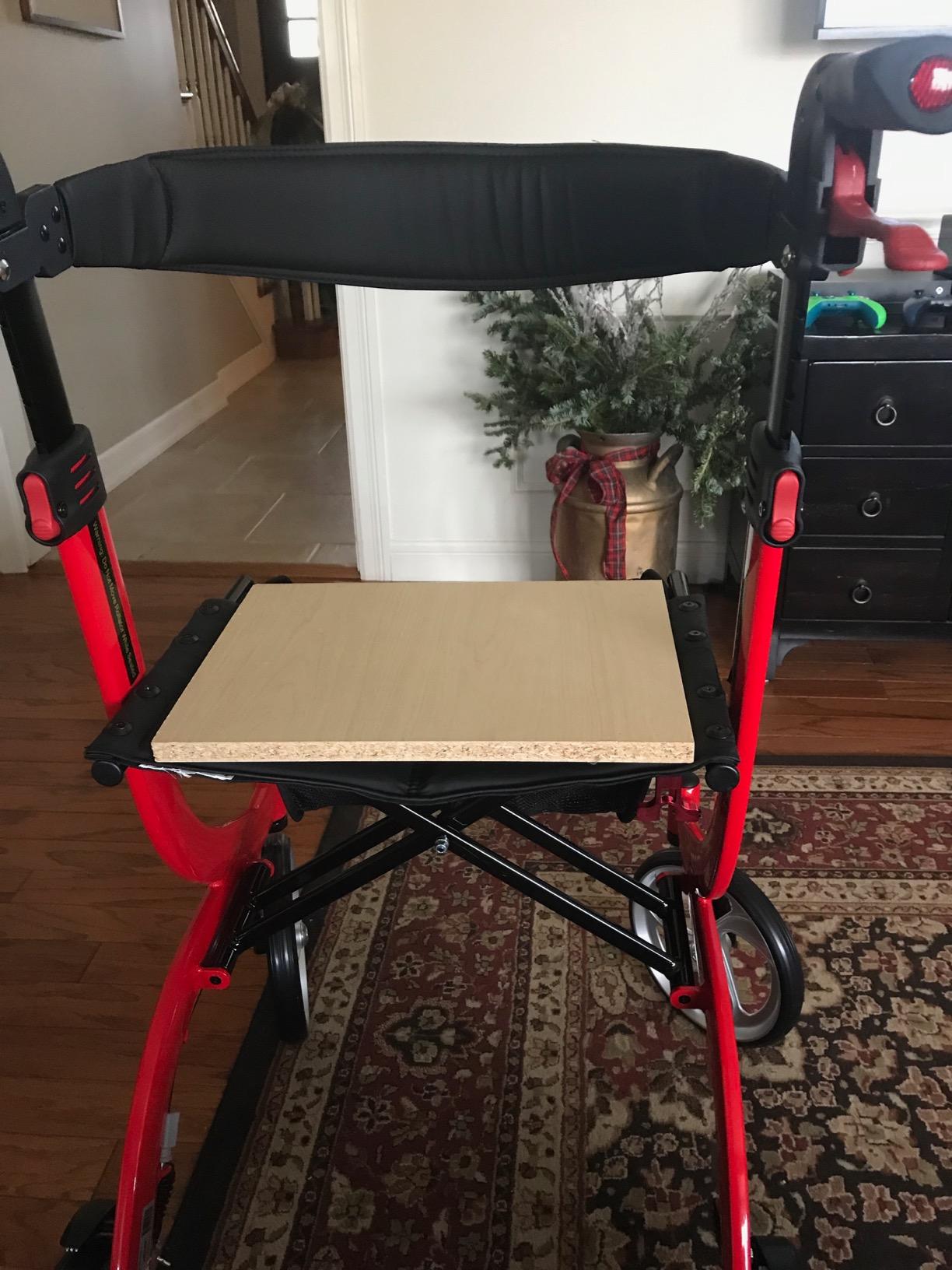
Handle adjustment uses push buttons rather than a thumb screw, and the range suits very tall users who are constantly sliding down on cheaper models. The brake cables run inside the frame, which is a small detail until you load a bag on the handle and the exposed cable catches on a seatbelt buckle.
Our lift test is simple: fold it, pick it up with one hand at the frame, and carry it ten paces. It clears that. It also holds a line on a sloped ramp without the front end wanting to wander, which is the reason several lighter frames on this list failed our ramp check.
The one thing to budget for is the pouch. The front mesh storage bag is the part most likely to tear, and replacement bags cost more than they should. Everything else on this frame has held up in reviews going back years, which is why it carries the highest rating and the largest review count of anything we tested.
Who this rollator suits
This is the pick for someone who travels on uneven ground, not just smooth airport flooring. If your trips involve cobblestones, older European sidewalks, park paths or a lot of loading and unloading from a car, the 10 inch casters and the enclosed cables make it the lowest-friction option here.
It also suits taller users. The push-button handles go higher than most of the 33 to 36 inch models on this list, and the seat and backrest adjust with a thumb screw rather than a fixed strap.
Who should skip this rollator
Skip it if trunk space is your binding constraint and you do not need the large wheels. The folded package is 34.1 inches long, which needs a real trunk or a hatchback cargo area, not a sedan cavity. It is also the heaviest pick in our top three, so if lifting 14.5 pounds repeatedly is the problem you are solving, read the lighter sections first.
2. byACRE Carbon Ultralight Rollator – Best Carbon Frame for Upright Posture
byACRE Carbon Ultralight Rollator Walker – World’s Lightest Carbon Rollator – Only 10.6 lbs | Indoor and Outdoor Use | Foldable with seat and Easy to Travel with (Champagne Gold, Wide Track)
10.58 lb carbon frame
9.8 x 29.5 x 31.5 in
Lifetime frame warranty
Arrives assembled
+ The Good
- Exceptionally light carbon frame
- Arrives fully assembled with no tools
- Hidden internal brake cables
- Upright handle geometry
- The Bad
- Narrow shallow seat
- Fixed seat height suits few body sizes
- Very light frame feels less stable in quick turns
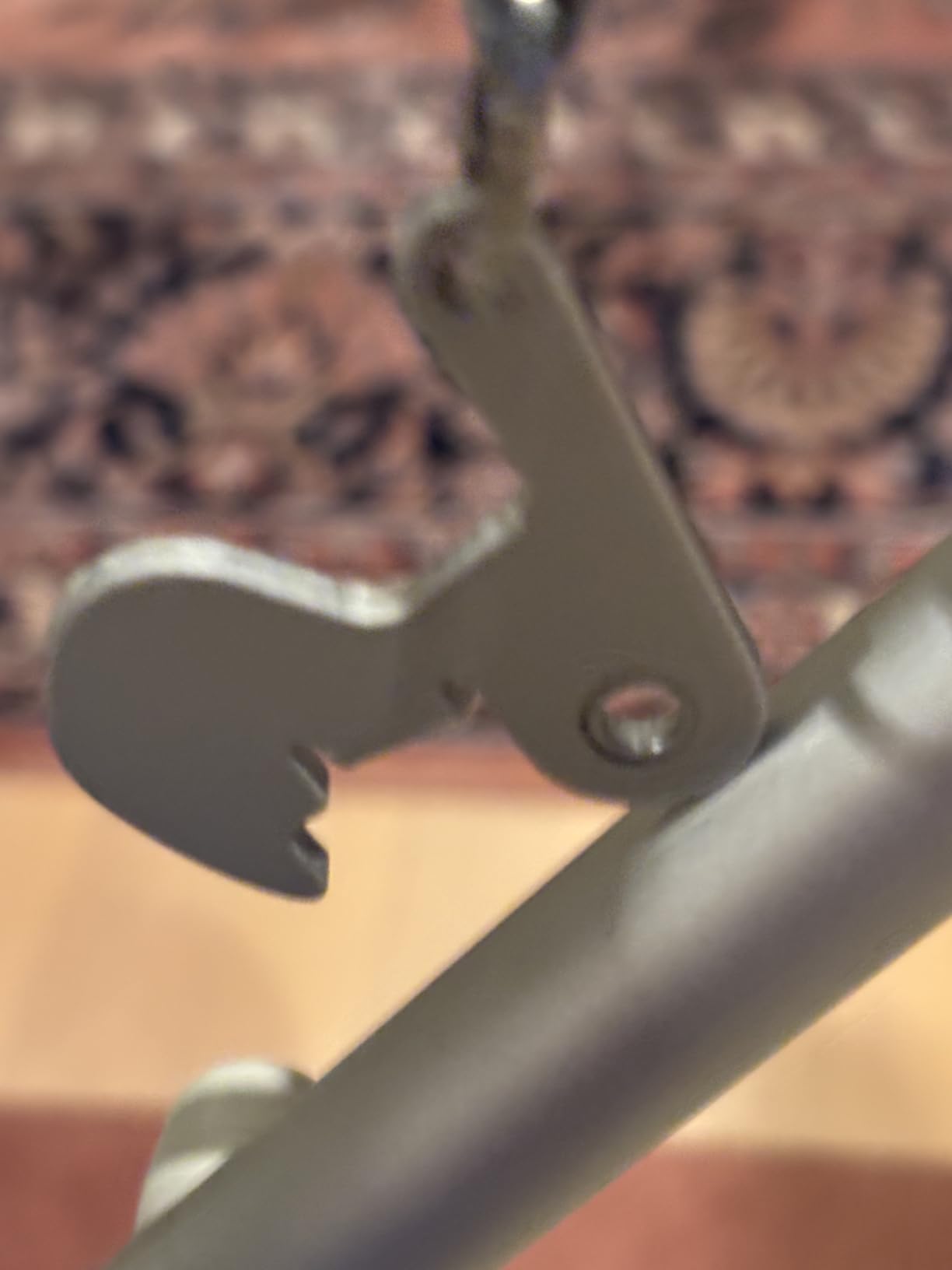
The carbon frame is the reason to look at this one. It weighs 10.58 pounds, and it arrives fully assembled, which means there is no first-day assembly job while you are still finding your feet. The handle geometry also holds you more upright than a typical rollator, which takes load off the neck and shoulders on a long airport day.
Brake cables are hidden inside the frame tubes. On a travel rollator that is not a luxury, because exposed cables snag on overhead bin lips, car door frames and other people’s carry-on bags.
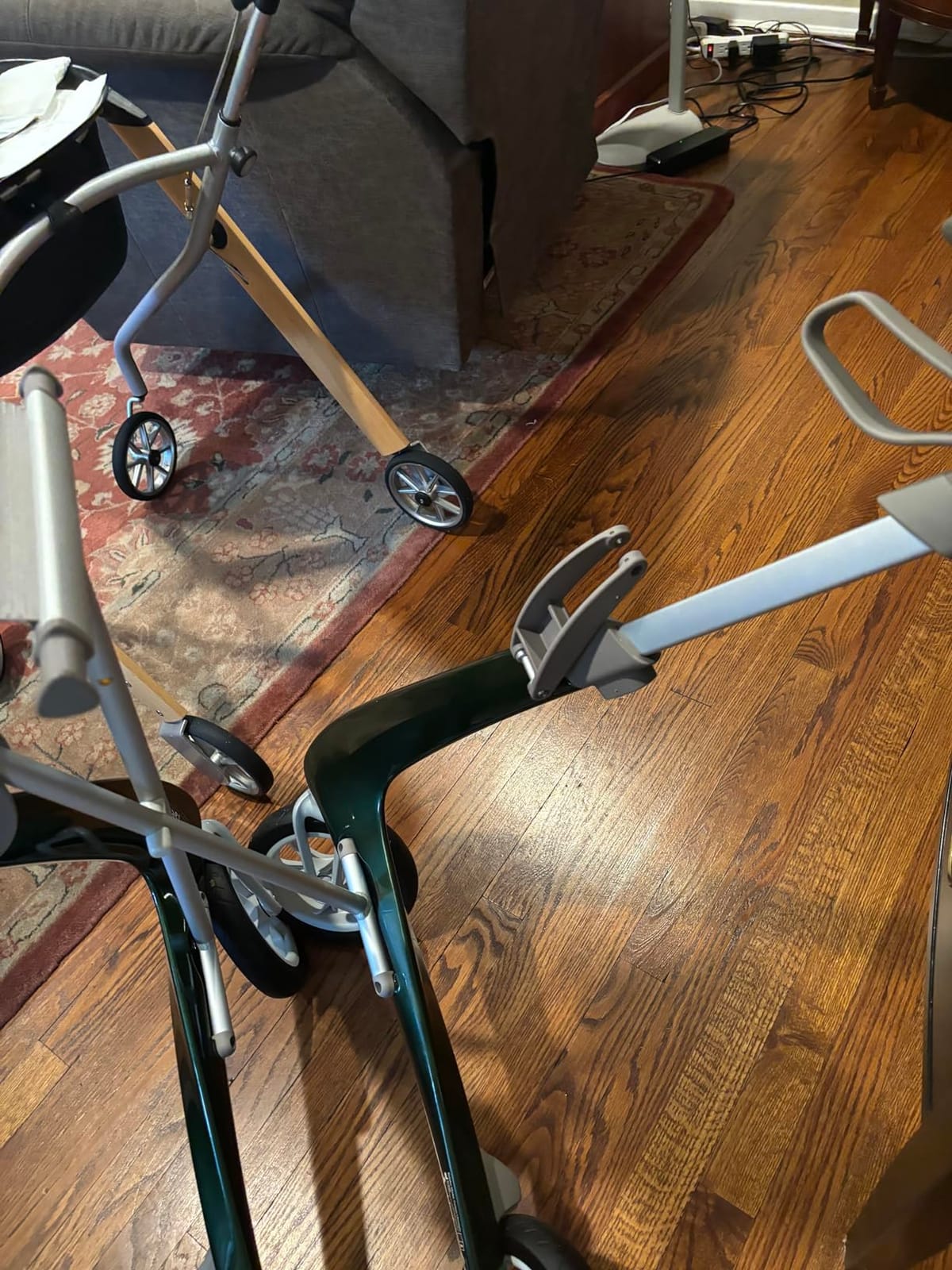
The tradeoff is stability, and buyers say so plainly. Several reviewers with balance deficits, dizziness or neck problems warn that a frame this light feels nervous under quick direction changes. Our own ramp handling agrees. It tracks straight at walking pace but pushes back more noticeably when you turn fast.
Fit is the other issue. The seat height does not adjust, and the seat itself is narrow and shallow. That is fine for a two-minute rest while you wait for a gate, and it is not fine for sitting through a long layover. If you are under about five feet tall, the fixed seat height is a genuine problem rather than a minor annoyance.
Wide Track and Compact Track versions are both offered, which lets you choose between stability and doorway width instead of guessing. The frame carries a lifetime warranty, which is unusual at this weight class.
Who this rollator suits
It suits users with upper body strength who want the lightest full-featured frame they can carry, and anyone whose doctor has told them to keep an upright posture rather than hunching over a walker. The color range is also the widest in the group, which matters if you would rather not fly with something that looks clinical.
It is a strong match for car travel, where the 9.8 inch folded width slides under a seat or into a footwell more easily than a full four-wheel frame.
Who should skip this rollator
Skip it if you have balance issues, a history of falls, or existing shoulder, hip or neck problems. The angled handles that create the upright posture are exactly what aggravates those conditions for some users. Anyone who needs a wide seat for long sits should look at the adjustable-seat models instead.
3. Stander Wonder Rollator Plus – Best Folded Size for Cruise and Air Travel
Stander Wonder Rollator Plus, Lightweight Folding Mobility Rolling-Walker, EZ Fold-N-Go-Rollator for Seniors and Adults, 6-inch Wheels, Locking Brakes and Padded Seat with Backrest, Black Walnut
14.5 lb
Patented EZ Fold-N-Go
10 x 11 in folded footprint
Perch seat to 250 lb
+ The Good
- Folds roughly three times smaller than a typical rollator
- Stands upright when folded
- Arrives pre-assembled
- Popular with cruise and air travelers
- The Bad
- Perch seat is small and narrow
- Standard handle height suits average users
- 6 inch wheels suit smooth surfaces
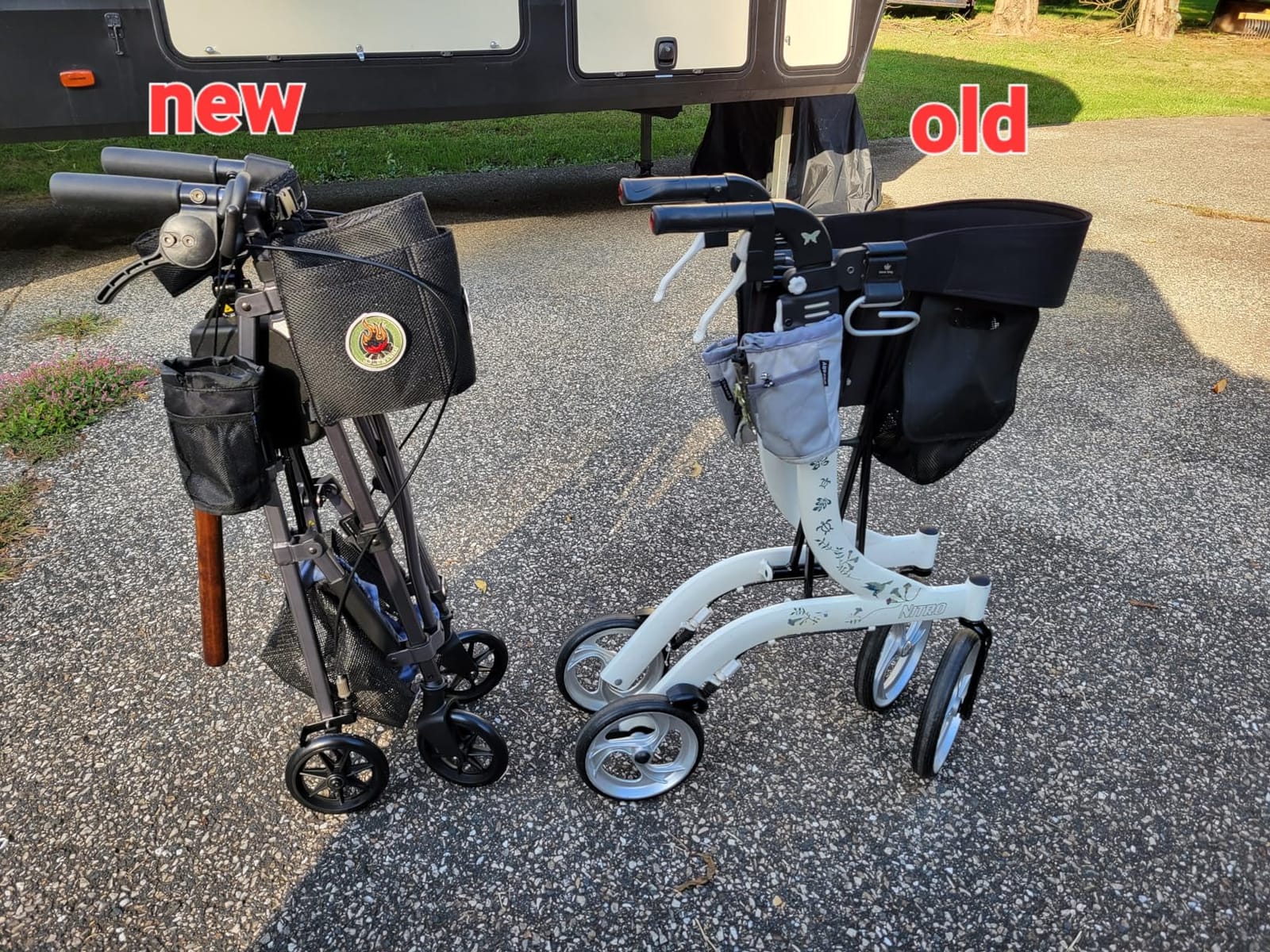
If your travel problem is storage rather than weight, this is the answer. The patented EZ Fold-N-Go system collapses the frame to a 10 by 11 inch footprint, roughly a third of the size of a typical rollator. It stands on its own, so you can park it upright in a cruise cabin corner, a hotel closet or the back of a hatchback without holding it there.
At 14.5 pounds it is not a featherweight, but the fold changes how often you need to actually lift it. A bulkier walker you can roll into place beats a lighter one you have to hoist.
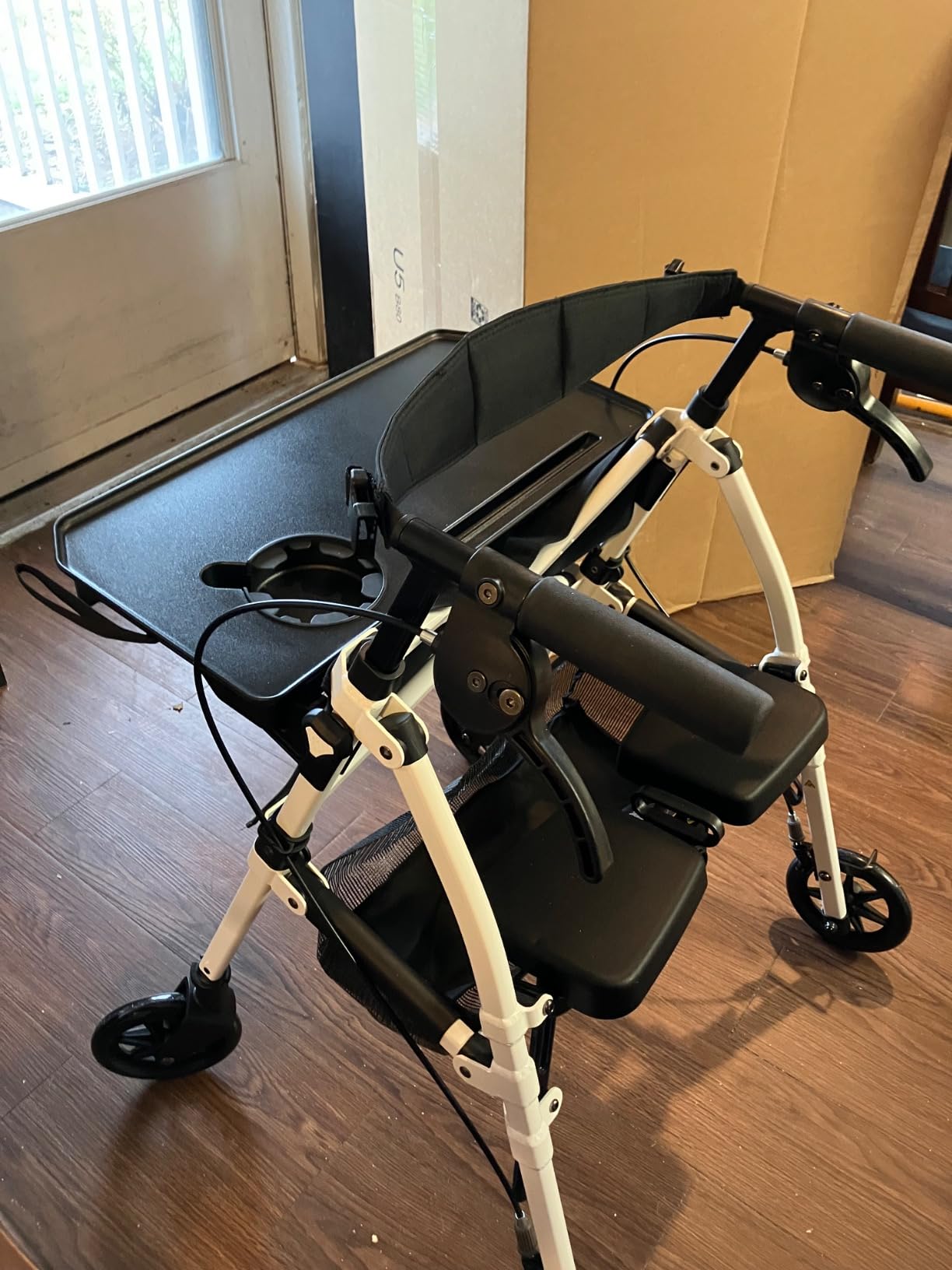
The seat is a perch, not a chair. It measures 18.5 by 6 inches and is rated to 250 pounds, which works for short waits and a quick rest at a restaurant but not for an hour on a pool deck. The removable zippered mesh tote carries a small bag and a jacket.
Handles adjust from 33 to 36 inches, and padded grips plus a compact back strap give you something to hold when you are lifting it. Six inch wheels handle pavement, sidewalks and indoor floors without drama; they are not the choice for gravel or grass.
This one comes up over and over in traveler conversations as the cruise and airport favorite, and reviewers consistently lead with the folded footprint rather than the weight. The narrower Stander Space Saver in the next section is a closely related sibling if you prefer a different frame width.
Who this rollator suits
It suits cruise passengers, anyone in a small hotel room, and people whose car has a tight trunk or no trunk at all. It also suits users who are strong enough to lift 14.5 pounds but cannot manage a wide frame through a cabin door.
A Short version exists alongside the standard model, which is worth checking if you are under five foot six.
Who should skip this rollator
Skip it if you need a real full-width seat, if you plan to walk on gravel or grass, or if you are over 250 pounds. The 6 inch wheels and the perch seat are the two limits people run into most often on this model.
4. Stander Space Saver Rollator – Best Compact Rollator With a Padded Seat
Stander Space Saver Rollator, Lightweight Folding Rolling Walker with Seat for Seniors & Adults, 4-Wheel Mobility Aid with 6-inch Wheels, Locking Brakes & Padded Seat with Backrest, Cobalt Blue
14.5 lb aluminum
10 x 11 in folded footprint
250 lb capacity
Padded seat
+ The Good
- Compact 10 by 11 inch folded footprint
- Lightweight aluminum at 14.5 pounds
- Pre-assembled with no assembly needed
- Locking brakes for inclines and rest stops
- The Bad
- Perch seat suits short rests only
- 6 inch wheels are poor on gravel
- Narrow frame may feel cramped
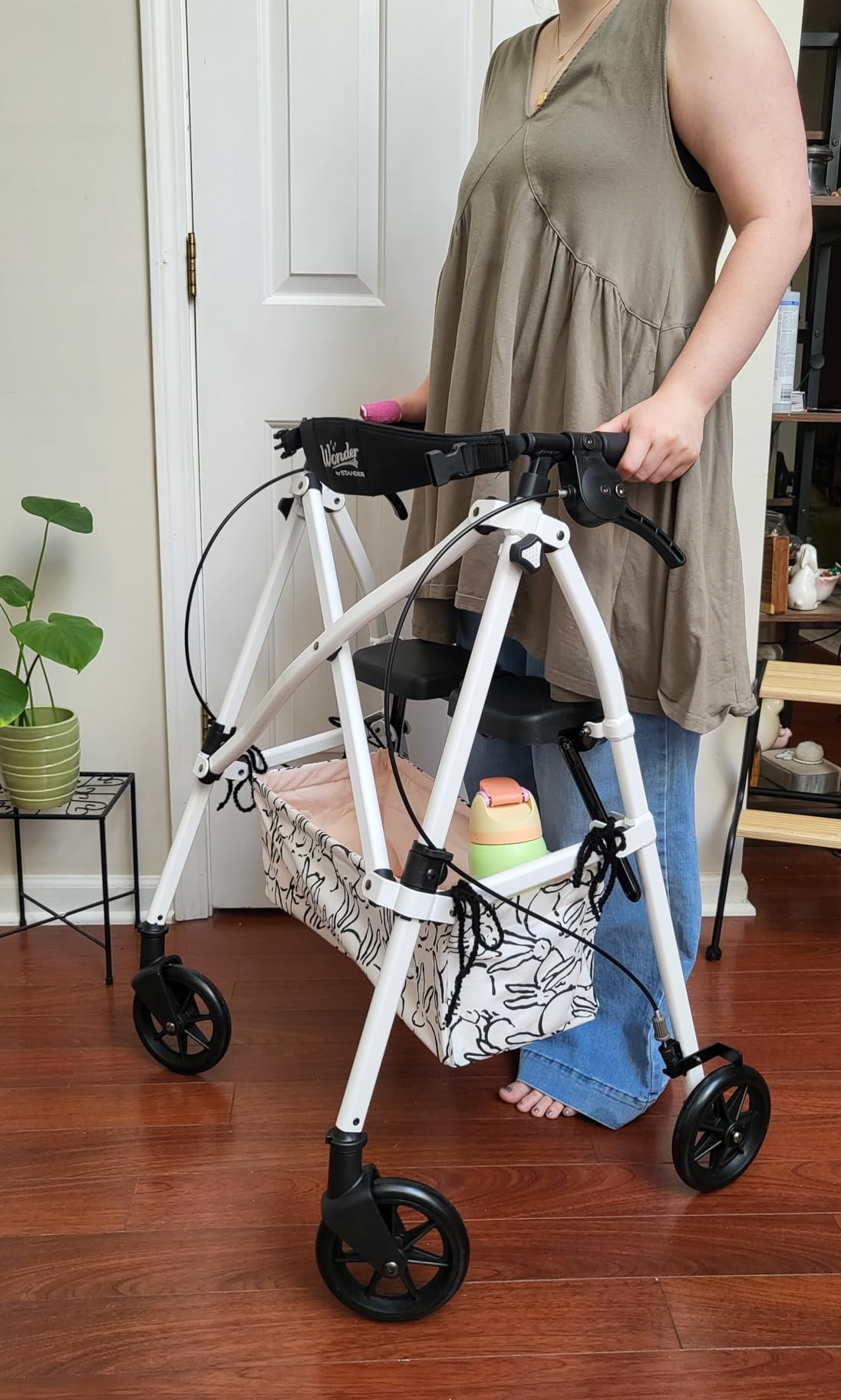
The Space Saver shares the EZ Fold-N-Go footprint with the Wonder Rollator but is the plainer, more direct package. It folds to the same 10 by 11 inch footprint, arrives pre-assembled, and weighs the same 14.5 pounds. What you get in return is a slightly simpler, more utilitarian frame at a lower tier.
That simplicity is genuinely useful for travel. Fewer adjustment points means fewer things to check before a flight, and there is no curved upright-posture geometry to worry about. If you want a travel rollator that just folds, brakes and waits, this is the clean version of that idea.
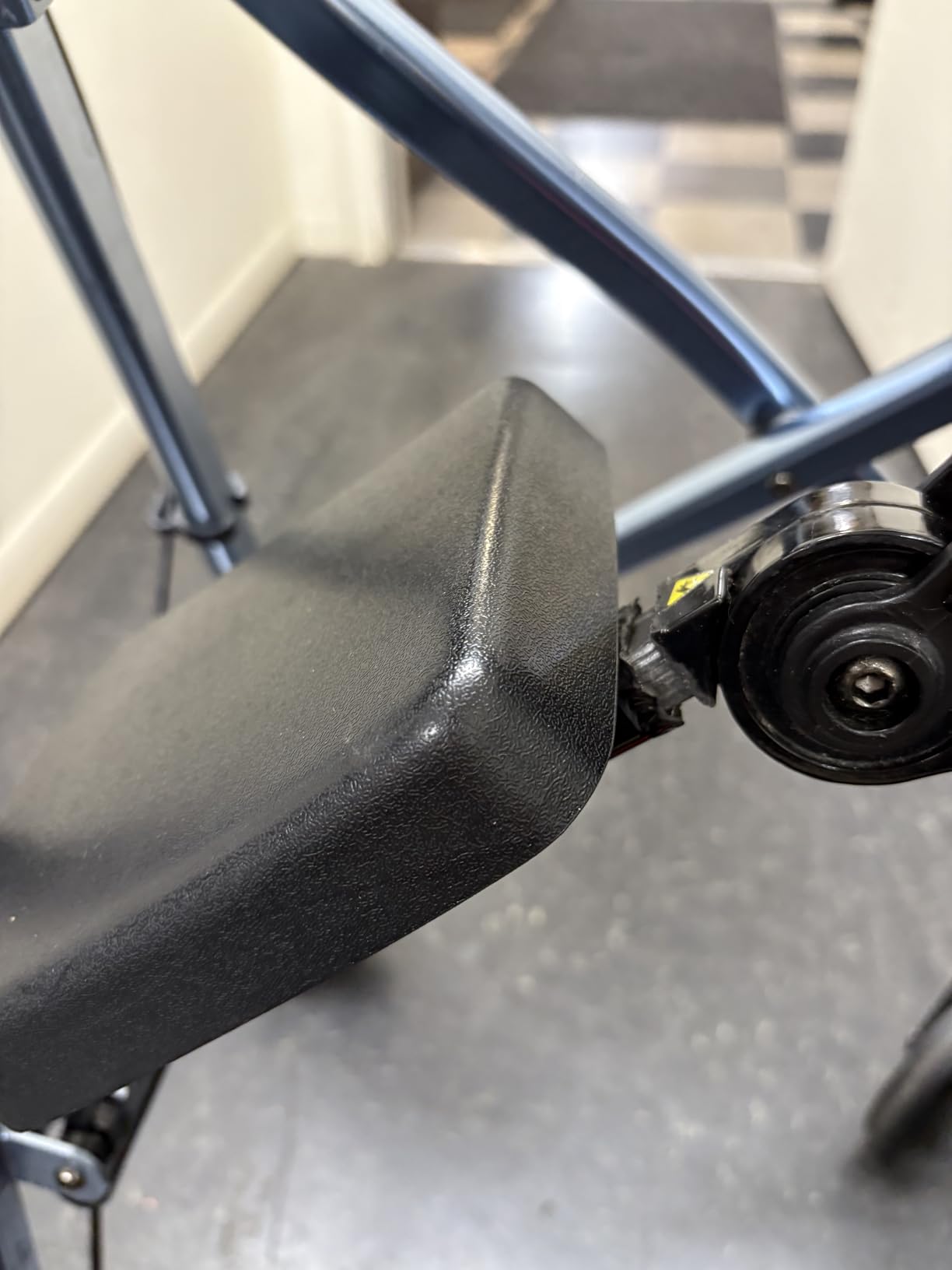
Handles adjust from 33 to 36 inches and the seat is the same 18.5 by 6 inch non-slip perch rated to 250 pounds. The material is aluminum, which is the main reason it lands under 15 pounds at all; the equivalent steel frames in this category run 20 pounds or more.
Item dimensions are 23 by 26.5 by 36 inches, and the 6 inch wheels are fine on carpet, sidewalks and smooth floors. On rough ground they skip and rattle, which is the trade-off for the low weight and small fold.
One reviewer point worth carrying over from our testing: the locking rear brakes are the reason this holds on a ramp. Without an independent parking lock, a rollator creeps, and a creeping rollator on a ship ramp or a hotel driveway is a genuine fall risk.
Who this rollator suits
It suits travelers in small spaces: cruise cabins, hotel rooms, apartments with narrow halls, and cars where the folded rollator has to share space with luggage. The 250 pound capacity covers most users, and the aluminum frame keeps the carry weight down.
It is also a good fit if you like the Wonder Rollator concept but do not need its extra frame shaping or larger perch seat.
Who should skip this rollator
Skip it if you need a wide supportive seat, if you are over 250 pounds, or if your travel involves gravel paths, grass or uneven park trails. Six inch wheels are an indoor and pavement choice, and calling them all-terrain would be a stretch.
5. PLANET WALK Super Lightweight Rollator – Best Lightweight Rollator for Uneven Ground
PLANET WALK Super Lightweight Rollator Walker for Seniors, Foldable Rolling Walker with Seat and 8″ Rubber Wheels for All Terrain, Unique Design Aluminium Frame Sturdy Walkers for Traveling – Blue
13 lb aluminum
8 inch rubber wheels
300 lb capacity
Folds to 26.5 x 10.9 x 35 in
+ The Good
- Only 13 pounds with 300 lb capacity
- 8 inch anti-skid wheels handle gravel and carpet
- One-hand fold with detachable frame
- Five handle settings from 35 to 39 inches
- The Bad
- Fixed seat height is too high for short users
- Handle range excludes taller users
- Frame is wide for small bathrooms
At 13 pounds with a 300 pound capacity, this is the most useful weight-to-capacity ratio in the roundup. It is light enough for a user with back or shoulder problems to load into a sedan, and it is still rated high enough that you are not buying it for a short-term rental period.
The four 8 inch anti-skid rubber wheels are the differentiator. They roll over carpet, gravel and uneven ground that stalls the 6 inch wheels on most of the light frames here, and the 360 degree swivel on the front pair handles tight corners and crowds better than you would expect.
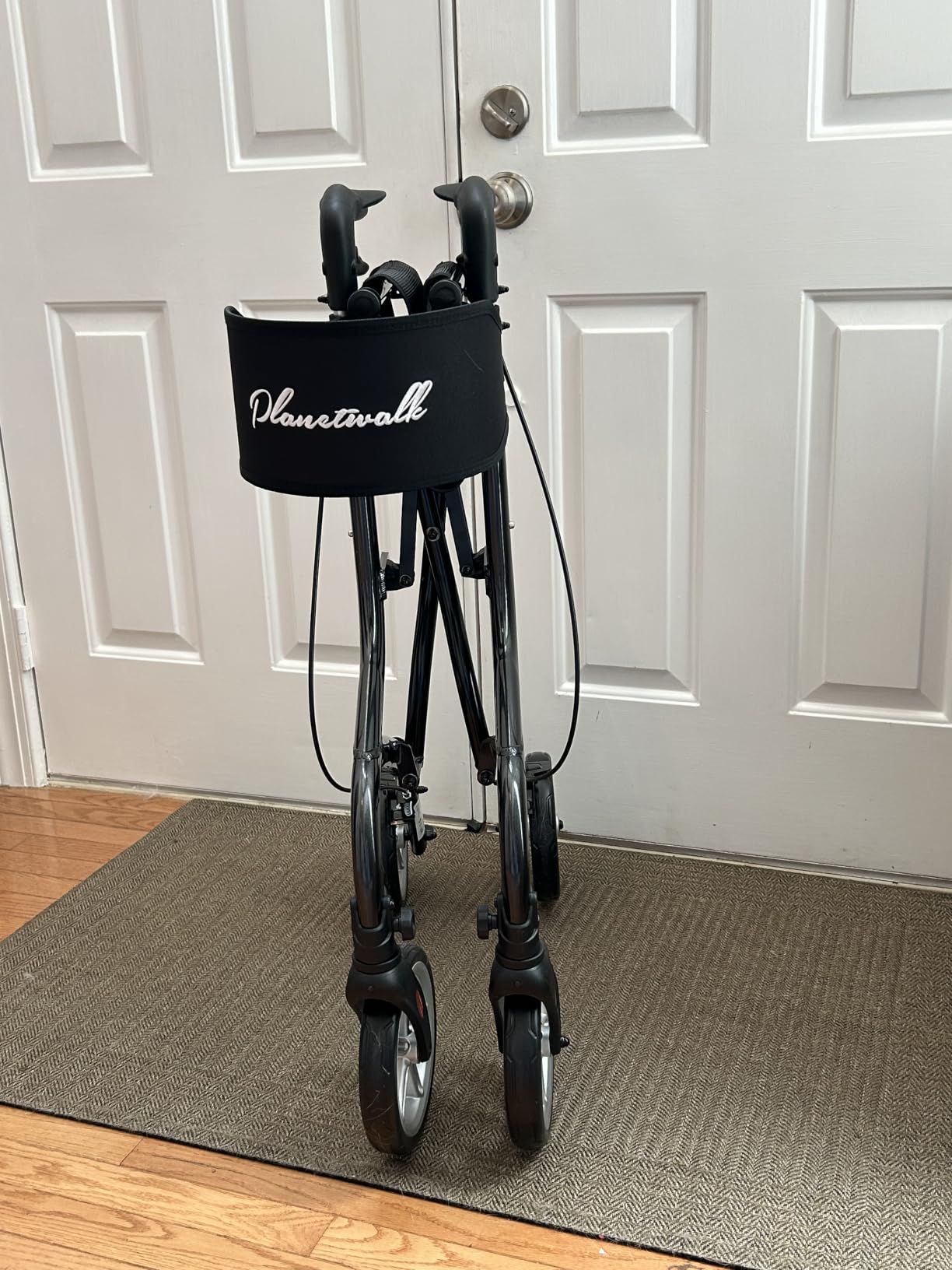
Roomy foot placement between the legs is a real comfort difference. Many lightweight frames squeeze your feet into a narrow triangle; this one gives you room to place your feet the way you would on flat ground, which helps with the cramped feeling that pushes people off lighter rollators.
The brake setup is a two-way parking brake plus dual responsive brakes, and there are reflective strips on the front wheels and the storage bag for early morning and evening airport runs. A breathable waterproof 18.5 inch seat and a widened backrest handle heat better than plastic or mesh seats.
It folds to 26.5 by 10.9 by 35 inches with a one-hand release and a detachable frame design. That is not a closet-flat fold like the Stander, but it is a manageable package for a hatchback or an SUV cargo bay.
Who this rollator suits
It suits travelers who cover mixed surfaces rather than clean airport floors. Beaches, park paths, gravel lots, uneven hotel driveways and older city streets are exactly where 8 inch rubber wheels earn their place. It also suits users who need a higher capacity without carrying a heavier frame.
The 35 to 39 inch handle range is the widest for the height adjustment on this list, which makes it a candidate for tall users who keep sliding on short-handled models.
Who should skip this rollator
Skip it if you are under about five foot three. The seat height is fixed and sits high enough that shorter users cannot get their feet flat on the floor, which is both uncomfortable and unsafe when standing back up. It is also too wide for the smallest bathrooms and the tightest trunks, and some buyers report shallow tread that still slides slightly on smooth floors.
6. HOMLAND 3 Wheel Foldable Walker – Best Lightweight Three-Wheel Design
HOMLAND Foldable 3 Wheel Walkers for Seniors, Lightweight 10.4 lbs
10.4 lb
8 inch casters
260 lb capacity
Handles 34 to 38 inches
+ The Good
- Light at 10.4 pounds so a user can load it alone
- Folds one-handed and stands upright when folded
- Narrow footprint clears tight doorways
- Cup holder and cane holder included
- The Bad
- No seat for rest stops
- Three wheels tip on curbs and slopes
- Not designed for vehicle entry support
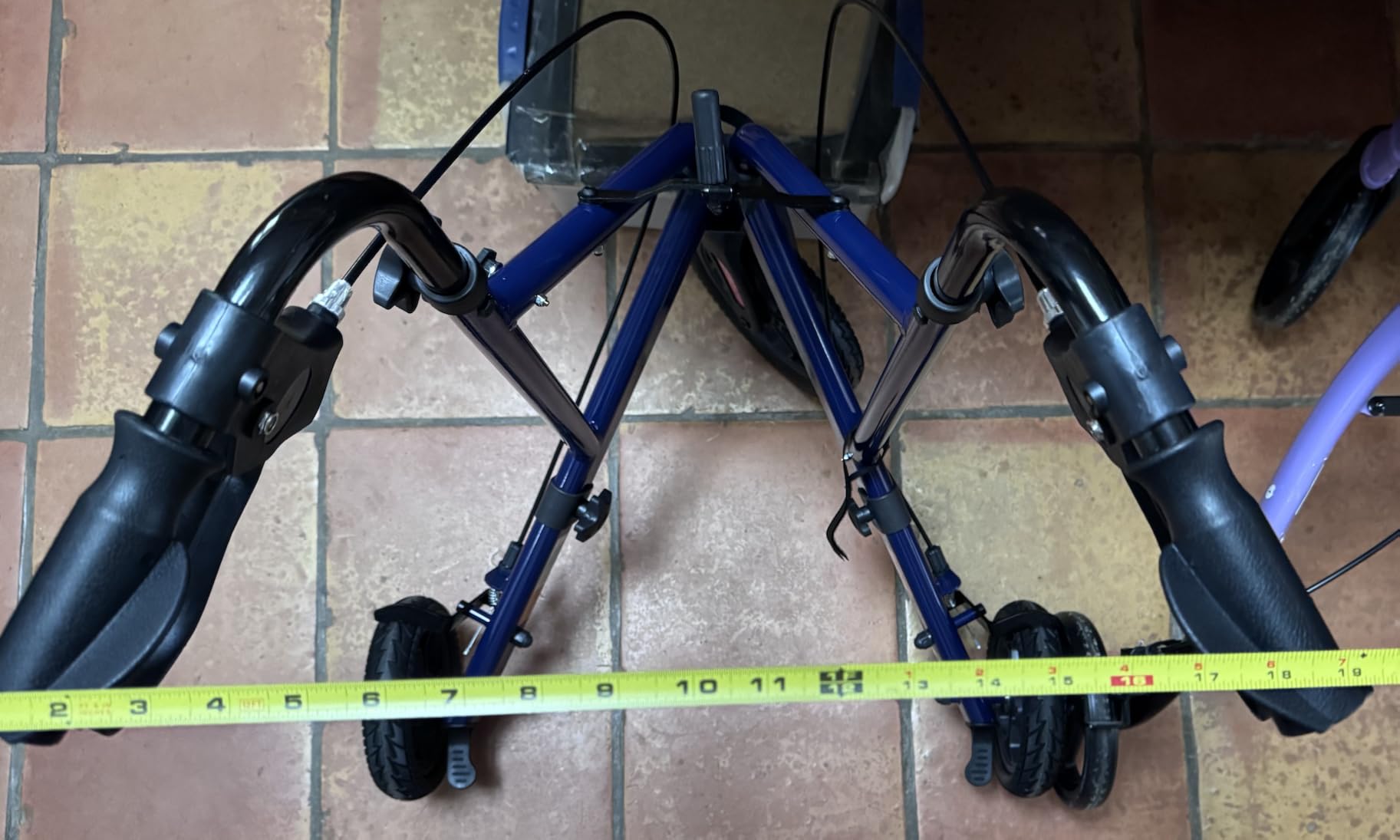
The three-wheel layout is the reason to look here. A triangular frame is narrower than a four-wheel rollator, turns faster in a tight space and weighs less, and at 10.4 pounds it folds and lifts without a second pair of hands. The two-side one-hand fold also leaves it standing upright when folded, so it parks against a wall or in a car footwell.
Handles adjust from 34 to 38 inches, which covers roughly four foot eight to six foot one. A cup holder and cane holder are included, which sounds minor until you are walking a long terminal without free hands.
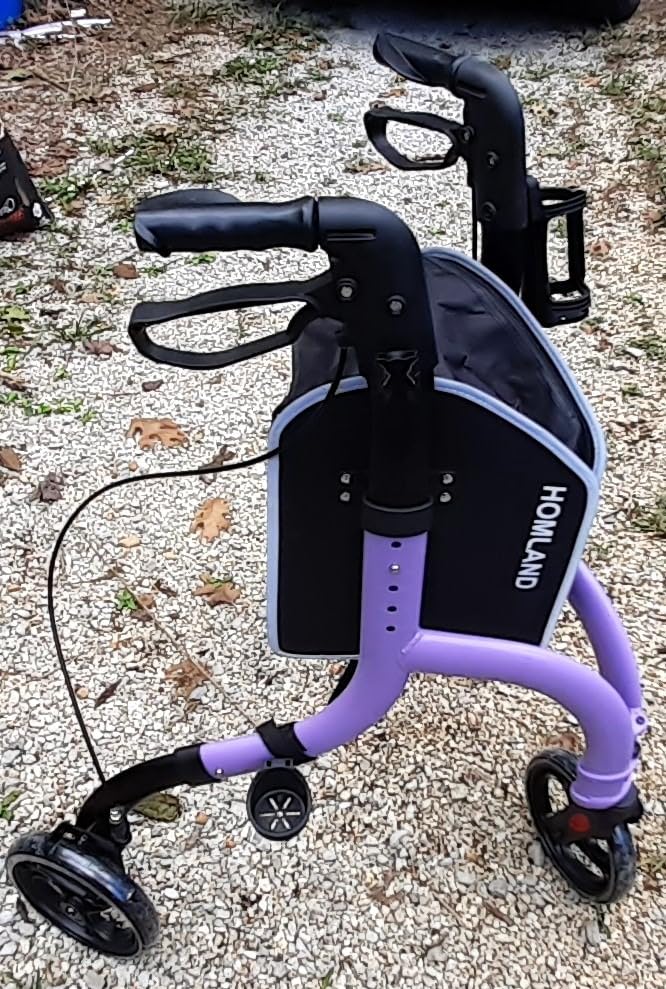
There is no seat. That is the honest trade-off of every three-wheel model, and it is a real problem for anyone who needs to rest while waiting for a gate, a table or a ride. A perch seat that will not fit on a triangular frame cannot be added later.
The 8 inch casters are a good size for indoor floors, sidewalks and neighborhood paths. They are not designed for curb cuts, steep ramps or heavy side loads such as a full bag of groceries pulling you sideways.
The manufacturer states plainly that this is not a support aid for getting into or out of a vehicle. That is worth taking seriously: with a triangular base, standing on it while climbing into a car is a tipping scenario, and you should have a handrail or a person on the other side of the door.
Warranty coverage is one year plus a one-year extended service period, with US-based support.
Who this rollator suits
It suits users who spend most of their walking time on flat, hard surfaces: apartments, hotel corridors, airport terminals, sidewalks and clinics. The narrow footprint is a genuine advantage in older buildings and small European hotel rooms, and the 260 pound capacity covers most users.
It is also a good companion walker for someone who already has somewhere to sit at every stop.
Who should skip this rollator
Skip it if you need a seat, if you walk on curbs and slopes regularly, or if you plan to hang bags on the handles while crossing uneven ground. Anyone who will be using it to steady themselves entering or exiting a vehicle should choose a four-wheel model with rear locking brakes.
7. soundfuse Lightweight 3 Wheel Walker – Lightest Rollator in the Roundup
soundfuse Lightweight 3 Wheel Walkers for Seniors, Foldable Aluminum Frame
10.2 lb aluminum
260 lb capacity
Handles 34 to 38 inches
8 inch wheels
+ The Good
- Lightest frame here at 10.2 pounds while rated to 260 lb
- Folds flat to sit behind a front seat
- Upright posture eases neck and shoulder strain
- Tool-free assembly and single-release fold
- The Bad
- No seat for rest stops
- Triangular base can tip on curbs and heavy side loads
- Max handle height still feels short to some
At 10.2 pounds this is the lightest rollator we could find that still carries a 260 pound rating, which makes it the answer for anyone whose real constraint is upper body strength. People who cannot comfortably lift 14 pounds into a trunk can lift this, and the difference compounds over a week of travel.
The aluminum tubing is thicker and wider than most frames in this weight class, so the low weight does not come from thin gauge metal. Five-level handle adjustment runs from 34 to 38 inches, and the upright handle layout lets you stand taller than you would on a folded-down traditional walker.
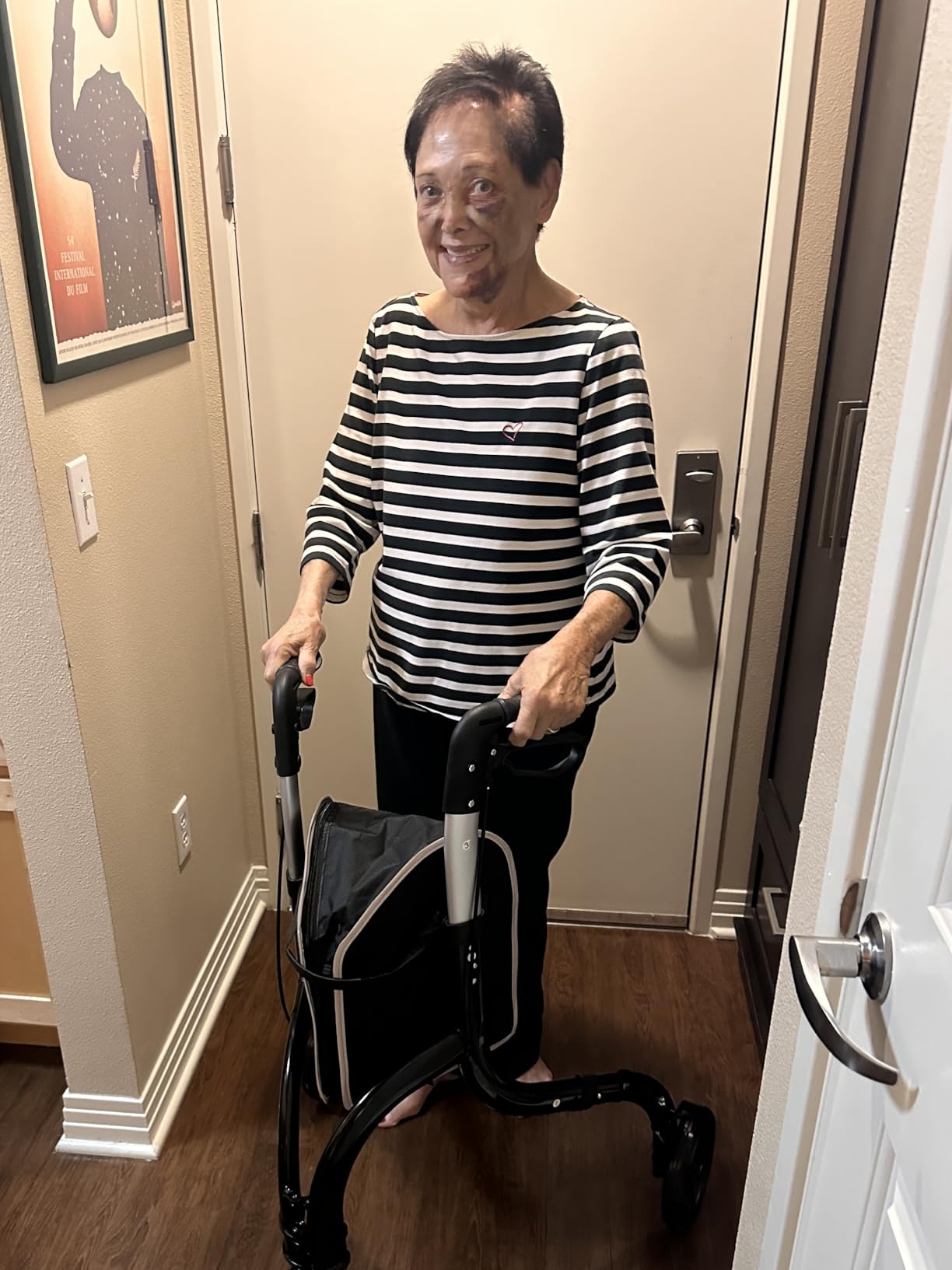
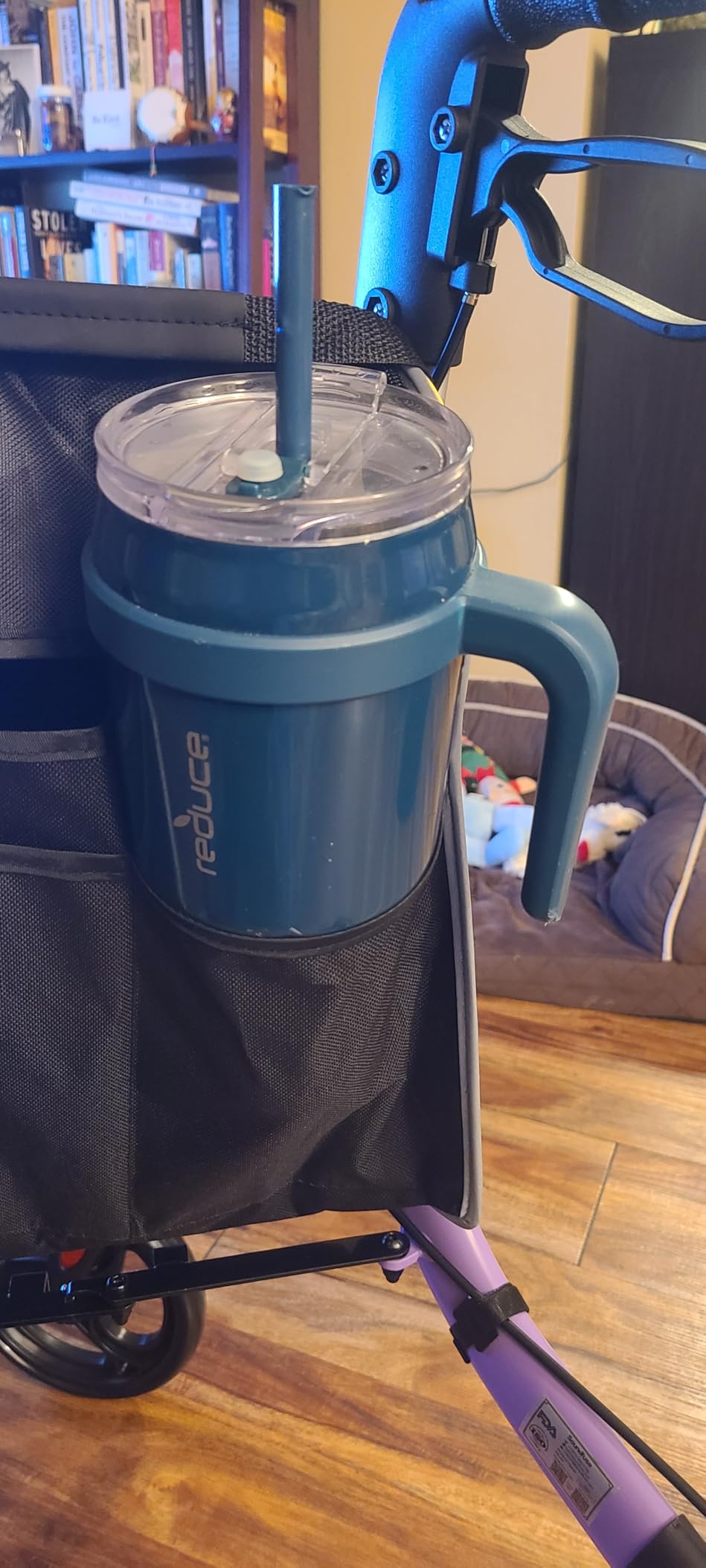
The dual-brake system is straightforward: squeeze the levers to slow, push down to lock. A removable storage bag is sized for a phone, a cup and a small grocery run, which is more realistic than the deep baskets on full-size rollators.
Tool-free assembly and a single-release fold mean there is nothing to disassemble before you fold it, and nothing to reassemble when you get it home. The package is 25.55 by 18.15 by 5.9 inches, so shipping and unboxing stay simple.
Safety-conscious reviewers consistently frame this as a level-ground tool. The triangular footprint is quick and nimble indoors, and that same quickness works against you at a curb edge or with a heavy bag hanging off one side.
Who this rollator suits
It suits users with limited shoulder or back strength who need the lightest possible frame, and travelers whose destination is mostly flat and hard-surfaced. Folding it flat enough to live behind a front seat is a real advantage for car travel and taxi use, where a bulky four-wheel frame simply will not fit.
US-based customer support draws repeated positive mentions in buyer reviews.
Who should skip this rollator
Skip it if you need to sit while waiting, if you cross curbs or sloped driveways daily, or if you plan to hang loaded bags on the handles. Even at maximum handle height, some users find 38 inches too short, and the three-wheel base adds tip risk that a four-wheel frame with a seat simply does not have.
8. Cosydora Rollator with Adjustable Seat – Best Rollator for Adjustable Seat Height
Cosydora Rollator Walkers for Seniors with Seat, 15 Lbs Ultra Lightweight
15 lb
350 lb capacity
Seat adjusts 20 to 22 in
13.8 x 12 in padded seat
+ The Good
- Seat height adjusts from 20 to 22 inches
- Handle height adjusts 32.5 to 38 inches
- 350 lb capacity on a 15 lb frame
- Padded seat stays comfortable for long sits
- The Bad
- 8 inch wheels are thin on rough ground
- Bulkier than three-wheelers when folded
- No built-in fold lock so some add Velcro
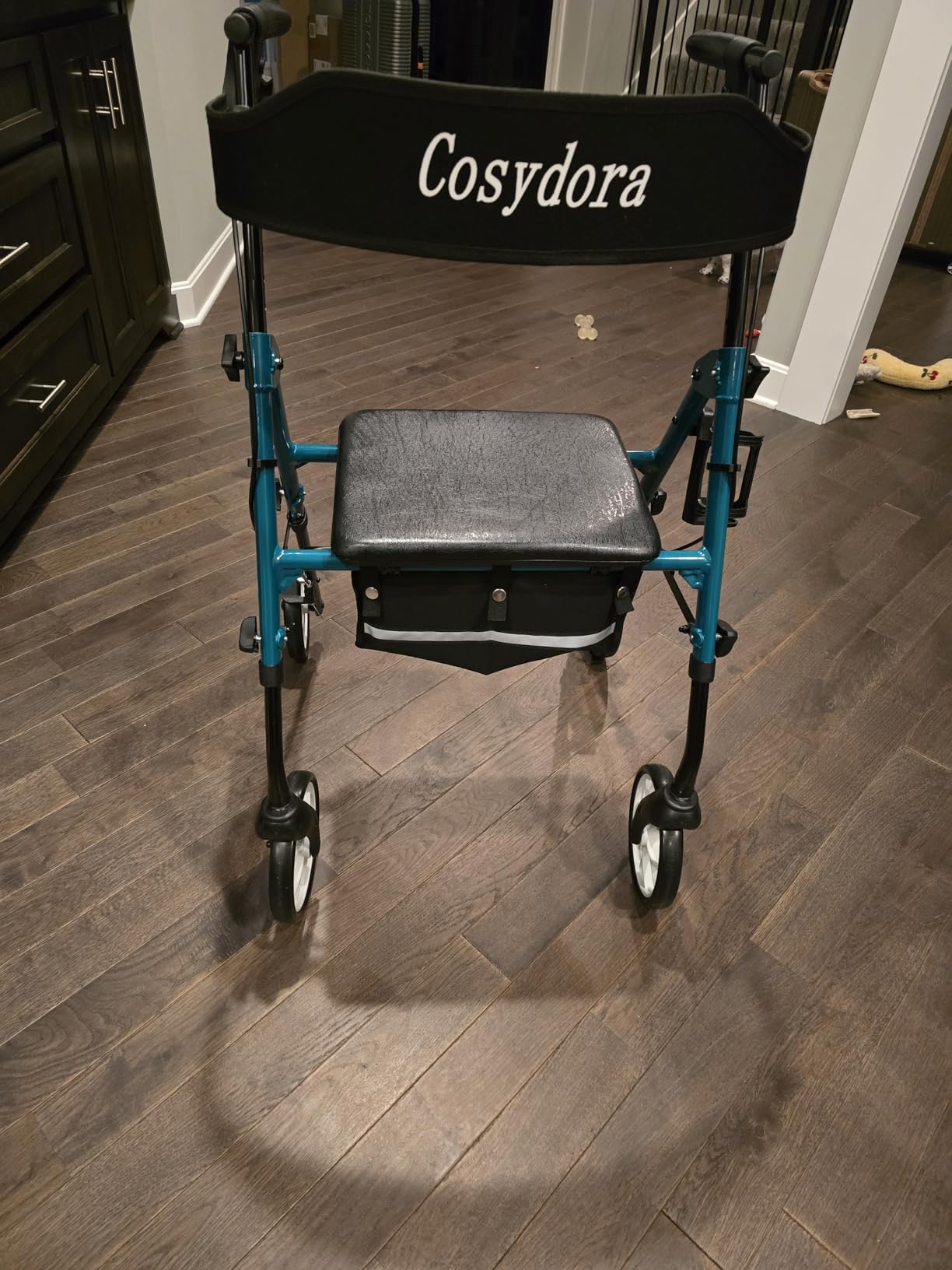
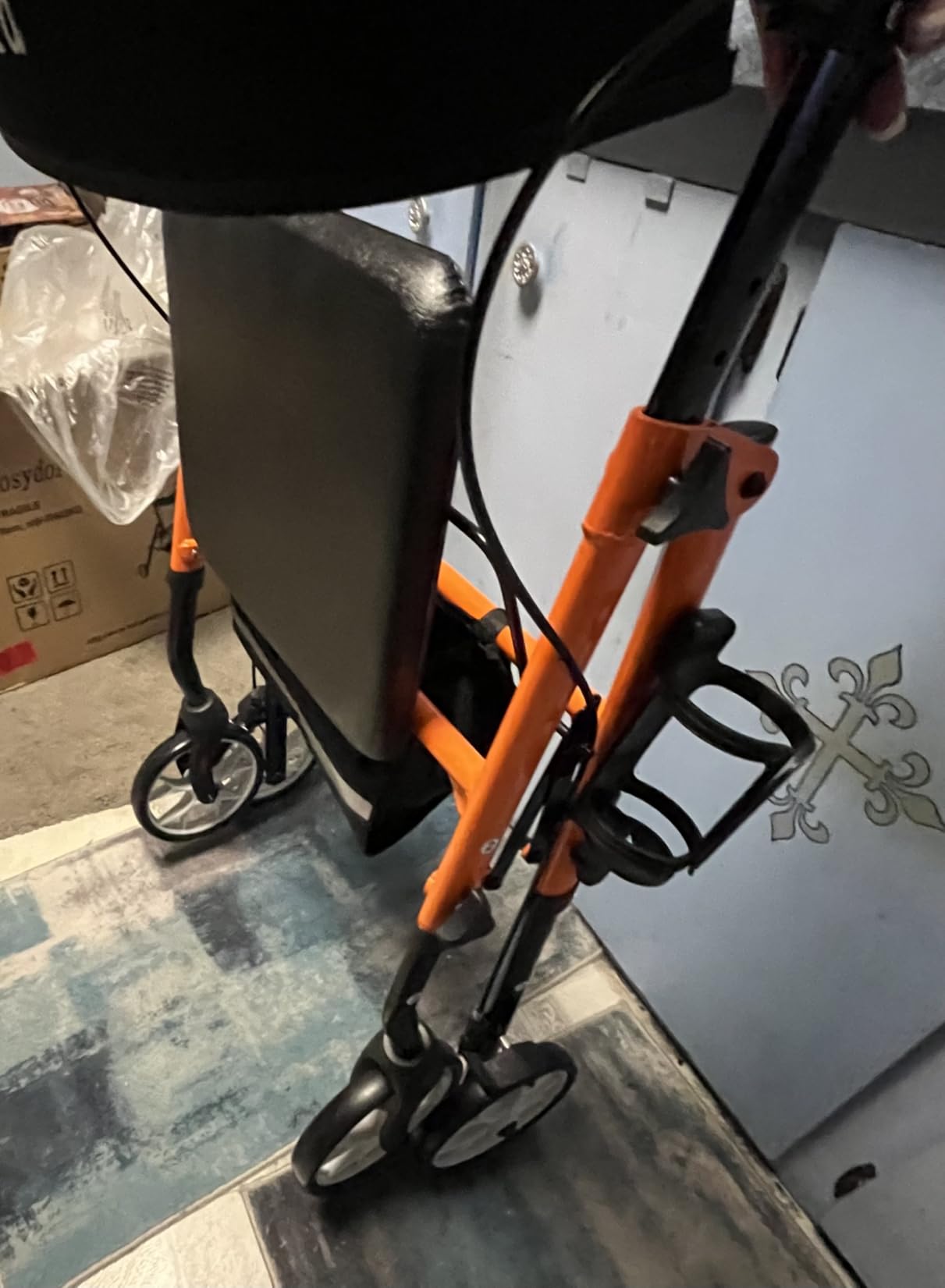
Most lightweight rollators have a fixed seat, which quietly rules out a large share of shorter users. This one adjusts the seat from 20 to 22 inches, and buyers who could not get their feet flat on other models single this feature out as the reason they kept it. Getting your feet flat is not a comfort preference; it is what lets you stand back up without rocking forward.
Handles also adjust from 32.5 to 38 inches, and the fit range runs from about four foot seven to six foot six. That is the widest height window of any seated model in this roundup.
Capacity is 350 pounds on a 15 pound frame, which is the highest rating here and the reason we kept it in the roundup despite the weight. Buyers who need a bariatric-rated frame without a heavy-duty steel chassis should also read our guide to the best heavy-duty rollators for bariatric users, where capacity comes at a larger weight penalty.
The 13.8 by 12 inch padded seat is genuinely a seat, not a perch. Owners report sitting through outdoor events for over an hour comfortably, and the thickened breathable backrest does the same job. A detachable under-seat bag rated to 11 pounds and a cup holder handle errands.
The one-hand fold brings it down to a 9.5 inch width, but the folded package is still bulkier than a three-wheeler because you are folding a full seat and backrest. There is no built-in latch to keep the frame folded, so some users add a hook-and-loop strap after traveling.
Who this rollator suits
It suits shorter users who need their feet flat on the floor, and anyone who needs a real wide seat for long sits rather than a two-minute perch. It also suits users near or above 300 pounds who still want a lightish aluminum frame, and the color range in green and orange is easier to spot than another red walker in a sea of identical equipment.
Numbered, color-coded parts make the tool-free assembly one of the more straightforward in the group.
Who should skip this rollator
Skip it if your travel involves rough ground; the 8 inch wheels are thinner than premium equivalents and skip on gravel. It is also one of the heavier seated models here at 15 pounds, and the folded bulk takes a full trunk or back seat. Check every fastener after assembly, since a few buyers reported missing hardware on arrival.
9. Vive Ultra Lightweight Narrow Rollator – Best Rollator for Narrow Doorways
Vive Ultra Lightweight Rollator Walker with Seat – Foldable, Narrow
16.5 lb listed
Narrow 24 in wide frame
300 lb capacity
Handles 31 to 36 in
+ The Good
- Narrow frame passes through tight doorways
- Lowest entry tier with a full seat
- Handle range 31 to 36 inches covers short users
- Padded seat with backrest and underseat storage
- The Bad
- Listed weight conflicts with the marketing figure
- 6 inch wheels roll poorly on gravel
- Narrow frame feels cramped for wider users
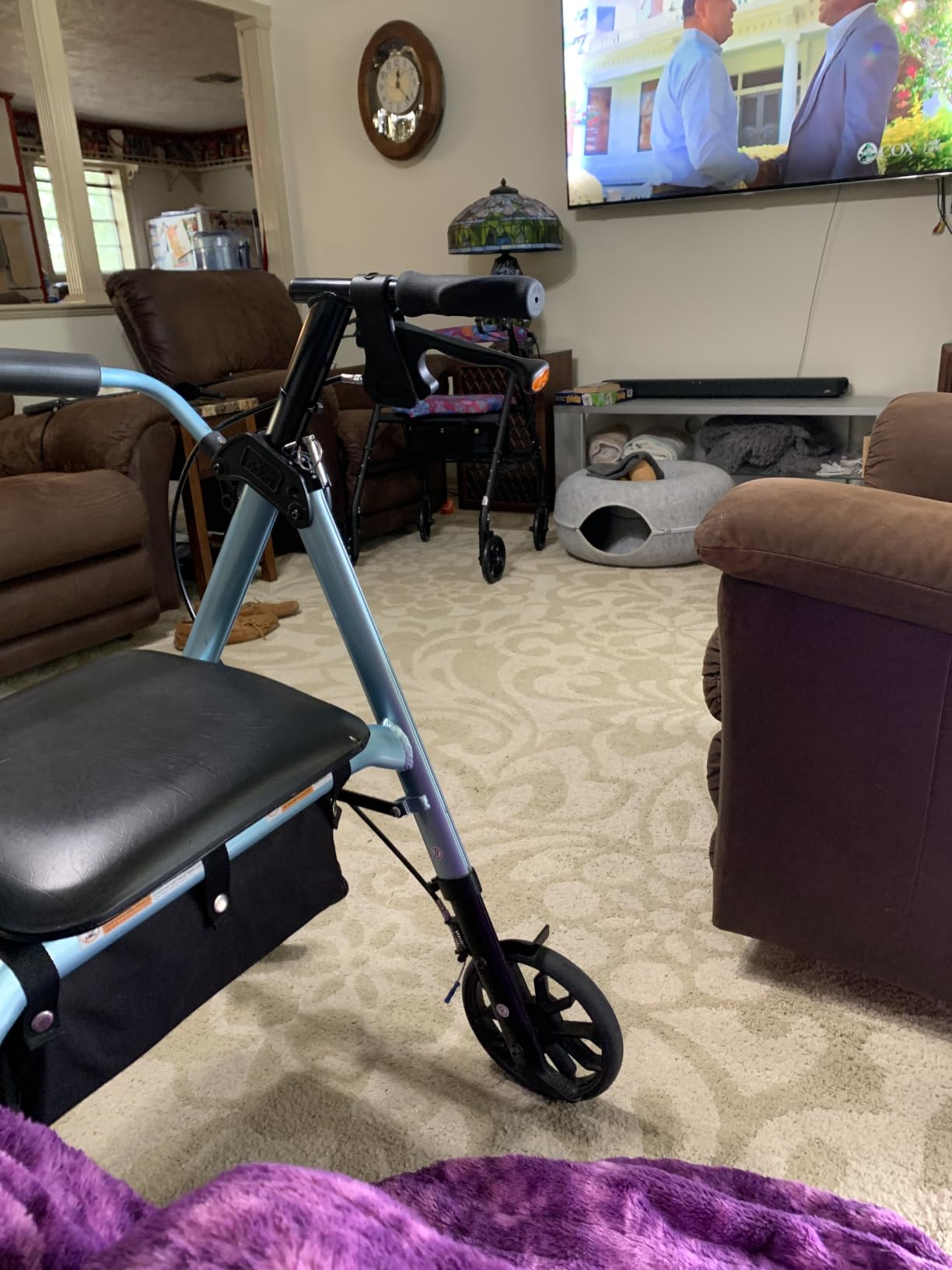
The case for this model is width. At 24 inches wide by 23 inches deep, it clears doorways that stop a 25.6 inch frame, which matters in older apartments, historic European buildings, narrow hotel bathrooms and standard accessible stalls. If you have ever gotten a full-size rollator wedged in a doorway, this solves that specific problem.
Handles adjust from 31 to 36 inches, the lowest starting point of any seated model here, which makes it a candidate for shorter users. The padded 14 by 12 inch seat with a 21 inch height and a backrest is closer to a real seat than a perch, and there is underseat storage.
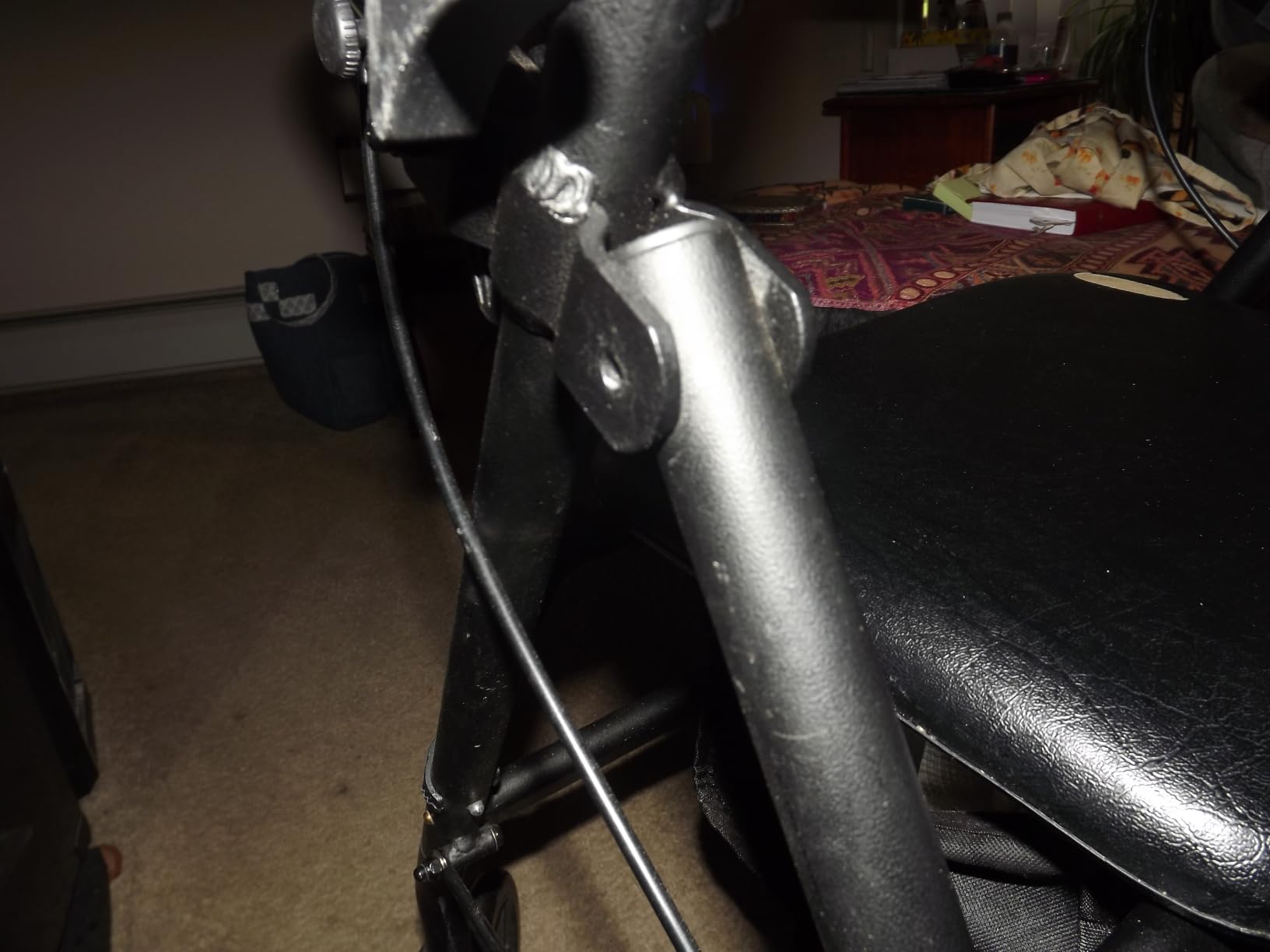
One caution that we will not paper over: the listing weight is inconsistent. The spec block states 16.5 pounds while the marketing copy says 14 pounds. Buyers cross-check the weight number, and if the frame is too heavy to lift that is the whole purchase, so measure and verify before you commit. The narrow frame also feels cramped for wider users, and the fixed 21 inch seat height does not adjust.
The 6 inch wheels are the smallest on the list, which is the direct cost of keeping the frame narrow and light. They are acceptable on carpet, sidewalks and smooth floors and poor on gravel and grass.
It is FSA and HSA eligible and carries a one year manufacturer guarantee, which matters more than usual in this category because parts availability is the main long-term risk with any rollator.
Who this rollator suits
It suits users in older or narrow housing, travelers staying in historic properties where doorways are tight, and anyone whose primary indoor problem is a full-size rollator that will not fit through the door. Short users benefit most from the 31 inch minimum handle height.
It is also a reasonable first rollator for indoor and short outing use, particularly if reimbursement through an FSA or HSA matters.
Who should skip this rollator
Skip it if you need outdoor rough-terrain capability, if a narrow frame will feel claustrophobic for you, or if lifting 16.5 pounds is a problem. Because of the weight discrepancy between the marketing copy and the spec block, we would not choose it for travel where weight is the deciding factor.
10. Medline Superlight Folding Aluminum Rollator – Best Value Lightweight Rollator
Medline Superlight Folding Aluminum Mobility Rollator Walker, Smoky Blue, 250 lb. Weight Capacity, 6″ Wheels, Adjustable Arms and Seat, Foldable Rolling Walker for Seniors
12.6 lb aluminum
250 lb capacity
Seat adjusts 18 to 23 in
Handles 29.5 to 36 in
+ The Good
- Genuinely light at 12.6 pounds
- Seat and handle height both adjust
- Brakes feel solid and work reliably
- Longest documented durability in the group
- The Bad
- Folds less flat than earlier versions
- Rear stabilizer bar is now fixed
- 6 inch plastic wheels slide on uneven ground
The Medline has the largest review base of anything in this roundup, and that is the point. When a rollator has thousands of long-term owners, you know what breaks and what does not, and the recurring feedback here is that the brakes work, the frame is light and the dual height adjustment genuinely fits a range of body sizes.
At 12.6 pounds with a 250 pound capacity, it is the traditional aluminum answer. Steel frames in the same class run five to ten pounds heavier, and users consistently note that difference when comparing to models marketed as light.
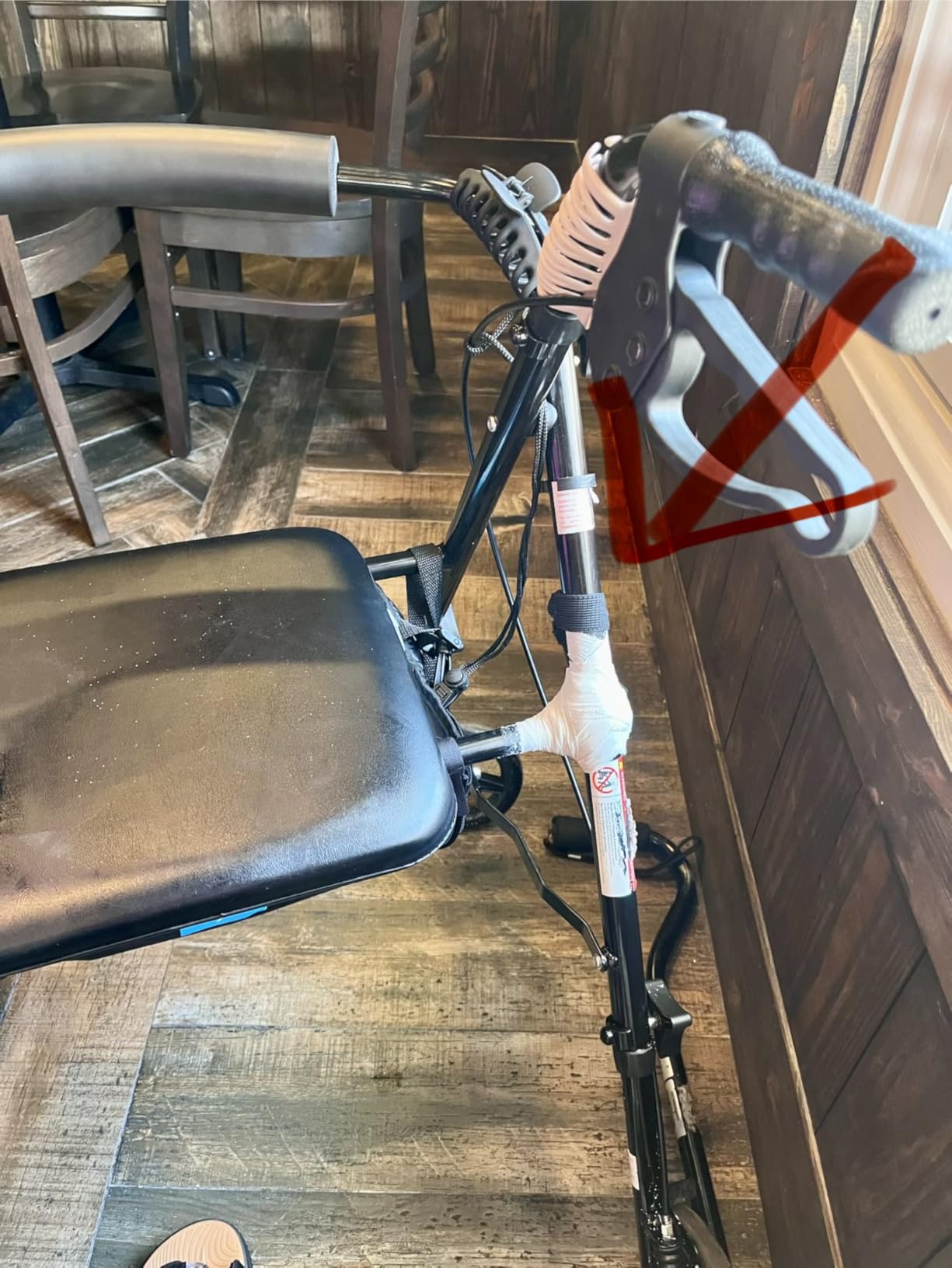
Both the seat and the handles adjust: the padded seat runs from 18 to 23 inches off the floor and the handles from 29.5 to 36 inches. Having both is unusual in a frame this light, and it is why shorter users who felt excluded elsewhere in the roundup can use this one.
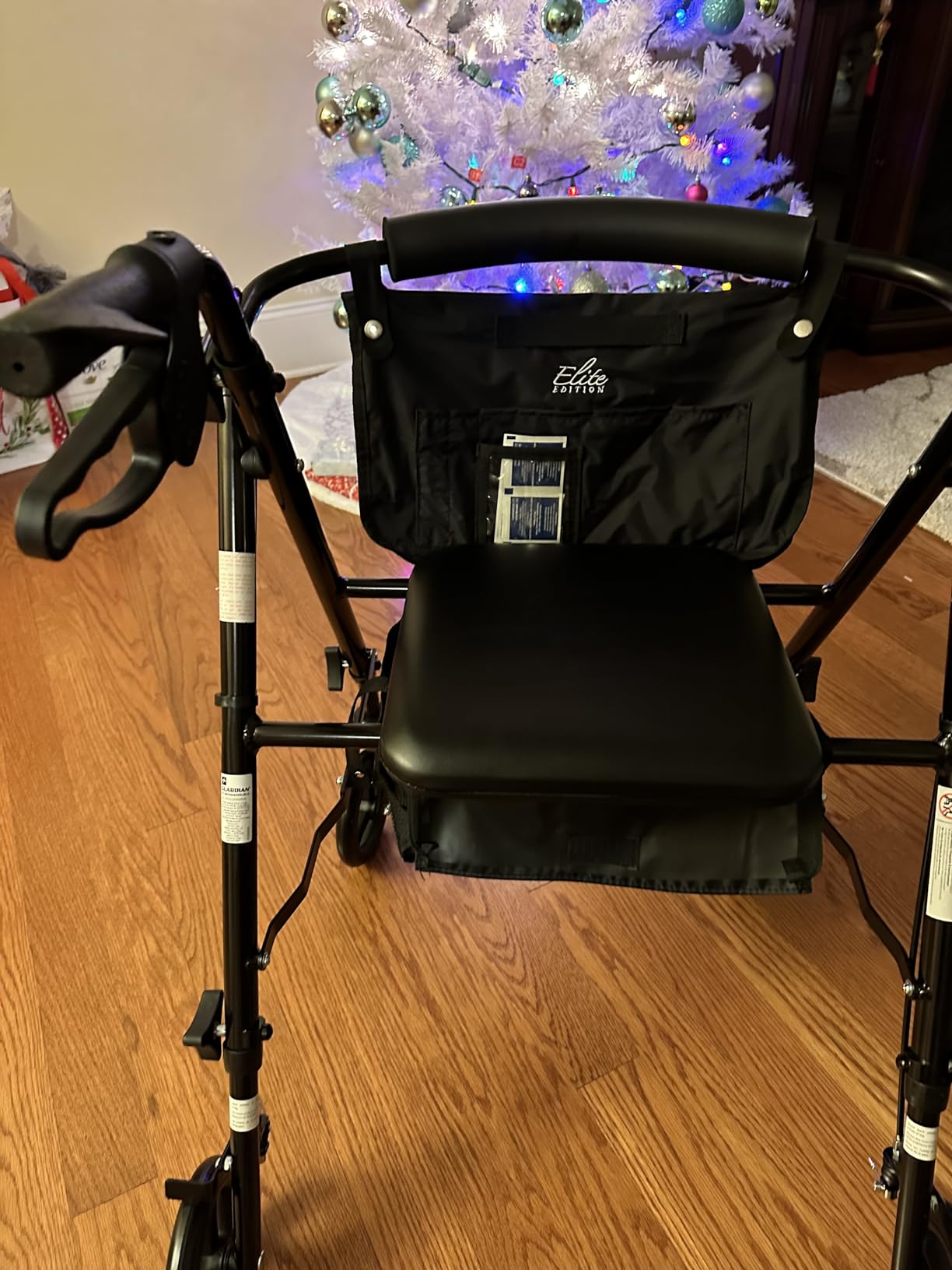
There is an underseat storage compartment, push-up to brake and push-down to lock, and 6 inch wheels for indoor and outdoor rolling. Assembly takes about five minutes, though buyers note the legs are not marked front and back, so read the instructions before you start.
Two design changes in newer versions get repeated criticism. The frame folds less flat than earlier versions, which makes trunk and airline packing tighter, and the rear stabilizer bar is now fixed rather than movable, so it no longer works as a shoulder carry handle. Neither is disqualifying, but both are exactly the features you would check first if trunk space is your main constraint.
Who this rollator suits
It suits buyers who want proven long-term durability at a modest weight and a moderate price. It also suits shorter users who need a low seat and low handles, and anyone who prefers a familiar mass-market frame with widely available replacement parts.
Because it is light and dual-adjustable, it is a solid general-purpose travel rollator for pavement, sidewalks and indoor surfaces.
Who should skip this rollator
Skip it if you need a tight fold, since the current version packs less flat than the classic design. The fixed stabilizer bar costs you a carry handle, 6 inch plastic wheels are the wrong choice for gravel or grass, and 250 pounds is the lowest capacity in this roundup.
11. HOMLAND 16 lb Rollator with Seat – Best Budget Rollator for Narrow Doorways
HOMLAND Foldable Walkers for Seniors with Seat, 16lb Light Rollator Walkers
16 lb
300 lb capacity
21.9 in front width
Removable backrest
+ The Good
- Lowest entry point in the roundup
- Narrow frame glides through interior doorways
- Padded waterproof seat and underseat bag
- Removable backrest reduces folded size
- The Bad
- Wheels lock only while brakes are squeezed
- Seat back folds past the backrest
- 16 lb is heavy for a budget model
This is the least expensive seated rollator in the group, and the reviews treat it that way. Buyers consistently describe it as the value pick and single out the narrow frame, which measures 21.9 inches between the front wheels and passes through standard interior doorways without scraping.
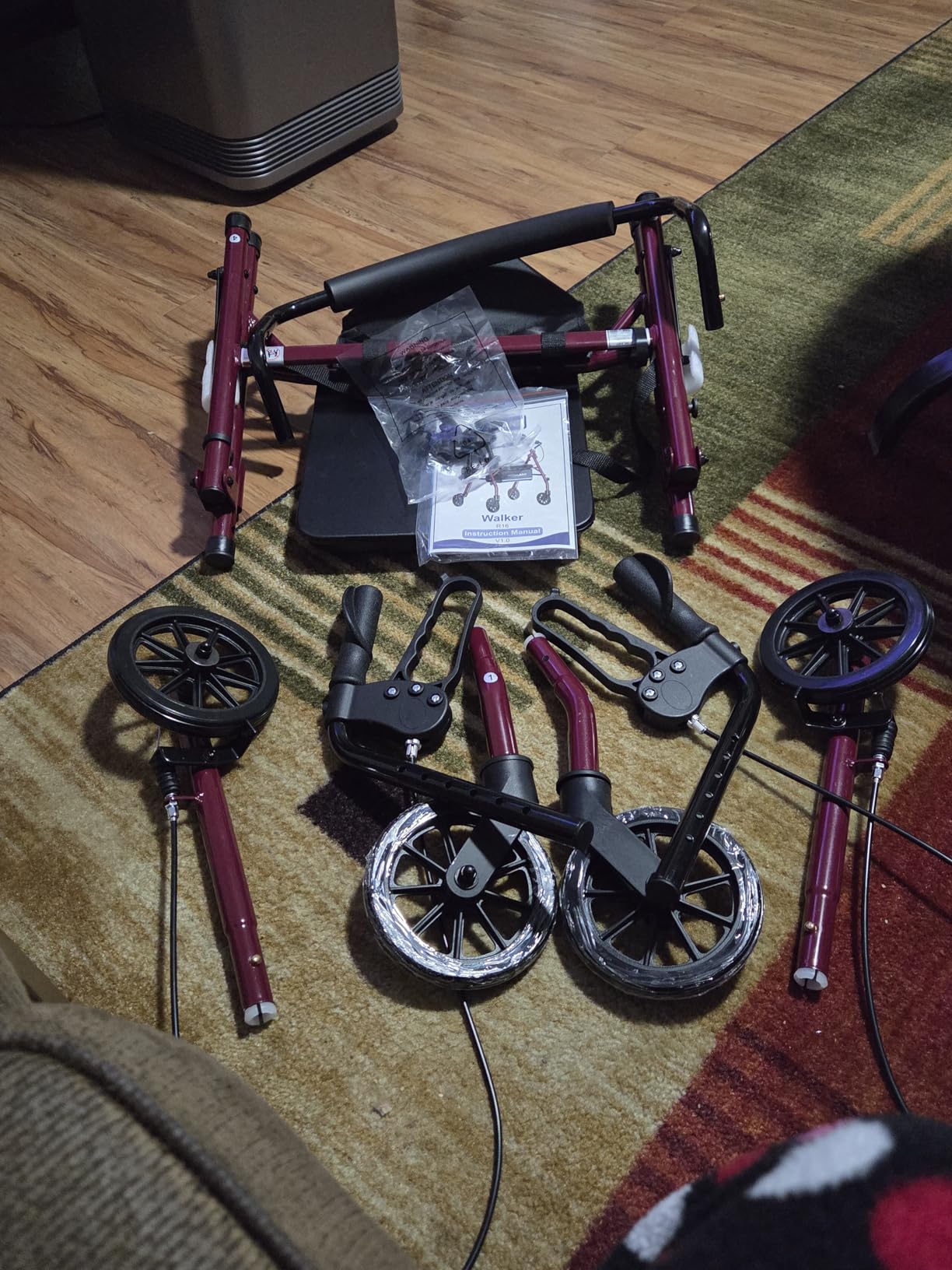
At 16 pounds with a 300 pound capacity it is not a true ultralight, and we would not call it one. What it is, is a capable aluminum-framed seated rollator at the bottom of the price range, and the reinforced frame gives it a 300 pound rating that many lighter models cannot match.
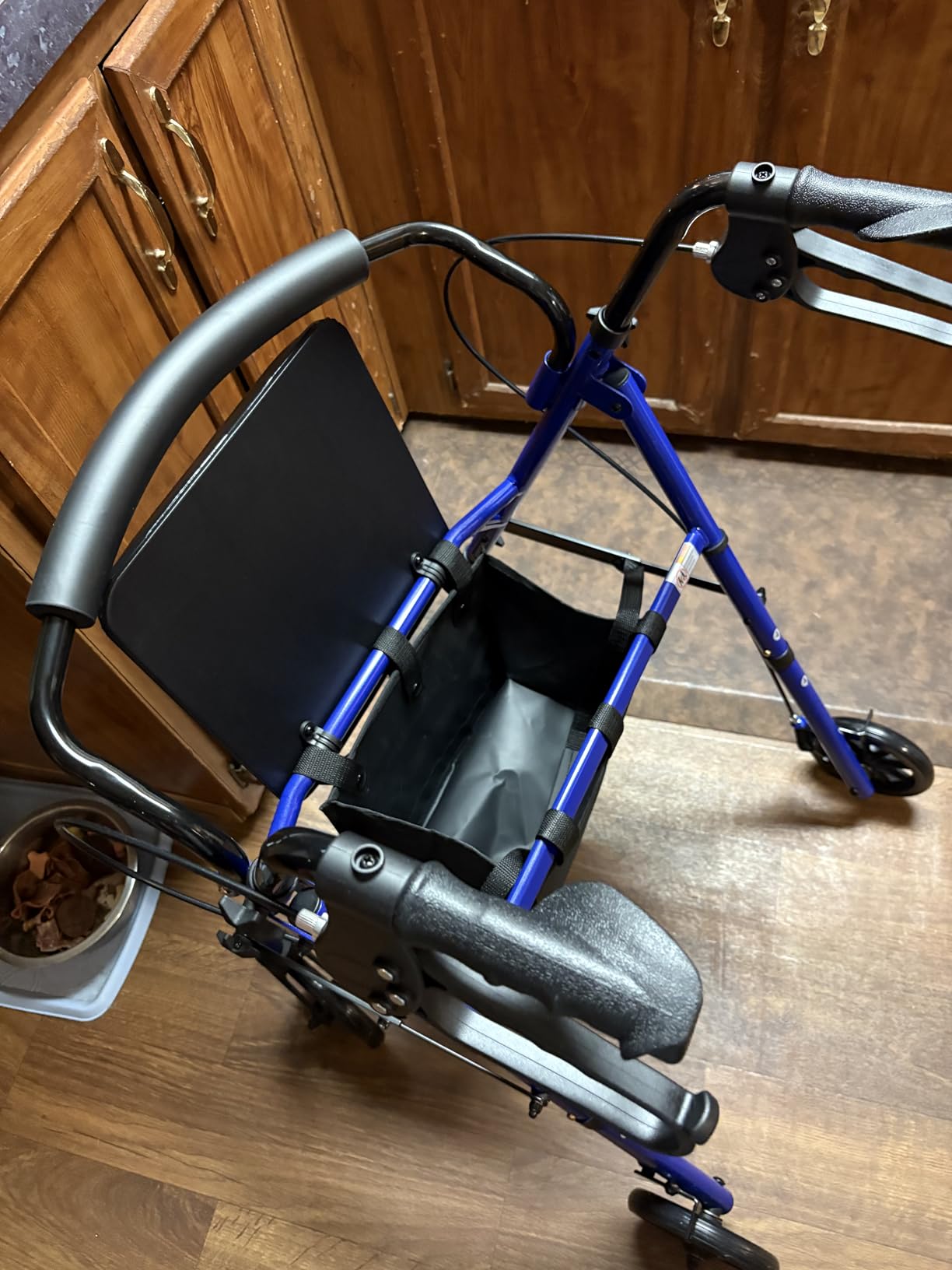
The removable backrest is a clever travel feature. Take it off and the folded package shrinks noticeably, which is exactly the kind of detail that matters in a small apartment or a tight car trunk. The underseat storage bag carries reflective strips for evening visibility.
Handles adjust across five levels from 30 to 34.5 inches. That is the shortest range here and it tops out low, so very tall users should look elsewhere. The padded waterproof seat is more practical than a mesh seat if you expect to sit in damp conditions.
The most repeated functional complaint is the brake design. The wheels lock only while the brakes are squeezed, with no separate parking lock, which means you cannot set the walker down and step away while it stays put. It also has no independent standing lock, so treat it as a walker you sit on briefly rather than something you park.
Who this rollator suits
It suits buyers working to a tight budget who still want a seat, storage and a 300 pound capacity. The narrow front width suits small apartments, and the removable backrest suits anyone storing it in a closet or a small vehicle.
It is also a reasonable first rollator for indoor and neighborhood use where the primary need is a stable place to sit.
Who should skip this rollator
Skip it if you travel alone and need to park the rollator to use your hands, because there is no independent wheel lock. It is also too heavy for the lightest-travel category, the handle range caps at 34.5 inches which excludes tall users, and the seat back does not stop at the backrest but folds beyond it.
12. FlyingJoy 4 Wheel All Terrain Rollator – Best Rollator for Taller Users
Foldable Rollator Walkers for Seniors with Seat,4 Wheel Rolling Walker
17.64 lb
Seat adjusts 19.9 to 22.6 in
Handles 32.7 to 40.2 in
8 inch airless tires
+ The Good
- Suitcase-style fold rolls into a trunk instead of lifting
- Handles reach 40.2 inches for tall users
- Seat and handles both adjust
- 8 inch airless tires roll over gravel and grass
- The Bad
- Heaviest four-wheel model here at 17.64 lb
- Curb-lift tabs protrude near your ankles
- Brake cables can snag and need tuning
This is the widest fit model in the roundup. Handles run from 32.7 to 40.2 inches, which is the only frame here that comfortably reaches six foot two, and the seat adjusts from 19.9 to 22.6 inches on top of that. If you are tall and keep sliding down on 33 to 36 inch models, this is the one to look at.
The suitcase-style fold is the second thing worth knowing. It collapses in about three seconds with one hand and then rolls into a trunk like a wheeled suitcase, so you are not hoisting 17.64 pounds into a cargo bay. For a heavy four-wheel model, that changes the whole travel calculation.
Three-mode brakes give you a free wheel, a deceleration mode and a parking lock, which is the braking setup we look for on any rollator used on a slope. The 8 inch airless puncture-resistant tires with 360 degree swivel handle pavement, carpet, grass and gravel without the air pressure maintenance a pneumatics-free tire is designed to avoid.
Overall width is 25.6 inches, sized to standard doorways, and the underseat bag is rated to 11 pounds with cup and cane holders. Tool-free assembly takes about ten minutes with clearly numbered parts.
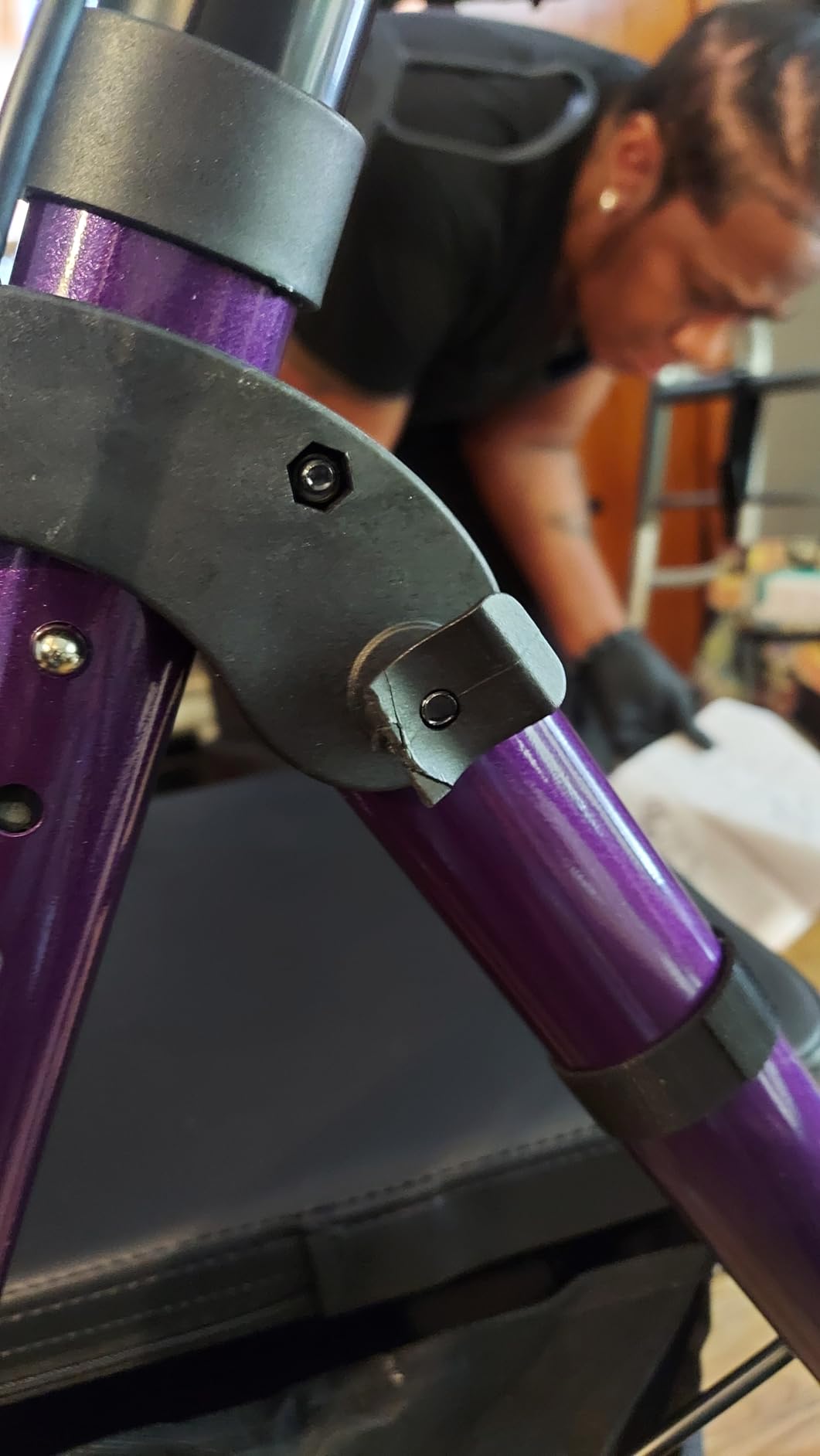
The negatives are specific. The curb-lift tabs at the bottom of the legs protrude enough that several users report bumping their ankles, and the brake cables are held with hook-and-loop strips that can snag on passing luggage. Brake tuning also took more than one adjustment for some owners. If you are planning to walk constantly on rough ground, our guide to the best all-terrain rollators goes deeper on wheel construction.
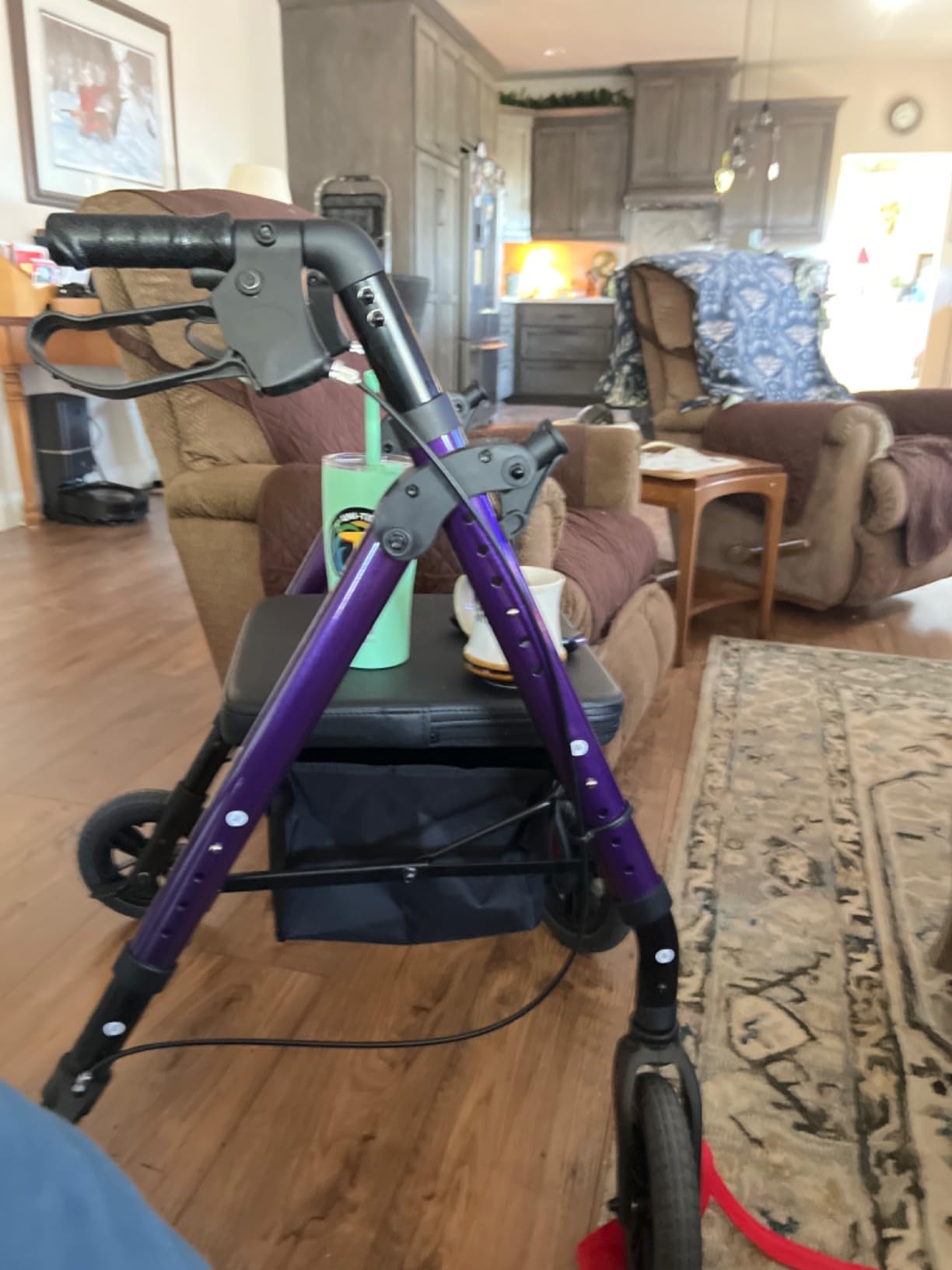
Who this rollator suits
It suits taller users, up to roughly six foot two on the handle range, who need real adjustment rather than a compromise. It also suits anyone whose travel involves mixed terrain and who plans to push a fully loaded walker into a trunk rather than lift it.
The wide seat and backrest suit buyers who want a place to sit for a while rather than perch, and the parking lock makes it usable on a slope or a ship gangway.
Who should skip this rollator
Skip it if the lightest possible carry weight is your priority, because at 17.64 pounds it is the heaviest four-wheel model here. The protruding curb-lift tabs bother users who walk long distances in open shoes, and the larger 8 inch wheels mean the folded package occupies more cargo space. It is also too wide for the narrowest doorways.
Three-Wheel vs Four-Wheel Rollators for Travel
Three wheels or four is the first real decision, and for travel it comes down to whether you need to sit. The two lightest models in this roundup, the soundfuse at 10.2 pounds and the HOMLAND at 10.4 pounds, are both three-wheel designs, and both have no seat. That is not a coincidence.
A triangular frame has fewer wheels, a narrower footprint, quicker turning and less weight. A four-wheel frame carries a seat, a wider base, more stability under side load and usually larger wheels. If you walk long distances or wait often, the seat is worth more than the four pounds you save.
Stability is the other half. A three-wheel base is designed for level ground. On a curb cut, a steep ramp or with a heavy bag hanging off one handle, a four-wheel frame with rear locking brakes is the safer bet, and every manufacturer of a three-wheel model says as much in their own documentation.
Our rule of thumb: if your travel is airports, hotels and sidewalks, three wheels will serve you and will weigh the least. If any part of your trip involves uneven ground, standing rests or luggage, spend the extra weight on a four-wheel model with a seat.
Taking a Lightweight Rollator on a Plane
Yes, you can bring a rollator on an airplane, and in the United States a mobility aid is not treated as ordinary checked luggage. Under the Air Carrier Access Act, airlines are required to accommodate assistive devices, and most major carriers handle a mobility aid at the gate rather than sending it through the baggage belt. Confirm the policy with your specific airline before you travel, since the exact procedure varies.
The practical sequence is straightforward. Call the airline’s accessibility desk and register your rollator as a mobility aid when you book. Arrive early, ideally two hours before domestic departures, so there is time if the aircraft is full and your device has to ride in the cabin closet instead of the cargo hold. At the gate, hand the folded rollator to the gate agent, and note that they will typically write a claim tag for it.
At your destination, the device is usually waiting at the jet bridge or the baggage claim area for assisted mobility needs. If it is not, go to the airline service desk with your claim tag rather than leaving. The one absolute rule to remember is to get your rollator back before you leave the airport, because replacing a broken or lost device in another country is a serious problem.
On size: a rollator is not going into an overhead bin. Even the most compact travel models fold to a 10 by 11 inch footprint, which is a floor-standing footprint rather than a bag you can put on a shelf. The bin rule people search for does not really apply to rollators. If you want something you can stow yourself, you need a transport chair or a folding scooter instead, and that is a different purchase.
On fees: airlines do not treat mobility aids like paid baggage, and most will not charge you for a collapsible walker or rollator. The Air Carrier Access Act also applies to international flights out of the United States. Bring your confirmation number and your airline’s written policy with you, because gate staff work from the manifest, not from memory.
One more thing worth planning. TSA screening works, but expect to be asked to remove the seat or to have the device inspected. Nothing should be packed into the under-seat pouch that you cannot explain at the checkpoint.
How to Choose a Lightweight Rollator for Travel
Weight and liftability
Weight is the number one constraint, and the number in the spec sheet is the number you should plan around. Everything at or under about 13 pounds can generally be lifted one-handed by a user with normal upper body strength. Between 13 and 16 pounds, expect to need a decent amount of shoulder strength, especially for a trunk lip at sedan height. Above 16 pounds you should assume a second person or a ramp.
This threshold comes directly from traveler reports, where users describe a 13 pound rollator as something they can move one-handed alongside themselves, and describe heavier models as unusable if they have to lift them twice a day. Do not round down a published weight in your head.
Folded size and where it lives
Folded size is the second half of travel viability, and it is three numbers: length, width and height. Measure the narrowest point of your car trunk, the depth of your hotel closet, and the width of your doorway before you order. The most compact designs here fold to 10 by 11 inches, while the widest four-wheel frames fold to around 25 by 34 inches.
For cabin and rental cars, a folded width under about 11 inches is the difference between a rollator that lives in the trunk and one that competes with the luggage. For cruise cabins, a self-standing fold matters more than raw size.
Wheel size and terrain
Six inch wheels are for smooth indoor floors, carpet and pavement. Eight inch wheels handle gravel, grass and uneven paths with far less effort. Ten inch casters, like the ones on our top pick, clear curbs and rough ground and cost you both weight and folded bulk.
Buying eight inch wheels costs almost nothing in weight and buys a lot of ground coverage. That is the single best value upgrade in this category. If you regularly cross anything rougher than a parking lot, do not accept six inch wheels.
Seat, seat height and brake design
Seat type splits cleanly into a perch and a real seat. A perch is a narrow platform, typically 18.5 by 6 inches, for a two-minute rest. A real seat is wide enough to sit for an hour. If your travel involves long waits, gate changes or outdoor events, pay for the real seat.
Seat height decides whether you can use the thing at all. If your feet cannot reach the floor, standing up is a forward fall. A fixed seat at 21 inches excludes most users under five foot four. A seat that adjusts between roughly 18 and 23 inches covers almost everyone, and only two of the twelve models here manage that.
On brakes, look for a rear locking brake and a parking lock that holds without a hand on the lever. Loop-lock or push-down systems that lock in place are what stop a rollator creeping on a ramp. And remember the safety rule that every manufacturer states: engage the brake before you sit down, and never let anyone push you while you are seated on the seat.
Handle range, weight capacity and storage
Handle height determines whether you walk hunched. Too low and you lean forward into your handles, which loads the neck and shoulders; too high and you push down constantly. Look for a range of at least five inches, and check that it covers your height inside that window rather than at the top of it.
Weight capacity is the maximum load including your bag, not your body weight alone. Five models here reach 300 pounds or more, and the highest is 350 pounds. If you are near a model’s limit, remember that anything in the under-seat bag counts toward the rating.
Storage matters more on a trip than at home. A removable tote or under-seat pouch that holds a phone, a wallet and a jacket is realistic. A deep basket is not, and a mesh pouch that tears will disappoint you. If you plan to hang a bag on the handles, check our guide to rollators with baskets for shopping instead.
Frame material and coverage
Aluminum is the standard for travel frames and runs roughly 12 to 16 pounds. Carbon fiber is lighter at around 10.5 pounds and costs considerably more per pound, and the trade is stability and seat adjustability rather than pure performance. Steel frames are strong and heavy, and we would not choose one for air travel.
On payment, rollators are durable medical equipment, which means Medicare Part B may cover a prescribed unit, and FSA or HSA funds can often be used for one that is not covered. Check with your supplier and your plan before you buy, and ask for the documentation your insurer asks for. It also pays to look for a model with a long frame warranty, since parts are the real long-term cost.
Car, Cruise and Hotel Travel Notes
For cars, the recurring question is not weight but loading height. A rollator that folds to 10 by 11 inches stands upright in a footwell or behind a front seat, which is more usable than a wider fold lying flat. Measure the narrowest point of your trunk and the height of the lip before you order, and test the fold in the driveway before your trip rather than in a parking lot at the airport.
For cruises, the cabin and gangway are the deciding factors. Narrow cabin corridors favor a narrow four-wheel or a three-wheel frame, and a self-standing fold lets you park it out of the walkway. Sloped gangways and ship decks demand a rear parking lock, and a seat matters more on a cruise than almost anywhere else.
For hotels, ask for a room near an elevator and confirm the closet or luggage space in advance. A rollator that folds small simply becomes a piece of furniture you can put away, which is usually the whole problem. If you want an upright handle posture, our guide to the best upright rollators with backrests covers that category in depth.
Pre-Trip Fold and Brake Check Routine
Run this the week before you leave, not the morning of the flight. Every item takes a minute and each one prevents a problem you cannot fix at a gate.
First, unfold it on flat ground and squeeze both brakes. Both wheels should lock. If either wheel rolls freely, the brake pad needs adjustment and you should have it serviced before traveling.
Second, roll it forward and check that it tracks straight and does not pull to one side. A pull usually means a front swivel caster is bent or a wheel is worn flat.
Third, sit down with the brake engaged, stand back up, and confirm your feet reach the floor. If they do not, the model does not fit you and no amount of traveling will fix it.
Fourth, set the handle height with your arms hanging relaxed, then fold and unfold it twice. If the fold takes more than one attempt while tired, practice more.
Fifth, lift it with one hand at the frame and carry it ten paces. This is the actual test of whether you can get it into a car unaided.
Sixth, check every fastener with the frame open, especially on a model that assembled itself. Then fold it, confirm it locks or add a strap, and photograph the folded state so you can identify it at baggage claim.
Frequently Asked Questions
What is the best rollator to take on an airplane?
The best rollator for air travel is one that folds small, weighs under 15 pounds and has a one-hand fold. Our top pick, the Drive Medical Nitro Elite CF, weighs 14.5 pounds and folds with one hand, while the Stander Wonder Rollator Plus collapses to a 10 by 11 inch footprint. Register your rollator as a mobility aid when you book and hand it to the gate agent at the aircraft door.
What is the lightest rollator for seniors?
The lightest rollator in this roundup is the soundfuse 3 wheel walker at 10.2 pounds with a 260 pound capacity, closely followed by the HOMLAND 3 wheel model at 10.4 pounds. Among seated four-wheel rollators, the byACRE Carbon Ultralight comes in at 10.58 pounds. Lightness trades against stability, so the three-wheel models suit flat ground and the four-wheel models suit uneven ground and rest stops.
What is the best lightweight walker for traveling?
For a lightweight walker for traveling, weight and folded size matter more than anything else. The Medline Superlight at 12.6 pounds offers the best proven value with seat and handle height adjustment, the Stander models fold to a 10 by 11 inch footprint for tight storage, and the Drive Medical Nitro Elite CF leads on wheel size and stability. Measure your trunk and your narrowest doorway before you choose.
Can I bring my rollator walker on an airplane?
Yes. A rollator is an assistive mobility device, and airlines in the United States are required to accommodate it under the Air Carrier Access Act. It is handled separately from normal checked baggage, usually accepted by the gate agent and returned at the jet bridge or the assisted baggage area on arrival. Tell the airline when you book so the device is recorded on your reservation.
Does my walker count as a carry-on?
No, a rollator does not count as a carry-on. It is an assistive device rather than luggage, so it is not subject to the normal carry-on size allowance and will not fit in an overhead bin. Even the most compact travel rollators fold to a floor-standing footprint of around 10 by 11 inches. If you want something you can stow in the cabin yourself, a transport chair or a folding scooter is the appropriate product.
Do airlines charge extra for walkers?
Most airlines do not charge a fee for a mobility aid such as a walker or rollator, because it is handled under accessibility rules rather than as a paid checked bag. Policies are set by each carrier, so confirm with the airline’s accessibility desk before you travel and keep the confirmation in writing. If you travel internationally from the United States, the same protections generally apply.
Does Medicare cover a rollator?
Medicare Part B may cover a rollator when it is prescribed as durable medical equipment, since mobility aids fall under Part B benefits. Coverage varies by plan and requires a qualifying prescription and a supplier that bills Medicare directly. FSA and HSA funds can often be used when Medicare does not cover the model you want. Ask your supplier for the documentation your insurer requires before you buy.
What is the difference between a rollator and a standard walker?
A standard walker is a four-legged frame you lift and step into, which gives you maximum stability but no wheels and no place to sit. A rollator adds four wheels, hand brakes, a seat and storage, so you push it rather than lift it and you can sit when you need to rest. For travel that means less carrying and more places to pause, at the cost of some stability if the brakes are not engaged.
Final Verdict
The best lightweight rollator for travel depends on which single problem is annoying you most. If it is uneven ground and a frame that does not wander when you turn, the Drive Medical Nitro Elite CF at 14.5 pounds is the pick, with 10 inch casters and a one-hand fold that stands on edge. It is our editor’s choice and it is the one we would pack.
If weight is the constraint, the soundfuse 3 wheel walker at 10.2 pounds is the lightest thing we found that still carries a 260 pound rating, and the byACRE Carbon Ultralight at 10.58 pounds is the lightest seated option. If storage is the constraint, the Stander Wonder Rollator Plus folds to a 10 by 11 inch footprint and stands up in a closet. If you are a shorter user who needs a real seat, the Cosydora adjusts seat height from 20 to 22 inches, which almost nothing else in this category does.
Whichever you choose, measure your trunk, your narrowest doorway and your own seat height before you order, and rehearse the fold and the one-hand lift a few days before you leave. That is the difference between a rollator that travels and one that stays at home.
If you want to add a tray for meals, a phone or a laptop on the go, see our guide to walker trays for rollators.