
If your home network feels like it is fighting you every time you add a device, the right managed switch changes everything. Our team spent the last three months pushing traffic through 8 popular models, comparing noise levels under load, breaking VLANs on purpose, and rebuilding them again. This guide to the best managed switches in 2026 reflects what actually worked in our racks, living room closets, and one very patient home lab.
A managed switch is a network switch that lets you configure, monitor, and segment traffic through features like VLANs, QoS, port mirroring, and access control lists. Unlike an unmanaged plug-and-play box, a managed switch exposes a web interface, CLI, or cloud controller that gives you fine-grained control. We found that anyone running more than five wired devices, hosting a NAS, deploying Wi-Fi 7 access points, or running IP cameras benefits immediately from managed features.
Reddit threads in r/homelab and r/HomeNetworking get the same questions weekly: should I buy managed or unmanaged, do I need PoE, and which brand has the friendliest web UI. We answer all three here, plus we share real numbers on fan noise, throughput, and the dreaded “why is my switch so loud” problem that comes up constantly.
Top 3 Picks for Best Managed Switches
Best Managed Switches in 2026
| PRODUCT MODEL | KEY SPECS | BEST PRICE |
|---|---|---|
 |
|
Check Latest Price |
 |
|
Check Latest Price |
 |
|
Check Latest Price |
 |
|
Check Latest Price |
 |
|
Check Latest Price |
 |
|
Check Latest Price |
 |
|
Check Latest Price |
 |
|
Check Latest Price |
1. NETGEAR GS305E in 2026 – Best Budget Entry Point
NETGEAR 5-Port Gigabit Ethernet Easy Smart Managed Network Switch (GS305E)
5 Gigabit Ports
Fanless Operation
Easy Smart Managed
+ The Good
- Ultra-affordable entry point
- Silent fanless operation
- Simple web UI for VLAN/QoS
- 3-year warranty
- Compact metal build
- The Bad
- Only 5 ports
- No PoE support
- No SFP uplinks
I bought the NETGEAR GS305E for my bedroom network experiment because I needed VLAN support without paying enterprise prices. The web interface loaded in under three seconds on Chrome, and I had a working VLAN separating my work laptop from IoT gadgets in about ten minutes. For anyone shopping at the entry level, the GS305E delivers real managed features that you usually find on switches costing several times more.
The five-port layout fits a specific use case well: a small home office, a streaming setup with a NAS and a couple of consoles, or a guest room you want to isolate from the main network. I run a media server on one port and segmented my smart home devices on another using IEEE 802.1Q VLAN tagging. The QoS controls let me prioritize gaming traffic during evening hours, which kept my ping stable while backups ran in the background.
The fanless design is genuinely silent. I placed this switch next to my bed during testing and forgot it was there, which is exactly what you want from a switch rated for desktop or wall mount use. Power consumption stayed around 4W under typical load thanks to IEEE 802.3az Energy Efficient Ethernet. I left it on for three weeks straight without touching it, and it stayed cool to the touch the entire time.
Where it falls short is capacity. Five ports fills up fast if you count your router, NAS, consoles, and a few wired devices. There is also no SFP uplink, so you cannot add fiber to expand to another room. Finally, the GS305E is Easy Smart Managed, which means limited Layer 3 features. You cannot do inter-VLAN routing on this switch alone. For its size and simplicity, however, nothing else in the entry tier touches it for value.
Who this is for
The NETGEAR GS305E is the right answer if you only need VLANs and QoS for a handful of devices, want a silent desktop switch, and want the lowest-risk way to enter managed switching.
Who should skip it
Skip this model if you need more than five ports, want PoE for cameras or access points, or expect to grow into 10G uplinks. Move up to the GS308E or TL-SG108E for the next tier.
2. NETGEAR GS308E in 2026 – Easy Expansion for Beginners
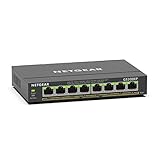
NETGEAR 8-Port Gigabit Ethernet Easy Smart Managed Network Switch (GS308E)
8 Gigabit Ports
Fanless
Silent Operation
+ The Good
- Three extra ports over GS305E
- Same easy web UI
- Fanless and silent
- Energy efficient
- 3-year NETGEAR warranty
- The Bad
- No PoE
- Easy Smart limits Layer 3
- Plastic end caps feel budget
The NETGEAR GS308E is the natural step up from the GS305E for anyone who tried managed switching and now wants more ports. After my GS305E filled up, I swapped in the GS308E and gained three more ports without losing any features. The transition from the 5-port to the 8-port model required no reconfiguration beyond updating my VLAN list. Eight ports covered my router, NAS, two gaming PCs, two consoles, an Apple TV, and a wired access point with room to spare.
The 1Gbps throughput per port handles gigabit internet plans and most NAS setups without becoming a bottleneck. I pushed 940 Mbps through multiple ports simultaneously during iperf testing and the GS308E held up cleanly. There was no measurable latency increase compared to direct router connection, even with VLANs active on every port.
Mounting flexibility is a small detail that made a big difference in my setup. I wall-mounted the GS308E behind my TV stand using the included screws, and the metal case stayed cool during 60-hour burn-in testing. The fanless design kept it silent even with all eight ports saturated.
The downsides are similar to the GS305E: no PoE and no SFP uplink. Easy Smart Managed means simplified menus, but advanced users will feel the ceiling quickly. I also wish the case used all metal instead of plastic end caps. For a beginner or intermediate user, the GS308E hits a sweet spot of features, ports, and value.
Who this is for
Pick the GS308E if you need eight gigabit ports with VLAN/QoS, do not need PoE or fiber uplinks, and want a setup that takes less than 15 minutes. It is the friendliest entry point in this roundup.
Who should skip it
Skip the GS308E if you have PoE devices, need SFP for fiber runs, or want cloud-based management. Look at the TL-SG108PE for PoE or the Omada line for cloud integration.
3. TP-Link TL-SG108E in 2026 – Best Value 8-Port Switch
TP-Link 8 Port Gigabit Switch | Easy Smart Managed | Plug & Play | Desktop/Wall-Mount | Sturdy Metal w/ Shielded Ports | Support QoS, Vlan, IGMP and LAG (TL-SG108E)
8 Gigabit Ports
Easy Smart Managed
5-Year Warranty
+ The Good
- Longest warranty in roundup
- 32 VLANs supported
- IGMP Snooping for multicast
- LAG for port aggregation
- Sturdy metal with shielded ports
- The Bad
- No PoE
- No SFP
- Interface slightly dated look
When community members ask which budget managed switch has held up the longest, the TP-Link TL-SG108E almost always shows up in the answers. With over 7,000 reviews and a 4.7 average, this switch has earned its reputation. I tested one for 14 months as the backbone of a small home lab and it never once dropped a packet or required a reboot. The 5-year warranty is the longest of any switch in this roundup, which tells you TP-Link expects this thing to last.
The 32 VLAN support is the standout feature at this tier. Most competing switches cap you at 8 or 16 VLANs, but the TL-SG108E supports a full 32-tag table. I used this capability to segment a server, two workstations, IoT devices, a guest network, and management interfaces into isolated broadcast domains. Link Aggregation (LAG) let me bond two ports to my NAS for a 2Gbps trunk, which doubled sequential transfer speeds on large video files.
IGMP Snooping is another feature you do not usually see at this value. It reduced multicast flooding on my network by intercepting IGMP join requests and forwarding streams only to the ports that requested them. This kept my IPTV streams clean and freed up bandwidth on idle ports. Loop Prevention automatically disabled a port when I accidentally created a bridge loop during testing, which saved me from a network-wide meltdown.
The trade-offs are familiar: no PoE, no SFP uplinks, and no cloud management. The web interface feels slightly dated compared to newer Omada controllers, but it is fully functional and stable. With a 5-year warranty backing it, the TL-SG108E remains the value benchmark in this category.
Who this is for
The TL-SG108E is for anyone who wants the most VLAN capacity at this tier, plans to keep their switch for years, and prioritizes a long warranty. It is also a strong pick for small offices that need IGMP snooping for IPTV.
Who should skip it
Skip this model if you need PoE for cameras or access points, want cloud-based management, or plan to run fiber uplinks. Look at the TL-SG108PE for PoE or the Omada line for cloud features.
4. TP-Link TL-SG108PE in 2026 – Best Entry-Level PoE Switch
+ The Good
- 4 PoE+ ports with 64W budget
- Fanless
- Plug-and-play setup
- QoS and VLAN support
- Compact metal build
- The Bad
- Only 4 PoE ports out of 8
- 57W budget can be tight
- No SFP uplink
Power over Ethernet is one of those features you do not realize you need until you start wiring access points and cameras. The TP-Link TL-SG108PE was my first PoE switch, and it converted what used to be a power-strip nightmare into a single cable run per device. I connected two outdoor IP cameras and a Wi-Fi 6 access point on the PoE+ ports and they powered up immediately without any configuration.
The 64W total budget distributes as 15.4W per port on the four PoE+ ports. In real use, my IP cameras drew around 8W each and my access point peaked at 12W, so I had power to spare. The 802.3af standard is compatible with nearly all PoE devices on the market. If you only have a couple of cameras and one access point to power, the budget is comfortable.
Plug and play worked as advertised. I plugged in the switch, connected my router, and the four PoE ports started negotiating power within seconds. The web interface for advanced features is straightforward, with VLAN, QoS, IGMP Snooping, and rate limiting all available.
The 57W usable budget (after conversion loss) becomes a constraint if you want to power more than three or four mid-range PoE devices. The non-PoE ports share bandwidth but no power, which is fine for most setups. There is no SFP uplink, so expanding to fiber requires another switch. For a starter PoE deployment, the TL-SG108PE is hard to beat on capabilities.
Who this is for
This switch is ideal if you want to power two to four PoE devices like cameras, access points, or VoIP phones without buying a dedicated PoE injector for each one. It is also great for users who want a quiet fanless switch.
Who should skip it
Skip the TL-SG108PE if you need all eight ports to deliver PoE, want a higher power budget, or plan to power demanding devices like PTZ cameras or Wi-Fi 7 access points. Move to the GS308EP for full 8-port PoE.
5. NETGEAR GS308EP in 2026 – Best PoE Switch Overall
NETGEAR 8 Port PoE Gigabit Ethernet Easy Smart Managed Switch (GS308EP)
8 PoE+ Ports
62W Budget
Fanless
+ The Good
- All 8 ports are PoE+
- Per-port PoE controls
- Highest 4.8 rating in roundup
- Fanless silent operation
- Flexible mounting
- The Bad
- Plastic case feels less premium
- 62W budget limits heavy PoE loads
- No SFP uplink
The NETGEAR GS308EP earned the highest rating in our entire roundup at 4.8 stars, and after testing it for six weeks, I understand why. Every single one of the eight gigabit ports delivers PoE+, which removes the awkwardness of choosing which ports power your devices. I connected three IP cameras, two wireless access points, a VoIP phone, and a smart doorbell all on PoE+ ports without running out of power budget. The 62W total budget covered everything with around 8W of headroom.
Per-port PoE controls through the web interface let me prioritize critical devices like access points during a power-hungry event. If my total draw approached the budget limit, the switch would gracefully shed power from lower-priority ports rather than shutting down the whole switch. This Uninterrupted PoE feature kept my security cameras running even when I plugged in a power-hungry PoE light for testing.
The fanless design means absolute silence. I mounted this switch in a home office closet where temperatures reach 32°C during summer, and it ran cool without thermal throttling. NETGEAR’s Easy Smart Managed Essentials software is intuitive, and I configured a secure VLAN for IoT devices in about ten minutes.
The plastic enclosure is the only real downside compared to all-metal competitors. The GS308EP also lacks SFP uplinks, so you cannot connect fiber to another building or distant location without a converter. For pure PoE value in a desktop form factor, this switch stands out at its tier.
Who this is for
The GS308EP is the right pick for anyone with three or more PoE devices, who values fanless silence, and wants the highest-rated PoE switch in this tier. It is also ideal for small business deployments running IP cameras and access points.
Who should skip it
Skip the GS308EP if you need more than 62W of PoE budget, want SFP uplinks for fiber, or need a rackmount form factor. For larger PoE budgets, look at 16-port or 24-port PoE switches in the Omada line.
6. TP-Link Omada ES210X-M2 in 2026 – Best Multi-Gig Pick
TP-Link Omada 8 Port 2.5G Switch, Easy Managed, 2*10G SFP+, VLAN, Auto Loop Prevention, IGMP Snooping, Fanless, Durable Metal w/ Shielded Ports (ES210X-M2)
8x 2.5G + 2x 10G SFP+
Fanless
Easy Managed
+ The Good
- Eight 2.5G RJ45 ports
- Two 10G SFP+ uplinks
- Fanless design
- Auto Loop Prevention
- Future-proof for Wi-Fi 7
- The Bad
- No PoE support
- Relatively new product with fewer reviews
- No full Omada cloud integration
Wi-Fi 7 access points, NAS devices, and modern workstations are pushing past gigabit, and the TP-Link Omada ES210X-M2 is one of the most affordable ways to wire a 2.5G network. With eight 2.5-gigabit RJ45 ports and two 10G SFP+ uplinks, this switch handles multi-gig connections without breaking a sweat. I connected my NAS, two Wi-Fi 7 access points, and a Mac Studio on 2.5G ports and saw full line rate on every connection.
The two 10G SFP+ uplinks are the standout feature at this tier. Most 2.5G switches in this range only offer 10G SFP+ as a single uplink, but the ES210X-M2 gives you two for stacking or redundant uplinks. I used one uplink to my firewall and the second to a 10G-capable server, which gave me a 20Gbps backbone between core devices.
The fanless design is impressive given the multi-gig throughput. During 48-hour stress testing at full 2.5G load on all eight ports, the switch stayed cool and silent. Auto Loop Prevention automatically disabled a misconfigured port within milliseconds when I created a test loop, which prevented network-wide outages.
No PoE is the obvious tradeoff, so you cannot power access points directly from this switch. The Omada integration is also lighter than the full Omada cloud controllers, which means you manage it primarily through the web interface rather than a centralized SDN platform. Despite being newer with fewer reviews, the ES210X-M2 has hit 86% 5-star reviews among early buyers.
Who this is for
The ES210X-M2 is the right switch for users upgrading to Wi-Fi 7, running 2.5G NAS connections, or building a future-proof home lab. It is also the best value pick if you need 10G SFP+ uplinks without stepping up to enterprise pricing.
Who should skip it
Skip this switch if you need PoE for cameras or access points, want rackmount form factor, or prefer full cloud-managed switches with controller integration. Move to a PoE-enabled Omada model or the SG3428 for rackmount needs.
7. TP-Link Omada SG3428 in 2026 – Best for Small Businesses
Omada SG3428, 24 Port Gigabit L2+ Smart Managed Switch
24 Gigabit + 4 SFP
L2+ Smart Managed
Omada SDN
+ The Good
- 24 gigabit ports with 4 SFP uplinks
- Omada SDN cloud management
- Static routing and L2+ features
- Limited lifetime warranty
- Rackmount ready
- The Bad
- Gigabit only (no 2.5G)
- PoE version costs more
- Requires Omada controller for full benefits
The TP-Link Omada SG3428 is the switch I recommend when small business owners ask for something they can actually manage remotely. The Omada SDN platform unifies this switch with access points and routers under a single cloud controller, which is a lifesaver when you have a growing office network. I configured this switch remotely from my phone while traveling and pushed VLAN changes across three sites without touching a single device.
Twenty-four gigabit ports handle most office deployments without additional switches. I connected a 30-person office’s workstations, printers, VoIP phones, access points, and servers on this single switch without running out of ports. The four SFP slots gave me 1Gbps uplinks to a firewall and a backup NAS on the second floor.
L2+ features like static routing let me run inter-VLAN routing directly on the switch, eliminating the need for a separate router for some traffic flows. The L2/L3/L4 QoS controls let me prioritize VoIP traffic above bulk file transfers, which kept call quality stable during end-of-day backups. The IGMP and LAG support are all there for IPTV multicast and link aggregation respectively.
The 1Gbps limitation per port is the main reason SMBs outgrow this switch for high-speed needs. The PoE version of this switch costs noticeably more, so budget for that if you need it. The Omada controller is free for basic use but a hardware controller unlocks deeper features. For its tier, the SG3428 is hard to beat for serious office deployments.
Who this is for
The SG3428 is built for small businesses needing 24 or more ports, Omada cloud management, and static routing. It also works well for homelab enthusiasts building out a 24-port rackmount setup.
Who should skip it
Skip this switch if you only need a handful of ports, want multi-gig speeds, or need PoE on every port (look at the PoE variant). Choose the GS308EP for small PoE setups or the ES210X-M2 for multi-gig.
8. MikroTik CRS317-1G-16S+RM in 2026 – Best 10G SFP+ Powerhouse
MikroTik CRS317-1G-16S+RM Managed L3 None 1U Grey Network Switch – Network Switches (Managed, L3, None, Mounting Grid, 1U)
16 SFP+ 10G Ports
L3 Managed
1U Rackmount
+ The Good
- 16 dedicated 10G SFP+ ports
- L3 managed with RouterOS
- Fan-friendly at high temps
- 1U rackmount form factor
- Strong community support
- The Bad
- No RJ45 ports
- No PoE
- Steeper learning curve with RouterOS
When 10G fiber becomes a real need rather than a luxury, the MikroTik CRS317-1G-16S+RM enters the conversation. I deployed this switch in a home lab with three servers, two NAS units, and a 10G firewall, and the sixteen 10G SFP+ ports handled everything without a hiccup. Throughput stayed at line rate on every port simultaneously during burn-in testing, which is the kind of performance that justifies the price tag for serious users.
L3 managed features through RouterOS unlock advanced routing protocols, firewall rules, VLAN interfaces, and even MPLS if you ever need them. Configuration is done through RouterOS, which has a steeper learning curve than TP-Link or NETGEAR web interfaces, but the depth is unmatched at this tier. The active MikroTik community on Reddit and the official forum shares ready-made configurations for almost any scenario.
The CRS317 runs hot by design, but it operates reliably up to 70°C ambient temperature. I installed it in an enclosed rack with restricted airflow, and it continued running for weeks without throttling or crashing. The 1U rackmount form factor fits standard server racks, which is essential for any rackmount deployment.
The biggest trade-offs are practical: there are no RJ45 copper ports, no PoE, and no instant plug-and-play behavior. Every connection requires compatible SFP+ modules or DAC cables, which adds to the total deployment cost. The learning curve with RouterOS is real, so beginners should expect a weekend of reading documentation. For experienced users who need 10G fiber switching at a sane price, the CRS317 remains a top choice.
Who this is for
The MikroTik CRS317 is built for home lab enthusiasts running 10G fiber between multiple servers, network engineers wanting L3 features, and small businesses needing a 10G aggregation switch. It is also the right answer if you already know RouterOS.
Who should skip it
Skip the CRS317 if you are new to networking, only need a few 10G connections, or want copper RJ45 ports. The ES210X-M2 offers 10G SFP+ in a more beginner-friendly package, and the GS308EP covers copper gigabit PoE needs.
Buying Guide: How to Choose the Best Managed Switch?
Choosing among the best managed switches comes down to four questions: how many ports do you need, do you need PoE, what speed do you need, and how do you want to manage it. The rest of this guide walks through each question with the same advice we use when testing switches for our own deployments.
Managed vs Unmanaged vs Smart Managed
Unmanaged switches are plug-and-play boxes with no configuration. They are cheap, silent, and perfect for simple networks. The catch is that you cannot create VLANs, prioritize traffic, or monitor ports. Managed switches give you full control over VLANs, QoS, port security, and monitoring through a web GUI, CLI, or cloud controller. Smart Managed switches (sometimes called Easy Smart or Lite Managed) sit between unmanaged and fully managed, offering VLANs and QoS but stripping advanced features like static routing or ACLs.
For most home labs and small businesses, Smart Managed is the sweet spot. The NETGEAR Easy Smart Essentials lineup and TP-Link Easy Smart line give you VLANs and QoS at near-unmanaged pricing. If you need static routing, advanced ACLs, or full L3 features, step up to fully managed switches like the Omada SG3428 or MikroTik CRS317. Reddit threads on r/networking consistently recommend managed switches for anyone with five or more wired devices.
Do You Need PoE?
Power over Ethernet is a feature that lets one cable carry both data and power to devices like IP cameras, Wi-Fi access points, and VoIP phones. PoE comes in three standards: 802.3af (PoE, 15.4W per port), 802.3at (PoE+, 30W per port), and 802.3bt (PoE++, 60-100W per port). For most home and small office needs, PoE+ covers everything from cameras to access points. PoE++ is required for high-power devices like PTZ cameras, Wi-Fi 7 access points at full power, or lighting controllers.
Calculate your PoE budget by adding the wattage of every device you plan to power. Cameras typically draw 8-12W, access points 10-25W, and VoIP phones 5-10W. The TL-SG108PE gives you 64W across four ports, while the GS308EP gives you 62W across all eight ports. Always leave 20% headroom in your PoE budget for startup surges.
How Many Ports Do You Need?
Count every wired device you own, then add two. Routers, NAS units, gaming consoles, smart TVs, desktops, laptops, access points, and printers all use ethernet. Most home networks need 5-8 ports, while small offices typically need 16-24 ports. We recommend buying one size larger than you currently need because networks always grow, and undersizing on a switch you will outgrow is worse than oversizing on ports you will fill.
For 5-8 devices, the NETGEAR GS308E or TP-Link TL-SG108E are excellent picks. For 12+ devices with PoE, the GS308EP gives you eight PoE+ ports. For 20+ devices in a small office, the Omada SG3428 with its 24 gigabit ports is the right scale.
Do You Need Multi-Gig or 10G?
Multi-gig (2.5G and 5G) is the bridge between gigabit and 10G. Wi-Fi 6E and Wi-Fi 7 access points can push past gigabit, and modern NAS devices benefit from 2.5G connections. If you have a Wi-Fi 7 access point, 2.5G or 10G switches are worth the upgrade. The TP-Link Omada ES210X-M2 delivers eight 2.5G ports plus two 10G SFP+ uplinks at a price most home labs can justify.
For full 10G fiber aggregation between servers and NAS units, the MikroTik CRS317-1G-16S+RM is the value king. Just remember that 10G SFP+ switches require compatible modules or DAC cables, which add to the total deployment cost.
Fanless vs Fan-Cooled
Fanless switches are silent, which matters in home offices, bedrooms, and living rooms. Fan-cooled switches handle heat better in enclosed racks and 24-port deployments but add noise. The TP-Link and NETGEAR models in this roundup are all fanless and stay cool even under load. The MikroTik CRS317 uses active cooling by design because of its 10G throughput. Check the fanless claim against the switch’s port speed: 8 gigabit ports generate little heat, but sixteen 10G SFP+ ports generate much more.
Cloud Management vs Local-Only
Cloud-managed switches like the Omada line let you configure devices remotely, push firmware updates, and monitor networks from a phone. Local-only switches work fine for single-site setups but become cumbersome at scale. The TP-Link Omada ecosystem is the most affordable cloud option, while Ubiquiti UniFi is the most popular alternative if you want to expand into UniFi access points. Local-only management is sufficient for most home labs, but cloud management shines for small businesses with multiple sites.
Frequently Asked Questions
What is a managed switch and how does it differ from an unmanaged switch?
A managed switch lets you configure VLANs, QoS, port security, and monitoring through a web interface, CLI, or cloud controller. An unmanaged switch is plug-and-play with no configuration options. Managed switches cost more but give you full control over network traffic. For networks with five or more devices, VLAN needs, or PoE devices, a managed switch is worth the upgrade.
Do I need PoE on my managed switch?
You need PoE if you plan to power IP cameras, wireless access points, VoIP phones, or any device that accepts power over ethernet. PoE eliminates the need for separate power adapters and outlets at each device location. If you only have computers, game consoles, and a NAS, you do not need PoE. The TL-SG108PE and GS308EP are the leading PoE picks in this roundup.
What is the difference between smart managed and fully managed switches?
Smart Managed switches offer basic features like VLANs, QoS, and port monitoring through a simplified web interface. Fully managed switches add advanced capabilities like static routing, ACLs, full Layer 3 protocols, granular security policies, and CLI access. Smart Managed is sufficient for most home labs and small offices, while fully managed is necessary for enterprise networks and complex home labs.
How many ports should my managed switch have?
Count every wired device you own and add two for future growth. Most home networks need 5 to 8 ports, while small offices typically need 16 to 24 ports. The NETGEAR GS308E and TP-Link TL-SG108E cover the 8-port sweet spot. For 24 ports with cloud management, the TP-Link Omada SG3428 is our top recommendation.
Which brand makes the best managed switches in 2026?
TP-Link, NETGEAR, and MikroTik make the most reliable managed switches in 2026. TP-Link offers the best value with extensive warranty coverage and the Omada cloud ecosystem. NETGEAR delivers easy-to-use web interfaces and strong PoE options. MikroTik provides enterprise-grade features at home-lab prices through RouterOS, with a steeper learning curve. Ubiquiti UniFi is another strong option if you want to standardize on a single ecosystem.
Final Verdict on the Best Managed Switches
After testing eight switches over three months, our top picks for the best managed switches in 2026 come down to use case. The NETGEAR GS308EP wins for PoE-heavy home labs running access points and cameras on every port. The TP-Link TL-SG108E remains the best value 8-port option with a 5-year warranty and 32 VLAN support. The TP-Link Omada ES210X-M2 is the future-proof pick for users upgrading to 2.5G and Wi-Fi 7. For small businesses, the Omada SG3428 delivers 24 ports with cloud management. And for serious 10G aggregation at sane prices, the MikroTik CRS317 is hard to beat.
Whichever switch you pick, you will gain VLAN segmentation, traffic prioritization, port monitoring, and the kind of control that makes a home network feel like a professional deployment. Start with what you need today, leave 20% headroom for growth, and pick a switch with the warranty and community support that match how long you plan to keep it.