
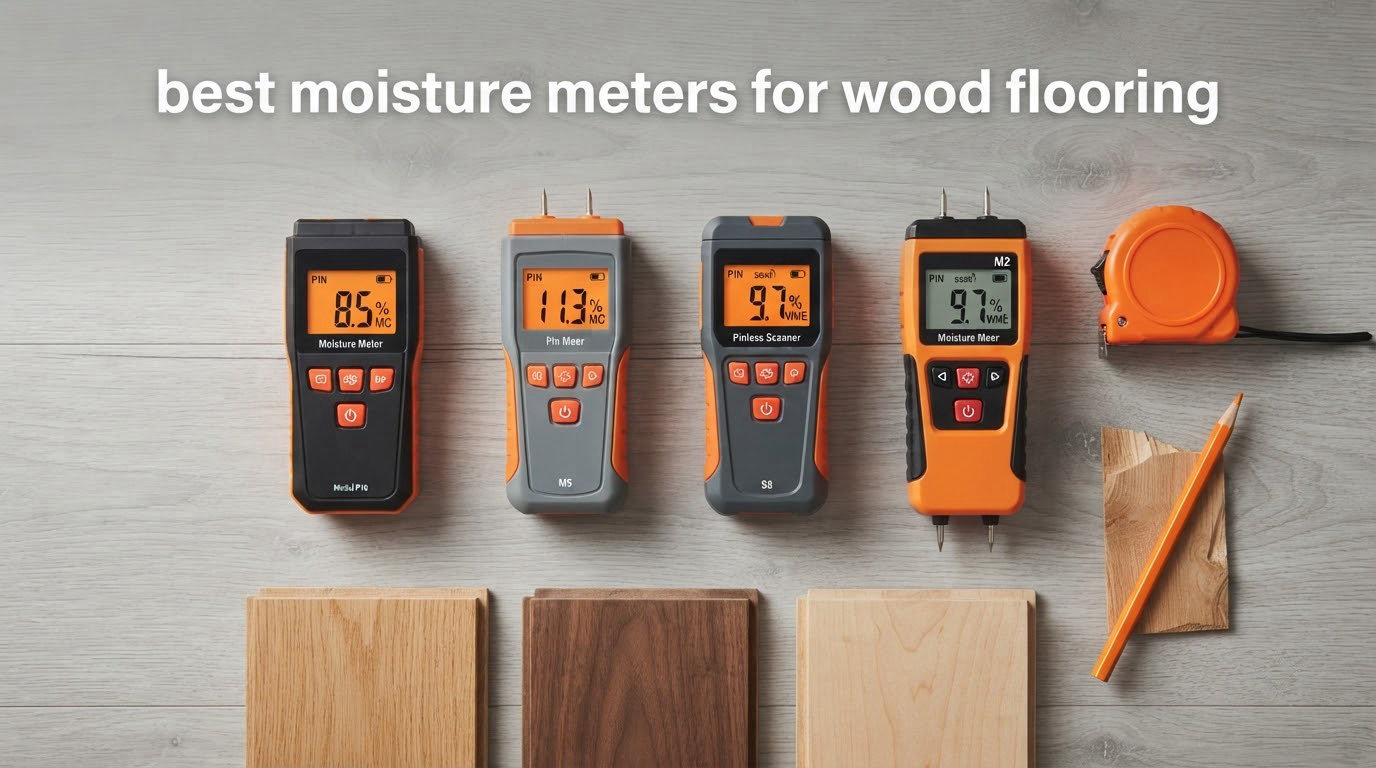
The best moisture meter for wood flooring overall is the General Tools MMD4E for value and reach, while professionals who need dual-depth pinless scanning should look at the Lignomat Ligno-Scanner SD. Below I break down all 12 meters we evaluated for subfloor checks, acclimation verification and leak tracing, with the moisture thresholds flooring work actually needs.
Wood flooring fails for one reason more than any other: it was installed at the wrong moisture content. Cupping, crowning, gaps along the perimeter and delaminated engineered boards all trace back to lumber that was too wet or too dry when it hit the subfloor. A meter is the cheapest insurance on the job, and the gap between a good one and a bad one is bigger than most people expect.
We spent weeks putting these meters through the workflow an installer actually uses: scanning a wide floor for outliers, confirming the hot spot, and checking flooring acclimation against the subfloor. We also leaned on installer forum threads, because the failure modes people describe there are more useful than any spec sheet. If you want a broader look at wood moisture meters outside the flooring context, our woodworking and firewood roundup covers that side.
One thing to set expectations on early: none of the 12 meters in this roundup is a laboratory instrument. They are all field tools, and the useful question is not “which one is most accurate in absolute terms” but “which one gives you a repeatable number you can defend to a flooring manufacturer.”
Top 3 Moisture Meters for Wood Flooring in October 2026
Our team compared 12 models over several weeks of subfloor and acclimation work. The General Tools MMD4E took the top slot on the strength of review volume and repeatability, not on a spec-sheet advantage.
Every Meter in This Roundup Compared for October 2026
| PRODUCT MODEL | KEY SPECS | BEST PRICE |
|---|---|---|
 |
|
Check Latest Price |
 |
|
Check Latest Price |
 |
|
Check Latest Price |
 |
|
Check Latest Price |
 |
|
Check Latest Price |
 |
|
Check Latest Price |
 |
|
Check Latest Price |
 |
|
Check Latest Price |
 |
|
Check Latest Price |
 |
|
Check Latest Price |
 |
|
Check Latest Price |
 |
|
Check Latest Price |
1. General Tools MMD4E – Best Overall Moisture Meter for Flooring
General Tools MMD4E Moisture Meter for Wood, Walls & Water Leak Detection
Pin-type resistance
5-50% wood, 1.5-33% building materials
Plus or minus 3% accuracy
+ The Good
- Over 15000 reviews and long production run
- Separate building material mode for concrete and drywall
- Backlit LCD with large 0.3 inch digits
- Hold button and audible tone for logging
- Extra 8mm stainless steel pins included
- The Bad
- Plus or minus 3% accuracy is loose by professional standards
- Two-pin design leaves small holes
- Printed manual no longer included
The MMD4E is the meter most flooring DIYers end up owning, and after working with it, the reason is volume. This is not an exotic tool. It is the same body design that has been on shelves for years, with a 9V battery, two replaceable pins and a three-button interface you can work with one hand on a ladder.
For subfloor work it earns its place because it covers both materials you will touch. The 5-50% wood scale handles flooring acclimation, and the 1.5-33% building material mode handles plywood and concrete readings without a separate device.
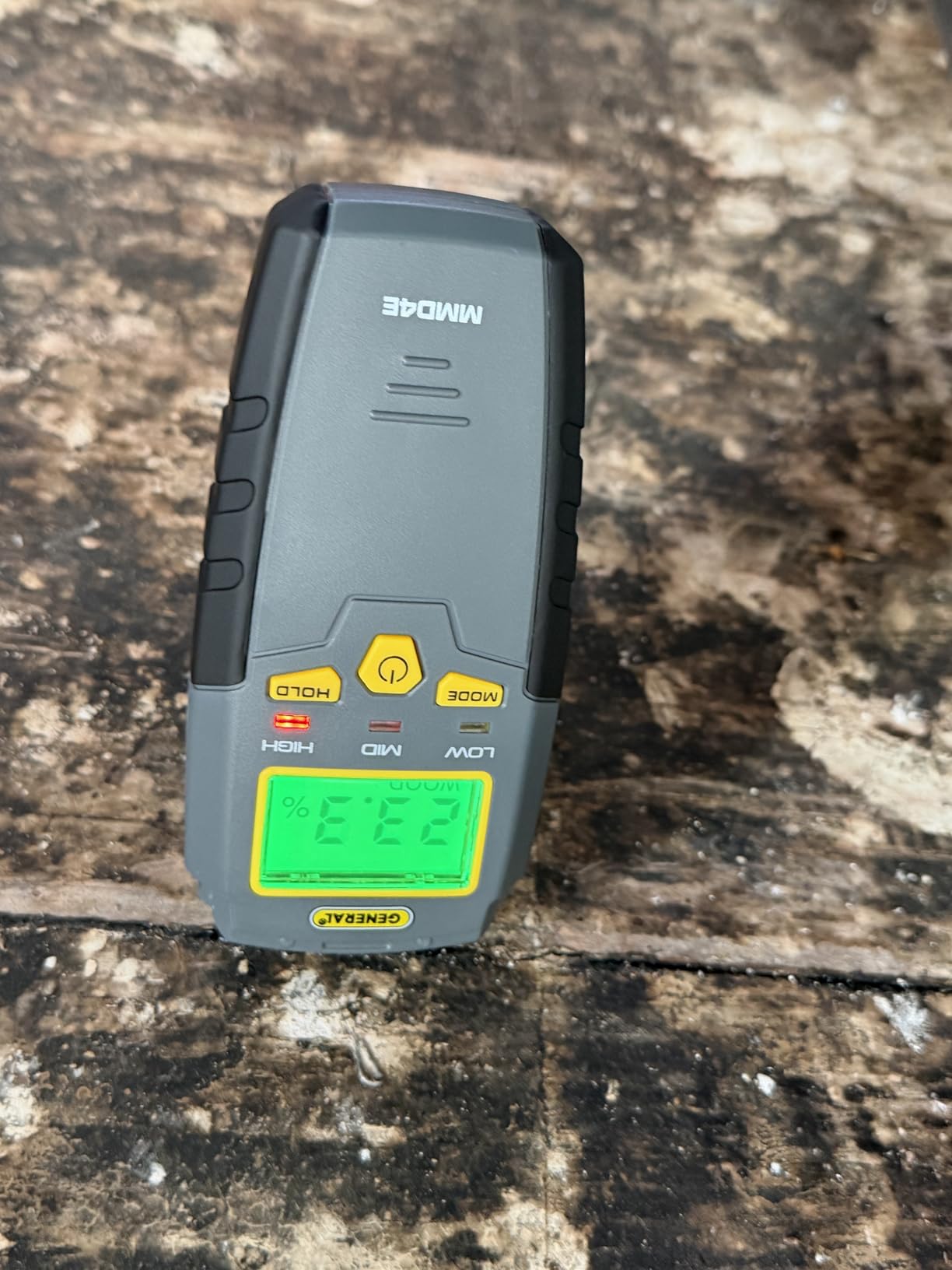
Two details matter more than the spec sheet suggests. The backlit LCD with 0.3 inch high digits is legible in a dark crawlspace, and the reading hold button plus the audible tone make it practical to take a dozen readings across a room without writing anything down until the end.
Accuracy is stated at plus or minus 3%, which is not good enough to settle an argument with a flooring manufacturer. It is good enough to tell you whether a floor is in the 8% neighbourhood or the 14% neighbourhood, which is the decision you actually need to make before you start nailing.
Buyers report using it side by side with the flooring itself to compare subfloor and board moisture before install. That is the correct use for a meter at this level, and it is where the huge review base gives you confidence – when a number seems off, thousands of other people have pushed these same pins into the same boards.
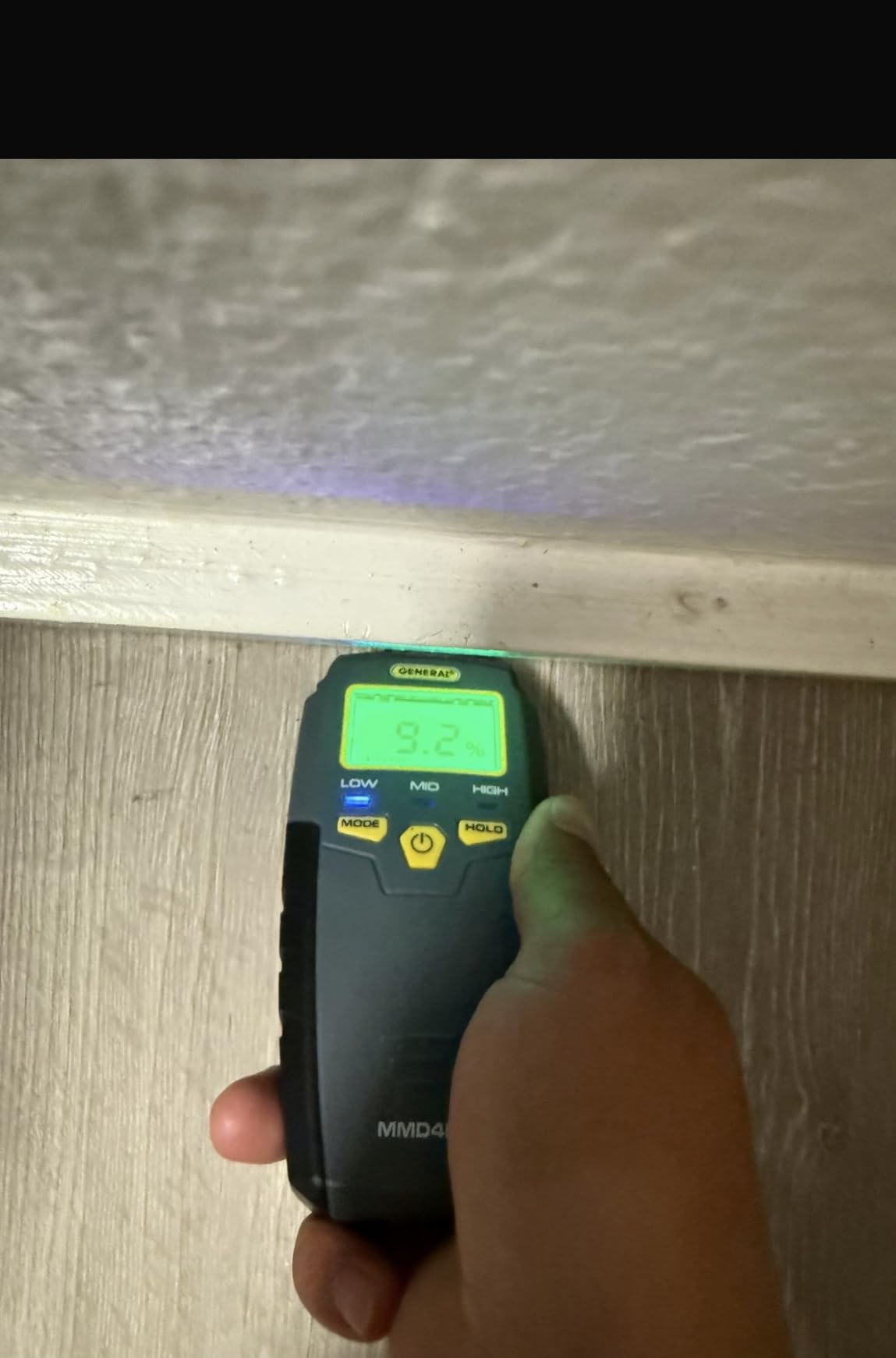
What the MMD4E gets right for a flooring job
The building material mode is the sleeper feature. Most subfloors in a renovation are plywood or OSB, and having a calibrated scale for them on the same device removes the guesswork from the first pass. Combined with the hold button, one meter covers the scan and the confirm.
The replaceable pins matter over a long install. Pins bend, corrode from adhesive and solvent, and eventually give you a drifting reading. General Tools supplies replacements, which keeps this meter working for years instead of seasons.
Where the MMD4E falls short
It leaves holes, and on pre-finished or engineered product that is a visible defect you cannot walk back. Take the reading on a board end, on an offcut, or in a spot the baseboard will cover.
The plus or minus 3% tolerance also means it cannot resolve the 2% to 3% acclimation gap between subfloor and flooring that the standards care about. If the two numbers it gives you are within a point of each other, treat that as inconclusive rather than a pass.
2. Klein Tools ET140 – Best Value Pinless Meter
Klein Tools ET140 Pinless Moisture Meter for Non-Destructive Moisture Detection in Drywall, Wood, and Masonry; Detects up to 3/4-Inch Below Surface
Pinless EMF detection to 3/4 inch
Reverse-contrast LCD with nine LED bars
Hold and auto power off
+ The Good
- Non-destructive 3/4 inch scan with no pin holes
- Repeatable readings for mapping damp boundaries
- Large reverse-contrast display with nine LED bars
- 2 metre drop protection and 9V battery included
- Light enough to scan a whole floor one-handed
- The Bad
- Hardwood setting can read low against a pin meter
- Flat pad struggles in corners and can jump to maximum
- Mode cycling is needed to reach softwood
The ET140 is the pinless meter we kept reaching for during leak tracing, because it leaves no holes and it is fast enough to sweep a room in a couple of minutes. Klein calibrates it for drywall, masonry, hardwood and softwood, and the electromagnetic field detection reaches 3/4 inch below the surface.
What you get is a reverse-contrast LCD with nine LED bars showing moisture range, plus hold, low battery and auto power off. The bar graph is the part you will actually use on site. You are looking for change across a floor, not a single precise number, and the bars make a gradient obvious at a glance.
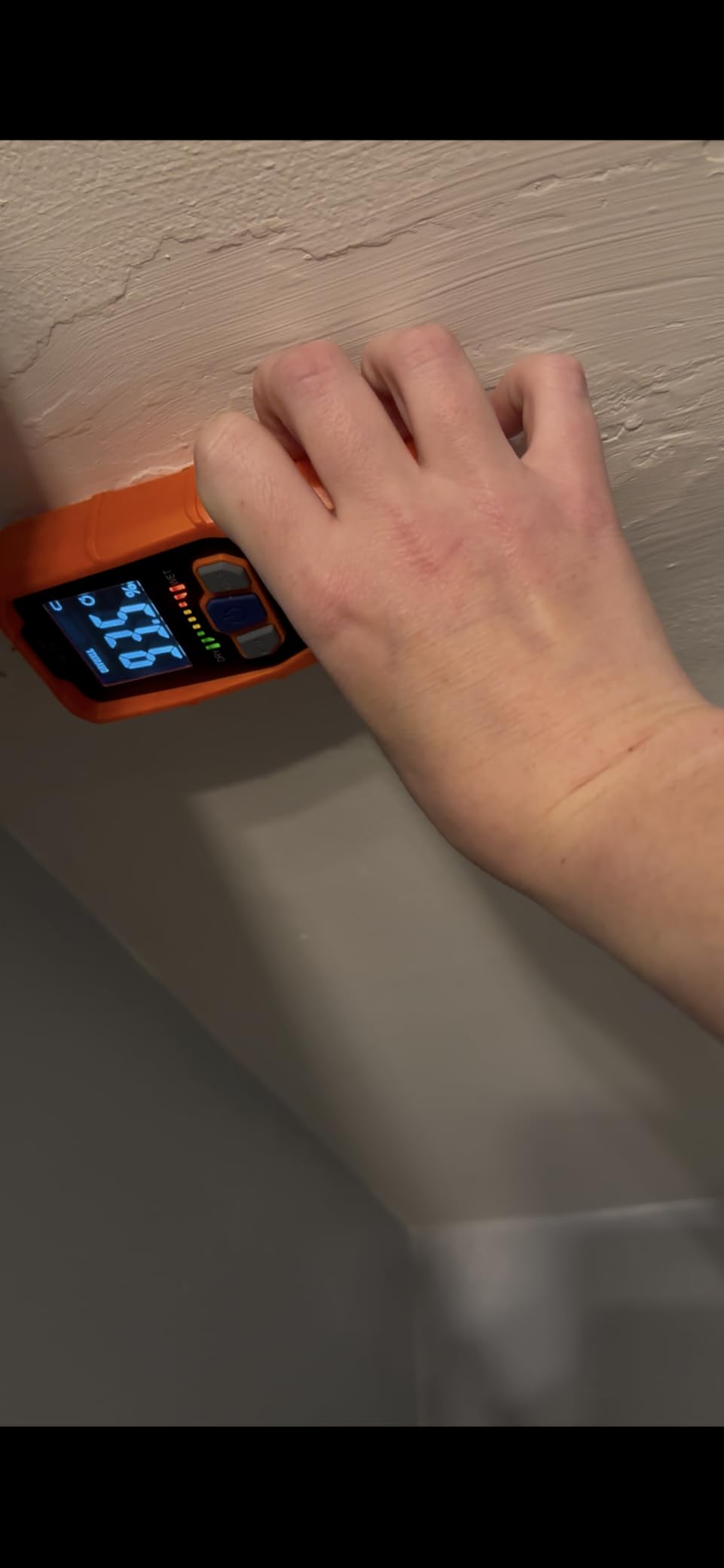
Owners report readings that matched a professional contractor’s meter within about 0.1% sensitivity, which is a reasonable expectation for this class of instrument. The consensus is that it is not calibrated to laboratory standard but delivers consistent, comparable relative readings that are good enough for leak tracing and quick acclimation checks.
Plumbers and inspectors use it the same way flooring crews do, to find where moisture starts and stops rather than to produce a number for a report. The 2 metre drop protection and 7 ounce weight mean it survives the drop off a ladder that ends most electronics.
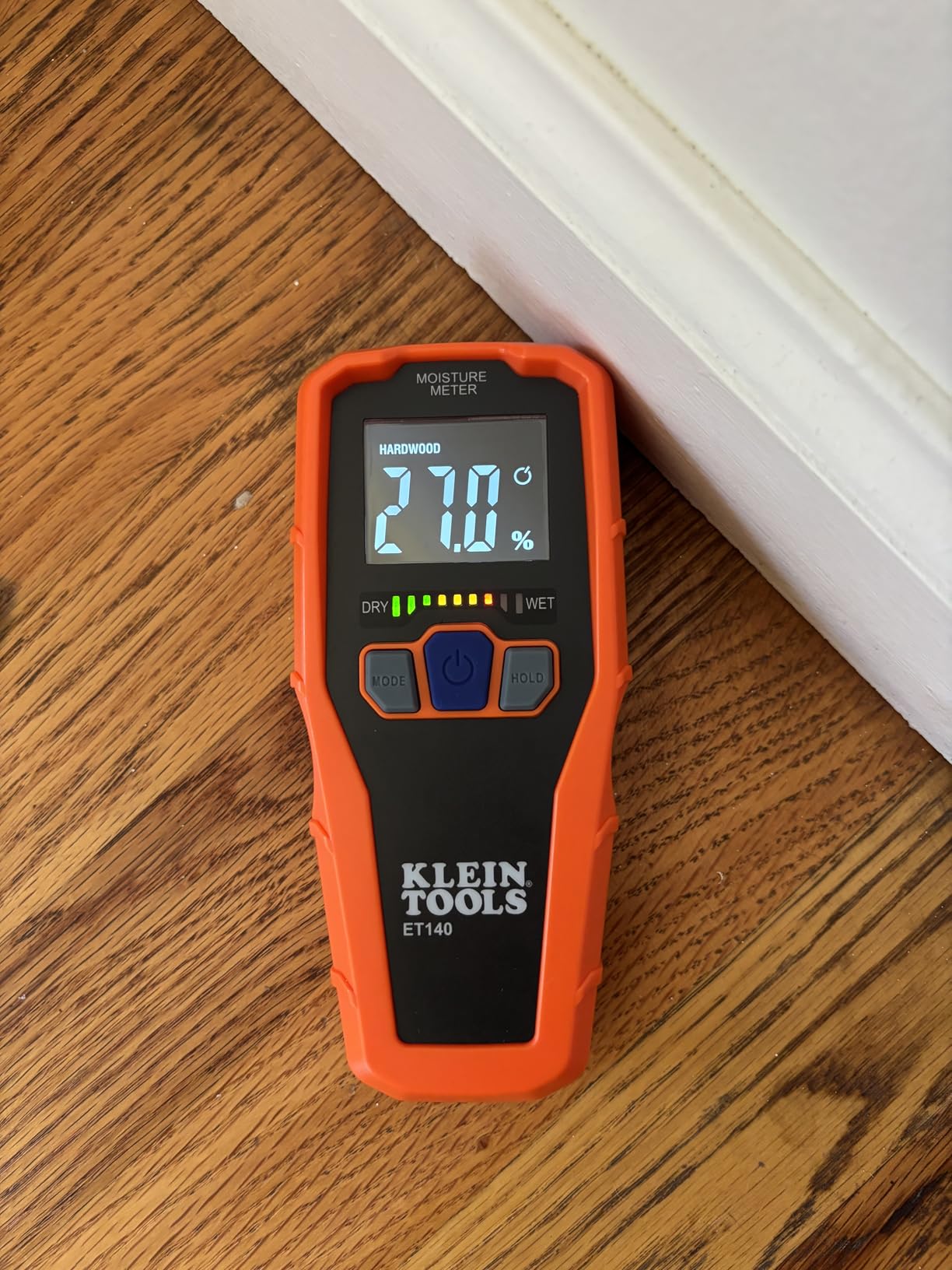
Why the ET140 works as a first pass
Repeatability is the feature. Because the same spot gives the same number, you can scan a floor on day one and again on day four and see whether the wet area is shrinking. That is the single most useful thing a meter does on a remediation job, and the ET140 does it well.
It also reads softwood more accurately than hardwood, which matters when your subfloor is pine or fir. You have to cycle through masonry, drywall and hardwood to get there, which is a clumsy interface but a small price.
Where the ET140 falls short
The hardwood setting reading low against a pin meter is the consistent complaint, and it is exactly the case you care about for solid oak and maple. Treat the number as a relative position on the scale, not an actual moisture content.
Corners are a real problem. The flat sensor pad needs a flat surface, and in an inside corner it has nowhere to sit – several owners report it jumping straight to the 100% maximum. Scan close to the wall but not on the wall, and if a corner reads high, verify with a pin before you believe it.
3. RDINSCOS MT19B – Best Budget Pin Meter
RDINSCOS Wood Moisture Meter for Firewood, Softwood, Hardwood
Pin-type reading at plus or minus 0.5%
Hardwood and softwood modes
4.72 x 2.36 x 1.18 inch body
+ The Good
- Plus or minus 0.5% accuracy is tight for the tier
- Backlit LCD readable in low light
- Storage bag and spare spanner included
- Compact body fits a pocket
- Replaceable pins swap with the included spanner
- The Bad
- Pin-type design leaves holes in the board
- Wood calibration only with no building material scale
- Surface readings can understate a wet core
The MT19B is the reason the budget recommendation in this roundup is a pin meter rather than a cheap pinless one. A plus or minus 0.5% stated accuracy puts it closer to the professional class on paper than anything else at this level, and pin readings are the ones a manufacturer will accept.
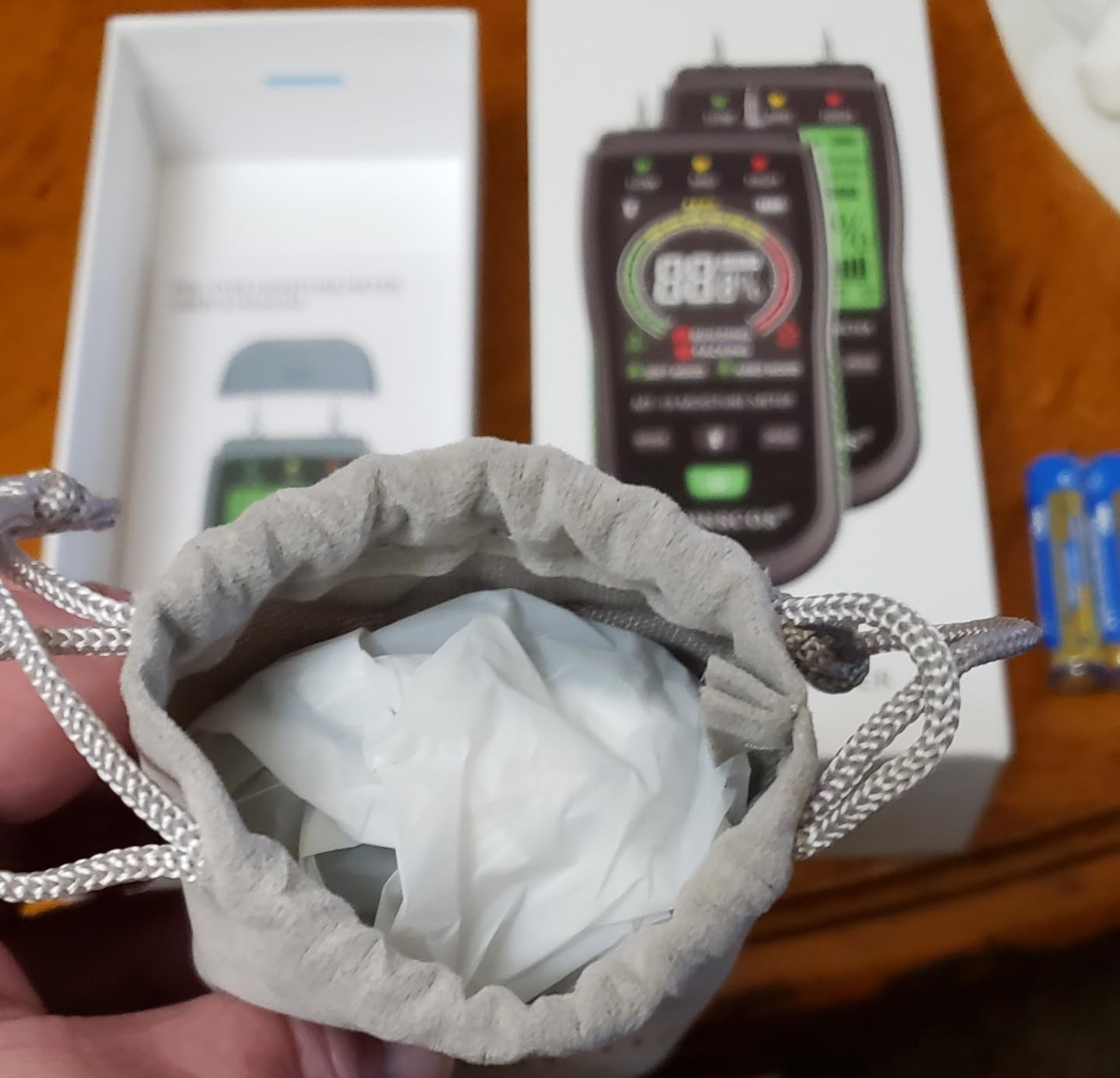
It is small, it takes three AAA batteries that are included, and the backlit LCD means you can read it in a crawlspace with the lights off. Separate hardwood and softwood modes keep readings close for common lumber without a printed reference table you have to carry.
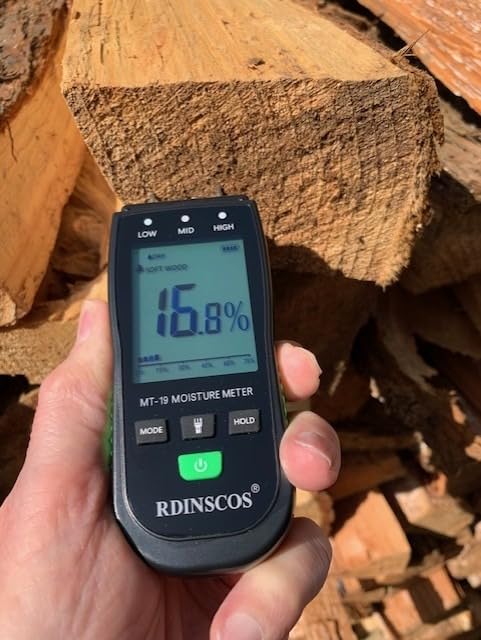
For flooring, its role is confirmation. Scan a floor with a pinless meter, find the suspect area, then drive these pins in to get a number you can write on a report. The included spanner means you can replace the pins yourself when they bend instead of hunting for a new meter.
Owners consistently describe it as a dependable budget pin meter for lumber, firewood and general checks, with the caveat that it is a surface reading. That caveat is the honest one to hold onto for flooring, because the surface of a board dries long before the core does.
Why the MT19B earns a flooring slot
Accuracy is the argument. Plus or minus 0.5% is fine enough to resolve the 2% to 3% gap between subfloor and flooring, which is the whole point of taking a reading. Most meters in this roundup cannot do that, and the ones that can cost several times more.
It weighs under 8 ounces and comes with a storage bag. On a job where you are moving between rooms all day, that matters more than any feature list item.
Where the MT19B falls short
There is no building material scale. The meter is calibrated for wood only, so a plywood or concrete subfloor reading means something different and you will need another tool for that pass.
Pin contact is everything. Reviewers note you need to insert the pins deep for best contact, and that dense flooring takes time to seat the probe. A shallow push gives you a number that is too low, and a too-low number is the dangerous direction on a flooring job.
4. VINHMOR MT270 – Best for Wood Species Tables
Wood Moisture Meter – Digital Moisture Detector Moisture Tester, Pin-Type Water Leak Detector Damp Tester Dampness Meter for Wood Building Material Firewood Walls Paper Floor (Sliver)
Eight wood calibration scales
6-60% wood and 0-40% building material
Temperature in C and F
+ The Good
- Eight wood calibration scales with a printed conversion table
- Large backlit LED screen with hold and memory
- Well-built body with screw-secured battery cover
- Dual wood and building material modes
- Consistent readings across multiple boards over years
- The Bad
- Calibration table is cumbersome to carry and incomplete for some species
- Surface-only readings can miss a wet core
- No reading below 6% for wood
The MT270 is the most species-aware meter in this roundup, which is the feature installers on woodworking forums ask for by name. Eight wood calibration scales with a printed conversion table give you readings that account for density differences between, say, a soft pine subfloor and a dense oak floor.
Density is the whole argument for species tables. Wood varies enormously in how it responds to an electrical field, and a meter with no species table will read a walnut board differently from a poplar board at identical moisture content. That gap is exactly the size of the error you are trying to avoid.
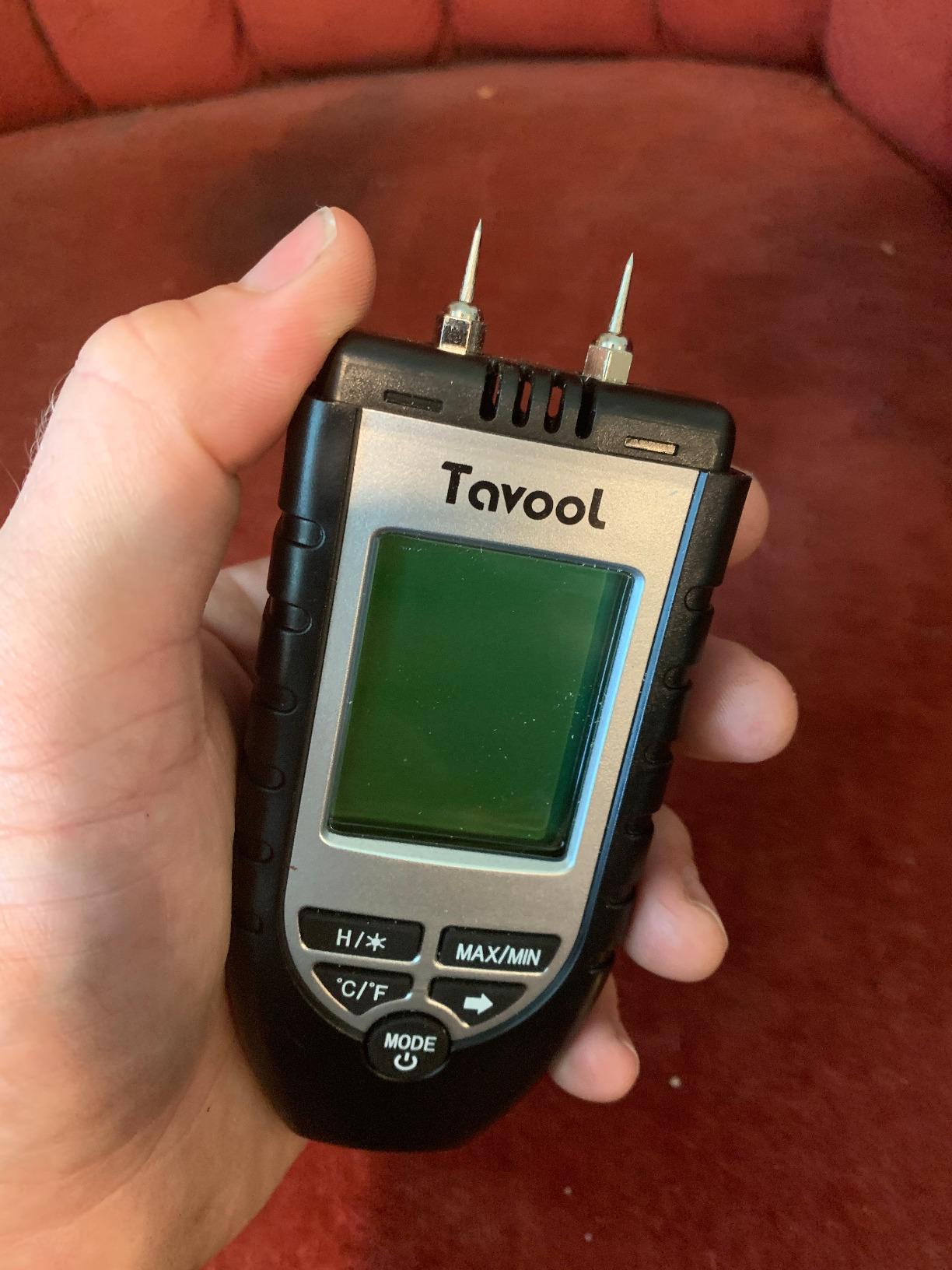
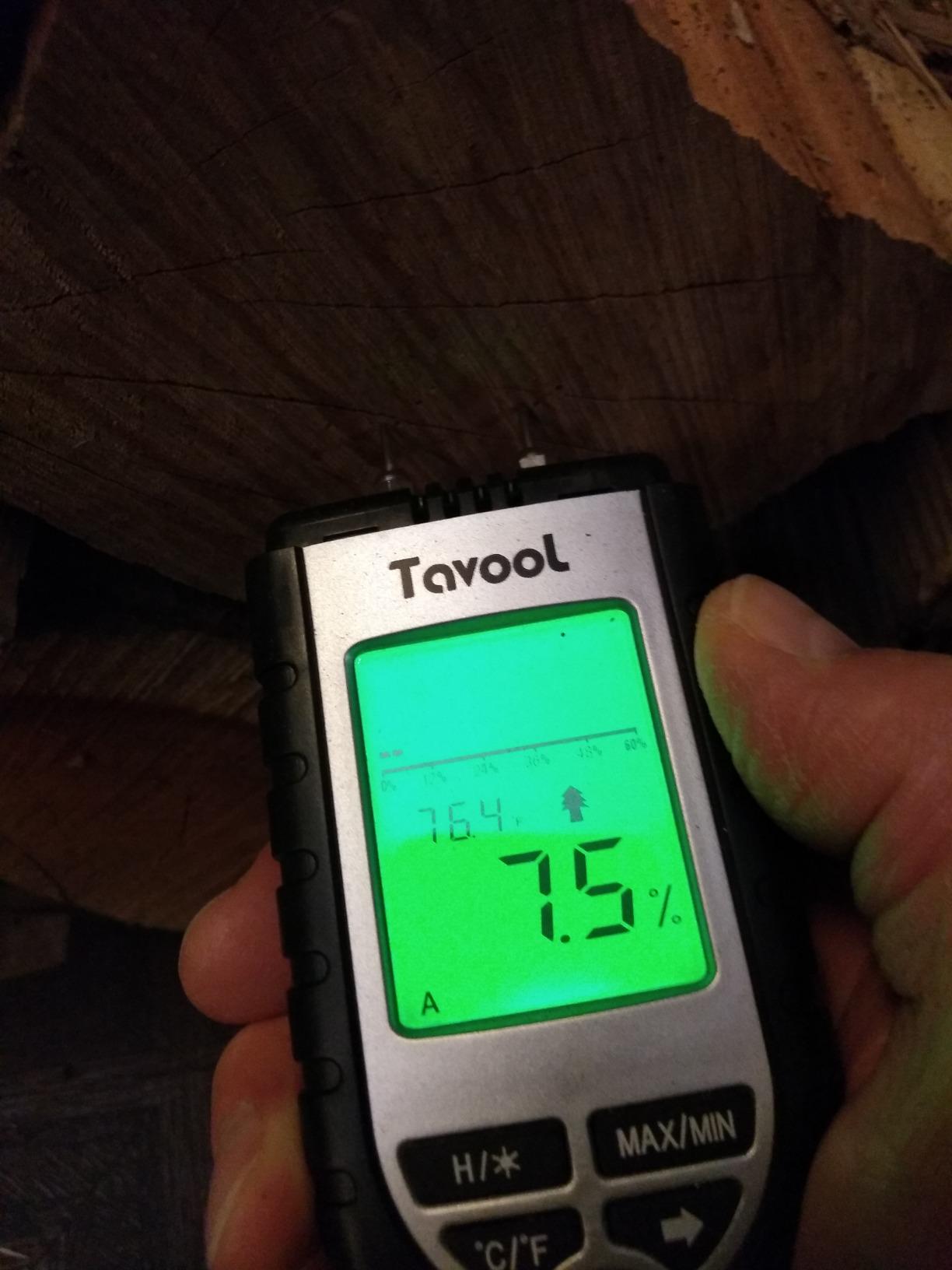
Build quality stands out for the tier. The probe lid fits tightly, the battery cover is screw-secured, and owners report consistent results across multiple boards that persist after three to four years of use. The backlit LED is large, and hold plus memory and max/min functions cover the logging needs of a long install.
Red oak and white oak are listed as Quercus spp and require MODE A, which is the kind of detail that only appears in a meter with a real species library behind it. If your floor is oak – and a lot of floors are – that mapping is worth the effort of finding the right mode.
When the species table earns its place
Any install with more than one species in the building. Remodel jobs routinely have an oak floor going over a pine or fir subfloor, and a meter that treats both the same will hand you a false match. The table lets you compare them honestly.
The dual wood and building material modes also mean one device covers the subfloor pass and the flooring pass, which removes a step from the workflow.
Where the MT270 falls short
The conversion table is a genuine inconvenience. You carry it, you look it up, and the listing says eight scales while the manual actually contains ten settings under A-J. Budget time for that friction rather than assuming the scale count on the box is complete.
There is also no reading below 6% for wood, so genuinely dry lumber can look like a fault. On a flooring job in a dry winter climate, that matters. The reading is a surface measurement too, so pressure-treated or sealed lumber can read dry while the core stays wet.
5. RDINSCOS MT35P – Best Pin and Pinless Combo
RDINSCOS 2-in-1 Pin & Pinless Moisture Meter for Wood & Walls,Rechargeable
Pinless and pin measurement in one body
Rechargeable 1200mAh battery
2.9 inch backlit LCD with hold
+ The Good
- Only combo meter in this roundup
- Rechargeable battery runs up to 8 hours per charge
- Adjustable alarm threshold with red LED and buzzer
- 2.9 inch backlit LCD with hold
- Separate floor and wall settings for acclimation checks
- The Bad
- Pinless readings vary if the sensor is not held flat and firm
- Some owners report inconsistent readings on the same area
- Body feels light and somewhat delicate
The MT35P solves a problem most flooring DIYers do not realise they have: the scan and the confirm normally mean two devices in two pockets. This one puts pinless scanning and pin measurement in the same body, and the rechargeable 1200mAh lithium battery gives up to 8 hours per charge over USB.
That battery is the quiet advantage on a flooring job. A 9V alkaline meter is fine until you are two rooms deep with no spare, and this one simply goes back on a USB cable overnight.
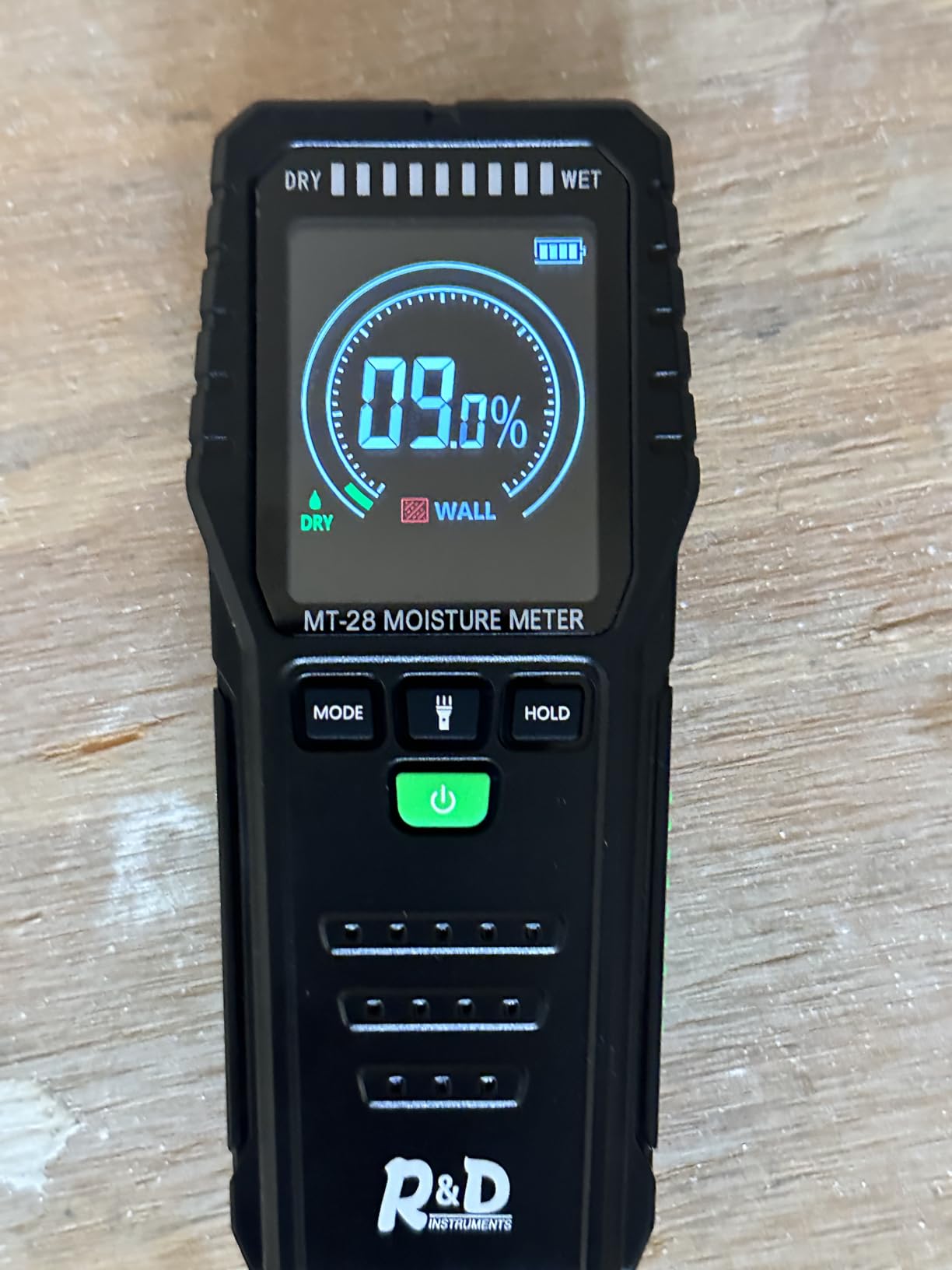
The adjustable humidity threshold is more useful than it sounds. Set it to 9% for a flooring job and the red LED and buzzer fire the moment a scan crosses your limit, which turns a 20-minute inspection into a fast pass with a clear pass/fail line.
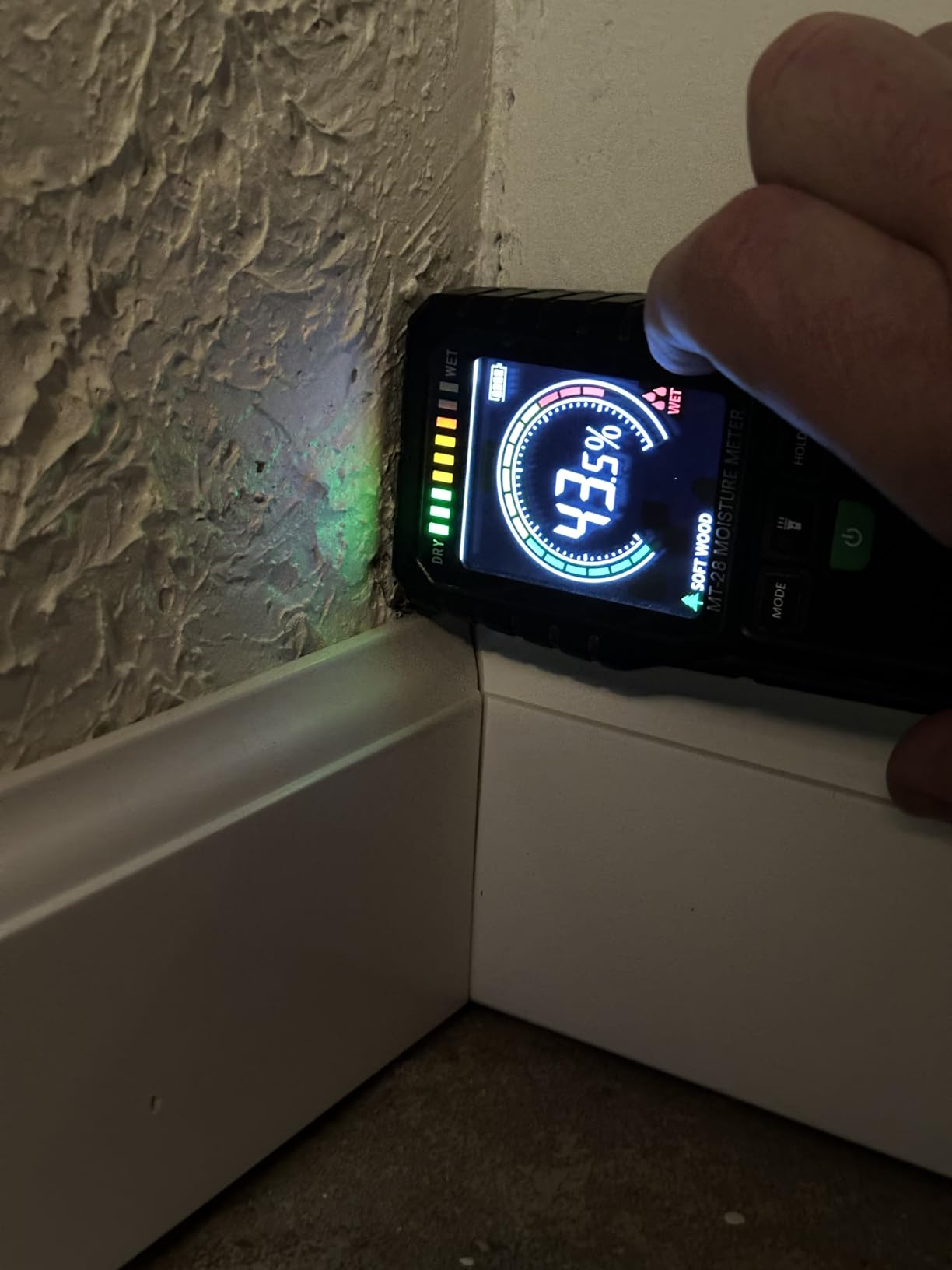
Owners use it after flood or leak events to track drying progress in walls and floors, and the separate floor and wall settings suit the acclimation workflow. The 2.9 inch backlit LCD with a hold button is readable in a dark crawlspace.
Why one device beats two
Workflow continuity. You do not lose your place, you do not forget to charge the other meter, and you do not set the pinless unit down on a wet subfloor. For a DIY install or a small contractor, that is worth real money in saved time.
It also means you can demonstrate the difference between a scan reading and a pin reading on the same spot, which teaches you how much to trust the scan.
Where the MT35P falls short
Pinless readings depend on flat, firm contact, and this is the combination unit’s weak point. Some owners report mixed or inconsistent readings on the same area, which is usually a pressure problem rather than a fault.
The body also feels light and somewhat delicate despite the rechargeable internals, so it is not the meter for a job where it will be dropped off a ladder regularly. Neither sensor is species-calibrated, so treat both readings as relative.
6. Bosch UniversalHumid – Best for Parquet and Wood Group Selection
Bosch Moisture Meter UniversalHumid (Precise Results Thanks to Wood Group Selection and LED Traffic Light for Easy Interpretation)
Pin-type with two selectable wood groups
Traffic-light LED readout
Cap doubles as a calibration check
+ The Good
- Two wood group settings give noticeably more consistent readings
- Traffic-light LED makes the go or no-go call instantly
- Cap doubles as a built-in calibration check
- Solid sharp prongs pierce dense wood easily
- Rugged non-slip body with two-button operation
- The Bad
- Drains batteries even when switched off
- Battery cover can slip when prongs are pulled from dense wood
- Only two wood groups so exotics are not individually calibrated
The UniversalHumid is the one meter here that tells you whether the floor is ready rather than handing you a number and leaving the judgement to you. The traffic-light LED reads red for not recommended, yellow for of concern and green for ready to use, and on a parquet or herringbone job that binary clarity is genuinely useful.
Two selectable wood groups are the accuracy story. Reviewers repeatedly contrast it with budget pin meters and say the group selection produces noticeably more consistent readings, which is the same density argument that makes the VINHMOR’s eight scales worthwhile, just compressed into two settings.
It is also built like a tool. The prongs are solid and replaceable, the body has a non-slip grip, and Bosch ships wood group stickers in 12 languages so you can identify which group a species belongs to without a manual.
The cap slides to the back with a magnet while in use, which is a small thing that stops the cap from getting in the way when you are pushing into hardwood. It also doubles as a calibration check, and reviewers trust that more than the advertised self-calibration routines on cheaper meters.
The meter stores the last three readings on screen, which makes the flooring and subfloor comparison genuinely quick. Take the flooring reading, move to the subfloor, and the previous number is still there to compare against.
Why the traffic light matters on a flooring job
Speed of decision. The threshold everyone is arguing about – 6 to 9 percent, 10 to 12 percent maximum – collapses into one glance at the LED. On a job with twenty rooms, that is the difference between a two-hour measurement pass and a five-minute one.
It also removes a whole class of mistake. People who eyeball a percentage against a threshold in a dark basement misread it. Nobody misreads green.
Where the Bosch falls short
It drains batteries even when switched off, so you have to pull the cells after a day’s work. The near-universal complaint among owners, and an avoidable annoyance on a long install.
Two wood groups is not many. Exotic species are not individually calibrated, and the battery cover can slip when you pull the prongs out of dense wood – both minor, both worth knowing before you depend on this meter for an exotic floor.
7. Proster PST050 – Best Low-Cost Pin Meter for Lumber Checks
Proster Wood Moisture Meter 4 Modes 0-99.9% for Wood/Paper/Firewood
Pin-type digital measurement with 10mm electrodes
0-99.9% range at 0.1% resolution and plus or minus 0.5%
Four modes covering about 28 species
+ The Good
- Very low cost with readings consistent with split firewood state
- 0-99.9% range at 0.1% resolution
- Large HD LCD with data hold and auto power off
- Bright yellow body and hard case are easy to find
- Reinforced battery connectors prevent random shutdowns
- The Bad
- Does not remember the wood species mode between power cycles
- No backlight makes it hard to read in low light
- No group for dense North American woods such as hickory
- Pin cap is tight and awkward to open
- Pins need firm pressure in hardwoods like oak
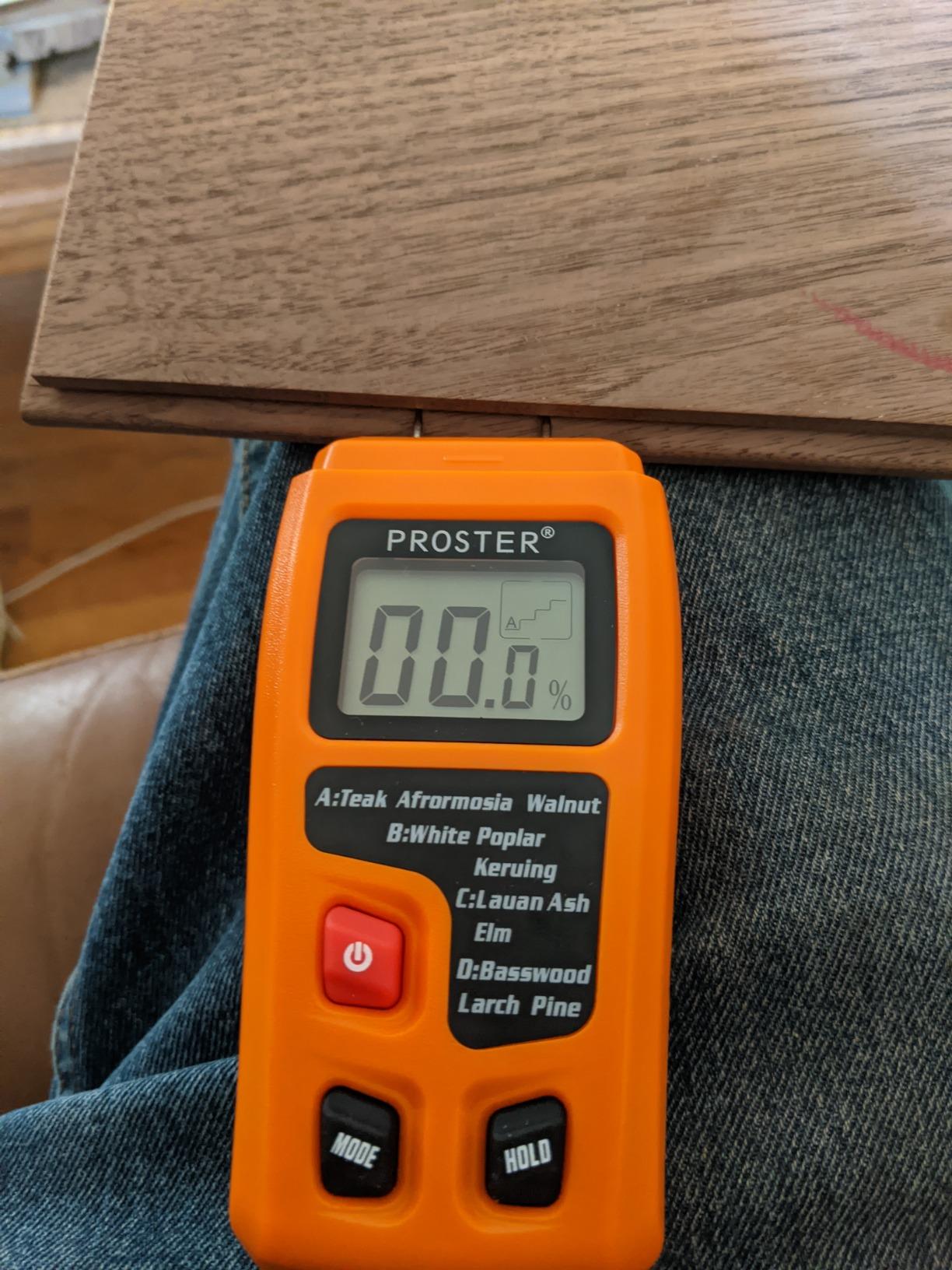
The PST050 is the cheapest accurate pin meter here, and its four species modes cover roughly 28 woods including teak, walnut, cedar, maple, ash, pine and birch. That is a broader library than several meters twice its size, and walnut and maple alone cover a lot of flooring.
Accuracy is stated at plus or minus 0.5% with 0.1% resolution across a 0-99.9% range, which is a wide span that covers wet lumber, seasoning stock and finished flooring in one instrument.
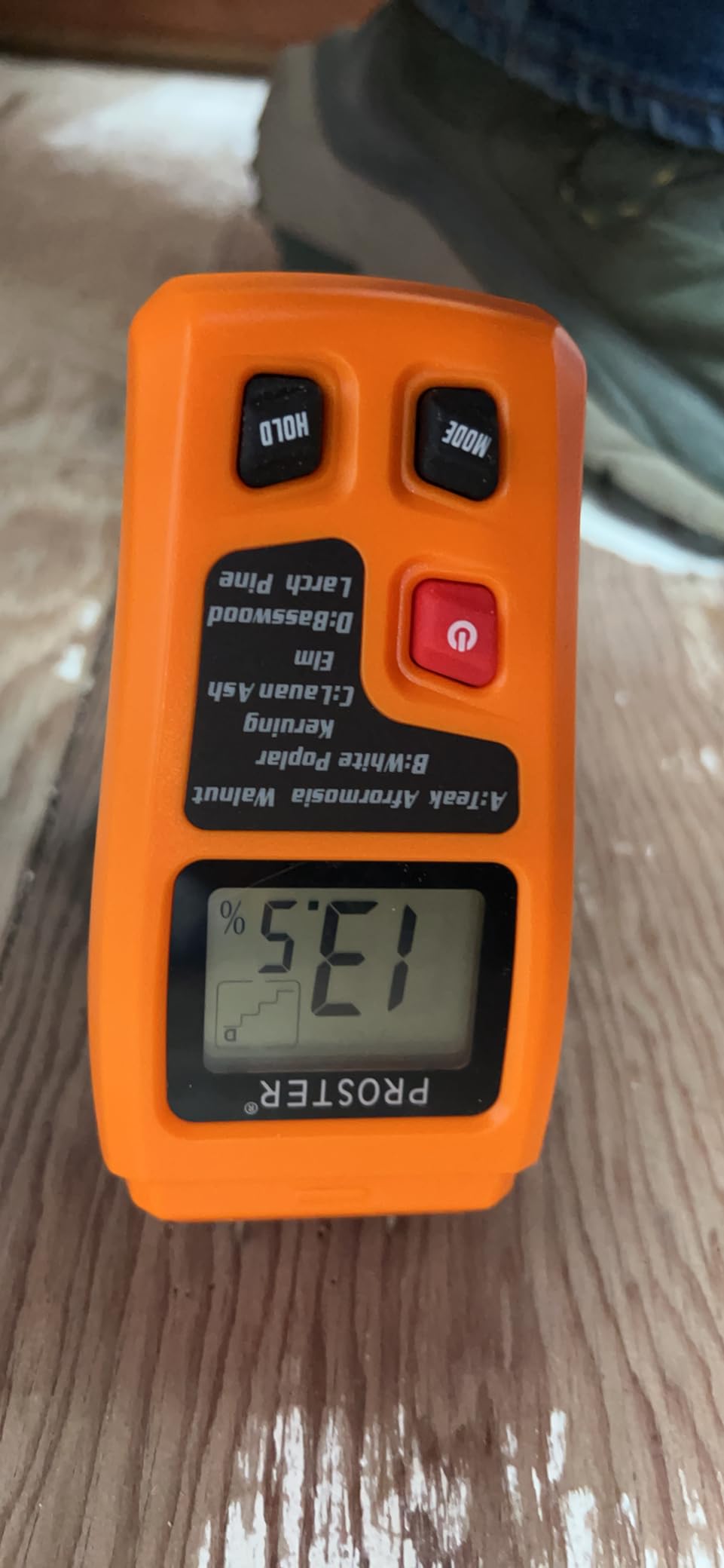
It is a lumber and firewood meter more than a flooring meter, and users treat it that way – checking that split firewood matches its visible state, checking boards before they go on the wall. For a flooring job it serves the same confirm role as the RDINSCOS, at a lower entry point.
What makes it useful on a floor
Species coverage. Group A includes teak and walnut, group C includes maple and ash, group D includes pine and birch, so most North American flooring species have a real setting rather than a guess.
The reinforced battery holder is an unglamorous upgrade that matters. Owners report it stops the random shutdowns that plague cheap 9V compartments, and a meter that dies mid-scan is worse than no meter.
Where the PST050 falls short
It forgets the wood species mode every time you power it on, so you reselect it each session. Get that wrong and your reading is off by a meaningful amount, with nothing on screen to warn you.
There is no backlight, which makes it a poor choice for a dark crawlspace, and the tight protective cap needs a tool or some effort to pry off with bare hands. It also has no group for dense North American woods such as hickory, and pushing the pins into oak takes real force.
8. Proster PST199-P – Best Pinless Meter for Leak Tracing
Proster Pinless Moisture Meter 3/4″ Depth Color Alarm Non-Destructive
Pinless sensing to 3/4 inch below the surface
5-75% wood and 5-70% wall and masonry ranges
Three-colour LED bar graph with audible alert
+ The Good
- Pinless design leaves no holes in finished surfaces
- 3/4 inch depth suits standard flooring and wallboard
- Colour LED bar graph and audible alert show damp zones instantly
- Backlit colour LCD with hold function
- Storage bag and 9V battery included
- The Bad
- Consumes its 9V battery faster than comparable pin meters
- Readings are relative rather than species-calibrated
- Slower to stabilise on rough or uneven surfaces
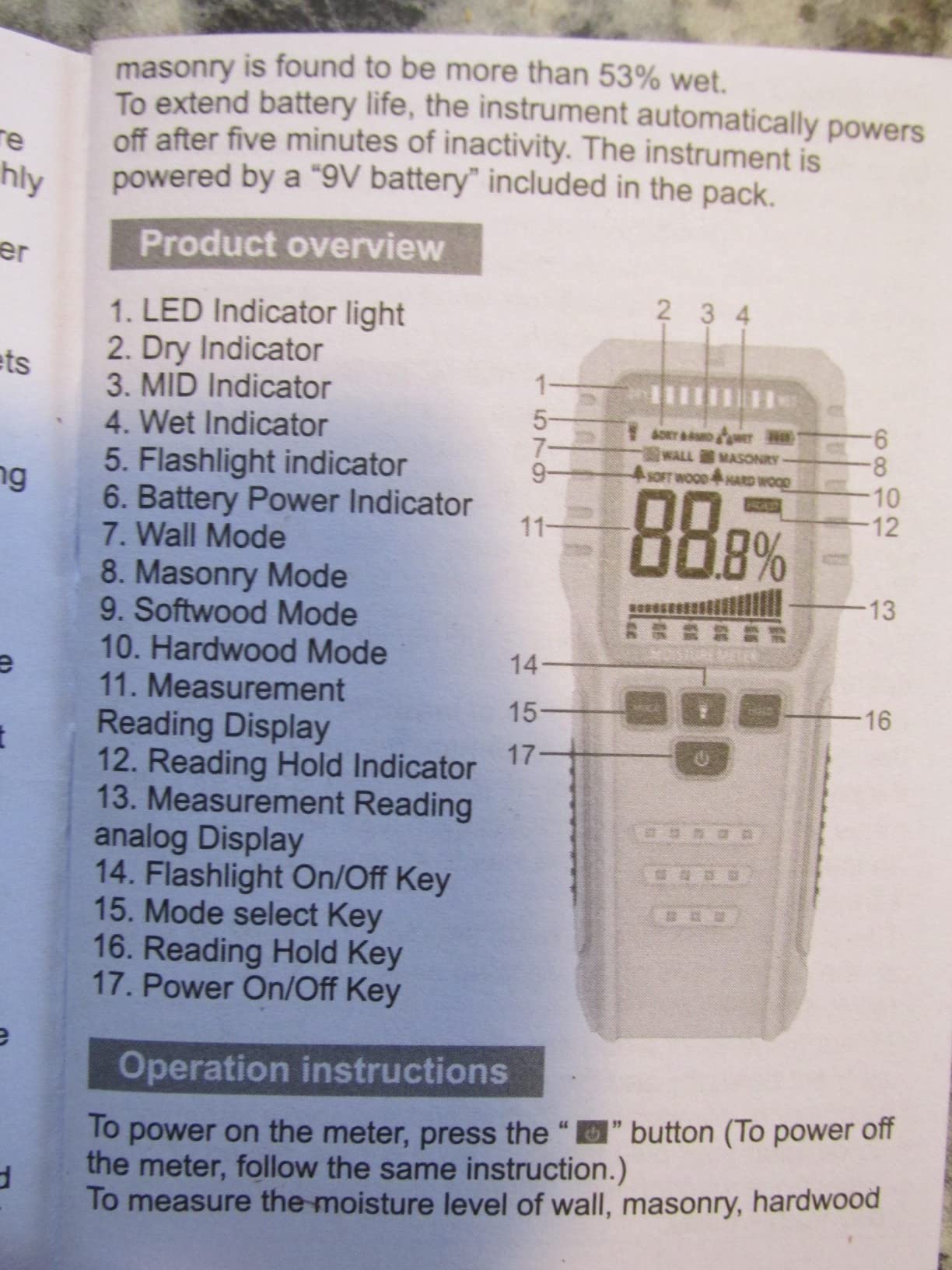
The PST199-P is a pinless meter aimed squarely at finding water rather than certifying wood. The three-colour LED bar graph plus an audible high-pitch alert means a damp region announces itself while you are still moving across the room, which is much faster than reading digits one at a time.
Ranges are generous: 5-75% for soft and hardwood, 5-70% for wall and masonry. The 3/4 inch detection depth matches the standard subfloor thickness assumption, and the pinless sensing leaves finished floors and cabinetry completely unmarked.
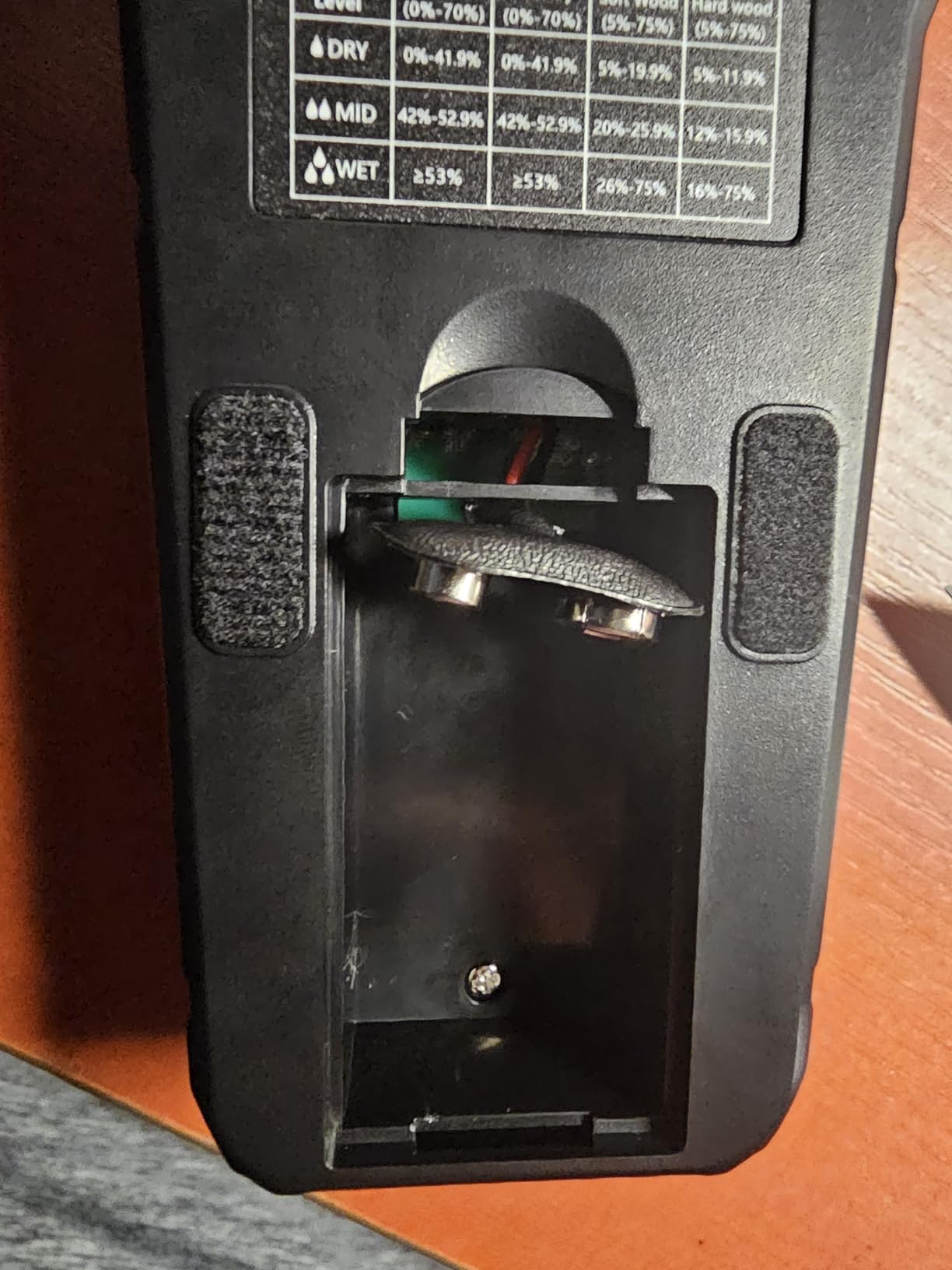
Reviewers recommend it for quick non-destructive checks of wood, drywall and masonry, especially for leak tracing behind finished surfaces, and they accept that readings are indicative rather than precisely calibrated. That is a fair description of where this meter sits.
Why the colour alarm speeds up a scan
You can sweep a room without looking closely at the screen. The bar graph and the tone do the sorting, and you stop walking when the colours change. On a large floor that is the difference between ten minutes and an hour.
Because nothing is punctured, it is the right tool for a floor that is already installed but suspect. You can map the whole area in one pass and mark the boundary.
Where the PST199-P falls short
Readings are relative, not species-calibrated, so you cannot use them to prove an acclimation match. It consumes its 9V faster than pin meters in the same range, which matters on long remediation jobs.
It also stabilises more slowly than a pin reading on rough or uneven surfaces, and a rough sawn subfloor is common. Let it settle before you record the number rather than writing down the transient.
9. Mecurate WMM – Best Built-In Calibration
Mecurate Digital Pin Type Wood Moisture Meter with 3 Colored Indicators, Moisture Detector 2 Mode 8 Calibration Large Backlit for Wood, Wall, Firewall (Orange)
Pin-type measurement with 0.1% resolution
Wood and building material modes with 8 calibrated scales
Self-testing calibration aid built into the protective cap
+ The Good
- Among the highest rated meters here for consistency
- Cap-mounted self-test calibrates without an external block
- Sixteen selectable wood types plus a building material mode
- Sensitive sensor settles without jamming pins deep
- Jumbo backlit display with anti-slip grip and pouch
- The Bad
- Ships with batteries that may already be depleted
- Cap needs force to pop off
- Pin-type design leaves small holes
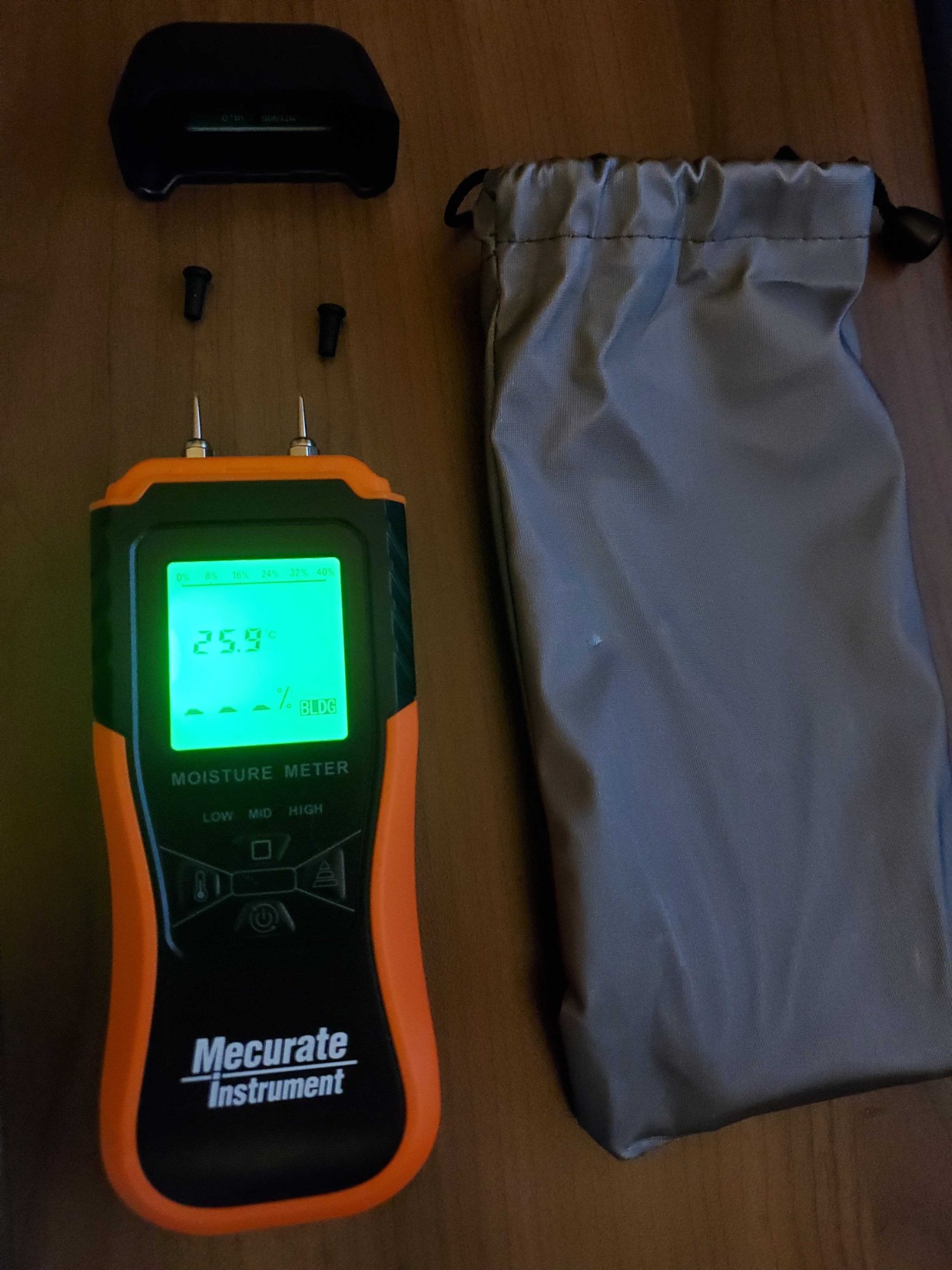
The Mecurate WMM is the meter that answers the most common complaint in installer forums, which is not knowing whether the meter itself is lying to you. It carries a self-testing calibration aid built into the protective cap, so you can confirm the meter is behaving without carrying a reference block.
That habit – check the meter before you check the floor – is what separates a defensible reading from an arguable one, and a cap-mounted test is the only way most people will actually do it.
It rates at 4.6 with owners calling it more accurate and more capable than models costing several times more. Painters, restorers and serious hobbyists use it to verify that water-damaged framing or lumber is dry enough to finish, and several buyers report matching readings from professional restoration teams.
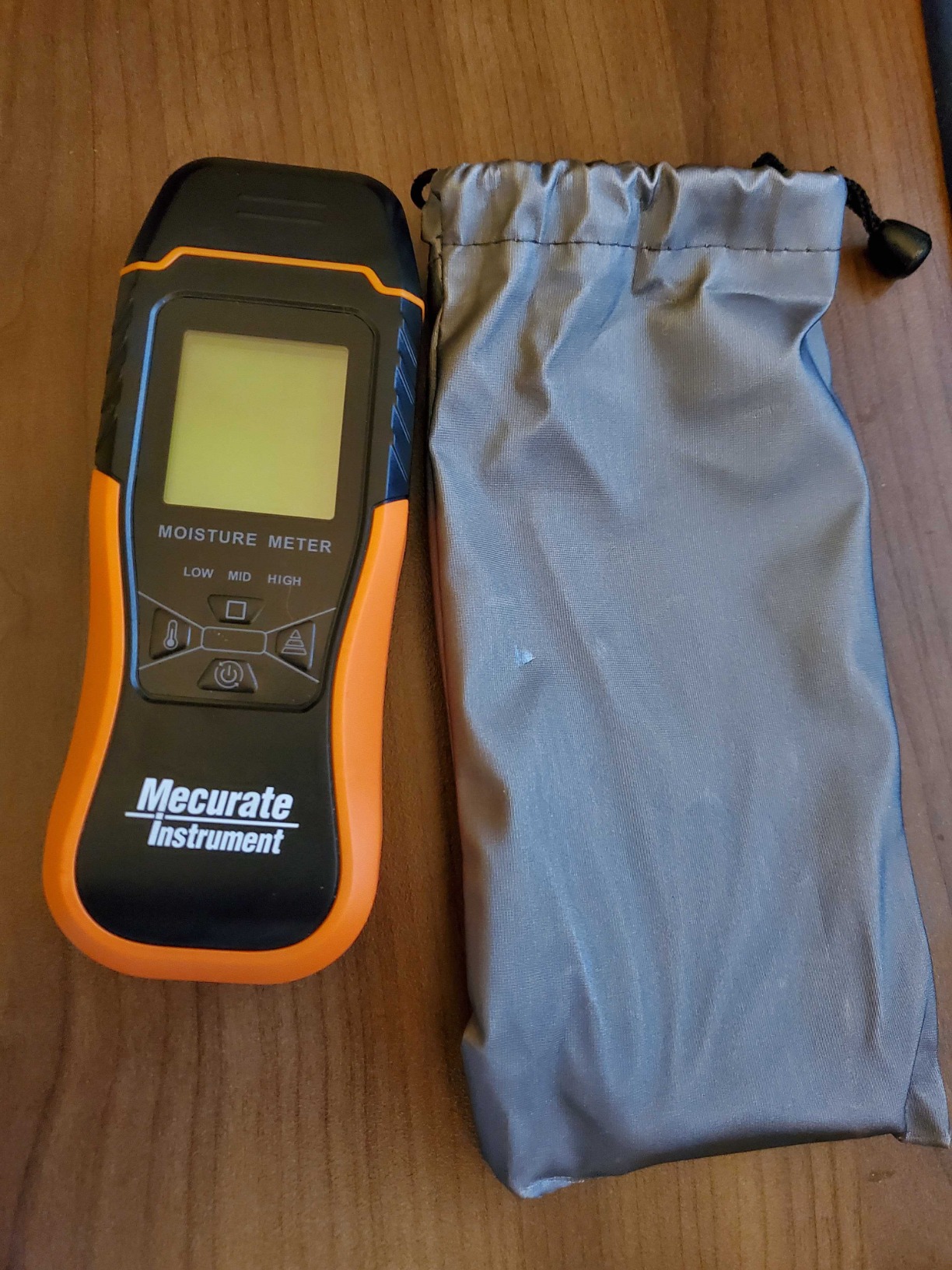
Under the hood you get 0.1% resolution, wood and building material modes, and 8 calibrated wood scales – 16 selectable wood types in total. A wood type quick-search index printed on the back of the device removes the manual from the workflow, which is a small design decision with a real effect on a busy job.
The jumbo backlit display, temperature detection in C and F, hold button, low battery icon and water-resistant carry pouch cover the everyday needs without a menu.
Why the cap calibration changes how you work
You can start every job with a known-good baseline. If the self-test fails, you know the reading is worthless before you have put a hole in someone’s floor or told them their subfloor is dry.
It also makes the meter defensible. When a flooring manufacturer asks how you verified the instrument, checking it against its own built-in reference is a simple answer to give.
Where the Mecurate WMM falls short
It is still a pin meter, so it leaves holes. The cap also needs a bit of force to pop off, though small rubber pin covers reduce the risk of pokes when pins are stored.
It ships with batteries that may already be depleted, which is a first-day annoyance that costs you twenty minutes of troubleshooting. Bring spares.
10. Kiprim WM01 – Best for Post-Leak Floor Checks
Kiprim WM01 Non-Destructive Pinless Moisture Tester for Wood, Floors, Walls
Pinless inductive sensing to 40mm depth
Four modes for softwood hardwood wall and masonry
Under 4 ounces with carrying pouch
+ The Good
- Pinless sensing leaves floors and walls unmarked
- Under 4 ounces and small enough for tight spaces
- Four dedicated modes for wood wall and masonry
- Colour LEDs plus audible alert with mute option
- Owners report readings matching an industrial meter
- The Bad
- Occasionally produces a flash reading on a dry area
- Not recommended for drywall or low-density materials
- Not professional grade and needs a second method for critical jobs
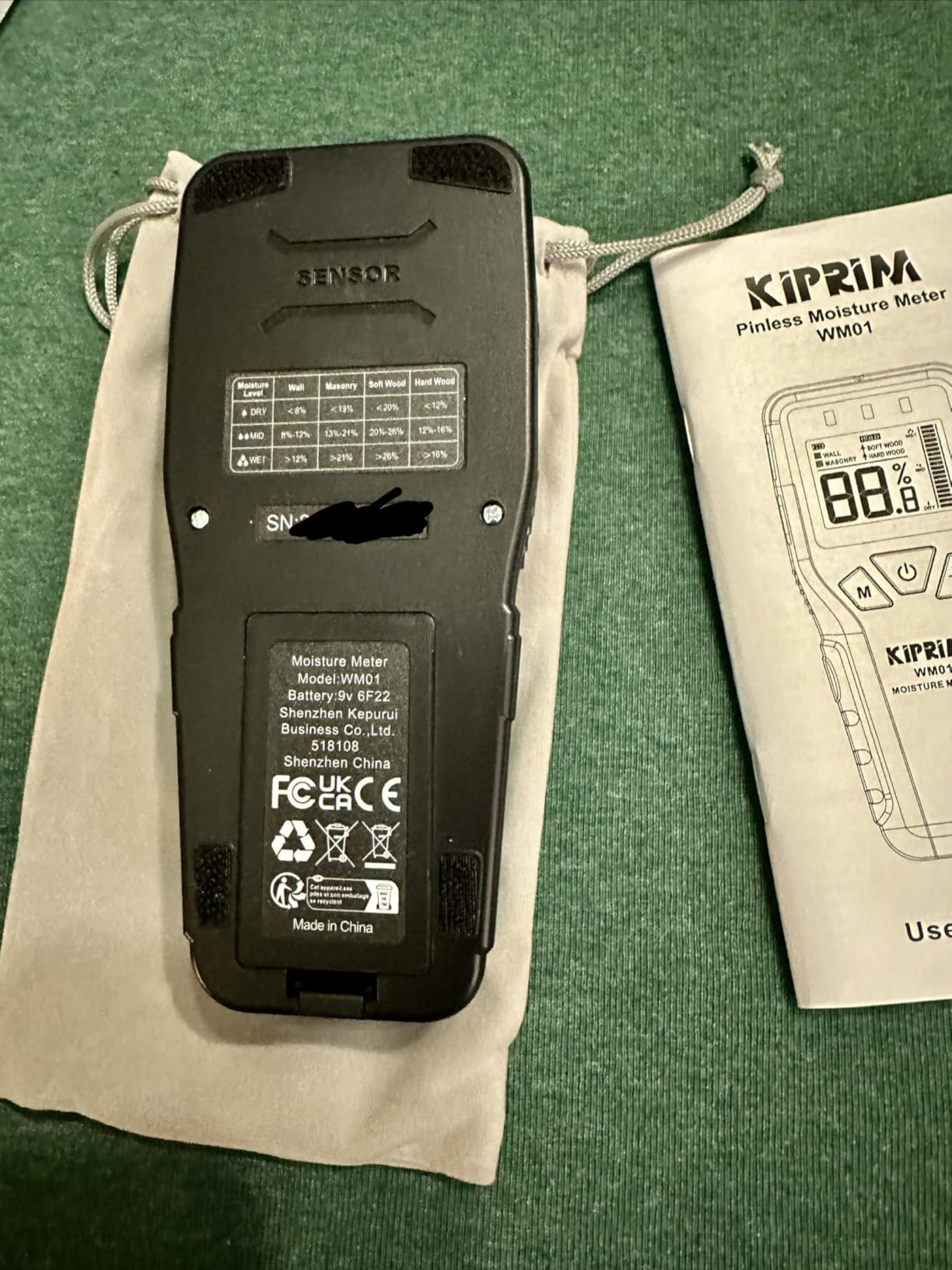
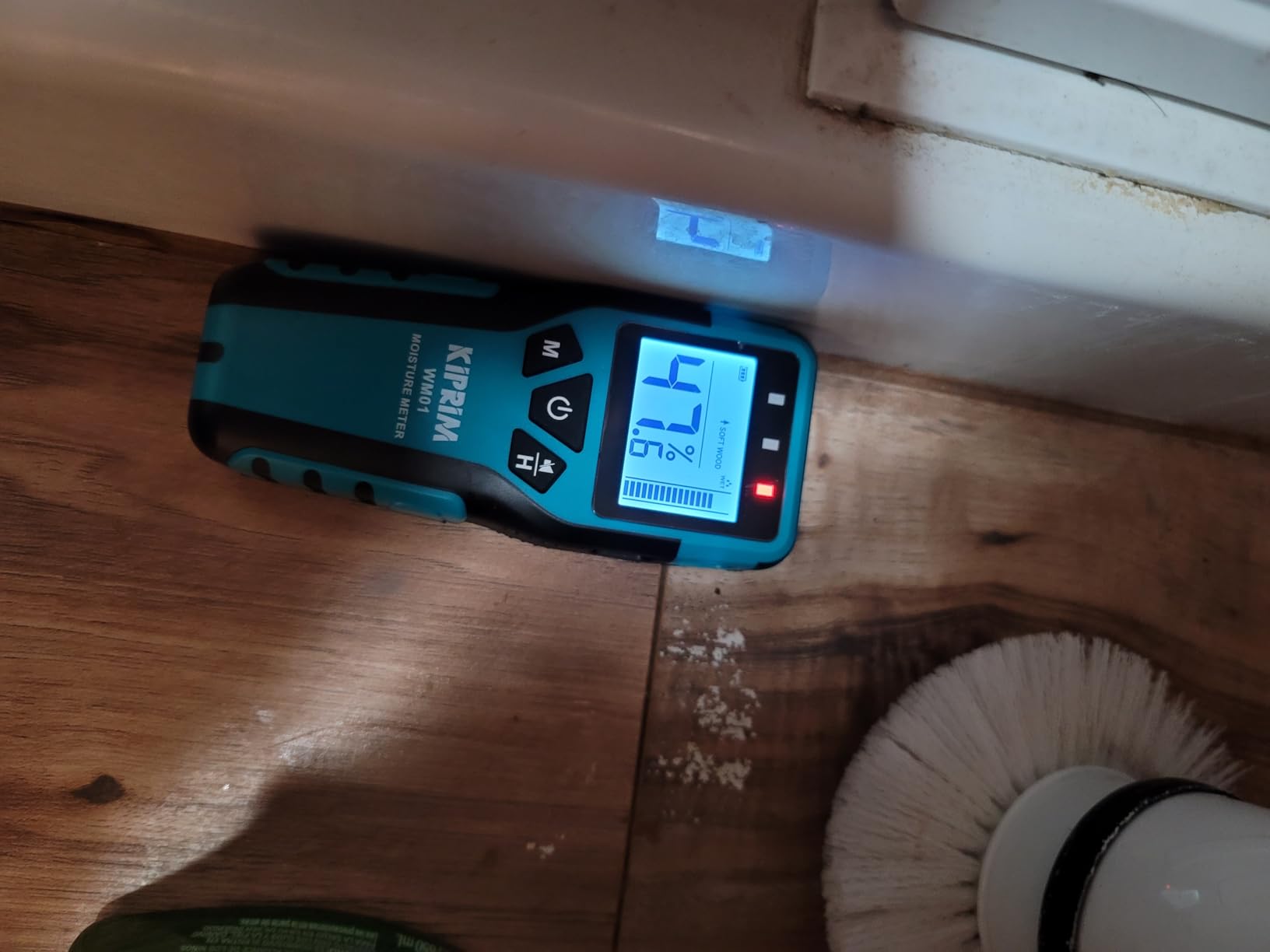
The WM01 is the meter for tracking a floor as it dries. At under 4 ounces with a carrying pouch, it is easy to keep on you through a remediation visit, and pinless inductive sensing to 40mm means you can check progress across a floor without marking it.
Four measurement modes cover softwood, hardwood, wall and masonry, and the colour LED indicators with an audible wet-condition alert make results intuitive for anyone who has not used a meter before. The one-key data hold locks a reading for your notes.
Homeowners use it to track damp patches and confirm when walls and floors have dried after leaks, floods or water damage, and it is valued for being compact, clear to interpret and free of pin holes.
Because the sensing is non-destructive, you can walk the same route across the floor each day without adding a single mark to the surface, which makes before-and-after comparison honest.
Why it suits drying tracking
Repeatable, comparable readings on the same spot over days is the whole workflow. This meter does not produce a certification-grade percentage, but it will tell you whether the corner behind the dishwasher is improving or not, which is the question you are actually asking on day four.
Nothing gets punctured, so you can walk the floor in socks, in finished areas, without leaving a trail of holes to explain later.
Where the Kiprim falls short
It occasionally produces a flash reading or flags a clearly dry area, and a small number of owners report occasional false-high readings. Verify anything surprising with a second method before you act on it.
It is not recommended for drywall or other low-density materials, and the documentation is unusually clear that you should keep metal objects, pipes and wiring away from behind the surface being tested. It is not a professional-grade instrument, so critical jobs need confirming.
11. Lignomat mini-Ligno E/D – Best Pocket Meter from a Specialist Brand
Lignomat Mini-Ligno E/D Pin Moisture Meter – Moisture Detector & Tester for Wood Floors, Woodworking, Building & Home Maintenance – Moist Meter for Wood Walls and Firewood
Pin-type meter with 6-45% measuring range
Two built-in wood group settings
Short and long pin sets with belt holster
+ The Good
- Pocket size with single-button operation and a reading in about two seconds
- Consistent readings across fir pine cedar oak maple and walnut
- Two pin lengths at 5mm and 10mm for surface or deeper work
- Sharp probes penetrate easily and the cap doubles as a push block
- Belt holster and two-year warranty included
- The Bad
- No built-in temperature correction so a printed table is needed
- Only two wood groups so exotics can read a couple of percent off
- Battery or pin changes require taking the case apart
- Included pin sets feel weak for deep penetration
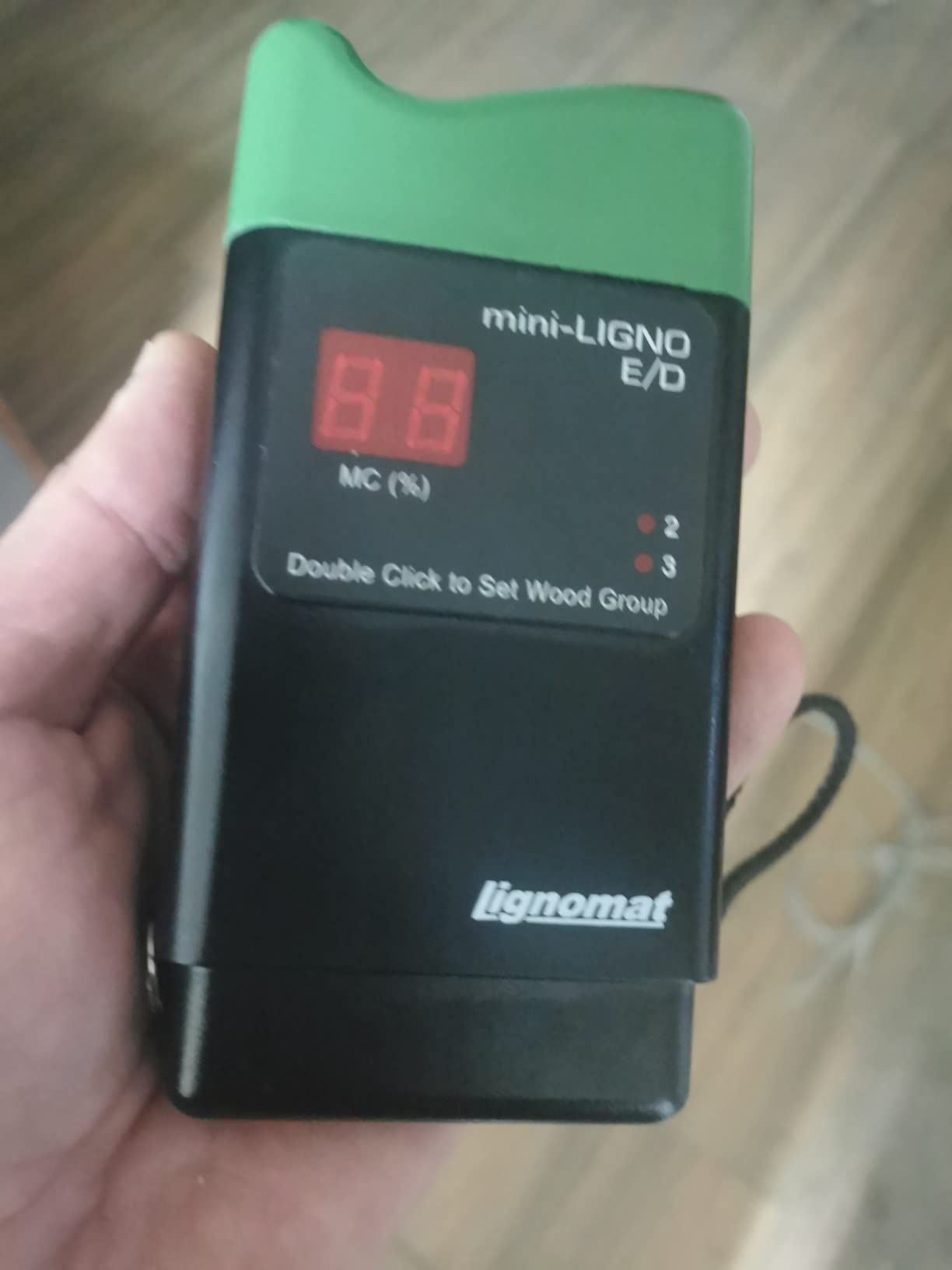
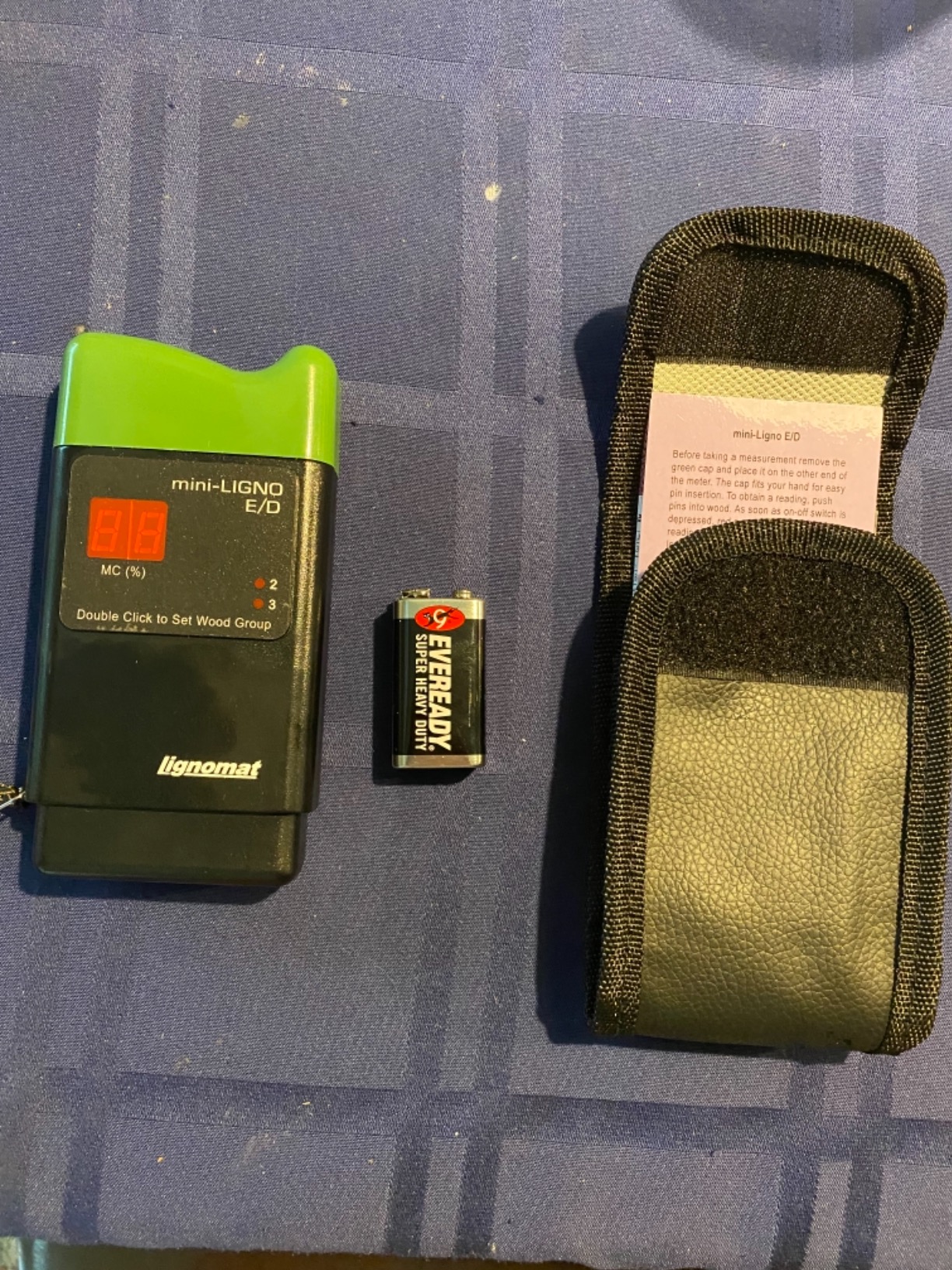
Lignomat is the brand that comes up most often in woodworking forums when anyone asks who makes a good flooring meter, and the mini-Ligno E/D is the entry point into that line. At 6 ounces with a belt holster and single-button operation, it disappears into a pocket and gives you a reading in about two seconds.
The two built-in wood group settings – group 2 for hardwoods, group 3 for softwoods – with automatic calibration on selection give more consistent readings than an uncalibrated budget pin meter. Users report it tracking expected seasoning levels across fir, pine, cedar, oak, maple and walnut.
Two pin lengths at 5mm and 10mm let you take a shallow surface reading or push deeper, which is a real advantage on a floor where you want to know whether the moisture is in the surface or throughout the board. The cap fits on the opposite end and doubles as a push block for seating the probes.
Reading in about two seconds matters when you are taking twenty readings across a floor and a subfloor before an install window closes. The single-button design means there is no mode cycle to get wrong.
Why the specialist brand matters
Reviewers who know the higher-end Lignomat in-situ models treat this as an accurate entry point for in-home hardwood flooring checks – adequate for matching hardwood and subfloor moisture content within industry tolerances, without temperature correction or per-species calibration.
Single-button operation is underrated on a job. There is no mode cycle to get wrong while you are holding a flashlight in your teeth.
Where the mini-Ligno falls short
There is no built-in temperature sensor, so you use the printed correction table in the manual. Temperature compensation is on the deal-breaker list that forum users keep, and this meter does not have it.
Only two wood groups means exotic species can read a couple of percent off. Battery and pin changes require taking the case apart and the circuit board is not retained, and one unit arrived with a dead battery. The included pin sets also feel weak for deep penetration into dense flooring.
12. Lignomat Ligno-Scanner SD – Best for Engineered Flooring
Lignomat Ligno Scanner SD Pinless Moisture Meter – Wood Moisture Meter for Different Wood Species, Panels and Floor Planks – Dual-Depth Humidity Tester for Woodworking & Flooring
Dual-depth scanning at 1/4 inch and 3/4 inch
Calibration for engineered panels and floor planks
Battery-free with self-calibration on power-up
+ The Good
- Dual 1/4 inch and 3/4 inch depth readings in one tool
- Pinless scanning leaves no pin holes in finished flooring
- Self-calibrating with a large display showing species and depth
- Calibration specialised for engineered panels and floor planks
- Battery-free so nothing fails on a damp job site
- The Bad
- Costs several times more than pin-type meters in this roundup
- Small review base of 111 ratings so long-term field data is limited
- No dedicated building-material or drywall mode compared with some competitors
The Ligno-Scanner SD is the reason this roundup recommends spending at the top end. Dual-depth technology with 1/4 inch and 3/4 inch depth settings is the specific workflow the flooring industry uses on engineered product, and no other meter in this list offers it.
Here is the problem it solves. Engineered flooring is a thin hardwood wear layer bonded to a softer core. A shallow scan at 1/4 inch isolates that wear layer; a deeper scan at 3/4 inch tells you what the board as a whole is doing. If the two disagree, the floor is going to move, and a single-depth meter cannot show you that.
Calibration is specialised for engineered panels and floor planks, not just generic wood. The display is large and shows the moisture percentage, the wood species setting and the depth you selected, so there is no ambiguity about what you just measured.
Why dual depth changes the decision
It is the difference between measuring the floor and measuring the floor correctly. On solid hardwood, 3/4 inch is generally the answer. On engineered, you need both numbers and you need to compare them.
Self-calibrating on power-up and battery-free operation are both practical wins. There is no battery to fail in a damp crawlspace and no startup state to forget, which removes a whole category of small daily annoyances.
Where the Ligno-Scanner SD falls short
It costs several times more than the pin-type meters in this roundup, and the review base is small at 111 ratings, so long-term field data is limited. Owner feedback that exists is consistently favourable on accuracy and display readability.
There is also no dedicated building-material or drywall mode compared with several competitors here, so it is a wood instrument. If you need to read a concrete slab or trace a leak behind drywall, you need something else alongside it.
How to Test a Subfloor Before Installing Flooring
The measurement pass is quick once you have a pattern. Here is the workflow our team used, and it matches the advice from people who own a wood moisture meter for general woodworking and forum readers describing the same job.
1. Set the conditions first. Check indoor relative humidity and temperature before you check wood. If RH is outside 30-60%, the readings you take will not describe a stable environment and no meter fixes that. HVAC first, always.
2. Check the meter. If your model has a calibration check in the cap or a self-test, run it. Bosch, Mecurate and the Lignomat models all support some form of this. Five seconds here saves an argument later.
3. Scan, do not spot-check. With a pinless meter, sweep the entire floor in a grid rather than testing the corners people assume are wet. Damp often comes from a plumbing line or a rim joist in the middle of a wall, not from the visible edge.
4. Mark the highest reading. Record the highest numbers you see and their locations, not the average. An average hides the failure. One wet corner is enough to delay an install.
5. Confirm with pins. Take pin readings at the marked spots, on the subfloor and on the flooring itself. Push the pins in fully and wait for the number to settle. Confirming on both surfaces is the only way to verify the acclimation gap.
6. Compare the two numbers. The flooring and subfloor should be within 2% to 3% of each other. Closer than that, you can install. Wider, you cannot, no matter what either meter says.
7. Read both depths on engineered. If the floor is engineered, take a 1/4 inch and a 3/4 inch reading on the same spot. A large divergence between them is a red flag that a single-depth scan would miss entirely.
8. Write it down with dates. Record location, depth, meter model and reading for every point. Documentation is what protects you if the floor moves six months later, and it is the step everyone skips and then regrets.
On a slab subfloor, none of the above replaces an in-situ relative humidity test. Use the wood meter to verify the flooring itself, and let RH probes handle the slab.
Moisture Meter Buying Guide for Flooring Work
Decide what you are measuring before you decide what you are buying. A DIY homeowner installing a solid oak floor over a plywood subfloor needs a different meter than an inspector documenting water damage, and the second case is where accuracy starts to matter more than price.
Pin or pinless? Both, if you can. Pinless to scan and find, pin to confirm and document. If you can only have one, a pin meter with species settings gives you the number you will have to defend, at the cost of leaving holes.
Depth. A single-depth pinless meter reads roughly 3/4 inch. That is fine for solid wood and useless for engineered flooring, where you need to isolate the wear layer. Dual-depth is the feature to pay for if engineered or bamboo is in your scope.
Species calibration. More wood groups means better accuracy on dense species like walnut and teak, which is where uncalibrated meters diverge most from the truth. Two groups is workable. Eight is genuinely useful. Per-species tables are better still.
Calibration check. A built-in check in the cap or a self-test is the cheapest quality signal you can get, and users on forums are openly skeptical of meters without one. Prefer a meter that can be verified in the field.
Temperature compensation. Wood conductivity changes with temperature, and a meter that does not compensate will read differently in a cold crawlspace than in a warm room. Few meters in this price band have it, so know the correction rather than assuming it is handled.
Display and logging. A backlit screen and a hold button are not luxury features on a job site. Hold lets you press, look and write in that order instead of memorising a number. Bluetooth and app logging matter if you are producing reports for clients or warranty claims.
Build and warranty. Pin meters need replaceable pins, because pins bend and corrode. A warranty of two years or more is a reasonable durability proxy, and brands with replaceable parts and real support are worth a small premium when you are buying tools for work rather than a single afternoon.
Our broader guides cover digital moisture meter kits if you are also working in wet spaces, and light meters if you are checking a room’s conditions before acclimation, since poor lighting is a leading cause of misread meter displays.
Frequently Asked Questions
What is the ideal moisture meter reading for hardwood floors?
The standard installation range is 6% to 9% moisture content for solid hardwood, with 10% to 12% treated as the practical maximum. Below 6% the boards will take on moisture from the air and later show joint gaps, and above 10% the core is still wet enough to cup the floor after installation. The flooring and the subfloor should also be within 2% to 3% of each other before you start.
Which is more accurate, pin or pinless moisture meter?
A pin meter is more accurate at a single point because it measures electrical resistance directly between two electrodes in the wood. A pinless meter reads a deeper volume non-destructively but returns a relative figure, and dense or dark species can skew it. In practice installers scan with pinless to find outliers and confirm with pins, which is why owning both gives the most defensible readings.
What is the most accurate moisture meter for engineered wood flooring?
A dual-depth pinless meter is the right tool, because engineered flooring needs two numbers. A 1/4 inch reading isolates the hardwood wear layer and a 3/4 inch reading shows what the whole board is doing. If those two diverge, the floor will move after installation. The Lignomat Ligno-Scanner SD is the meter in this roundup built specifically for that workflow.
Are pinless moisture meters worth it?
They are worth it when you have a floor to scan, because they cover 3/4 inch in a few seconds and leave no pin holes in boards that are already installed. For sorting firewood or a single spot check, a pin meter is more accurate for less money. The premium only pays off if you want depth control, species calibration or logged readings rather than basic detection.
What are the common problems with wood moisture meters?
The most common problems come from the material, not the device. Metal screws, joists and wiring pull pinless readings up. Dense dark species like walnut and teak over-read on meters without species tables. A flat sensor pad cannot read a corner and often jumps to its maximum. Coatings, sealants and foil-backed underlayment also change readings. With pin meters, the usual error is not seating the probes fully, which reads low.
Is 10% moisture in wood bad for a floor?
Ten percent is at the top of the acceptable range and inside the risk zone for most installations. The standard is 6% to 9%, with 10% to 12% treated as the practical ceiling. In dry regions installers sometimes accept up to 12%, and in humid regions the target moves down. If a subfloor reads above 10%, remediate and wait rather than installing into it, because the warranty risk is yours.
The Best Moisture Meters for Wood Flooring in 2026
The best moisture meters for wood flooring fall into two clear groups, and picking between them is mostly a question of what you are measuring. For a general subfloor and acclimation pass, the General Tools MMD4E is the meter to own: it is the most widely reviewed unit we tested, it covers both wood and building materials on one scale set, and its protective cap doubles as a calibration check.
For fast non-destructive scanning, the Klein ET140 and the Proster PST199-P both read 3/4 inch deep and leave no holes, and either will map a damp area or an acclimation gradient faster than any pin meter. If you want one body to do both jobs, the RDINSCOS MT35P combines pinless and pin readings with a rechargeable battery.
Where the money genuinely changes the outcome is engineered flooring. The Lignomat Ligno-Scanner SD reads at both 1/4 inch and 3/4 inch with calibration built for engineered panels and floor planks, and no single-depth meter in this roundup can substitute for it. The Bosch UniversalHumid and the Mecurate WMM are the picks if you want a go or no-go verdict rather than a raw percentage.
Whatever you choose, remember the numbers that actually decide the job: 6% to 9% for the floor, 10% to 12% as the ceiling, and a maximum 2% to 3% gap between the flooring and the subfloor. A meter tells you where you stand on those thresholds. The discipline of measuring the whole floor, confirming the highest reading, and writing it down is what keeps the floor intact. Use the buttons above to check current availability for the models that fit your scope.