
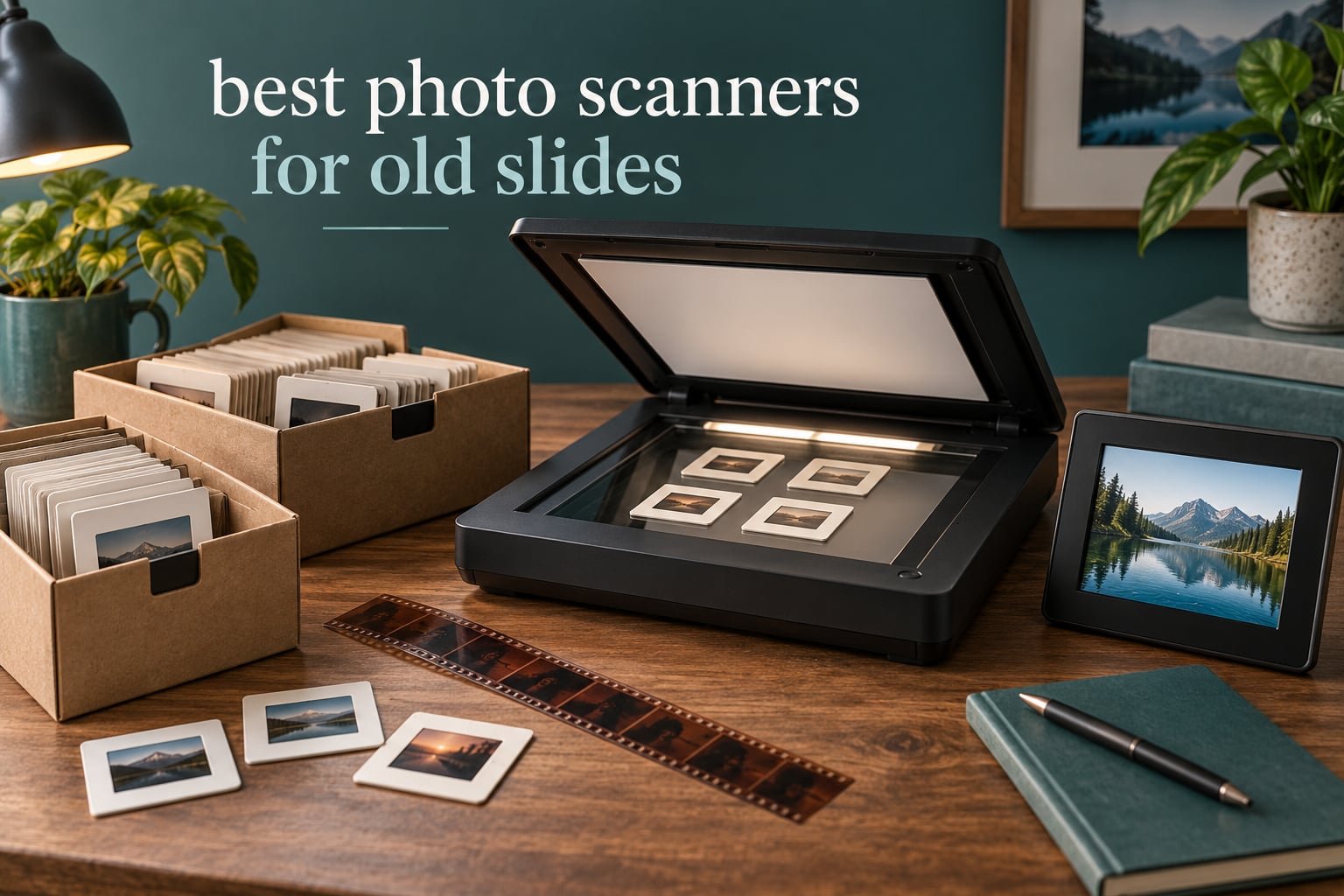
My grandmother’s slide collection came in a shoebox, then two cardboard cartons, then a plastic bin that finally broke my patience. Somewhere in there were 1,400 mounted 35mm slides from the 1970s, a set of unmounted strips someone had cut apart badly, and about 60 frames with a magenta cast that made everyone look faintly unwell.
That is the situation most people are actually in when they search for the best photo scanners for old slides. The print-scanning advice online assumes a stack of 4×6 prints. Slides are a different job entirely, and the machine that scans a shoebox of photos at a second a pop will happily produce a black rectangle for every slide you feed it.
So this roundup is built around one question first: can it actually read film? Every product below states plainly whether it handles mounted 35mm slides, unmounted strips, 110 and 126 formats, negatives, prints, or some combination. Only then do we get to resolution, dust removal and throughput. Prices are shown on the product buttons rather than here, since they move weekly.
One housekeeping note. Plenty of searchers type “old slides” meaning playground equipment. If that is you, start with our guide to the best indoor toddler slides and truck bed slides instead. Everything below is about celluloid.
Top 3 Picks for Slide Scanners for Old Slides in 2026
All three of those are standalone converters that light film from behind and save to an SD card, which is why they top this list. A serious flatbed with a transparency unit gives you better shadow detail and dust handling, but none of them moves through a shoebox the way these three do.
10 Best Photo Scanners for Old Slides (October 2026)
| PRODUCT MODEL | KEY SPECS | BEST PRICE |
|---|---|---|
 |
|
Check Latest Price |
 |
|
Check Latest Price |
 |
|
Check Latest Price |
 |
|
Check Latest Price |
 |
|
Check Latest Price |
 |
|
Check Latest Price |
 |
|
Check Latest Price |
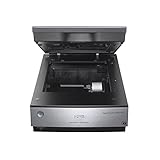 |
|
Check Latest Price |
 |
|
Check Latest Price |
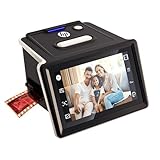 |
|
Check Latest Price |
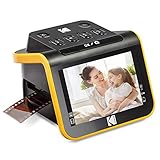
1. KODAK Slide N Scan: The Best Photo Scanner for Old Slides Overall
KODAK Slide N Scan Film & Slide Scanner, 22MP, 5″ LCD Screen, 135/110/126mm
22 megapixels
5-inch LCD
135 110 126 and 50mm
Saves to SD or SDHC card
+ The Good
- Bright 5-inch screen makes framing and editing easy
- Converts long strips quickly with the quick-feed tray
- Handles 135 110 126 film plus a 50mm slide holder
- Doubles as a digital picture frame in gallery mode
- The Bad
- Film type must be re-selected after every power cycle
- Scans crop roughly 10 percent off the top and bottom
- Fills a 32GB card fast
- Files land on the card rather than streaming to a computer
This is the unit I would hand to a relative with a shoebox and no technical background. You load the tray, the frame appears on the 5-inch screen immediately, one button saves it, and the next frame slides in. Owners consistently report converting a thousand or more frames in a single sitting, which matches what you need from a decade of family slide boxes.
Screen size does more work here than it sounds. On a 3.5-inch panel you squint; on 5 inches you can check framing, brightness and focus before committing a file to the card. The on-device controls for film type, colour, brightness and date mean no computer, no drivers, no software to install.
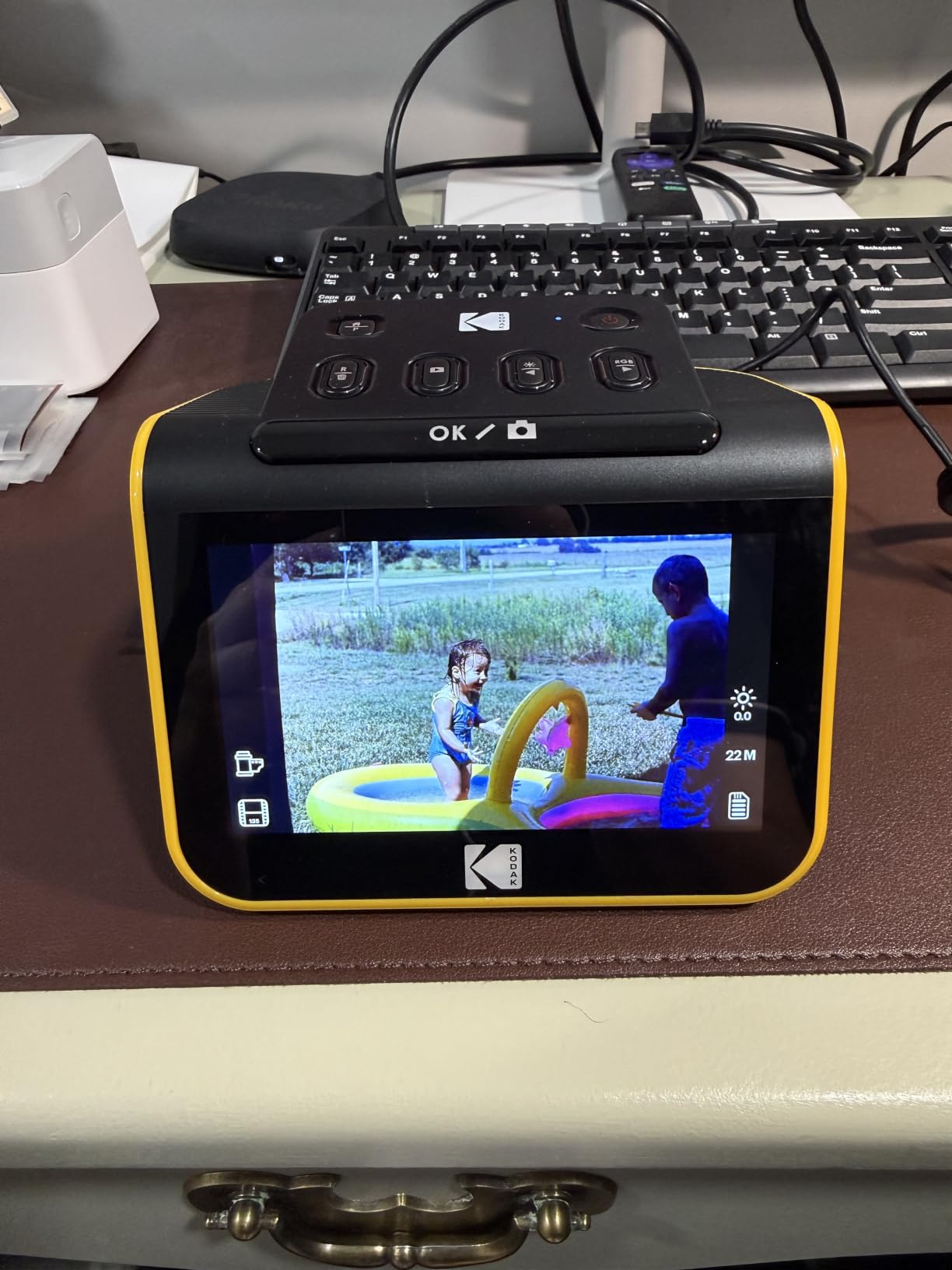
The 22 megapixel sensor is a CMOS, not a CCD, so do not expect the deep blacks and narrow depth of field a film-dedicated CCD gives you. For family snapshots at print and screen sizes that difference rarely shows. For a Kodachrome slide you intend to blow up large, it can show in the shadows.
Three workflow quirks trip people up. The film type resets each time you power on, which is mildly irritating at 400 slides. The scan crops about 10 percent off the top and bottom of the frame, so plan your framing accordingly. And everything saves to an SD or SDHC card capped at 32GB, so you will be moving files off the card as you go.

Who this slide scanner suits
Anyone with several hundred to a couple of thousand slides who does not want to learn software, own a color-managed workflow, or sit at a desktop. If your collection is loose 135 film, 110, 126 or standard 50mm mounts, the included adapters cover it, and the gallery mode makes it usable as a screen for relatives who want to see the pictures without a computer.
Where it falls short
It is a converter, not a scanner, in the technical sense. There is no transparency unit, no infrared dust channel and no software dust removal, so dust on the original shows in every frame. Reviewers also note that color and sharpness vary from frame to frame, so expect to spend real time in a photo editor afterwards if you want a consistent set. Colour-critical archival work belongs on a film-dedicated machine.
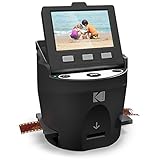
2. KODAK SCANZA: Best Value for Older and Smaller Film Formats
KODAK SCANZA Film & Slide Scanner, 3.5″ LCD, 35mm, 126, 110, Super 8 & 8mm
14 or 22MP output
3.5-inch tilt LCD
35mm 126 110 Super 8 and 8mm
CCD sensor
+ The Good
- Handles Super 8 and 8mm film as well as still formats
- One-touch scan and save buttons keep it simple
- Cleaning brush and cables included in the box
- Works on both Mac and PC
- The Bad
- 3.5-inch screen is small against newer 5-inch units
- SD card not included and sold separately
- Adapters only cover the listed formats
- Bundled inserts suit common slide sizes only
The SCANZA is the one I keep coming back to in forum threads, and it earns the place. A commenter in a Cincinnati community group recommended it by name for working through a large box, and that matches the design: push the strip in, hit scan, hit save. It converts long runs of 35mm without the software round-trip that slows a flatbed.
Its real advantage is format reach. Alongside 35mm and mounted slides, the included inserts cover 126, 110, Super 8 and 8mm motion film. If your collection includes home movies on small-gauge stock, this handles them in the same session, which almost nothing else in this price bracket does.
Two technical details worth knowing. First, the sensor is a CCD, which gives better depth of field and colour accuracy than the CMOS in the Slide N Scan, so slightly curled or textured film focuses more evenly. Second, the resolution field is listed at 7200 with 14 or 22MP output depending on the setting, and the SD card slot accepts up to 128GB, so a whole box can sit on one card.
The tiltable 3.5-inch LCD has adjustable brightness, which matters when you are judging a dim Kodachrome under tungsten light. Built-in RGB, resolution and gallery editing handle most corrections on device. You still need to buy an SD card, and the screen is the first thing people wish were bigger.
Who this slide scanner suits
Households with mixed formats, especially anyone who inherited Super 8 or 8mm home movies alongside slides. It also suits people who want a simple weekend project: no computer configuration, no calibration step, no account to create. Buyers who already own a modern DSLR can do fine framing work by shooting the display instead.
Where it falls short
The smaller screen makes careful inspection of dust and focus harder than on a 5-inch unit. There is no infrared dust detection, so cleaning the originals and the scanner path before you start is not optional. And because the inserts are fixed, uncommon mounts or thick glass slides will not fit without modification.
3. Magnasonic FS71: Best Budget Standalone Film Converter
Magnasonic All-in-One 24MP Film Scanner with Large 5″ Display & HDMI, Converts 35mm/126/110/Super 8 Film & 135/126/110 Slides into Digital Photos (FS71)
24 megapixels
5-inch LCD and HDMI
128MB memory plus SD slot
No computer required
+ The Good
- Big 5-inch screen for the money
- Each frame captures in under five seconds
- No computer software or drivers at all
- Brightness and RGB correction on device
- The Bad
- SD card not included and effectively required
- HDMI cable not included for TV viewing
- 128MB built-in memory is small
- CCD sensor in a plastic body feels basic
The FS71 is the cheapest way I know to put a 5-inch screen in front of a pile of slides. It converts 35mm, 110 and 126 negatives plus 135, 126 and 110 mounted slides, captures each frame in under five seconds with the fast-loading trays, and runs entirely standalone. Nothing to install, no drivers to chase.
On-device controls cover brightness, RGB correction, flip and mirror, which removes most of the reason people need a computer afterwards. The 128MB of internal memory holds a working batch, and the SD slot takes up to 128GB for bigger collections.
The 24MP output is the highest headline number among the converters here, and it is the reason this one undercuts its rivals on paper. Read it as a convenience figure though. A standalone converter’s real limit is glass quality and focus, not the marketing megapixel count, and a CCD in a plastic shell will not match a metal film-dedicated unit on shadow density.
Two practical notes. The SD card is not in the box, and without one the built-in memory fills quickly, so budget for that as part of the setup. The HDMI cable is also absent, which only matters if you want to run the gallery on a television.
Who this slide scanner suits
First-time digitizers, students, and anyone who wants to see slides appear on a screen without touching a computer. It suits small collections, a single shoebox of family snapshots, or a first pass to sort what is worth re-scanning on better hardware later. The 1-year manufacturer warranty is a little thin next to some rivals.
Where it falls short
No dust removal of any kind, no transparency unit, no batch scanning beyond a manual feed, and no way to stream files to a computer while you work. Colour accuracy depends entirely on the automatic RGB correction, which is decent on clean film and weaker on faded or colour-shifted slides from the 1970s.
4. Epson Perfection V550: Best Flatbed for Prints and Film Together
Epson Perfection V550 Color Photo, Image, Film, Negative & Document Scanner with 6400 DPI Optical Resolution
6400 dpi optical
Built-in transparency unit
48-bit color depth
Digital ICE dust removal
+ The Good
- Transparency unit handles 35mm slides with no accessories
- 6400 dpi supports enlargements to 17 by 22 inches
- Digital ICE plus one-touch Photo Fix restore faded originals
- Auto edge detection splits multi-photo layouts
- The Bad
- Software-driven film handling is slower than a one-touch converter
- Rubber lid gasket wears out and is awkward to replace
- 6400 dpi is impractical for bulk slide runs
This is the flatbed to buy if your boxes contain both prints and slides. The transparency unit is built into the lid, so film goes straight onto the glass and gets lit from behind, and the same machine handles 8×10 prints, documents and 35mm slides without swapping hardware.
The 6400 dpi optical resolution is real rather than interpolated, and 48-bit color depth gives you room to grade in post. Digital ICE handles dust and scratches, while one-touch Photo Fix is genuinely useful on faded prints that have gone yellow with age. Auto edge detection crops a multi-photo sheet into separate files.
ReadyScan LED means no warm-up time and no mercury lamp, which matters when you are scanning in short bursts across several evenings. Owners also rate the scan quality highly for prints up to 8×10 and for enlargement work.
The compromise is workflow. Film handling here is software-driven and noticeably slower than feeding a strip through a standalone converter, and scanning at 6400 dpi is impractical for a large batch of slides. If you have thousands of frames, this is the wrong tool for the film half of the job.
Who this slide scanner suits
Mixed collections under a few hundred slides, plus a heavy load of prints and documents. It suits people who already colour-manage their workflow and want one machine for everything. Genealogy is a good fit, since 48-bit scanning leaves headroom for scanning handwritten notes on the back of prints.
Where it falls short
It cannot scan media larger than A4 plus a little, and it holds only one slide or strip at a time. The rubber lid gasket is a known wear item with no easy replacement path. For volume, a converter in front of this machine would finish the slides in a fraction of the time.
5. Plustek OpticFilm 8200i SE: Best for 35mm Film Detail
Plustek OpticFilm 8200i SE , 35mm Film & Slide Scanner. 7200 dpi / 48-bit Output. Integrated Infrared Dust/Scratch Removal. Bundle Silverfast SE Plus 9 , Support Mac and PC.
7200 by 7200 dpi optical
48-bit input
Infrared dust channel
Multi-exposure 3.6 dynamic range
+ The Good
- 7200 dpi optical resolution pulls real detail from 35mm frames
- Infrared channel finds dust and scratches automatically
- Multi-exposure lifts dynamic range for smoother tones
- SilverFast SE Plus 9 and QuickScan bundled
- Mac and Windows both supported
- The Bad
- No built-in screen so a computer is mandatory
- Bundled software has a steep learning curve
- Only a 1-year limited warranty
- One frame at a time
This is a dedicated 35mm film and slide scanner, and it treats the job properly. Film sits in a carrier, gets lit by an LED array, and moves across a fixed CCD at 7200 by 7200 dpi optical resolution. That is 69 megapixels of real detail rather than an interpolated figure.
The infrared channel is the feature owners care most about. It reads the film a second time in infrared, where dust and scratches block the beam differently from image data, so the software can map defects and repair them without guessing. Multi-exposure captures the frame twice at different exposures and merges them, lifting effective dynamic range to 3.6 for smoother shadow gradation.
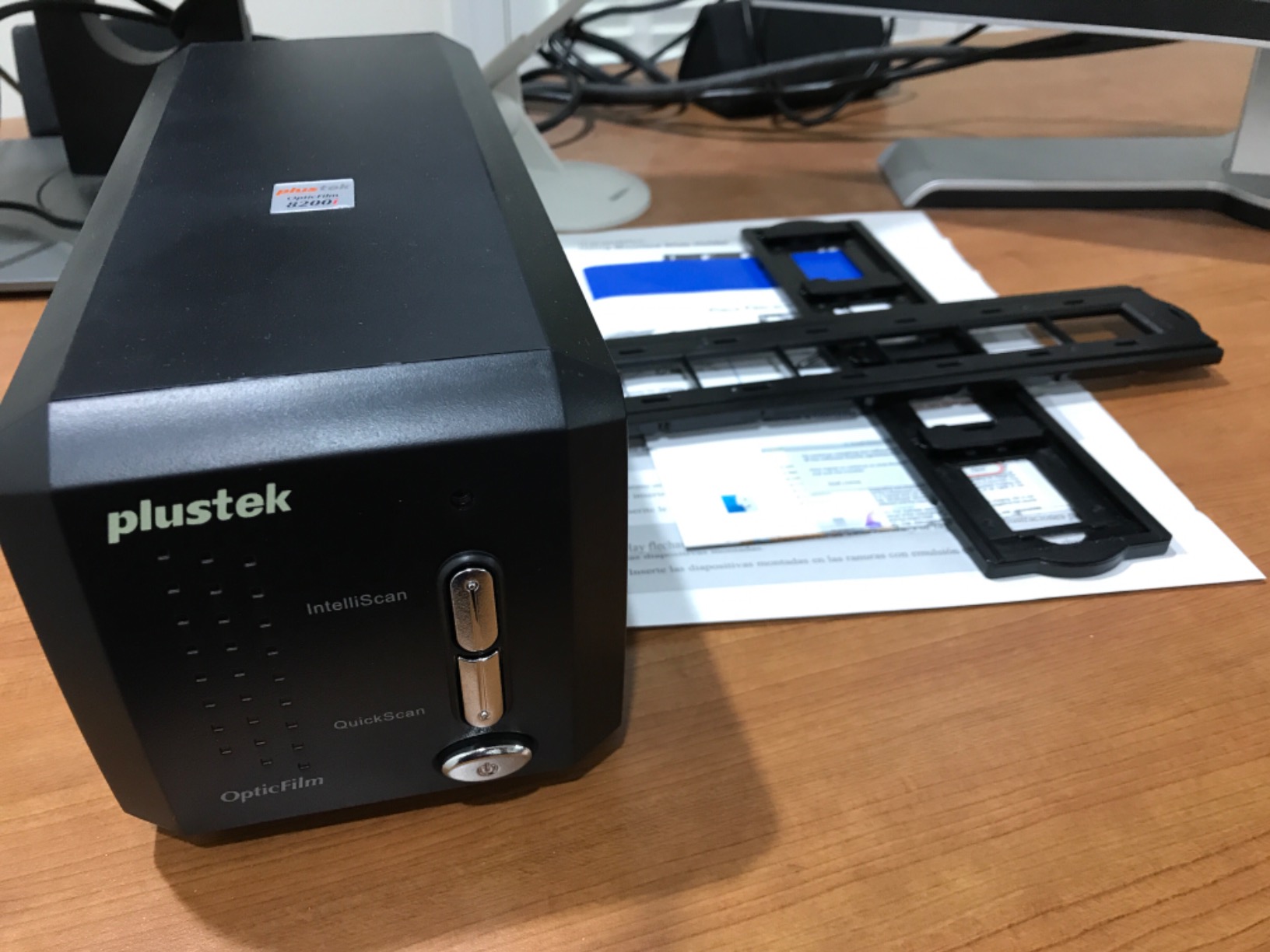
SilverFast SE Plus 9 and Plustek QuickScan ship in the box and both run on Mac and Windows. SilverFast is the serious option, giving you per-channel curves and a real scanning workflow, but it takes time to learn and some users find it slow on large jobs.
There is no built-in screen, so every scan is driven from a computer. The workflow is deliberate rather than fast: load one frame, set the software, preview, save. For an archive where you intend to look at each slide once, properly, that is the point.

Who this slide scanner suits
Anyone digitizing 35mm negatives and slides who cares more about the master file than about finishing this weekend. It suits slide shooters whose own scans they want to match or exceed, and institutions handling a bounded collection with staff time to supervise the process.
Where it falls short
It handles 35mm film and mounted slides, not prints, and it is single-frame. On a 5,000-slide shoebox this is a multi-week commitment. The one-year limited warranty is thin for hardware you might keep for a decade, and the learning curve is real if you have never run scanning software.
6. Epson Perfection V600: Best for Medium Format Film Alongside Slides
Epson Perfection V600 Photo Wired USB Connectivity Color Scanner – 6400 x 9600 dpi, Enlargements up to 17″ x 22″ Flatbed Image Scanner
6400 by 9600 dpi maximum
Transparency unit holds 4 slides or 12 negatives
Medium format to 6 by 22cm
CCD sensor
+ The Good
- Holds 12 negatives or 4 mounted slides per load
- Handles medium format film up to 6 by 22cm
- Digital ICE clearly outperforms the standard dust setting
- ReadyScan LED needs no warmup
- Four customisable one-touch buttons
- The Bad
- Slow at high settings for large slide batches
- Slide holder is a stencil loaded one slide at a time
- Epson Scan can crash unless run as administrator
- Starter software dust removal is weak
The V600 is the flatbed that serious film photographers point to when the collection includes 120 medium format. It supports medium-format film up to 6 by 22cm as well as 35mm, which is beyond what most transparency-unit flatbeds cover, and the CCD sensor handles the larger frame with even focus.
The transparency unit takes 12 negatives or 4 mounted slides per load, which is the practical difference between a batch job and a long afternoon. Digital ICE is singled out by long-term users as dramatically better than the default dust removal, particularly on film that has been stored in a hot attic.
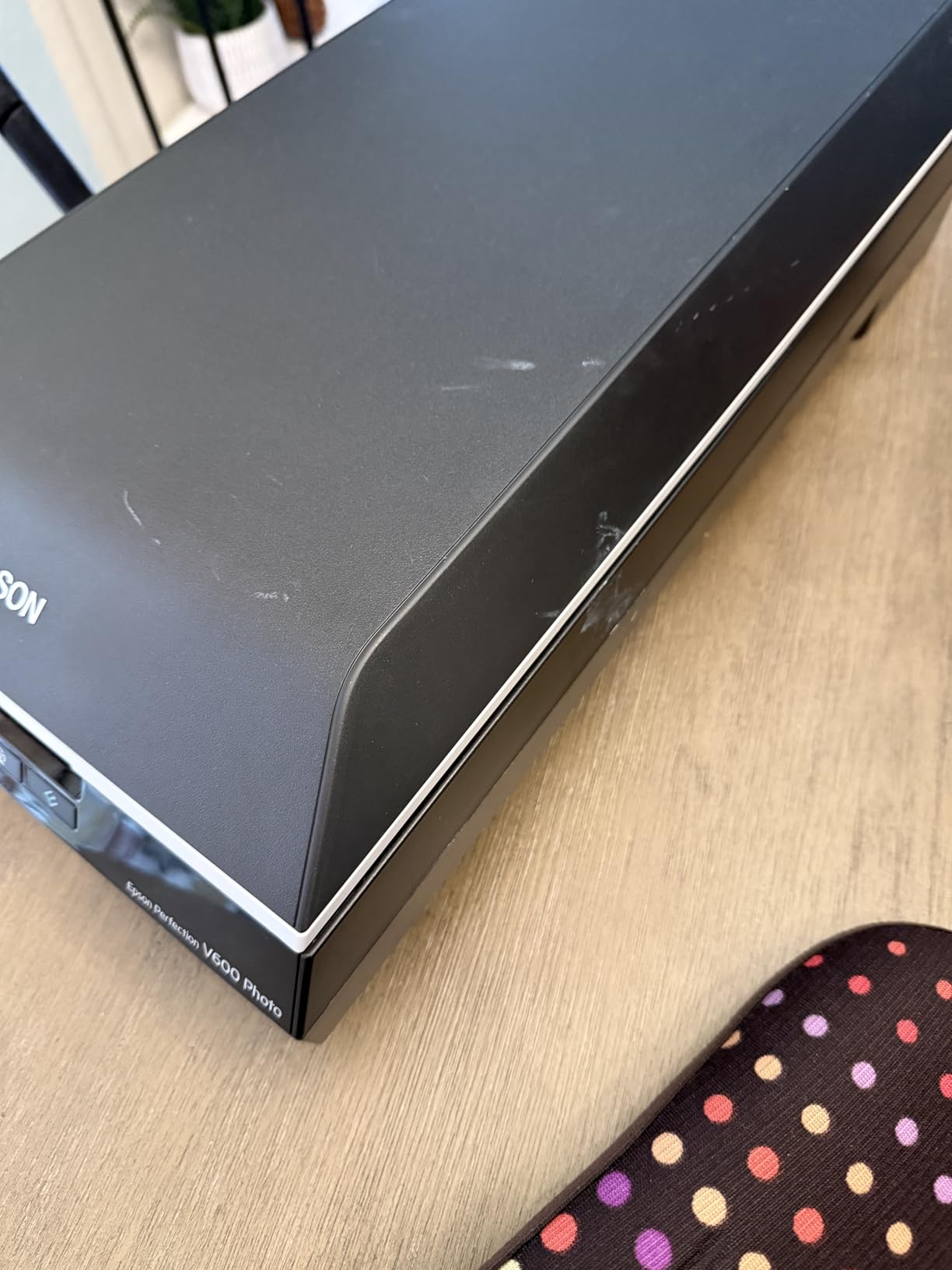
ReadyScan LED means instant-on scanning with no lamp warm-up, and four customisable one-touch buttons let you save separate profiles for negatives, mounted slides, prints and documents. Media up to 8.5 by 11.7 inches is covered, so prints still work.
The honest drawback is speed. At high resolution each strip takes minutes, and the slide holder is a stencil, so slides go in one at a time even though negatives batch nicely. Epson Scan also has a reputation for needing administrator rights to launch cleanly.
Who this slide scanner suits
Holders of mixed 35mm and medium format film who also have prints to deal with. It suits hobbyists who want to scan their own negatives for printing and web use rather than purely for preservation. Four one-touch profiles also make it quick to alternate between media types.
Where it falls short
It is a 20.9-pound class of machine with a big footprint, and it wants a desk and a computer. For a collection of a thousand mounted slides, the four-up slide stencil becomes the bottleneck. Color restoration does rescue faded magenta-shifted slides, but it takes a couple of passes to get right.
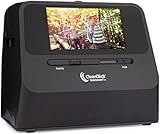
7. ClearClick QuickConvert 2.0: Best for Scanning Photos Without Removing Them from Albums
ClearClick QuickConvert 2.0 Photo, Slide, and Negative Scanner – Scan 4×6 Photos & 35mm, 110, 126 Film – No Computer Required – 22 MegaPixels
Photos slides and negatives in 2-3 seconds
14MP native with 22MP interpolated
Rechargeable battery
5-inch preview LCD
+ The Good
- Captures each item in 2-3 seconds with no computer
- Built-in rechargeable battery means cord-free use
- Scans prints without removing them from album sleeves
- 2-year warranty with US-based support
- The Bad
- No auto feeder so every item is loaded by hand
- Does not handle 5 by 7 prints
- 22MP figure is interpolated from a 14MP sensor
- Preview screen smaller than some rivals
The QuickConvert is the only unit here that treats bound albums as a first-class case. Its 5-inch preview LCD sits over the surface so you can capture 4×6 prints, 35mm slides, and 35mm, 110 and 126 negatives one at a time in two to three seconds, without lifting anything out of a sleeve or removing a print from a mount.
The rechargeable battery is the detail that changes the job. Unplugged, you can walk a set of albums around the house, capture pages in order, and save to an SD card. No computer on the desk, no USB cable, no software.
Be precise about the resolution: effective output is about 3824 by 2512 pixels, 14MP native, with 22MP interpolated. That is plenty for a web gallery and a small print, and short of what you would want for a large archival enlargement. The CIS sensor keeps the unit small and fast.
There is no auto feeder, so each item is loaded by hand, and 5 by 7 prints are out of scope. For a few hundred items that is fine. For a few thousand, the loading becomes the whole project.
Who this slide scanner suits
People with physical albums they want preserved page by page, rather than dismantled. It suits casual digitizers, and it suits mixed collections where prints matter as much as film. The 2-year warranty and US-based support are the strongest in this group.
Where it falls short
Hand loading means throughput falls off badly above a few hundred items. The interpolated resolution caps your long-term archival ceiling, and there is no infrared dust detection, so cleaning originals first matters more here than on a film-dedicated unit.
8. Epson Perfection V850 Pro: Best for Maximum Archival Detail
Epson Perfection V850 Pro Photo Scanner, 6400 dpi, Dual Lens, Digital ICE
6400 dpi professional output
4.0 Dmax dynamic range
Dual lens system
Digital ICE film cleaning
+ The Good
- 4.0 Dmax gives the smoothest gradations and shadow detail in this group
- Dual-lens system picks the right optic per job
- Digital ICE removes dust and scratches from film
- Handles slides negatives medium format and flatbed media
- 75 percent of reviews are five star
- The Bad
- Heavy and bulky at 20.9 pounds
- Needs a computer and desktop software
- Software can be demanding on older operating systems
- Listed support ends at Windows 8.1 and Mac OS X 10.10
Nothing else in this roundup matches the V850 Pro on shadow detail, and the reason is density rather than resolution. A 4.0 Dmax rating is what separates a scan that holds smooth gradation in the dark parts of a slide from one that posterises into blotches.
The dual-lens system selects between two lenses depending on the job and the media, so prints and film are each handled by an optic suited to them. Digital ICE cleans dust and scratches off film, and the same transparency unit handles slides, negatives and medium format alongside flatbed media up to A4.
Owners treat this as reference-class hardware, and 75 percent of its reviews are five star. It is the machine we would choose for a collection where the digital copy is meant to outlast us.
It is also the most demanding. At 20.9 pounds it needs a real desk, it requires a computer and desktop software for every scan, and the listed OS support runs only to Windows 8.1 and Mac OS X 10.10. Confirm compatibility with your current machine before anything else.
Who this slide scanner suits
Archives, institutions, and families preserving a collection they intend to keep for generations. It suits anyone with medium format film alongside slides, and anyone who already works in colour-managed software such as VueScan and wants headroom in the file.
Where it falls short
It is large, heavy, tethered, and slow per slide compared with a converter. For a beginner with 200 slides and no software experience, the extra quality will never be seen. The footprint and the OS support are the two hard blockers for most households.
9. Plustek OpticFilm 8300i Ai: Best for Calibrated Colour Accuracy
Plustek OpticFilm 8300i Ai Film Scanner – Ai Studio 9 + Advanced IT8 Target
7200 dpi CCD
16-bit colour and greyscale
Advanced IT8 target
SilverFast 9 Ai studio
+ The Good
- Advanced IT8 calibration target reduces colour interpolation
- 16-bit depth captures very smooth tonal transitions
- Infrared iSRD plus HDRi and NegaFix in SilverFast
- New chip generation raises scanning speed by 38 percent
- USB flash drive included for installation
- The Bad
- SilverFast 9 Ai is powerful but steep to learn
- No built-in screen so a computer is required
- One-year limited warranty only
The 8300i Ai is the pick for people who need the colour to be right the first time rather than correctable later. It ships with an advanced IT8 calibration target certified to ISO 12641-2, and a compliant target means the software can calibrate the sensor without interpolating as it measures.
The sensor is a 7200 dpi CCD with 16-bit colour and greyscale depth, which is deeper than the 48-bit input on most flatbeds and gives much finer gradation in skies, skin tones and shadows. SilverFast 9 Ai studio adds infrared iSRD, HDRi, multi-exposure and NegaFix for colour-negative work.
A new chip generation raises scanning speed by 38 percent over the earlier model, which is meaningful when you are processing film rather than slides. It supports Windows and Mac, and the included USB flash drive handles installation on a machine without an optical drive.
There is no screen, so every frame is driven from a computer. The honest trade is capability against patience: NegaFix and multi-exposure produce excellent files, and both require you to know what you are doing.
Who this slide scanner suits
Darkroom users, film photographers matching their own work, and small archives with a colour-managed operator. It suits anyone who has been disappointed by magenta or green casts from other units and wants to calibrate against a physical target rather than eyeball it.
Where it falls short
Single-frame film handling on a tethered computer, a one-year warranty, and software that will punish an impatient operator. It is aimed at 35mm film, not prints, and not at large collections that need to be finished quickly.
10. HP FilmScan 5: Best Touchscreen Batch Scanning on a Budget
HP Film & Slide Scanner HPFS500, Negative Scanner, Slide Viewer, USB-C
13MP CMOS with 22MP interpolation
5-inch all-angle touchscreen
Quick-load tray
USB-C powered
+ The Good
- All-angle touchscreen makes preview and editing intuitive
- Accepts high-capacity SD cards so collections run off-PC
- Fast continuous feed pushes through hundreds of slides in minutes
- USB-C runs from a laptop
- power bank or 5V adapter
- Date and time can be stamped as metadata
- The Bad
- 13MP native resolution caps archival detail
- Date entry uses slow arrows that cannot go earlier than the 1970s
- SD card sold separately
- Scans usually need cropping and colour work in software
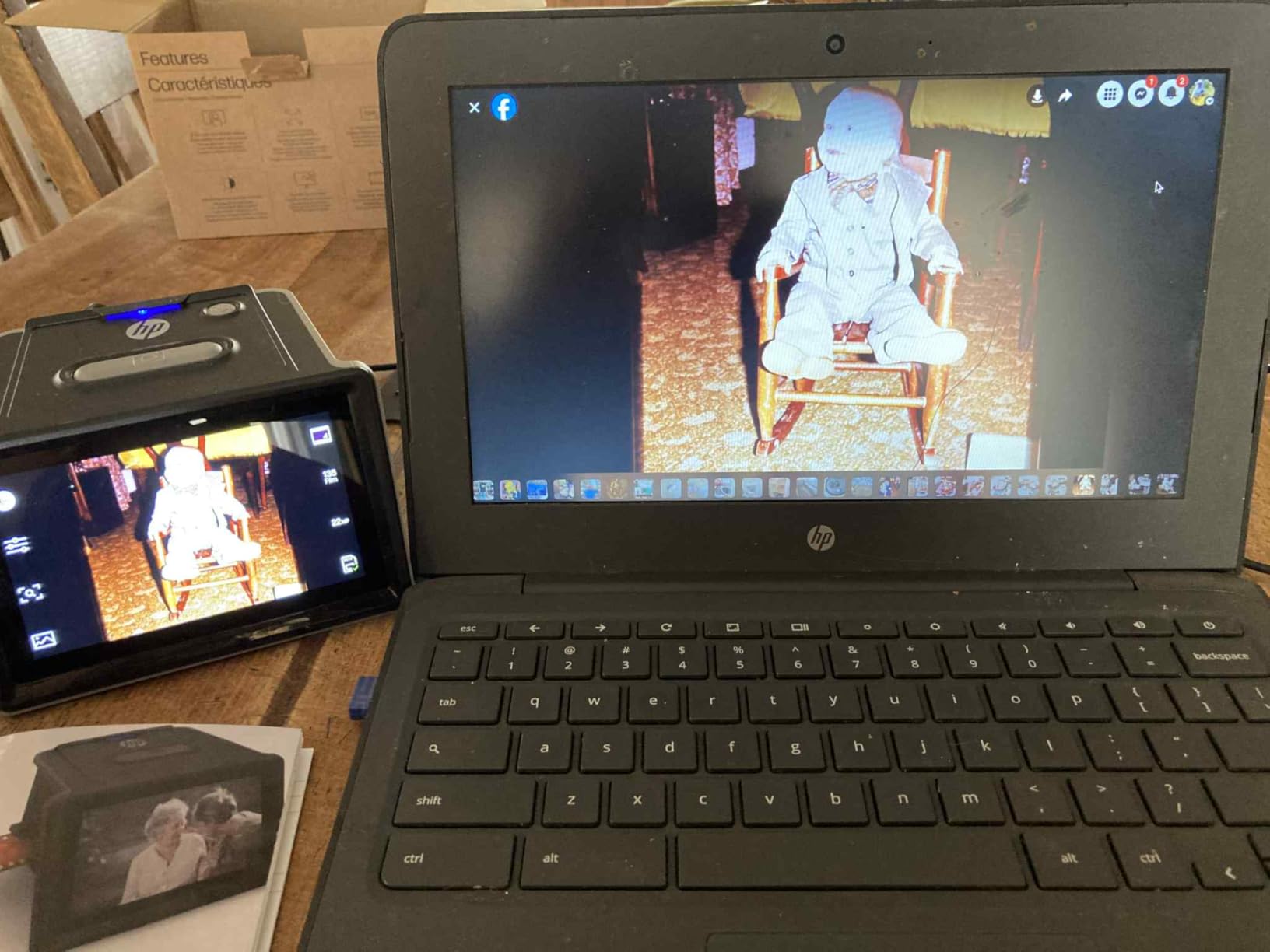
The FilmScan 5 is the newest-feeling converter here. The 5-inch all-angle touchscreen makes framing, editing and gallery browsing straightforward without digging through button menus, and the quick-load tray takes 135, 126 and 110 strips plus positive slides.
Its genuine advantage over the Kodak and Magnasonic units is large SD card support, so you can move through a big collection without staying tethered to a computer. USB-C means it runs from a laptop port, a power bank or a 5V adapter, which is convenient for sorting sessions away from a desk.
Users routinely report pushing thousands of slides through it quickly, and quality is judged good for sharing and for digital photo frames. Stamping the date onto captures as metadata is a small touch that helps when you are cataloguing by era.
Two limits are worth stating plainly. Native resolution is 13MP with 22MP interpolation, which is below the film-dedicated units on this list. And date entry uses up and down arrows that cannot go earlier than the 1970s, which is tedious if your collection starts before then.
Who this slide scanner suits
Anyone who wants slide-native scanning without a computer and prefers a touchscreen to buttons. It suits medium-sized collections where the large SD support matters, and it works alongside a laptop if you want to move files off the card periodically rather than after every session.
Where it falls short
13MP native is the ceiling, and reviewers report that scans often need cropping and colour correction afterwards. It has no dust removal, so cleaning slides first is essential. And the SD card is not included, so factor that into the setup.
How to Scan Old Slides: A 6-Step Workflow
The best way to scan old slides is to clean them first, sort by condition, confirm your format, load the correct holder, save as TIFF or JPEG at a sensible resolution, and back the results up in two places. Rushing any of those six steps is what produces disappointing archives.
Clean the slides and the scanner path. A blower and an anti-static brush take off surface dust in minutes. Mold needs a dedicated film cleaner and a separate tray, and you should keep moulded slides away from the rest of the collection.
Sort by condition before you scan. Put clean and dusty slides in separate runs, scan the fragile or colour-shifted ones while you still have attention to spare, and set aside anything with heavy base decay for a professional opinion.
Identify the format. Mounted 35mm, unmounted strips, 110, 126, medium format and thick glass lantern slides all need different holders. Confirm this before loading anything.
Load into the correct carrier or holder. Strips shift on flatbed glass, so use the supplied mask or holder rather than trusting alignment, and close the unit fully so the light is sealed.
Choose resolution and format deliberately. For slides, 3200 to 4000 dpi captures grain without absurd file sizes; save TIFF for the master and JPEG for sharing. Use Digital ICE or infrared iSRD for dust removal, not software-only cleanup.
Verify and back up twice. Check a sample frame from the first slide and the last. Keep the master files on two separate drives or in cloud plus local, and clear the SD card only after you have confirmed the files opened correctly.
How to Choose a Slide Scanner: Buying Guide
Which family of scanner you need
Decide this first and the rest gets easy. A budget converter such as the KODAK Slide N Scan or the Magnasonic FS71 is the fastest route from a shoebox to a folder of JPEGs. A flatbed with a transparency unit such as the Epson V550 or V600 is the better answer when you have prints as well as film, or medium format. A dedicated film scanner such as the Plustek OpticFilm models is the only route to archival-grade masters.
Resolution for film is not resolution for prints
A 300 dpi figure that suits a 4×6 print is meaningless on a slide. The film frame is tiny, so you need far higher optical resolution to get equivalent detail. Real optical numbers matter: 6400 or 7200 dpi optical on a dedicated unit, versus headline figures like 22 megapixels that may be interpolated from a smaller sensor. The Kodak SCANZA and the HP FilmScan 5 list 22MP output that is partly interpolation.
Density and dust removal decide the shadows
Dmax is the density range a scanner can capture. A 4.0 Dmax rating, as on the Epson V850 Pro, is what gives smooth gradation in dark parts of an image. Dust removal is either hardware or software: Digital ICE and infrared iSRD read an infrared pass and map defects, while converters with no such channel rely on software only. For 40-year-old slides, the hardware channel is a genuine advantage.
Volume math: how long will it actually take
Be realistic here. A standalone converter capturing a frame in a few seconds handles a few hundred slides in an evening. A dedicated film scanner working one frame at a time with software review can run to minutes per slide once you start adjusting settings, which turns a weekend into a month on a large collection. Forum users consistently treat roughly three minutes per slide as the honest DIY figure for a large shoebox. If you have thousands of frames, decide whether you want a fast first pass now and a quality pass later, or hire a service for the bulk.
Buy, DIY with a camera, or hire a service?
Several experienced contributors on r/photography and r/AnalogCommunity argue you may not need a scanner at all. A DSLR or mirrorless body with a macro lens on a copy stand, a bellows extension or even a flatbed rig, photographing slides directly, gives you a large sensor and files that a scanner cannot match. A user in one thread reported digitising 35mm slides with an older Canon body and a macro lens. If you already own a decent camera, this route costs one light stand and your time.
On the other side, small non-profits and community archives need mixed prints plus film in one device at a small cost per item, and a professional service quotes per slide. The break-even is volume and quality: pay per slide when you have thousands of frames and no appetite for setup time, and buy hardware when you want control, immediate results and no per-item cost.
Software and long-term storage
Bundled Epson and Plustek software gets the job done, but experienced users reach for VueScan or SilverFast for batch control and multi-scanning. Plan your file format and naming before you start, keep TIFF masters alongside JPEGs, and follow the 3-2-1 backup rule so a card failure never takes the archive with it.
Frequently Asked Questions
What is the best way to scan old slides?
Clean the slides with a blower and anti-static brush, sort them by condition, identify the format, load the correct holder, scan at 3200-4000 dpi saving TIFF masters plus JPEG copies, then back the files up in two places. Skipping the cleaning step is the most common reason scans look dusty.
What kind of scanner can scan slides?
Three types work: a dedicated 35mm film scanner, a flatbed scanner with a built-in transparency unit, and a budget standalone film converter with its own backlight and screen. A plain flatbed with an opaque lid, or a sheet-fed photo scanner with only an auto document feeder, cannot scan slides at all.
What is the best scanner for 35mm slides?
For most people the Epson Perfection V600 balances a built-in transparency unit, 6400 dpi optical resolution and Digital ICE dust removal. If you have a large collection and want the cheapest path to digital files, the KODAK Slide N Scan converts frames far faster for a fraction of the outlay.
What is the best photo scan app for slides?
For scanner control, VueScan and SilverFast handle batch film work better than the bundled manufacturer apps. Phone apps are useful for previewing and rough sorting a box, but no phone app delivers archival-quality 35mm files. Use a computer or a standalone unit for the masters.
Can you get photos from old slides?
Yes, if the film is undamaged. A scanner with a transparency unit or a dedicated film scanner reads mounted 35mm slides, unmounted strips, and 110 and 126 formats directly into digital images. Colour slides such as Kodachrome exist only as positives, so there are no negatives to scan instead.
How long does it take to scan 1000 slides?
A standalone converter capturing a few seconds per frame can clear a thousand slides in a long evening. A dedicated film scanner with per-frame software review can run to a few minutes each, which is closer to ten hours or more. Add sorting and cleaning time, and plan on several sessions rather than one.
Which Slide Scanner Should You Buy?
If you have a few hundred to two thousand slides and no colour-management experience, buy the KODAK Slide N Scan. It handles mounted 35mm plus 110, 126 and 50mm, shows every frame on a 5-inch screen, needs no computer, and has the deepest review history of any unit we looked at.
If your collection includes Super 8 or 8mm home movies, choose the KODAK SCANZA instead, because its included inserts handle motion film that the others ignore. If money is the tightest constraint, the Magnasonic FS71 gives you the same large screen and a 24MP sensor, with the SD card as the one extra purchase.
If you have prints as well as film, or medium format, move up to a flatbed with a transparency unit. The Epson Perfection V600 handles 12 negatives or 4 slides per load and medium format up to 6 by 22cm, which makes it the sensible all-rounder. The V550 is the smaller, cheaper sibling when your film collection is modest.
If the digital copy is meant to outlast you, go dedicated. The Epson Perfection V850 Pro for the highest density, the Plustek OpticFilm 8200i SE for infrared dust removal, or the 8300i Ai if you want to calibrate against an IT8 target. And if you already own a mirrorless or DSLR with a macro lens, a copy stand will get you better files than any of them.
Whichever route you take, clean the slides before you start and back the results up twice. That advice costs nothing and decides whether the collection survives.