
The loudest air compressor in a garage is rarely the one that gets replaced. Owners buy a big shop unit, run it for an afternoon, and then discover that every cycle sends a shudder through the wall shared with the house. In an attached garage that turns a tool purchase into a neighbour problem, and it is why so many people search for the best quiet air compressors for home garages instead of the most powerful ones.
Here is the tension most marketing pages gloss over. The quietest compressors on the shelf are almost always the smallest ones, and the smallest ones run out of air in the middle of a trim job. A 58 dB one-gallon tank sounds peaceful for the moment it runs, then starts again. A 70 dB ten-gallon unit that keeps a framing nailer fed for twenty minutes without restarting is quieter to live with, even though the number on the box is worse.
So we put twelve quiet compressors side by side and looked past the headline decibel figure to the three things that decide whether a unit is usable in a home garage: how much air it moves at 90 PSI, how big the tank is, and how often you have to move the thing around. Every pick below is rated at or below 71.5 dBA, so you are not reading about a machine that needs ear protection in a two-car garage. If you want the wider field, our general air compressor guide covers the loud high-CFM end, and the pancake compressor guide covers the thin-tank format in depth.
Top 3 Quiet Air Compressors for Home Garages in October 2026

Makita MAC210Q Quiet Series
- › 60 dB Quiet Series design
- › Oil-free dual-piston pump
- › 2-gallon tank
- › 135 PSI maximum pressure

California Air Tools 10020C
- › 70 dBA operation
- › 5.30 CFM at 90 PSI
- › 10-gallon steel tank
- › 1680 RPM motor

Makita MAC100Q Quiet Series
- › 58 dB Quiet Series design
- › 0.7 CFM at 90 PSI
- › 1-gallon tank
- › 27.6 lb build
Those three are the core of the list. The Makita MAC210Q is the one most garages should buy, the California Air Tools 10020C is the one that actually keeps working, and the Makita MAC100Q is the one you carry up the stairs when you only need to tack trim.
All 12 Quiet Compressors Compared for October 2026
| PRODUCT MODEL | KEY SPECS | BEST PRICE |
|---|---|---|
|
|
Check Latest Price |
|
|
Check Latest Price |
|
|
Check Latest Price |
 |
|
Check Latest Price |
 |
|
Check Latest Price |
 |
|
Check Latest Price |
 |
|
Check Latest Price |
 |
|
Check Latest Price |
 |
|
Check Latest Price |
 |
|
Check Latest Price |
 |
|
Check Latest Price |
 |
|
Check Latest Price |
Two patterns jump out. Five of the twelve run a genuine oil-free dual-piston pump at 1,680 or 1,750 RPM, and all twelve run on ordinary household electric current. Not one compressor in this list needs a 220V circuit, which is a big deal for a detached garage or a converted workshop with one socket.
1. Makita MAC210Q Quiet Series: The Best All-Round Quiet Compressor
Makita MAC210Q Quiet Series, 1 HP, 2 Gallon, Oil-Free, Electric Air Compressor
60 dB Quiet Series
1.6 CFM at 90 PSI
2-gallon tank
135 PSI max
44 lb
+ The Good
- Highest average rating in the group at 4.8 across nearly 1200 reviews
- 60 dB Quiet Series running at 1750 RPM
- Full roll-cage steel build
- Handles nailers and die grinders without stalling
- The Bad
- 2-gallon tank gives up pressure quickly on larger tools
- About 44 to 50 lb makes stairs awkward
The MAC210Q is the compressor I keep coming back to for a reason that has nothing to do with specifications. It carries the highest average rating of anything in this roundup, at 4.8 across close to 1,200 owner reviews, and that rating has been earned by people doing cabinetry, trim work and light framing in enclosed rooms.
The spec sheet explains why. This is a 1 HP induction motor turning at 1,750 RPM driving an oil-free dual-piston pump, wrapped in a full roll-cage steel frame rather than a plastic shell. The low motor speed is the whole trick: slow motors are quiet motors, and slow motors also run cooler, which is why owners report it holding steady through long sessions.
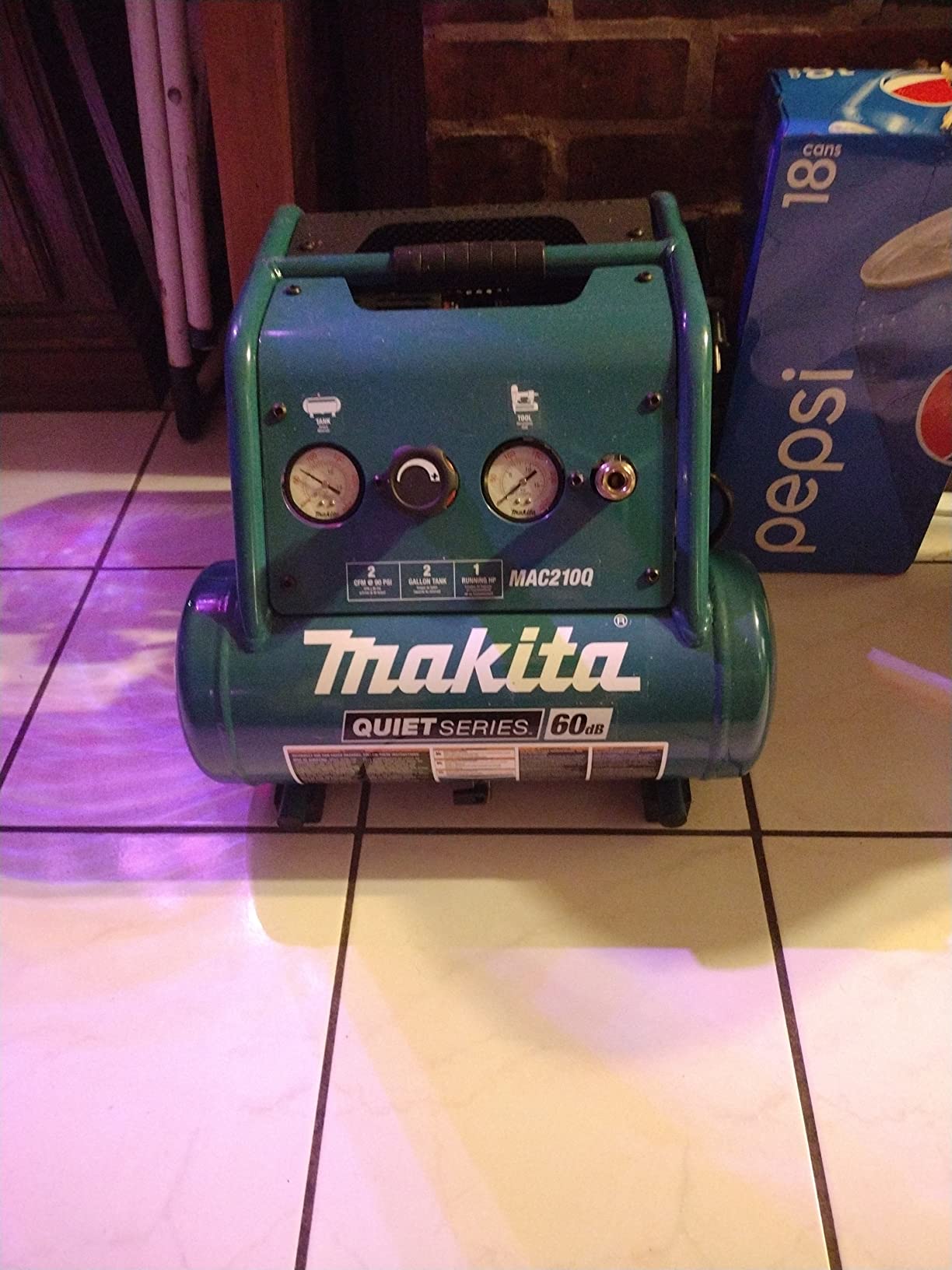
One owner measured 57.7 dB from two feet away while it ran, which is quieter than the published 60 dB figure. Others describe it as quieter than the refrigerator in their garage, which is the comparison most people will relate to. Several mention being able to hold a conversation right beside it, which is the real-world version of the 60 dB claim.
The pump is oil-free, so there is no oil mist in the line and no oil changes in your future. That matters more than it sounds for finish carpentry and spray work, where a single drop of compressor oil ruins a surface. Maximum pressure is 135 PSI, higher than most of the compressors here, which gives finish nailers the headroom they like.
What 2 gallons means for a full trim job
The 2-gallon tank is the honest limitation. Two gallons does not hold much, and in practice a finish nailer will outrun it. Owners describe it recovering quickly enough that you notice a brief pause rather than a stall, which is fine for one gun at a time and wrong for two.
Where the 44-pound weight gets annoying
Portable is the word Makita uses and the word buyers argue with. At 44 pounds listed, with some owners reporting closer to 50, this is not a one-hand carry up a basement stair. It is a two-hand carry by a fit adult, and it is the single most repeated complaint in the reviews.
2. California Air Tools 10020C: The One That Keeps Working
California Air Tools 10020C 2.0 HP Ultra Quiet and Oil-Free Air Compressor, 10 Gallon Steel Tank with Wheels, 70 dBA Noise Level
70 dBA operation
5.30 CFM at 90 PSI
10-gallon steel tank
1680 RPM
125 PSI max
+ The Good
- Strong 5.30 CFM at 90 PSI for impact wrenches and framing nailers
- 10-gallon vertical tank on wheels
- Quiet enough for late-night work
- Easy Start Valve reduces startup amps
- The Bad
- 82.5 lb is heavy to load into a vehicle
- Manual tank drain rather than an auto drain
- Needs a long cool-down after 30 to 45 minutes of continuous use
If you need actual work capacity and you need it quiet, this is the unit. Five and a third CFM at 90 PSI is more than triple what the MAC210Q delivers, and it does it at 70 dBA, quiet enough for late-night work in a residential garage.
It is also one of the most reviewed machines on this page, with more than 1,500 owner ratings. That volume matters because it means the failure reports are well documented rather than speculative, and the overall picture is a compressor that people trust for tire work, finish nailing and general garage duty.
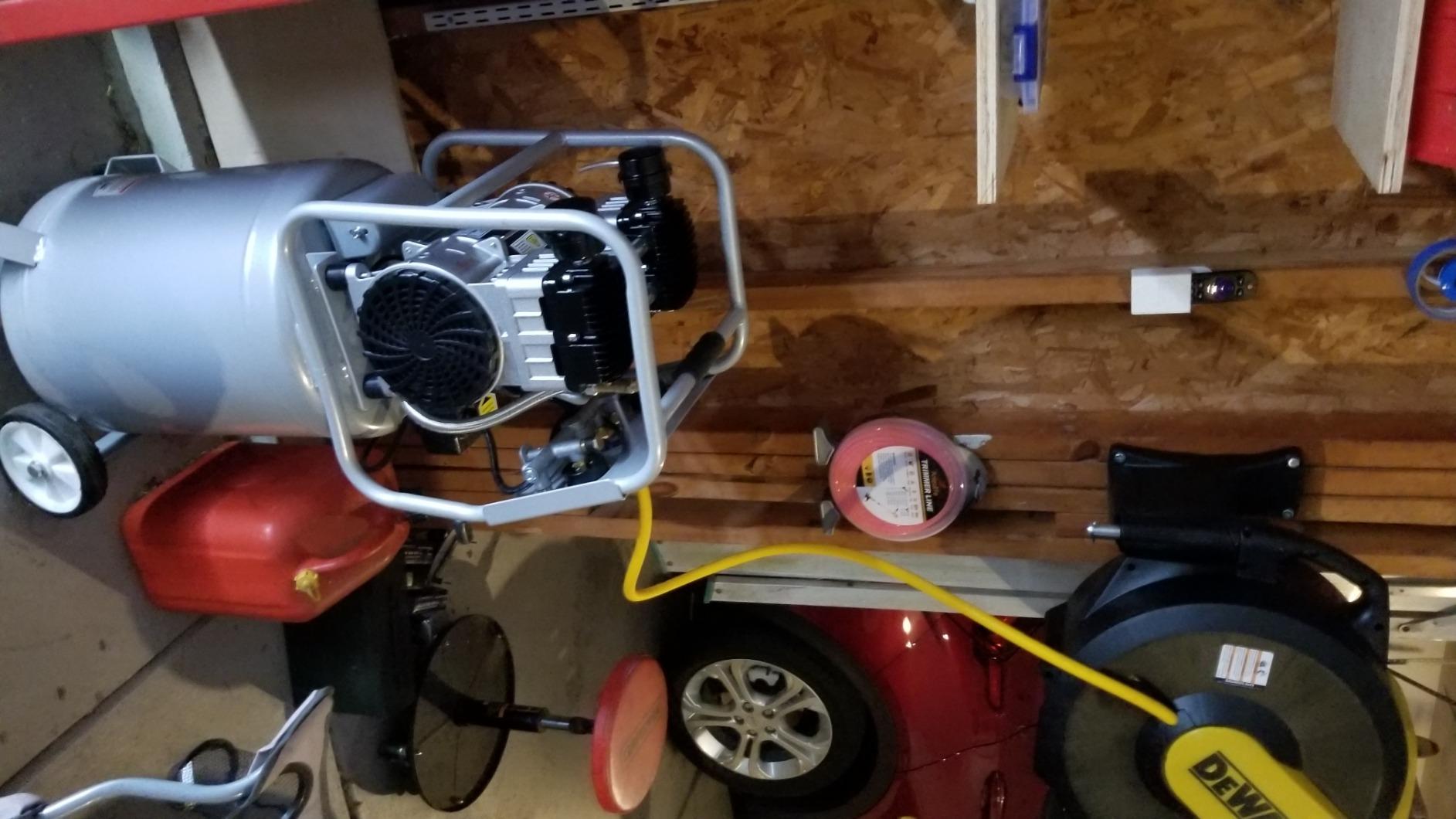
The pump is oil-free dual-piston running at 1,680 RPM, with a listed life cycle over 3,000 hours. The Easy Start Valve is a small thing that matters more than it sounds, drawing fewer amps on startup so the compressor will not trip a shared household breaker when it kicks on while you are using a saw.
Owners repeatedly frame this as the quiet replacement for a big loud shop compressor they were stuck with. The tank is steel rather than aluminum, so it is heavier, but it takes a beating and a vertical 10-gallon footprint does not eat much floor space.
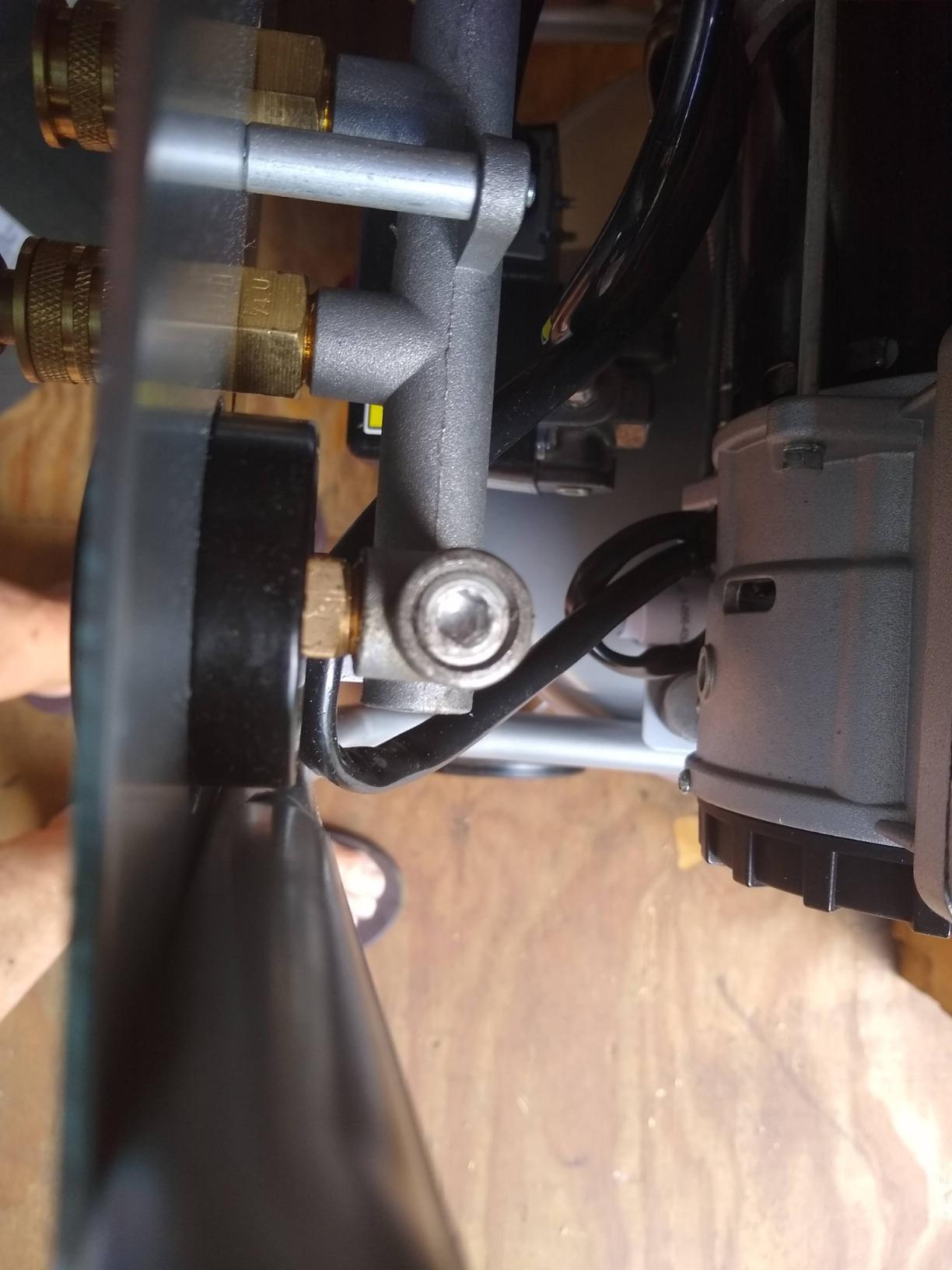
Why 10 gallons feels quieter than 2 gallons
Because it runs less. A 10-gallon tank holds five times the air, so the motor starts fewer times during a session. Each start is the loudest moment in any compressor cycle, and cutting the number of starts cuts the annoyance even though the steady-state noise is higher.
The duty cycle ceiling nobody mentions in the listing
Reports describe shutdown after roughly 30 to 45 minutes of genuinely continuous use, followed by a long cool-down. For weekend projects that never matters. For someone running a sander or a spray gun for half a day straight, plan on pauses. A minority of owners also report an air switch leak or early motor failure, which is why the rating sits at 4.4 rather than higher.
3. Makita MAC100Q Quiet Series: The Quietest Compressor Here
Makita MAC100Q Quiet Series, 1/2 HP, 1 Gallon Compact, Oil-Free, Electric Air Compressor
58 dB Quiet Series
0.7 CFM at 90 PSI
1-gallon tank
135 PSI max
27.6 lb
+ The Good
- Lowest noise rating in the roundup at 58 dB
- 1750 RPM motor and oil-free pump for long service life
- Full roll-cage construction
- Compact 27.6 lb build
- The Bad
- 1-gallon tank and 0.7 CFM cycle very frequently
- Owners report 68 to 73 dB at practical distances in an enclosed garage
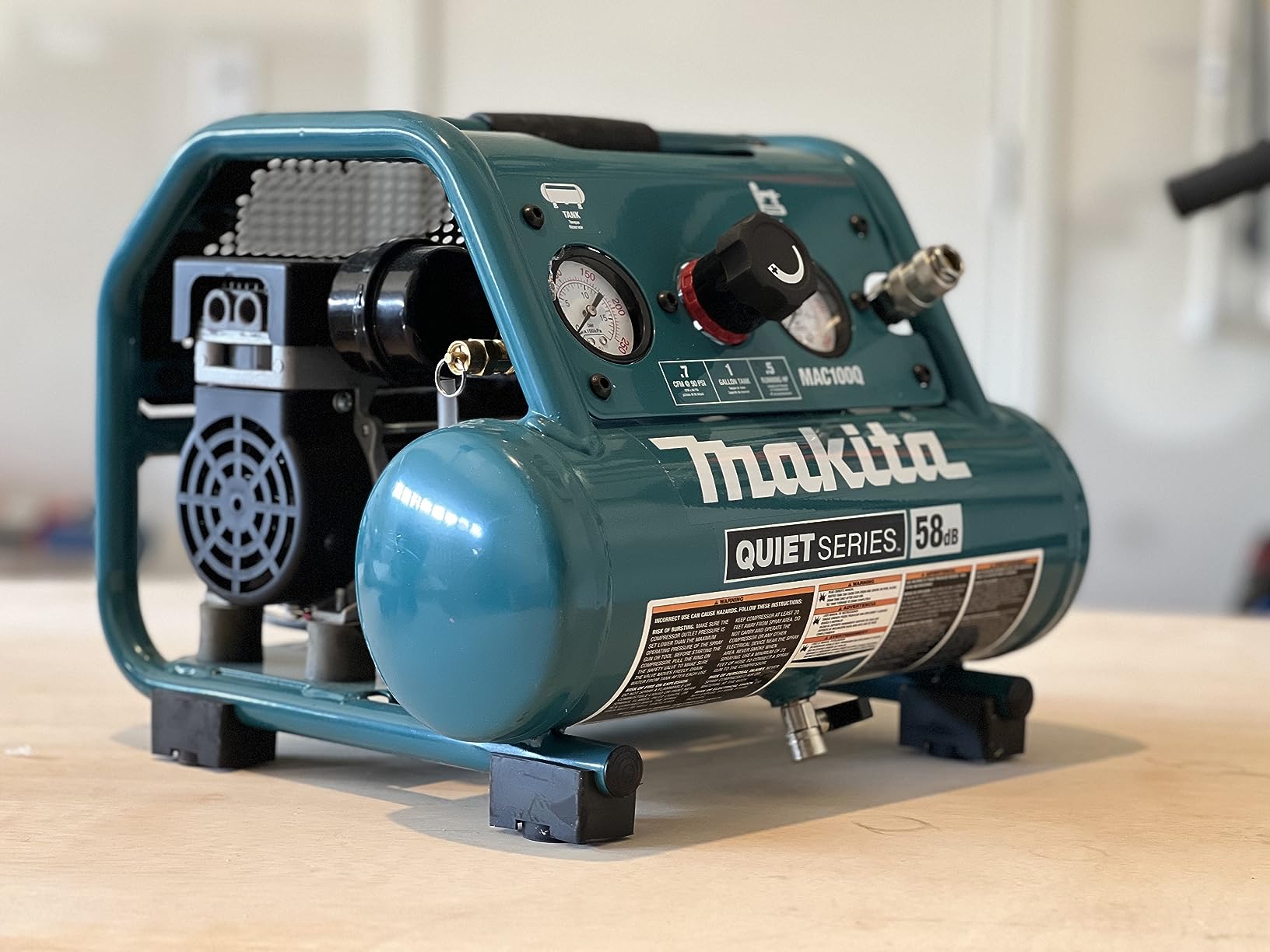
At 58 dB this is the quietest machine we list, and for a specific job it is the right answer. If you trim baseboards, fit cabinet hardware or inflate tires in a garage with a bedroom above it, nothing else in this roundup is quieter on paper.
The build matches the claim better than most. Same 1,750 RPM induction motor, same oil-free dual-piston pump, same full roll-cage steel construction as the larger MAC210Q, and it weighs just 27.6 pounds. Owners routinely describe it as quieter than conventional pancake compressors and quiet enough for indoor use.
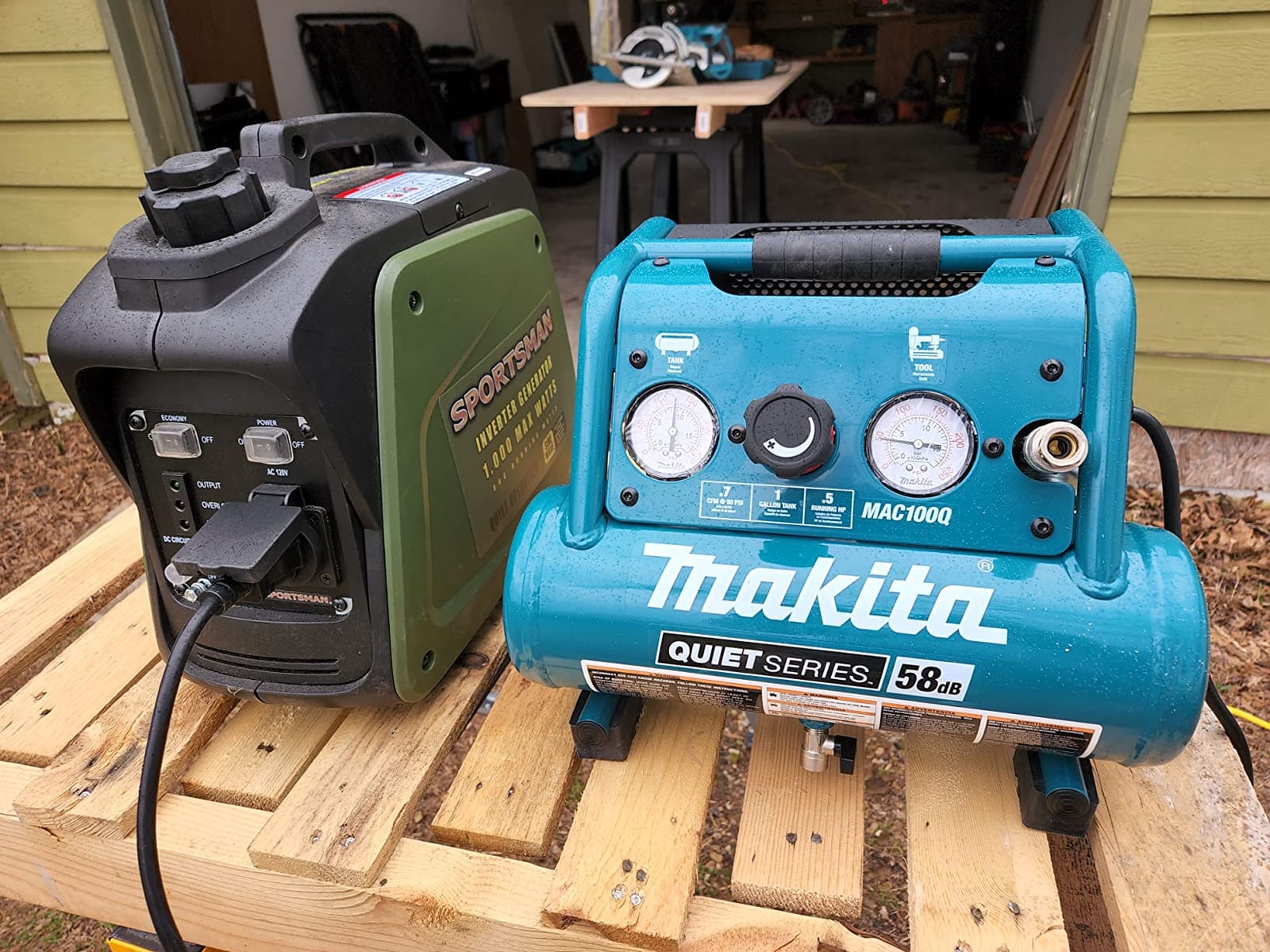
Two operating notes from the reviews. First, the regulator on the compressor needs to stay switched on for smart plugs and similar monitoring devices to read it, which trips up more than a few first-time owners. Second, the difference between 58 dB in a spec sheet and what you hear matters more here than anywhere else on the list.
Several owners measured closer to 68 or 73 dB at a normal listening distance in an enclosed garage. That is the honest number. A one-gallon tank refills constantly, and every refill is a motor start, so the unit that measures quietest on a bench can produce more starts per minute than a big tank.
Where 0.7 CFM is enough and where it is not
Enough: brad and finish nailers, airbrushing at low volume, inflating tires and bike wheels, blowing dust off a workbench. Not enough: HVLP spray guns, air wrenches, orbital sanders that draw real volume, or any framing nailer. If your list is longer than the first sentence, look at the 10020C instead.
Best case: a second-storey or condo workshop
This is the unit people buy when the garage is really a storage closet and the work happens inside. At 27.6 pounds it moves between rooms without planning, and 135 PSI maximum pressure gives finish guns the burst they need.
4. California Air Tools 2010A: The Best Budget Balance
California Air Tools 2010A 1.0 HP Ultra Quiet and Oil-Free Air Compressor, 2 Gallon Aluminum Tank, 60 dBA Noise Level, Silver
60 dBA operation
2.20 CFM at 90 PSI
2-gallon aluminum tank
50 second fill
35.3 lb
+ The Good
- 60 dBA lets you hold a conversation beside it
- 50 second tank fill and 14 second recovery
- Lightweight rust-free aluminum tank at 35.3 lb
- Drives roughly 19 to 20 brad nails per fill
- The Bad
- 2.2 CFM at 90 PSI cannot handle HVLP spray or air wrenches
- No air hose or male quick-connect fitting in the box
- Some report a stripped base screw or fused plug after years
The 2010A is the pick we would hand to a first-time buyer. It hits 60 dBA, weighs 35.3 pounds, and lists at 2.20 CFM at 90 PSI with a 4.6 owner rating across more than 1,250 reviews.
The recovery numbers are the standout. A 50-second tank fill from empty and recovery from 90 to 120 PSI in 14 seconds means a brad nailer barely pauses between passes, which removes the stutter that makes small compressors feel broken.
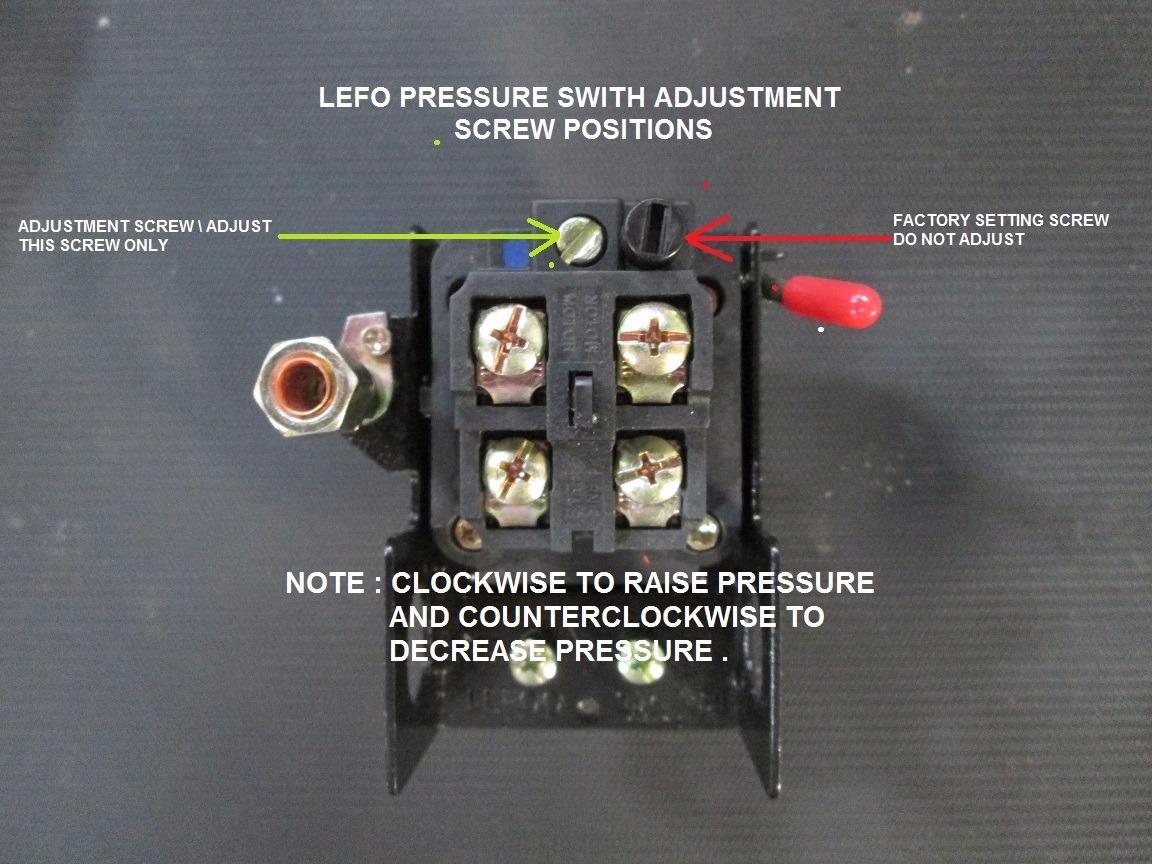
The tank is aluminum rather than steel, so it will not rust in a damp garage and it is light enough to lift into a car without a second pair of hands. That portability is why this one shows up in hobby woodshops more than any other machine in the list.
Long-term owners describe roughly three years of service before a powerhead failure, which is a reasonable lifespan for intermittent duty. They also warn, repeatedly and clearly, that it is not built for continuous work, HVLP painting or crews, and that it arrives without an air hose or a male quick-connect fitting.
Budget means the accessories are your job
Plan on buying a hose and a male quick coupler separately. Reviews flag this as a recurring surprise, and it is an easy fix that many buyers forget to plan for at checkout.
Best for weekend woodworkers
If your work is casing, baseboard, shelving and the occasional tire fill, the 19 to 20 brad nails per tank fill figure is genuinely enough. You will finish a full afternoon of trim and never hear the compressor over a conversation on the other side of the wall.
5. California Air Tools 8010A: Best for an Eight-Gallon Tank That Stays Light
California Air Tools 8010A 1.0 HP Ultra Quiet and Oil-Free Air Compressor, 8 Gallon Aluminum Tank, Lightweight with Wheels, 60 dBA Noise Level
60 dBA operation
2.20 CFM at 90 PSI
8-gallon aluminum tank
37.3 lb
120 PSI max
+ The Good
- Exceptionally quiet 60 dBA operation
- Aluminum tank on a wheel kit at only 37.3 lb
- Oil-free dual-piston pump rated over 3000 hours
- 165 second tank fill and 60 second recovery
- The Bad
- 2.20 CFM at 90 PSI limits high-consumption tools
- Not designed for continuous duty operation
Eight gallons in a 37.3 pound package is unusual, and it is why the 8010A makes this list. A steel eight-gallon tank that size would weigh far more, and most portable tanks in this class carry fewer gallons. This one carries eight and still rolls on a wheel kit you can lift with one arm.
The rating is 4.7 across more than 1,100 reviews, and the distribution is heavily positive with roughly 84 percent five-star reports. Owners point to the same combination repeatedly: 60 dBA, a 1,680 RPM motor and a tank big enough that the motor does not restart between every few nails.
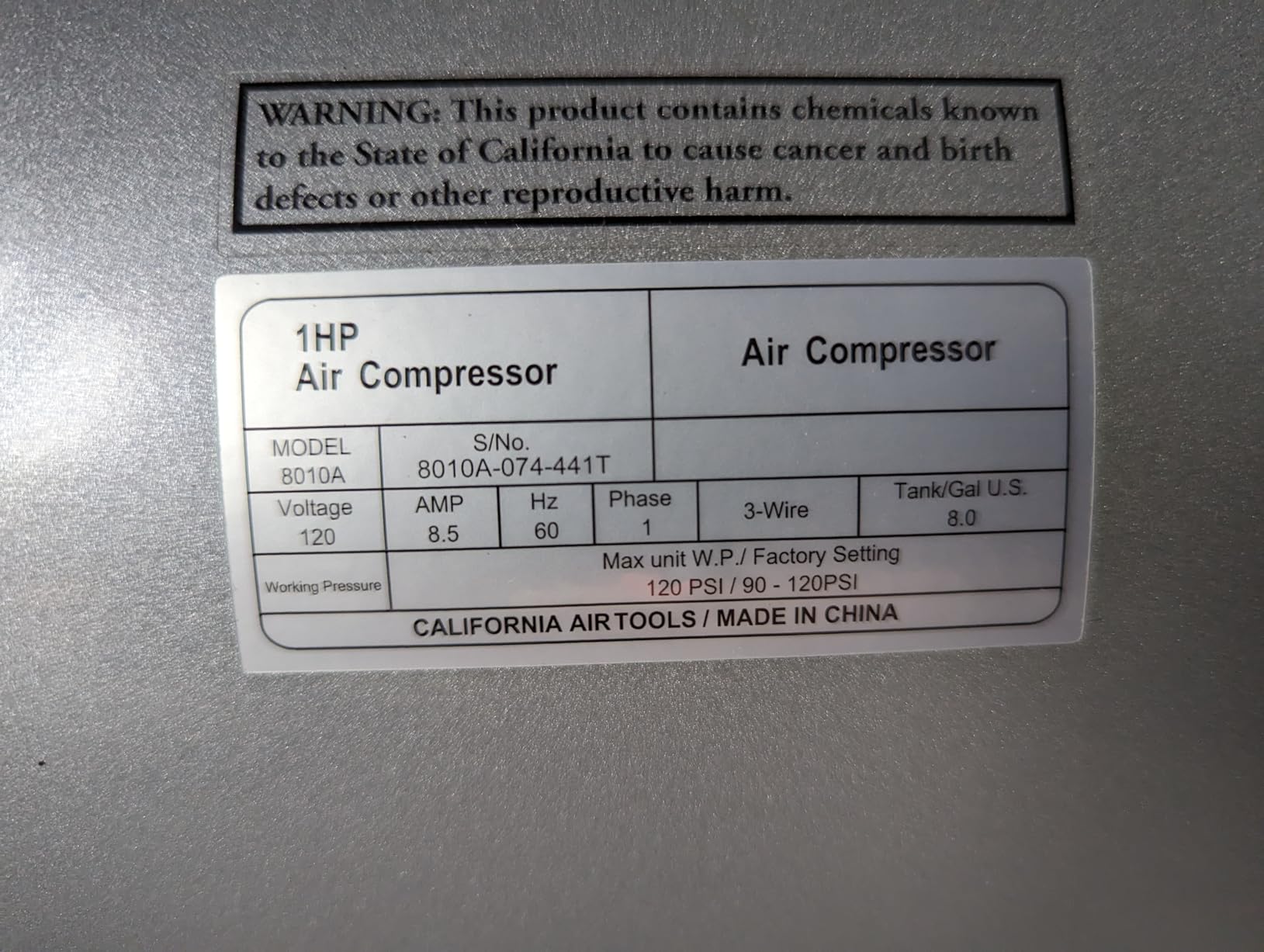
Technical details are straightforward. Maximum pressure is 120 PSI, the tank fills from empty in 165 seconds, and the pump recovers from 90 to 120 PSI in about 60 seconds. Maximum current is 8.5 amps, low enough that it will not cause trouble on a shared household circuit.
The pump is built to a stated life cycle over 3,000 hours and needs no oil changes. Airbrushing, ball inflation, blow cleaning, nailing, sanding and spraying are all listed as intended uses, which tells you how the manufacturer expects this machine to be used.
Why eight gallons beats two for perceived quietness
Duty cycle again. A bigger tank means fewer motor starts per hour of nailing, and each start is a transient spike that registers far more in an enclosed space than the steady hum does. This is why a 60 dBA eight-gallon unit often feels calmer than a quieter one-gallon tank.
The limit to know before you buy
Airflow is 2.20 CFM at 90 PSI, the same as the two-gallon 2010A. You gain tank size, not breathing room. If you plan to run a spray gun or an air wrench, this is not the machine, and reviewers are consistent about that boundary.
6. VEVOR 13-Gallon: Best for Auto Repair and Tire Work
VEVOR 13-Gallon Air Compressor, 2HP, 4.6 SCFM@90PSI, Oil-Free Tank, 66dB Quiet Operation, Ideal for Tire Inflation, Woodworking, Auto Repairs, and Spray Painting (Maximum Pressure 125 PSI)
66 dB operation
4.6 SCFM at 90 PSI
13-gallon tank
2 HP motor
125 PSI max
+ The Good
- 13-gallon tank is the largest here
- with 4.6 SCFM rated airflow
- Fills in under three minutes
- Quiet enough to run without hearing protection per owners
- Arrives fully assembled with gauges filters wheels and foot pads
- The Bad
- Heavy at about 71 lb and awkward to lift
- Some report bent legs from shipping damage
- Owners cite thermal cutout behavior and lower real-world continuous CFM
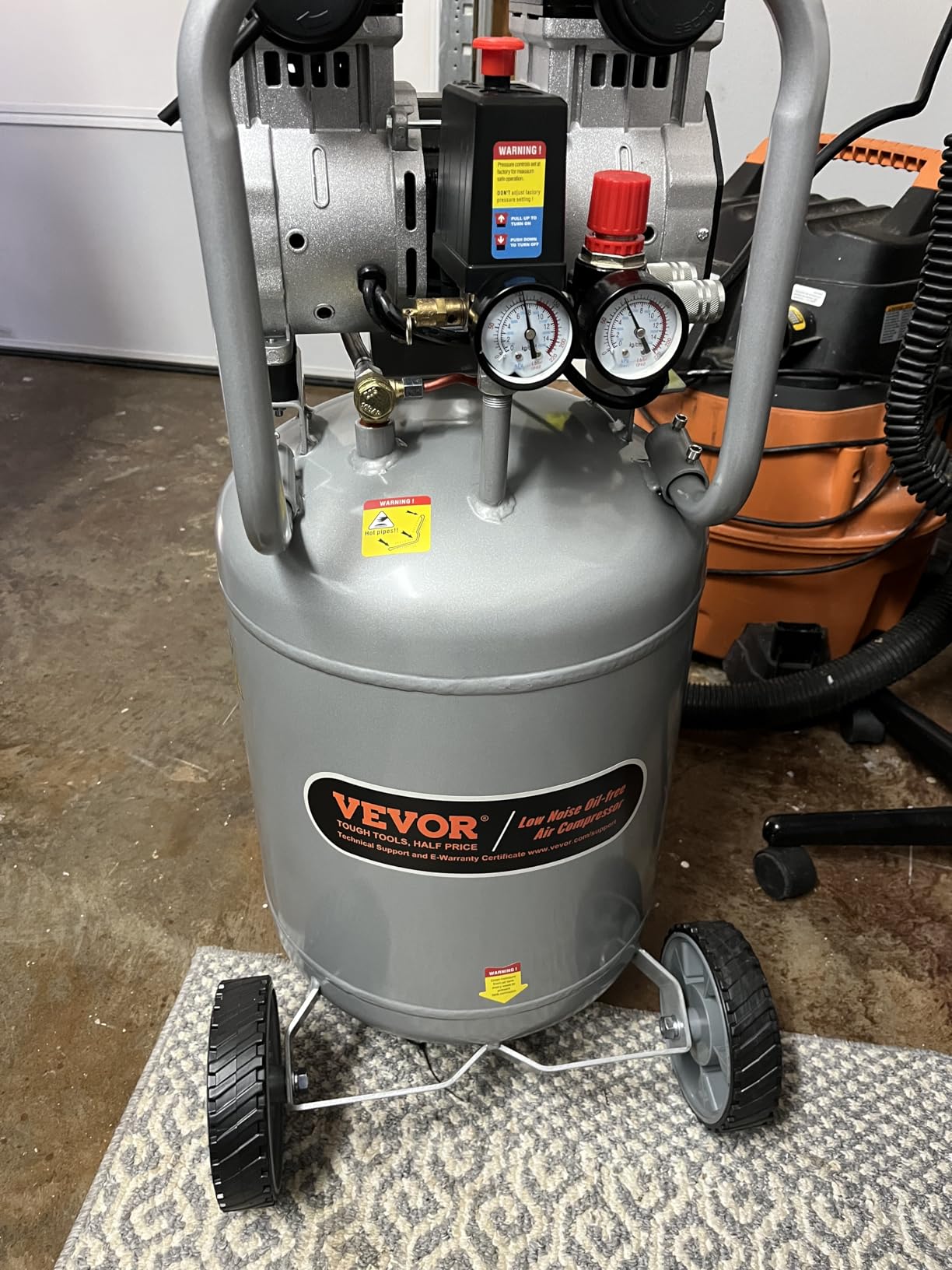
Auto repair is the one hobby that punishes a small tank. Running an impact wrench, an inflator or a bead blaster pulls far more air than a nailer does, and this 13-gallon VEVOR handles it at 66 dB with 4.6 SCFM at 90 PSI from a 2 HP motor.
Tank fill is under three minutes from empty, which means a tire change does not turn into a waiting game. Owners frequently note they can work beside it without hearing protection, and that the whole thing arrives assembled with two gauges, filters, wheels and foot pads already fitted. That is a longer hardware kit than most of the oil-free compressors here.
This is the quietest of the large-tank units on the list, and it is worth knowing why. Two 7-inch reinforced rubber wheels and a vertical 33.3-inch height keep the footprint narrow, so it can sit against a wall rather than in the middle of a single-car bay.
The critical reviews are consistent and specific. Around 71 pounds is heavy to lift onto a bench. Some owners report bent legs arriving from transport damage. And a few report the compressor failing to repressurize after heat cycling, or delivering less continuous CFM than the 4.6 SCFM label suggests once it warms up.
What 13 gallons changes on a weekend of car work
It removes the refills. Across a full afternoon of impact wrench and inflating, a 13-gallon tank means the motor starts a handful of times rather than dozens, which is both less noise and less heat in the room.
Who should skip it
Anyone in a small workshop with stairs or no lifting help. If the compressor will live on the floor of a garage and never move, the weight barely registers. If it has to go up and down, it becomes a two-person job, and our portable compressor guide covers lighter formats.
7. DEWALT DWFP55130: Best for Running Two Nailers at Once
DEWALT Air Compressor for Trim, 200-PSI Max, Quiet Operation (DWFP55130)
71.5 dBA ISO3744 tested
3.0 SCFM at 90 PSI
2.5-gallon tank
200 PSI max
36 lb
+ The Good
- Highest maximum pressure here at 200 PSI
- Dual quick couplers support two nailers at once
- Low 12 amp draw starts easily on shared circuits
- Thin 12.5-inch profile stores on a shelf or cart
- The Bad
- 71.5 dBA is among the higher noise ratings here
- 2.5-gallon tank limits sustained volume for large nail guns
The DWFP55130 is the odd one out on this page and there is a good reason for it. Its 71.5 dBA figure is tested to ISO3744, a real standard, and it still reads as the highest noise rating of any compressor we list. What it offers instead is the highest maximum pressure at 200 PSI and the only factory dual quick coupler pair.
Those two couplers are the reason to choose it. If your workflow involves running two nailers at once, or swapping tools without a tee fitting, nothing else in this roundup makes that as simple.
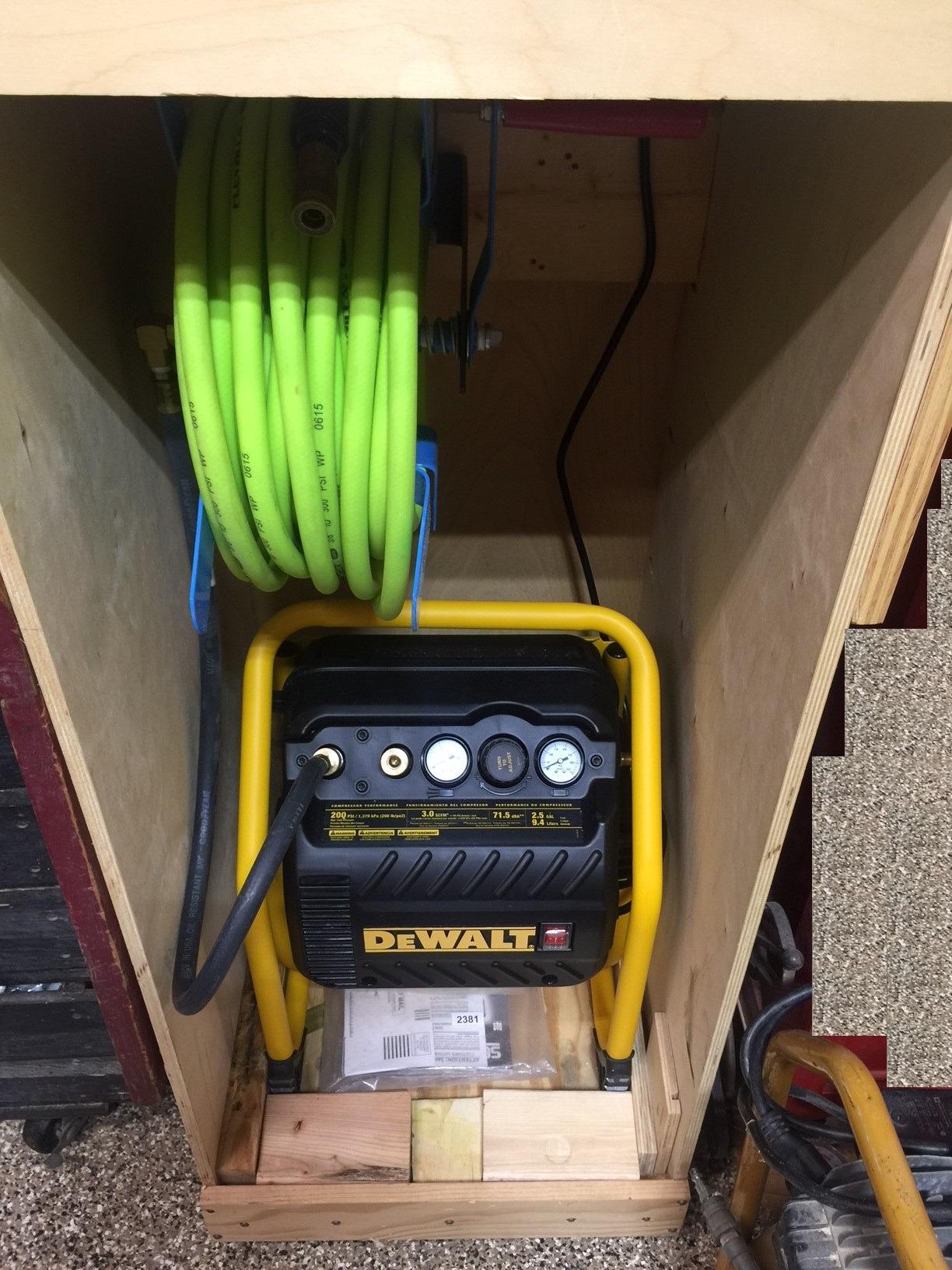
The 12 amp motor draws less than most compressors of this output, so it starts easily and is less likely to trip a breaker. A ball valve drain allows quick and thorough tank draining, and the pump is oil-free and maintenance-free.
Owners describe it as a dependable trim and finish machine with quick recovery and easy storage, and criticize it on two fronts: the noise level compared with premium ultra-quiet models, and the 2.5-gallon tank for heavy framing work.
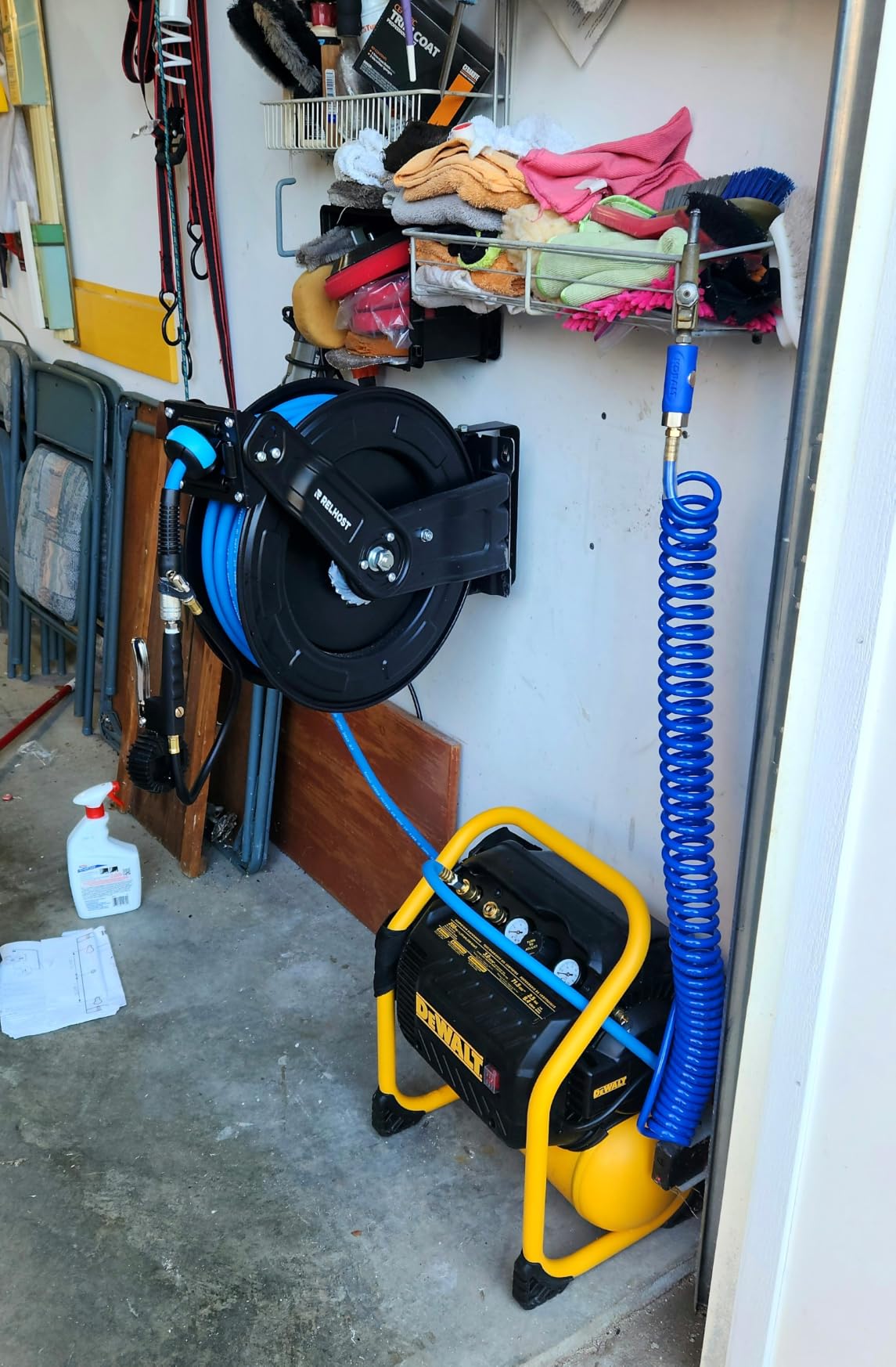
Vertical or horizontal, whichever fits
This unit can be operated and stored in either orientation, which matters more than it sounds in a shallow single-car garage. The thin 12.5-inch profile means it can sit on a shelf rather than a floor, and at 36 pounds it is one of the lighter vertical options.
When 200 PSI actually helps
Higher tank pressure means more stored air per gallon and better performance on tools that demand a working pressure spike. It also means more moisture in the tank, so drain it more often, especially if you are running a spray gun. If you paint regularly, our large-tank compressor guide goes into that in more depth.
8. Stealth 12-Gallon: Best for Big-Tank Nailing Without Leaving the House
Stealth 12 Gallon Ultra Quiet Air Compressor, 1.5 HP Oil-Free Peak 150 PSI 68 Decibel,5 CFM @ 40 PSI 4 CFM @ 90 PSI Silent Portable Long Life Electric Air Compressor W/Wheel for Garage
68 dB induction motor
4 CFM at 90 PSI
12-gallon Q235B tank
1.5 HP
150 PSI peak
+ The Good
- 12-gallon Q235B steel tank means far fewer refills
- 4 CFM at 90 PSI covers framing nailers
- 68 dBA keeps noise manageable in a residential garage
- 7-inch reinforced wheels and a limited lifetime warranty
- The Bad
- Heaviest machine here at 95 lb and difficult to reposition
- Lowest average rating in the group at 4.2 with a 9 percent one-star share
The Stealth 12-gallon solves the exact problem we keep circling. How do you get a big tank’s refuelling interval without a loud pump. At 68 dB with 4 CFM at 90 PSI and a 12-gallon Q235B steel tank, it delivers framing-nailer capacity at a residential noise level.
The induction motor has a stated life cycle over 1,000 hours, and the unit carries a limited lifetime warranty, which is stronger coverage than most of the one-year terms on this list.
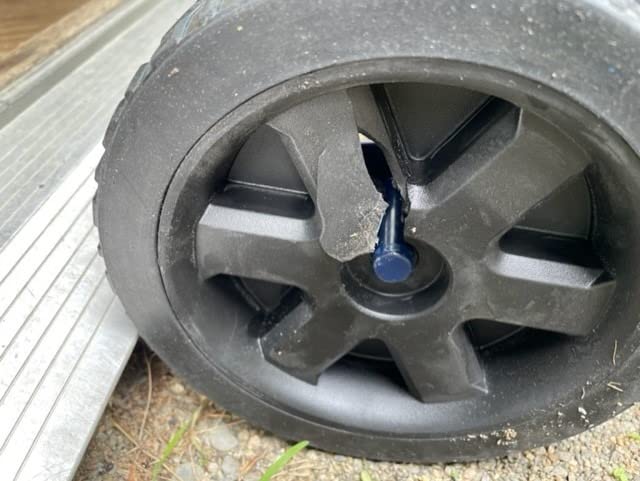
Peak pressure is 150 PSI, the highest here among the oil-free units after the DEWALT. Seven-inch rubber reinforced wheels give it a stable footprint on uneven garage floors, which is worth something on a 95-pound machine that will not be moved often.
The rating is the reason this sits at number eight rather than higher. At 4.2 it trails the rest of the field, with a 9 percent one-star share. Those low reviews concentrate on durability and on the weight, both of which are consequences of building a 12-gallon steel tank rather than flaws in the design.
Do the math on weight before you commit
Ninety-five pounds means it stays where you put it. If the compressor will live in one corner of a garage, that is fine and the 12-gallon capacity is a genuine advantage over everything smaller on this list.
The trade you are making
You are trading a thinner, lighter warranty story for capacity and CFM. The warranty is limited lifetime rather than the one-year coverage most competitors here carry, which partly offsets the lower average rating. Buy it for a garage, not for a job site.
9. Limodot LJ8120K: Best If You Want the Accessories in the Box
Quiet Oil-Free Air Compressor, 68 dB, 2.8 CFM @ 90 PSI, 8 Gallon Air Tank
68 dB induction motor
2.8 CFM at 90 PSI
8-gallon steel tank
120 PSI max
25 ft hose
+ The Good
- 68 dB induction motor quiet enough for residential use
- Only unit here shipping with a 25 ft hose and an 11-piece tool kit
- 120 second refill and 30 second recovery
- 8-gallon steel tank with wheel kit
- The Bad
- 2.8 CFM at 90 PSI is below what sustained spray or sanding needs
- Oil-free design limits duty cycle for prolonged continuous use
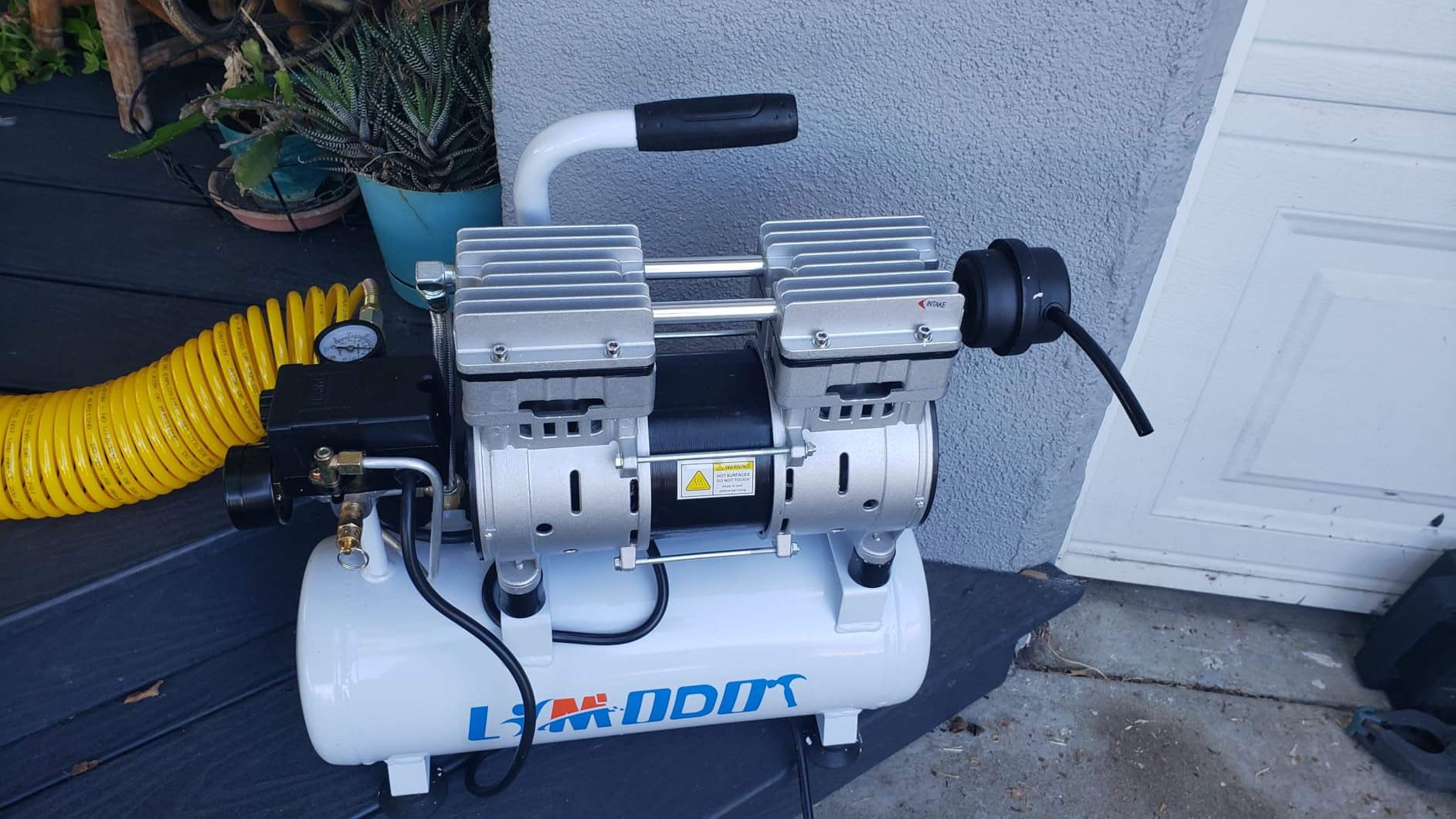
Every compressor on this list needs a hose before you can use it. This one includes a 25-foot PVC hose, a quarter-inch quick-connect fitting and an 11-piece air tool accessory kit in the package, which removes the most common first-day frustration for new buyers.
The machine underneath is a 1.2 HP oil-free design with an 8-gallon steel tank, rated 4 CFM at 40 PSI and 2.8 CFM at 90 PSI, at a listed 68 dB from an induction motor turning 3,400 RPM.
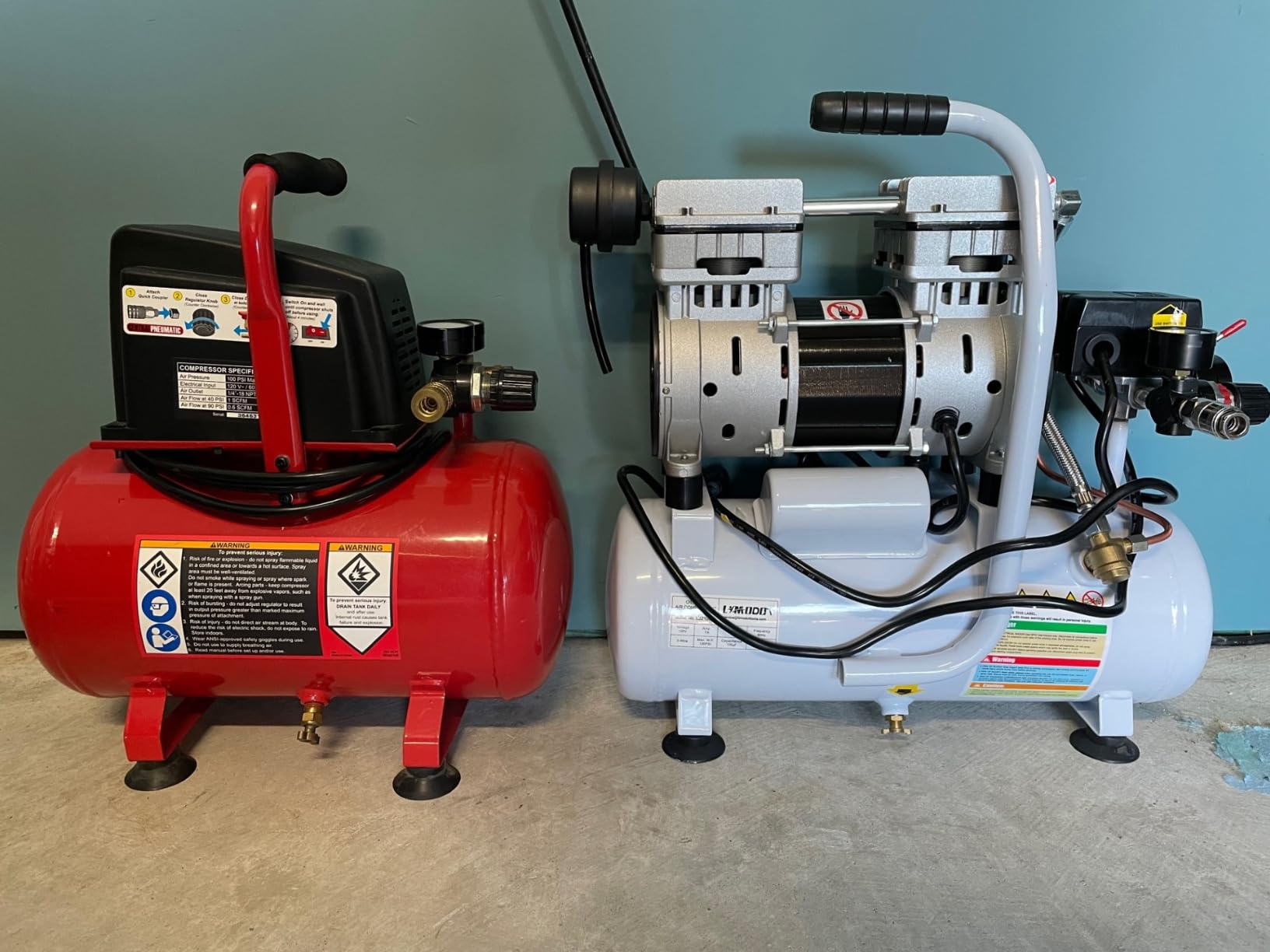
Refill from empty to full takes 120 seconds and recovery runs about 30 seconds, which is enough to keep a brad or finish nailer working without a noticeable gap. A wheel kit is included, and the tank holds enough air for staple guns, nailers, airbrushes and blow guns.
Buyers highlight two things most often: the bundled kit, and the noise level being acceptable for residential and indoor use. The consistent caveat is that 2.8 CFM at 90 PSI is an intermittent-duty pump, not a sustained one.
Why 3,400 RPM still sounds quiet
Motor speed alone does not set the noise level. This unit runs its induction motor at 3,400 RPM, well above the 1,680 and 1,750 RPM machines on this list, yet the published figure is 68 dB. Where you place it and what you run it against matter as much as the motor.
Best for a first compressor purchase
If you have never owned one, the accessory kit removes guesswork and the 8-gallon tank means you will not immediately outgrow it. If you specifically want the slim tank format, our pancake compressor picks narrow that down further.
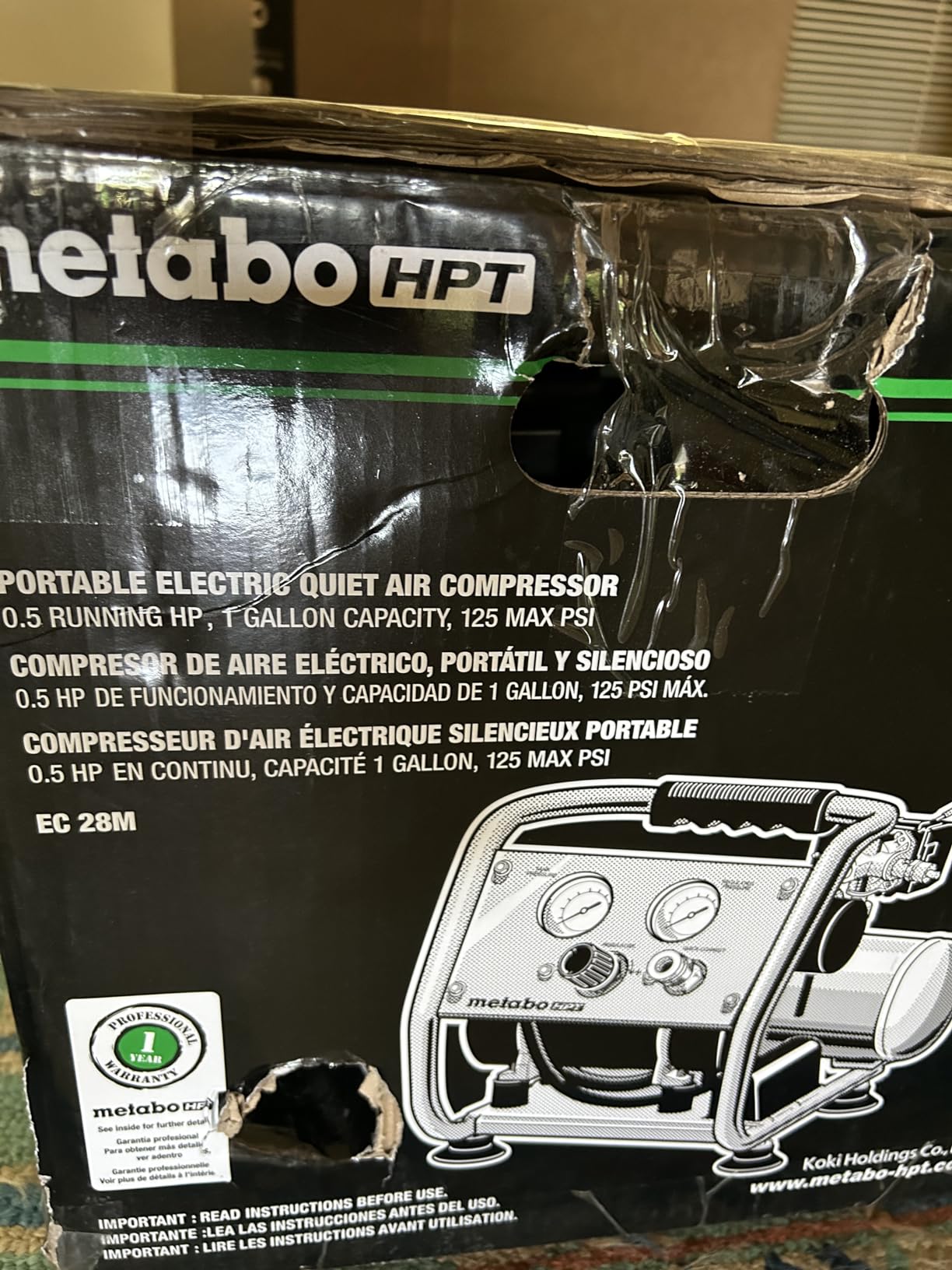
10. Metabo HPT EC28M: The Lightest Compressor on the List
Metabo HPT Quiet Air Compressor, Portable 1 Gallon Oil-Free, EC28M
59 dB operation
1-gallon tank
25.2 lb
steel roll cage
overload protection
+ The Good
- 59 dBA allows a normal conversation while cycling
- Lightest unit here at 25.2 lb with a rubber carry handle
- Steel roll cage protects the pump in transit
- Overload protection circuit adds durability for intermittent duty
- The Bad
- 1-gallon tank limits runtime and recovery on larger nailers
- Oil-free design means no continuous-duty capability
At 25.2 pounds with an ergonomically shaped rubber carrying handle, the EC28M is the compressor you can take up a set of stairs by yourself, or carry from a car to a bench without recruiting help. That is the entire pitch, and it is a good one.
It runs at 59 dB, which Metabo’s own listing frames as quiet enough that a normal conversation can take place while the compressor cycles. Owners back that up, frequently recommending it as a condo or indoor-friendly unit for finish and trim nailers.
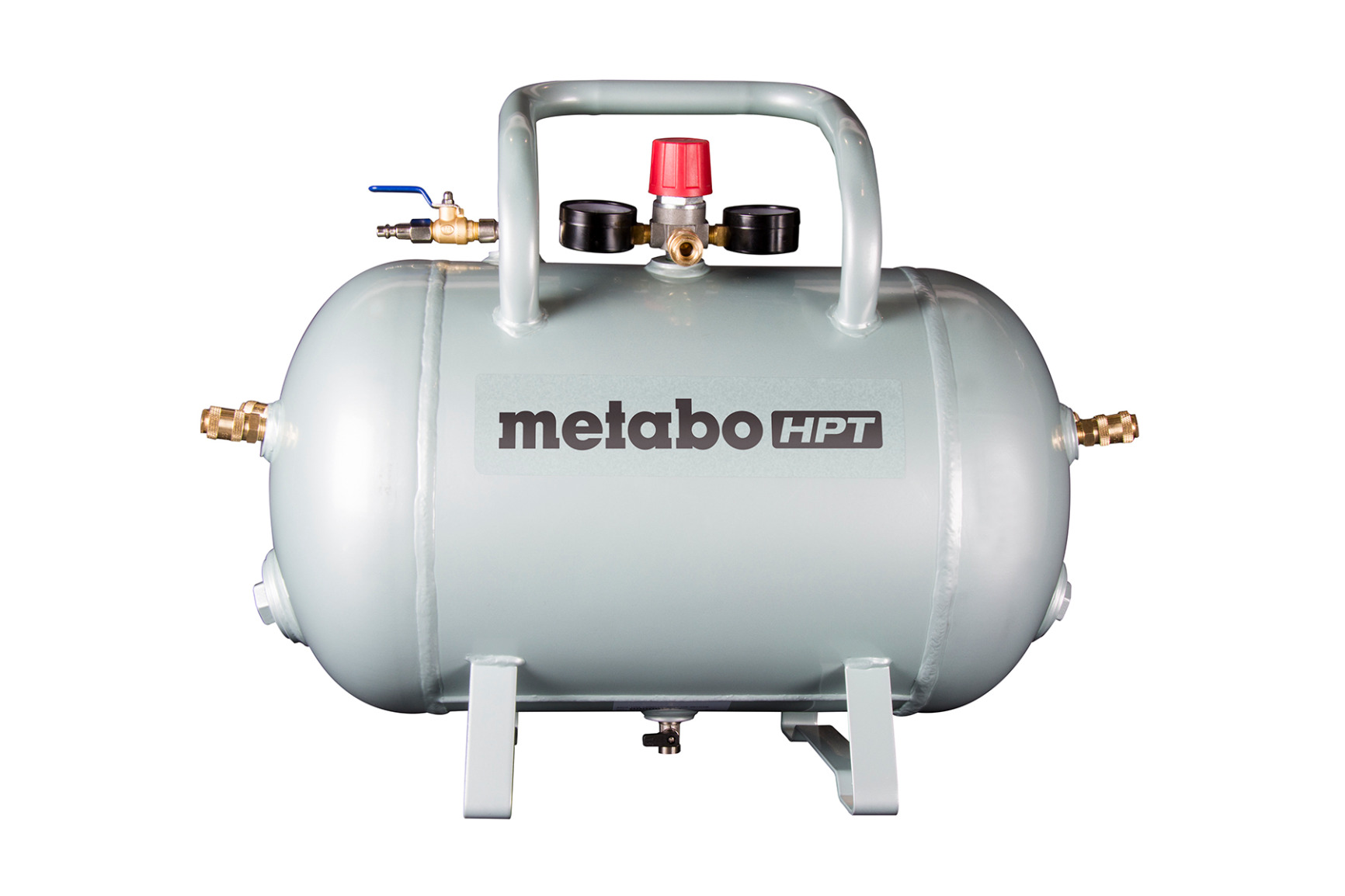
The build is more serious than the weight suggests. A steel roll cage protects the pump during transport, an integrated control panel handles accurate PSI adjustment, and a universal quick coupler makes tool changes fast across framing, siding, finish and roofing nailers.
A motor overload protection circuit is fitted, which is the right safeguard for intermittent use on a one-gallon tank. The warranty is one year through Metabo HPT’s professional channel.
Where one gallon is genuinely enough
Finish and trim nailing, stapling, inflating tires and blowing dust from a bench. This is a companion machine, not a shop compressor, and treating it any other way is how people end up disappointed.
Best for multi-level homes
Basements, upstairs utility rooms and apartments. At 25.2 pounds with a proper carry handle and a footprint of roughly 14 by 14 inches, it stows in a cabinet between jobs and runs quietly indoors.
11. Stealth SAQ-1234: Best for Airbrushing That Holds Pressure
Stealth Air Compressor 2 Gallon, 3/4 HP Oil-Free Compressor, Less than 60dB Ultra Quiet Electric Air Compressor,Max 125 PSI Pressure for Tire Inflation,Nailing,Home DIY Project(SAQ-1234)
Under 60 dB
1.8 CFM at 90 PSI
2-gallon Q235B tank
3/4 HP
125 PSI max
+ The Good
- Under 60 dB quiet enough for indoor evening work
- Owners report running a finish nailer all day without overheating
- Holds 60 to 80 PSI under continuous airbrush use
- Two-year owners report years of trouble-free service
- The Bad
- Heavier than compact pancake units at 41.9 lb
- Intake filter cannot be disassembled for cleaning as the manual states
- Preinstalled female quick disconnect may need adapters
Airbrushing punishes pulsating air more than almost anything else you can plug in, because inconsistent pressure shows up as blotchy paint. Owners of this Stealth report it holding 60 to 80 PSI under continuous airbrush use, which is exactly the behaviour that makes a model worth choosing.
It also refills from empty in roughly 25 to 120 seconds depending on the reported unit, and holds pressure between uses for days. For fine work that matters more than raw CFM.
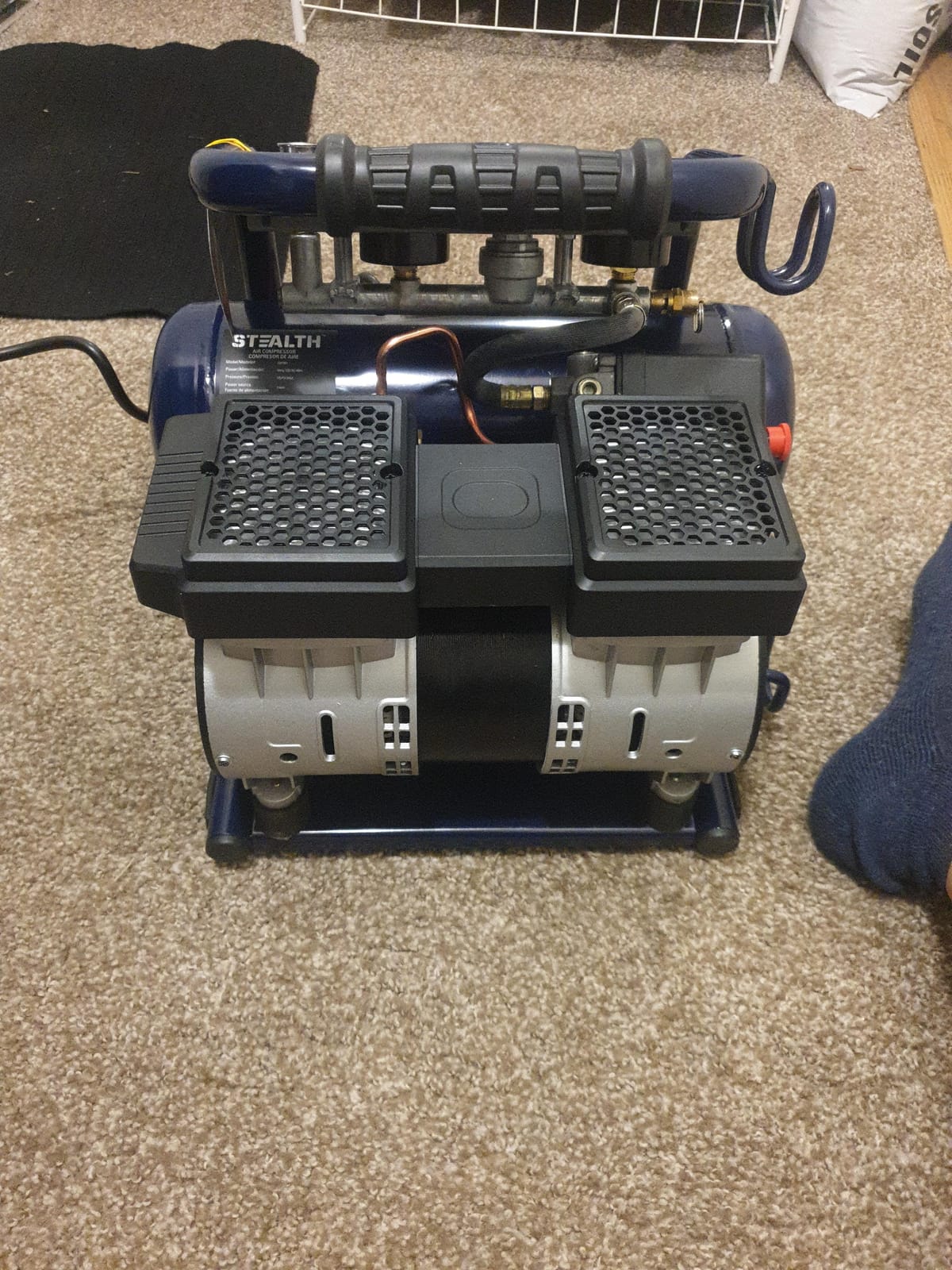
The noise figure is under 60 dB, achieved with high-grade soundproofing and a low-vibration design on a Q235B steel tank with rubber reinforced handle and bases. Maximum current is 5.5 amps, the lowest draw on this page, and it includes a safety valve and overheat protection.
Long-term owners report two years of airbrushing and finish nailing without failure, which is a better durability signal than most machines here can offer. A limited lifetime warranty is included as well.
Check your airbrush fitting first
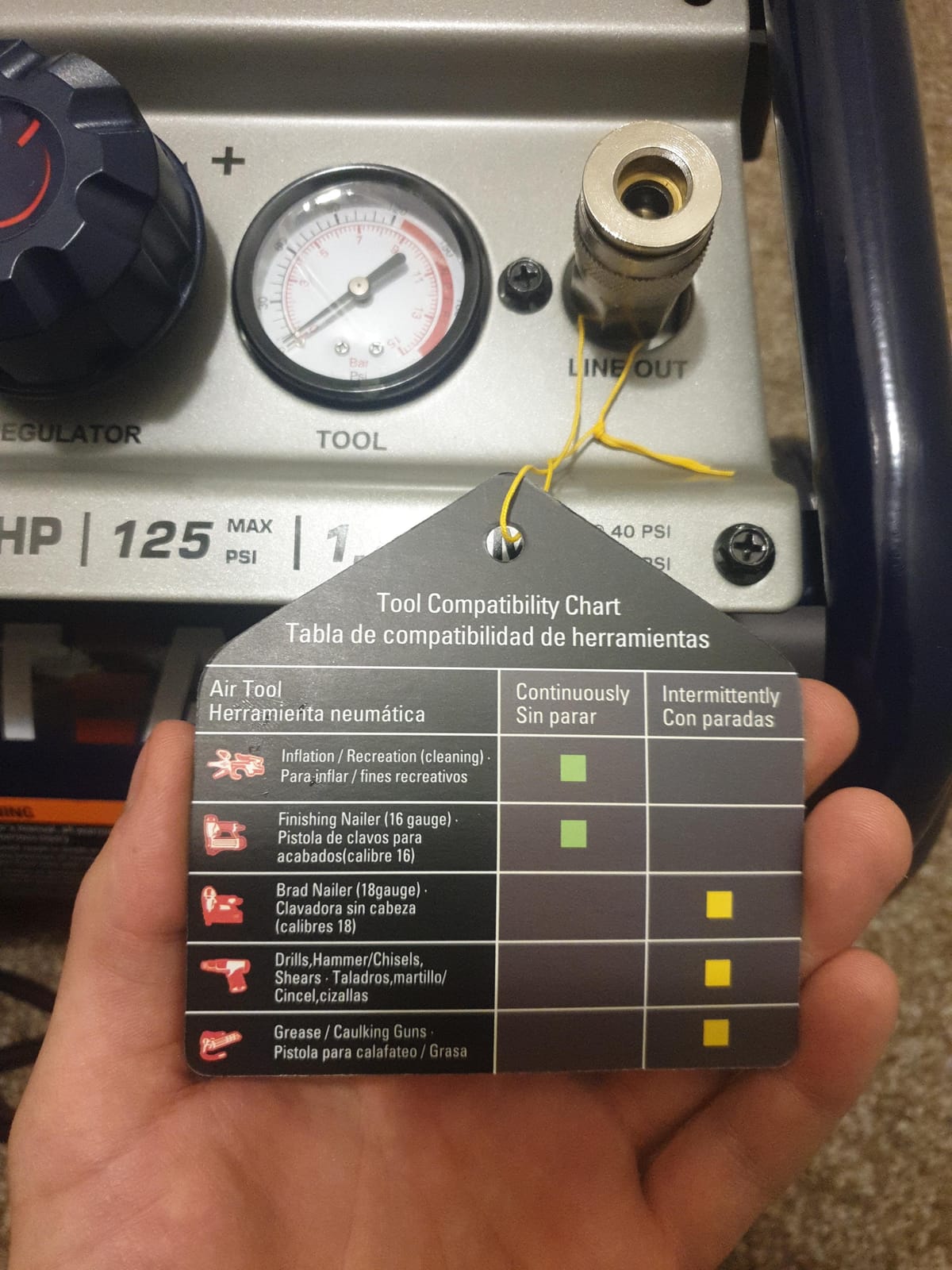
The female quarter-inch quick disconnect is preinstalled, and some airbrush setups need an adapter to reach it. Owners with existing airbrush hoses should confirm the fitting type before buying, since this is the most common surprise with this model.
Best for late-night detail work
Under 60 dB is quiet enough to run indoors after the house has gone quiet. Combined with the low 5.5 amp draw, it suits a basement bench, a spare room or a garage corner where the walls are close on all four sides.
12. VEVOR 4.8-Gallon: Best for Tire Inflation and Cleanup Duty
VEVOR 4.8 Gallon Air Compressor, 1.2HP 2.2 CFM@90PSI Oil Free Air Compressor Tank & Max. 116PSI Pressure, 70 dB Ultra Quiet Compressor for Auto Repair, Tire Inflation, Spray Painting, Woodwork Nailing
70 dB dual silencer
2.2 CFM at 90 PSI
4.8-gallon tank
1.2 HP
116 PSI max
+ The Good
- 4.8-gallon tank at an entry-level price with casters included
- 70 dB noise level suits garage and light shop use
- Overheating and pressure relief protection built in
- 34 lb weight and small footprint are easy to move
- The Bad
- 2.2 CFM at 90 PSI and 116 PSI max limit it to small tools
- Dual silencers can restrict airflow against single-vent designs
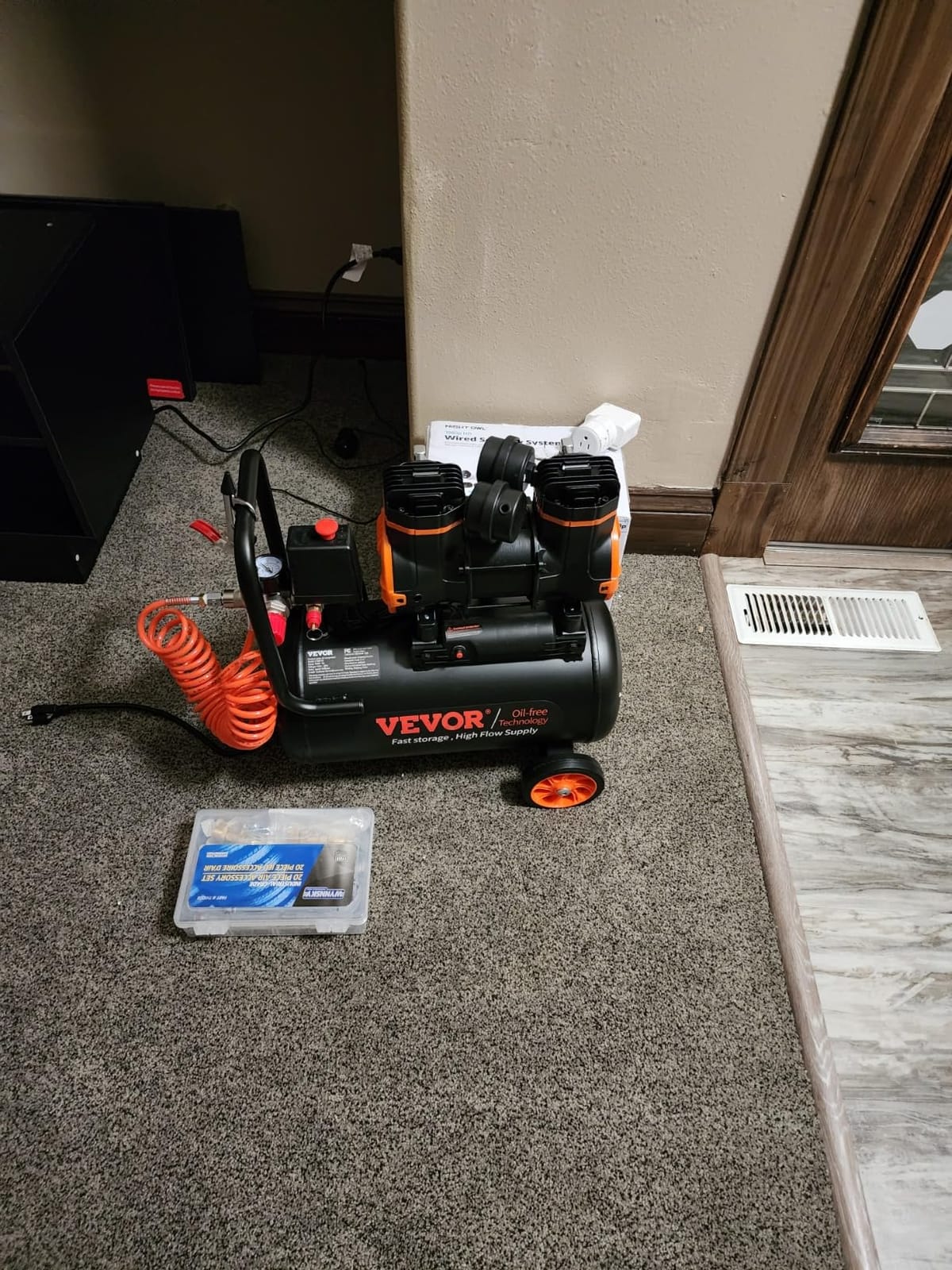
Sometimes the honest answer is that a compressor does not need to do much. The VEVOR 4.8-gallon covers tire inflation, blowing out garage debris and light nailing, at 34 pounds with casters included and a 70 dB noise level.
The build is more considered than the spec sheet suggests. It uses three-layer Q235B structural steel with seamless welding, a double tube and double cylinder intake, and a silicone intake pipe rated to 392 degrees F with a stainless steel braided mesh sleeve.
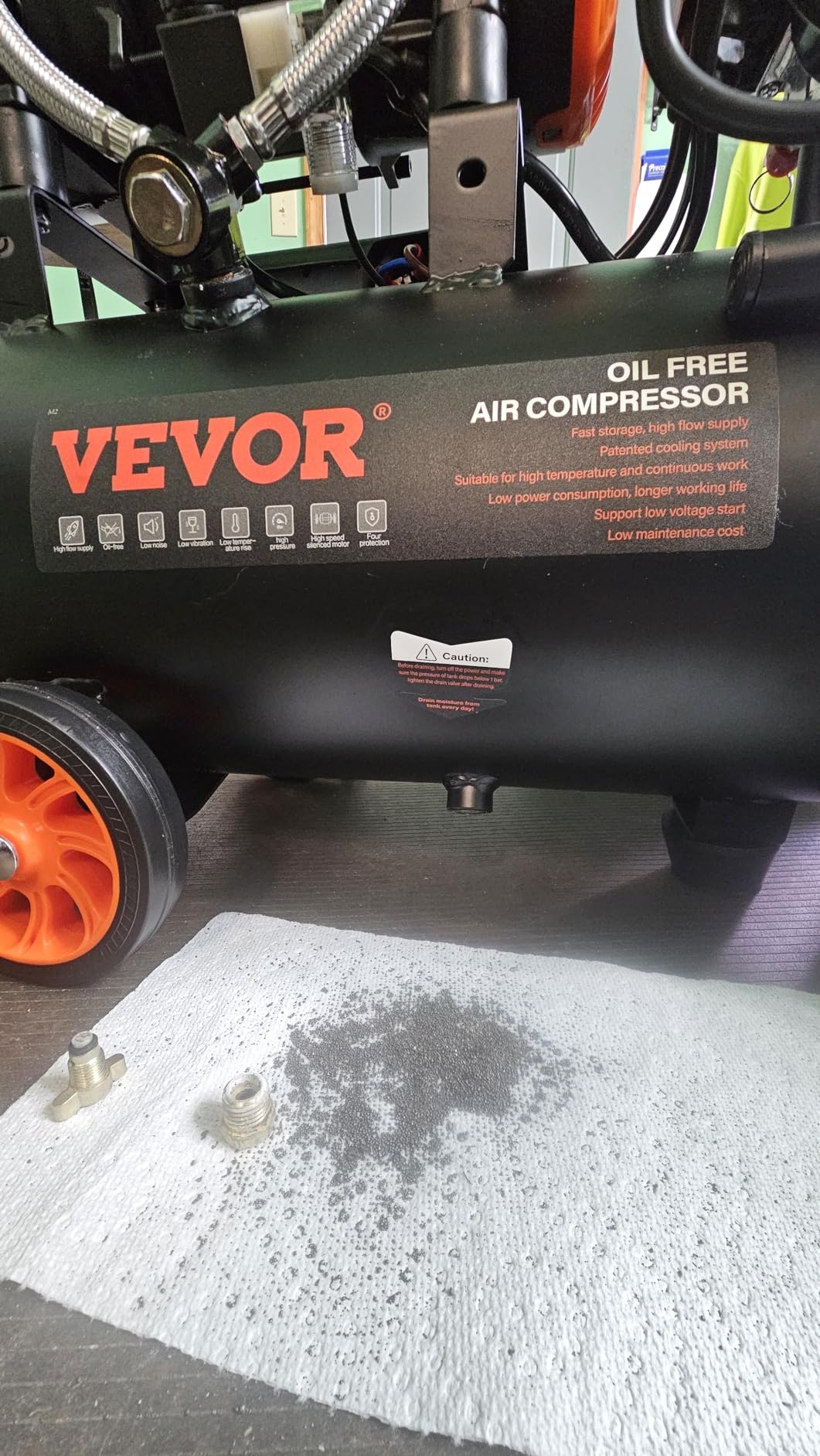
The noise reduction comes from two silencers with thickened covers, rubber pipes and filter cotton. Two large cooling fans, automatic overheating protection and pressure relief protection round out the safety story, and the package includes a compressor, foot pad, casters and silencers.
The motor is a 900W oil-free unit at 3,500 RPM producing 2.2 CFM at 90 PSI, with maximum pressure listed at 116 PSI. Buyers treat this as a step up from pancake compressors and appreciate the larger tank and the reduced noise from the dual muffler design.
Two silencers, one trade-off
Silencers dampen intake noise but add restriction. Compared with a single-vent design, you can lose a little airflow, which is why some owners suggest the dual setup is not ideal for paint spraying or impact tools on this model.
Best for the second bay in a two-car garage
A second compressor for tire work and cleanup alongside a bigger nailer machine is a reasonable pairing, and it takes up very little floor space. It is also an easy way to add air capacity without another dedicated outlet.
What Those Decibel Numbers Actually Mean
Decibels are logarithmic, so a 10 dB increase does not sound twice as loud, it sounds roughly twice as loud. Every step of 3 dB doubles the sound energy, and the perceptual doubling lands around 10 dB. That is why the gap between 60 dB and 70 dB matters far more than the gap between 78 dB and 85 dB, even though the second pair looks bigger on paper.
To make the numbers usable, here is what the ratings on this page correspond to in ordinary life. A modern refrigerator runs around 40 dB. A quiet conversation at arm’s length sits near 60 dB. A standard home air conditioner and a washing machine cycle land in the mid 60s to low 70s. A busy restaurant reaches the low 70s. So does a shop vacuum. Lawn equipment and a loud handheld blower sit in the mid to upper 70s, and a city traffic street runs 80 to 85 dB. Standard shop compressors fall into that upper band, which is exactly the range this roundup is trying to stay out of.
Which raises the question most buyers are actually asking: is 78 dB loud for an air compressor? Yes. At 78 dB you cannot hold a conversation a few feet away without raising your voice, and in a garage with concrete walls and an open door the sound carries further than the number suggests. Every unit in this roundup lands between 58 and 71.5 dB, which is refrigerator-to-washing-machine territory.
Why dB multiplied by duty cycle is the real answer
Here is the part most roundups leave out. A compressor’s noise has two components: the loud transient when the motor starts, and the lower hum while it runs. A one-gallon tank refills constantly, so it starts constantly, and each start is an audible thump. A 10-gallon tank holds five times the air, so it starts a fifth as often during a job.
That is why a 70 dBA ten-gallon tank often feels quieter to live with than a 58 dB one-gallon tank. Total noise exposure is dB multiplied by how long the machine runs. If you only need 2 CFM and the tiny tank is filling nonstop to keep up, you have bought the loudest experience on the market under a quiet-sounding spec sheet. If you buy the tank that covers your tool’s demand, the motor stops, the room goes quiet, and the decibel gap stops mattering.
So size the tank to your tools first, then pick the quietest compressor that can feed them. The reverse order is how people end up with a silent machine that stutters through every other nail.
How to Choose a Quiet Air Compressor for a Home Garage
CFM at 90 PSI decides whether the compressor keeps up. PSI decides how hard the air pushes, and for most home garage tools, pressure is not the constraint. A finish nailer wants around 90 PSI and roughly 1 CFM. A framing nailer wants 90 PSI and 3 to 4 CFM. An impact wrench and an orbital sander sit in the 3 to 5 CFM range. HVLP spray guns and sandblasters are the outliers, needing 5 CFM and upward.
Tank size is the second decision, and it is about how long you want between starts. A tank under 2 gallons is intermittent duty and nothing more. Between 2 and 4 gallons covers trim, finish work and auto detailing. 8 to 13 gallons covers framing, auto repair and repeat tool changes. Every extra gallon adds weight you may have to lift, so match the tank to the room rather than to your ambition.
Oil-free pumps need no oil changes, put no mist in the line, and start reliably in cold weather. They run hotter and wear faster than lubricated pumps, though the models here carry stated life cycles of 1,000 to over 3,000 hours. Oil-lubricated pumps generally last longer under sustained duty, but they need regular oil changes and they put oil in the air, which rules them out for finish carpentry and spray painting unless you add a coalescing filter.
Tank style mostly reflects airflow. Pancake units are thin, short and light, which suits shelving and shallow bays but usually means a small motor. Twin-stack compressors place two cylinders side by side for more airflow in a similar footprint. Belt-drive units run a pump off a belt, which cuts vibration and noise noticeably but needs more space and maintenance. If your garage is tight, the flat profile matters more than the pump type.
Voltage is the easy one. Every compressor in this roundup runs on 110V or 120V household current. Only look at 220V if you plan to run multiple tools simultaneously at sustained high volume, and remember that a 220V compressor needs its own dedicated circuit.
Two smaller details that decide day-to-day annoyance. Quick couplers: dual couplers let you run two tools without a tee fitting, and only the DEWALT on this page has them factory fitted. Drain valves: a ball valve drain empties a tank faster and more completely than a lever, and manual draining beats an auto drain only if you actually remember to do it. Moisture in the tank sprays water into your finish work, so build the habit early or add an inline moisture separator. Our rotary screw compressor guide covers the shop-tier options if you ever outgrow the consumer class.
How to Make Any Air Compressor Quieter
Most of the noise reduction available to you is free and takes an afternoon. Isolation pads come first: rubber or neoprene pads under each foot stop the tank’s vibration travelling through the slab into your walls, which is a different and lower-frequency problem than the noise itself.
Placement is the second lever. Keep the compressor at least a few feet from the wall shared with the house, and avoid placing it directly in a corner, because two hard surfaces plus a floor creates bass loading that makes a running motor sound considerably worse. The third step is routing: keep the hose off the floor where it can rattle, and let it reach its full length rather than leaving slack under tension.
For a compressor you are keeping long-term, a plywood doghouse enclosure lined with foam panel does more than anything else you can buy. Leave clearance on all sides for airflow, keep the vents open, and the reduction is usually larger than the gap between two compressor models.
Frequently Asked Questions
What is the best air compressor for a garage?
For most home garages the best balance of quiet and capability is the Makita MAC210Q, an oil-free 60 dB unit that handles trim, cabinetry and light framing. If you run framing nailers, impact wrenches or spray equipment, move up to the California Air Tools 10020C at 70 dBA and 5.30 CFM at 90 PSI. If auto repair is your main work, the VEVOR 13-gallon delivers 4.6 SCFM at 66 dB.
What size air compressor is best for a home garage?
A 2-gallon tank suits trim and finish nailing, an 8-gallon tank covers framing and general garage work, and a 10 to 13 gallon tank handles auto repair and sustained tool use. Pair that with at least 3 CFM at 90 PSI for nailers and impact tools, and 5 CFM or more for spray guns and sandblasters.
What type of air compressor is the quietest?
An oil-free dual-piston compressor driven by a low-RPM induction motor is the quietest type you can buy for home use. Motors running at 1,680 to 1,750 RPM produce far less whine than 3,500 RPM universal motors, and an oil-free pump avoids the mechanical oil noise of a lubricated compressor. Belt-drive models add a further noise cut but cost more space and maintenance.
What is the quietest air compressor you can buy?
The Makita MAC100Q is the quietest unit in our roundup at a rated 58 dB, with the Metabo HPT EC28M close behind at 59 dB and the Stealth SAQ-1234 at under 60 dB. Measured at normal listening distances in an enclosed garage, owners report the Makita running closer to 68 to 73 dB, so treat 58 dB as a best-case figure.
Is 78 dB loud for an air compressor?
Yes. At 78 dB you cannot hold a normal conversation a few feet away without raising your voice, and sound carries further from a garage with concrete walls and an open door. For comparison, a refrigerator runs near 40 dB, a quiet conversation sits near 60 dB, and a busy restaurant reaches the low 70s. Every unit in our roundup measures between 58 and 71.5 dB.
How to quiet down a noisy air compressor?
Put the compressor on rubber isolation pads to stop vibration travelling through the slab, place it several feet from the wall shared with the house, and avoid corners where bass builds. Route the hose so it does not rattle against metal, keep the vents clear, and for long-term storage build a plywood enclosure lined with foam panel with open ventilation.
Do I need a 220V compressor for a garage?
For most home garages, no. Every compressor in our roundup runs on standard 110V or 120V household current, which is why they are all oil-free and light enough to move. Consider 220V only if you plan to run several high-consumption tools simultaneously over sustained periods, and note that a 220V compressor needs its own dedicated circuit.
How often should I drain an air compressor tank?
Drain it after every use if you are running a spray gun or sandblaster, and at minimum once a week in humid conditions. Water in the tank sprays out with the air and can ruin a finish or a paint job, and it also corrodes the tank over time. A ball valve drain empties the tank faster and more completely than a lever, and an inline moisture separator catches what remains.
Final Verdict: Which Quiet Compressor Fits Your Garage
For most people, the best quiet air compressor for home garages is the Makita MAC210Q. It carries the highest owner rating in this roundup, runs at 60 dB, has no oil to maintain and handles trim, cabinetry and light framing without becoming the reason your neighbours knock.
If you need real airflow, the California Air Tools 10020C is the one that keeps working, and the VEVOR 13-gallon covers auto repair. If your garage is really a corner of a room, the Metabo HPT EC28M at 25.2 pounds is the one you will not resent carrying.
Whichever you pick in 2026, size the tank to your tools before you chase the decibel number. The quietest compressor in your garage is the one that runs least.