
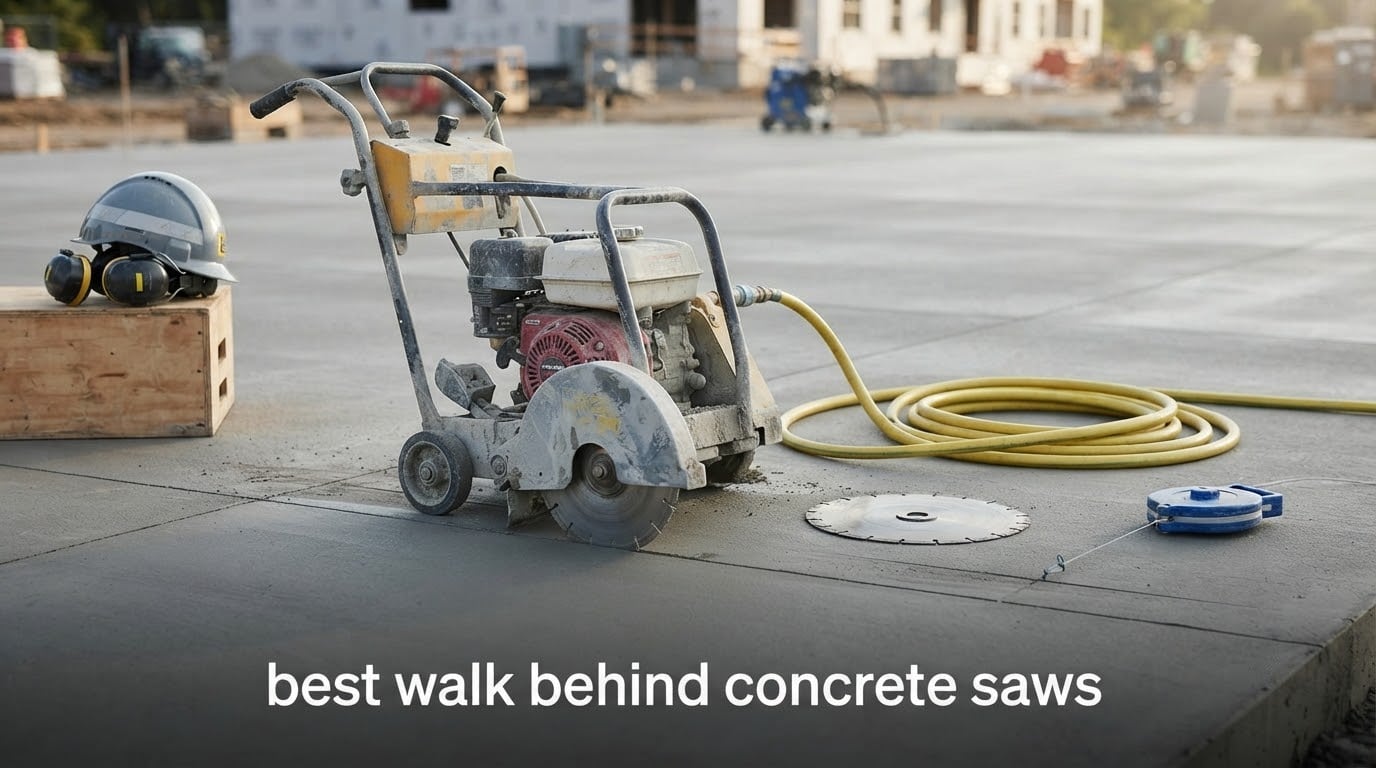
The SKIL SPT79A-10 is our best walk behind concrete saw overall in 2026, and the Tomahawk TFS6H is the one to buy if you are scoring joints in green concrete on the same day you pour. A walk-behind saw is a single-operator push machine with a diamond blade mounted below the frame, built for control joints, expansion joints, trenching and slab demolition.
What separates a walk-behind from a handheld cutter is the fact that the operator walks the cut instead of holding it. The depth is set once, the frame keeps the blade at a fixed angle, and you push a wheelbarrow-weight machine along a chalk line. That is why a walk-behind can reach full slab depth on a straight run and why a handheld saw struggles with anything past a foot of depth.
Most people searching for the best walk behind concrete saws do not need to own one. A single driveway joint or a weekend of trenching is cheaper to rent, and the rent-versus-buy math is broken down further down. Everything below is written for people who cut concrete regularly or who have enough linear feet of sawcut in front of them to justify owning the machine.
Top Walk Behind Concrete Saw Picks at a Glance
Best overall: SKIL SPT79A-10 – 7 inch blade, 1800W corded motor, wet or dry dust control, 31.7 pounds
Best for green concrete: Tomahawk TFS6H – 6 inch early entry blade, 3.5 HP Honda GX120, 1-3/16 inch depth, cuts joints the day of the pour
Best value gas saw: Stark USA 14 inch – 6.5 HP gasoline engine, welded steel chassis, adjustable depth, suits asphalt and slab work
Best for deep single-pass cuts: Tomahawk TFS20H – 20 inch blade, 13 HP Honda GX390, 7.1 inch maximum depth
Best for large early-entry pours: Tomahawk TFS10H – 10 inch early entry blade, triangular arbor, 1.25 inch depth
Best for handling weight: Husqvarna FS 309 – 112 pounds, 14 inch blade, 4-5/8 inch depth, spring assisted raise and lower
One note before the list: concrete cutting throws respirable crystalline silica into the air, and water is what keeps it down. If you do not already own one, our respirator mask roundup for concrete dust is worth a read before your first cut.
Top 3 Walk Behind Concrete Saws for September 2026
Walk Behind Concrete Saws Compared Side by Side in September 2026
Every saw in this roundup is listed with the numbers that actually decide whether it fits your job, so you can compare them in one pass before you read any individual review.
| PRODUCT MODEL | KEY SPECS | BEST PRICE |
|---|---|---|
 |
|
Check Latest Price |
 |
|
Check Latest Price |
 |
|
Check Latest Price |
 |
|
Check Latest Price |
 |
|
Check Latest Price |
 |
|
Check Latest Price |
 |
|
Check Latest Price |
 |
|
Check Latest Price |
 |
|
Check Latest Price |
 |
|
Check Latest Price |
 |
|
Check Latest Price |
 |
|
Check Latest Price |
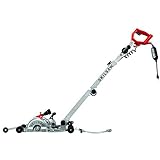
1. SKIL SPT79A-10 Worm Drive Saw for Corded Jobsite Power
SKIL 7″ Walk Behind Worm Drive Skilsaw for Concrete – SPT79A-10
7 inch blade
1800W corded electric
31.7 pounds
Wet or dry dust control
+ The Good
- Cuts straight with minimal chipping or spalling
- Worm drive power built for concrete
- Folding adjustable handle cuts fatigue
- Water and vacuum dust control
- Blades last a long time between changes
- The Bad
- Corded electric limits mobility
- Occasional chips on green concrete
This is the only true worm drive walk-behind in the group, and at 4.6 stars across 225 owner reviews it also has the deepest owner evidence of any saw we looked at. Owners report straight cuts with minimal chipping, which is the single thing a walk-behind exists to deliver.
At 31.7 pounds it is the machine you can actually move by yourself. The handle folds to fit your height and the two-finger trigger takes pressure off your grip, which matters on a long straight run where a stiff trigger shows up in your hands before it shows up in the cut.
The wet and dry dust management system is the feature owners bring up most. A water feed or a vacuum hose keeps the cut line clean, and reviewers note the blades hold up well between changes, which is the running cost that decides whether a saw makes financial sense.
The compromise is the cord. Sawing wet concrete while plugged into mains power means cable management across every pass, and a GFCI-protected circuit is not optional. If the work is spread across a driveway or a street, a gas saw removes that whole problem.
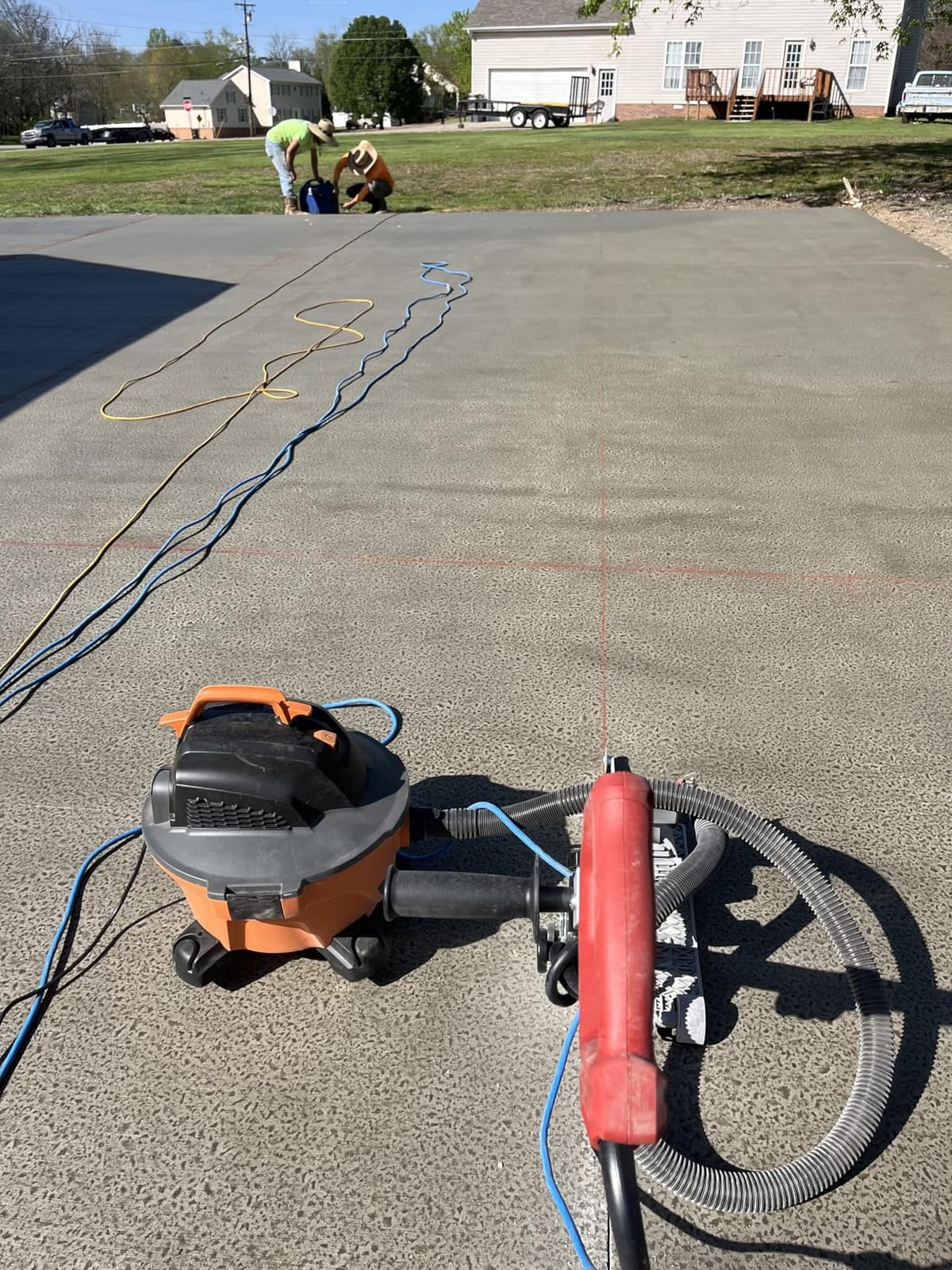
Seven inches is enough depth for repair work and joint lines
This is not a full-depth demolition saw. Reach is roughly a foot class, so it suits expansion joint lines, driveway repair cuts and shallow trenches. If your slab is thicker than that reach allows, take two shallow passes rather than forcing one deep cut.
Forcing depth is what bends a blade and pushes a saw off line. Two clean passes at half depth will beat one wandering cut every time.
Corded power only works near an outlet
A 120 volt saw with a 1800 watt motor needs real electrical capacity and a clean path for the cord. Wet cutting plus mains power is the least comfortable combination in this roundup.
We picked this saw because of the owner track record, the weight, and the control. Buyers who need cord-free range on a large pour should look at one of the gas machines instead.
2. CORMAC CQ480H 20 Inch Gas Saw for Deep Single-Pass Cuts
CORMAC CQ480H walk behind concrete floor saw max 20″ blade gasoline engine GX390 and water tank INCLUDES 1 x 20″ concrete blade
20 inch blade capacity
13 HP Honda GX390
287 pounds
Water tank and blade included
+ The Good
- Accepts 20 inch blades for deep cuts
- 13 HP Honda GX390 engine
- Water tank and 20 inch blade included
- Reinforced steel box frame
- The Bad
- Only a handful of owner reports
- 287 pounds is a two-person move in the rough
The CQ480H is the rare walk-behind listing that includes both a water tank and a 20 inch concrete blade, so it can cut the day it arrives. That matters if you are standing on a job with no time to source a diamond blade first.
Behind the panel is a 13 HP Honda GX390, which is the engine platform contractors ask for by name. Honda GX390 engines are the easiest to find parts for and the easiest to replace outright, and a replacement engine is a real option if the original ever lets go.
A 20 inch blade changes what jobs are possible
Blade diameter drives depth here. A 20 inch saw reaches far enough to cut through a full-thickness slab or a deep service trench in one pass, which means fewer passes, less slurry and a straighter second cut alignment.
The tradeoff is mass. At 287 pounds this is not a machine you lift onto a curb by yourself, so plan the set of blocks and the loading before the day starts.
Only three owners have reported on this saw
The 4.5 average comes from a very thin base, and all three ratings are positive with no lower scores among them. That tells you nobody has posted a complaint, but it does not tell you how the saw holds up over a few seasons.
If you like the spec sheet, verify the details with the seller before you commit, particularly the blade and the water system, because those are the parts that vary most between production runs.
3. Tomahawk TFS6H Early Entry Saw for Green Concrete Joints
TOMAHAWK 6″ Early Entry Concrete Saw Walk Behind Green Joint Saw with 3.5HP Gas Powered GX120 Honda Engine and Dust Control
6 inch early entry blade
3.5 HP Honda GX120
1-3/16 inch max depth
Quiet running
+ The Good
- Scores joints on same-day green concrete
- Honda GX120 engine
- Quiet next to full-depth saws
- Straight cuts
- Blade included
- The Bad
- Some units arrive with missing hardware or blade
- One report of an engine that would not start
- Depth control fades with extended use
- Listed item weight looks unreliable
This is the only early-entry machine in the roundup that is small enough to be a realistic buy rather than a fleet purchase. Early-entry saws exist to put a weak groove into concrete while it is still green, guiding where the slab wants to crack instead of chasing cracks later.
Owners like that it lets a crew score a pour the same day rather than come back, and they single out the Honda GX120 for having more than enough power for the job. It is also reported as noticeably quieter than a full-depth saw, which matters on residential pours with neighbours close.
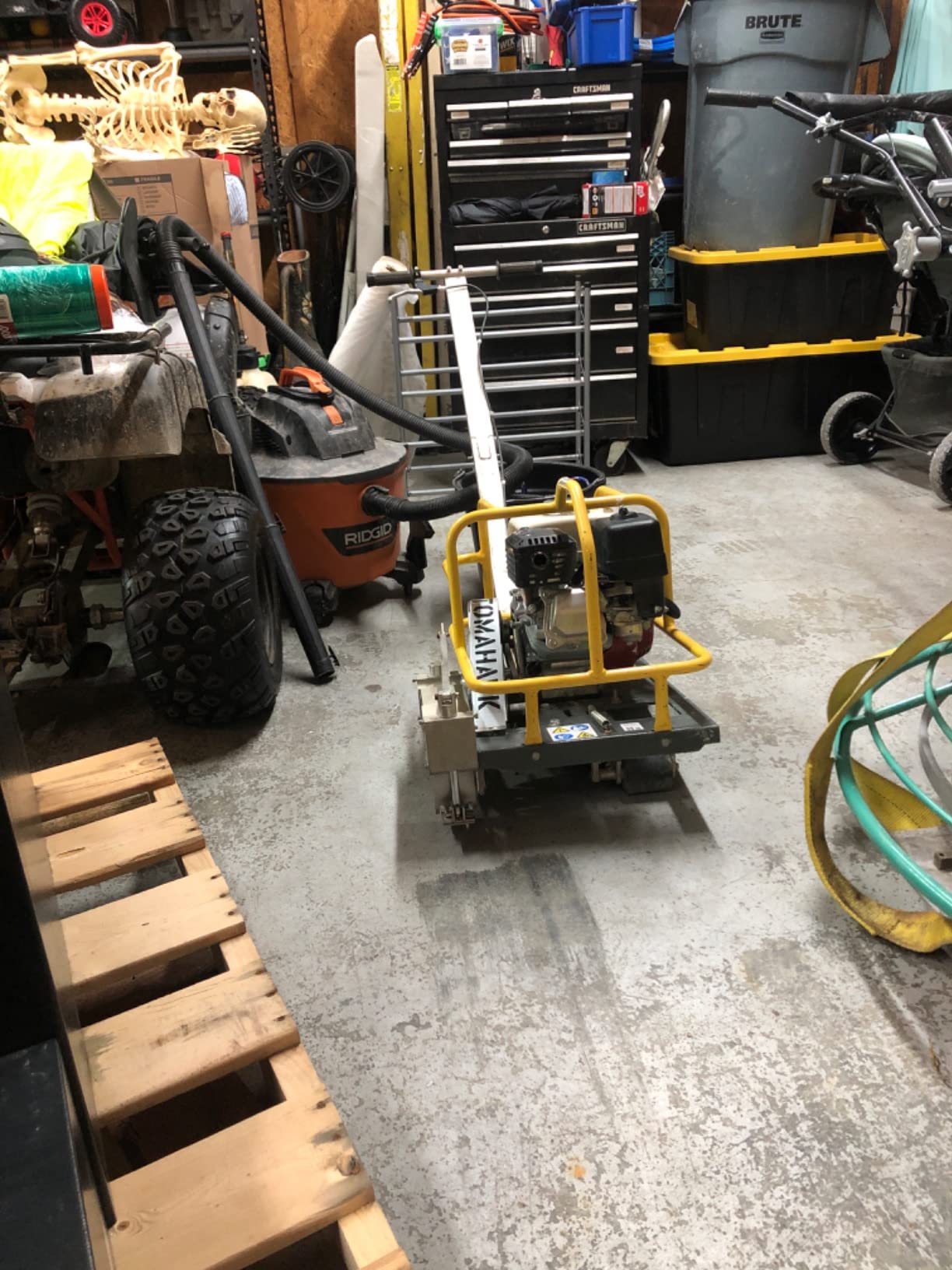
Early entry is a different job than a flat saw
The TFS6H runs a 6 inch soff-cut blade to a maximum depth of 1-3/16 inch, and that shallow reach is correct. A control joint in green concrete needs a weak plane, not a full-depth cut, and over-cutting early concrete is how you create the random cracking you were trying to prevent.
Contractors on concrete forums consistently point to Soff-Cut as the established name in early-entry work, and this machine follows that same concept at a size most people can actually own.
Quality control is the weak point here
The 3.8 average across 29 reviews reflects a real cluster of complaints, and they are worth reading before you buy. Some units arrived with missing or damaged hardware or without a blade, and one owner reported an engine that would not start after setup.
Another owner reports the depth control weakening over about a year and a half until the saw would not hold its setting. The listing also gives an item weight of 151 grams for a gas walk-behind, which tells you the specification sheet is not fully trustworthy. Inspect everything on arrival.
4. MechMaxx FS350Z Walk Behind Saw for Flexible Gas Power
MechMaxx 5.8 HP Walk-Behind Concrete Floor Saw, 14 in Blade, 4 in Cutting Depth, FS350Z
14 inch blade
5.8 HP Zonsen GB210
4 inch cut depth
3.2 gallon water tank
+ The Good
- 14 inch blade with 4 inch cut depth
- 3.2 gallon water tank
- Adjustable handle with control console
- Mechanical wheel lock for setup
- Lifting handles for jobsite handling
- The Bad
- No owner reviews to verify field claims
- Zonsen parts support is thinner than Honda
The FS350Z sits in the middle of this list on paper: 14 inch blade, 4 inch cut depth, a 5.8 HP Zonsen GB210 engine and a 3.2 gallon water tank. On paper that is a competent slab and pavement machine for joint work and pavement repair.
The details that separate a usable saw from a frustrating one are all present. The mechanical wheel lock keeps it stable while you set depth, the operator control console puts the throttle and blade brake in reach, and the lifting handles make it possible to move without dragging.
A 4 inch depth suits repair and joint cutting
Four inches is enough for expansion joint lines, driveway repair and shallow trenching on most residential slabs. It is not enough to take out a full-thickness slab, so match the depth to the job before you commit to the machine.
A 14 inch blade with this reach also means more of the blade stays engaged in the cut, which generally gives a straighter line than a very large blade barely entering the concrete.
No owner reviews means you are buying the spec sheet
This listing has no customer ratings at all. Everything we can tell you comes from the manufacturer, so treat the numbers as unverified until the saw has cut something.
The Zonsen engine is the one item to think hardest about. It is a serviceable commercial engine, but parts availability is thinner than for a Honda, and that is the difference between a five-minute repair and a shipping delay.
5. Tomahawk TFS20H 20 Inch Saw for Commercial Trenching Work
Tomahawk 20 Inch Walk Behind Concrete Saw with 13 HP Honda Water Tank GX390 Engine for Asphalt Concrete Cutting
20 inch blade
13 HP Honda GX390
7.1 inch max depth
364 pounds
+ The Good
- 7.1 inch depth in a single pass
- Rotating handle for depth control
- Water feeds both sides of the blade
- Three year warranty with next day parts
- The Bad
- No owner reviews on this listing
- 364 pounds needs a planned move
The TFS20H is built for a crew that cuts trenches and removes slabs for a living. A 20 inch blade with 7.1 inches of reach means full-depth utility trenching in one pass, and the 13 HP Honda GX390 is the engine most operators already know how to service.
Depth is set with a manual rotating handle rather than a lever, which is slower but far more repeatable. For trenching that is the right trade, because the difference between a 5 inch trench and a 5.5 inch trench is the difference between a fitting that seats and one that does not.
Water on both sides of the blade matters more than it sounds
Feeding water to both sides of the blade keeps slurry out of the frame and the blade shaft bearings, which is the single biggest cause of premature saw failure. It also keeps the silica dust down where the blade meets the concrete.
On a machine this size, the water system is not a small detail. Check the tank capacity and the plumbing before the job, because a blocked feed shows up as a stalled cut in the middle of a trench.
The warranty is the selling point, the reviews are the risk
A three year warranty with nationwide technician coverage and next-day parts is genuinely meaningful on a saw with a commercial engine, and it is the reason we rank this machine here.
There are no owner reviews on this listing, so the case for it is the manufacturer specification and the warranty. If the work justifies this machine, ask the seller to confirm the warranty terms in writing before you buy.
6. Tomahawk TFS10H Early Entry Saw for Large Pours
10″ Early Entry Green Concrete Saw with 13 HP Honda GX390 Engine
10 inch early entry blade
13 HP Honda GX390
1.25 inch cut depth
Triangular arbor
+ The Good
- 10 inch early entry blades
- 1.25 inch depth to control random cracking
- Electric key start
- Triangular arbor holds early entry blades
- Three year warranty with technician network
- The Bad
- No owner reviews on this listing
- No category sales history shown
Where the TFS6H handles a residential slab, the TFS10H is built for a large commercial pour. It takes early-entry blades up to 10 inches, driven by a 13 HP Honda GX390 with an electric key start for fast turnarounds between joints.
The triangular arbor is the detail that identifies it as a true early-entry machine. It holds the triangular early-entry blades in place so they cannot shift at depth, which is what keeps the groove consistent across a long run on fresh concrete.
Early entry prevents cracks, it does not repair them
The whole point of an early-entry saw is to give shrinking concrete a preferred path so the crack happens where you drew it. A 1.25 inch groove in green concrete is exactly the weak plane that makes that work, and a full-depth saw is the wrong tool for the task.
Timing is everything. Score the joint while the concrete is still soft enough to cut cleanly, because a saw that arrives after the slab has set is cutting cured concrete and you have lost the main advantage.
Verify availability of parts and support before buying
This listing shows no customer reviews and no category sales history, so there is no owner evidence to lean on. Confirm with the seller that the three year warranty and technician network apply to your region.
At 390 pounds this is a commercial machine with commercial logistics. Loading, fuel, water and blade inventory all have to be part of the plan.
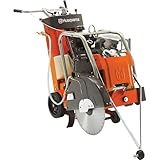
7. Husqvarna FS 309 Walk Behind Saw for Lightweight Handling
Walk Behind Concrete Saw, 14″, 1.59 gal.
14 inch blade
8.5 HP Robin engine
4-5/8 inch depth
112 pounds
1.59 gallon fuel
+ The Good
- Lightest walk-behind here at 112 pounds
- Spring assisted raise and lower
- Adjustable handles
- 2 inch blade to wall reach
- The Bad
- Cuts in one direction only
- No customer reviews on this listing
At 112 pounds the FS 309 is the machine you can put in a pickup and unload by yourself, and that changes who can realistically own one. Every other gas walk-behind here weighs between 212 and 390 pounds.
The spring assisted raise and lower system takes the weight off the blade as you set depth, and the adjustable handles let you set the stance that suits your height. For perimeter work it also has about 2 inches of reach past the blade to a wall, which handles a cut along a foundation.
Its weight is the reason to buy it
Gas walk-behinds are heavy because the frame, the engine and the water tank all have to sit over the blade. If you are working alone, that weight is the deciding factor, not horsepower.
The 8.5 HP Robin engine is adequate for joint and repair work. It is not the engine you want for long trenching runs in hard concrete.
One-way cutting is a real limitation
This saw cuts in one direction only, which is how the blade geometry and guide wheel are set up. Plan your route so you are not constantly turning around, because reversing mid-cut is where wandering lines happen.
There are no customer reviews on this listing, so the specification sheet is all we have to go on. If you need both directions, look at a push saw with a reversible guard.
8. Brave BRPCS210H Floor Saw for Faster Blade Changes
Brave BRPCS210H 20-in. Floor Concrete Saw
20 inch blade capacity
Gas powered
Hinged lift up blade guard
Easy crank depth control
+ The Good
- 20 inch blade for deep floor cuts
- Hinged guard speeds blade changes
- Dual flanges and reversible guard
- Pointer wheel helps keep cuts straight
- The Bad
- Blade sold separately
- No customer reviews on this listing
The BRPCS210H is a 20 inch floor saw built around blade handling rather than raw power. The hinged front guard lifts up for blade changes, dual blade flanges support the blade on both sides, and the guard itself is reversible.
That matters on a saw that takes large blades. Getting a 20 inch diamond blade on and off a walk-behind is one of the most frustrating parts of the job, and a design that opens up for it saves more time over a season than any small horsepower gain.
Budget for the blade before anything else
The blade is sold separately here, so the saw as listed is not ready to cut. Add a proper diamond blade matched to the material, and factor blade replacement into your cost from the first cut onward.
Blades are consumables, not accessories. A crew that cuts asphalt and concrete in the same week needs two blades on hand, not one.
The saw position guide is worth more than it sounds
The adjustable pointer wheel and the easy crank for raising and lowering the blade are what keep a 20 inch saw on a straight line. A 20 inch blade has a lot of opportunity to wander if the depth changes as you push.
There are no owner reviews on this listing, so the feature set is the manufacturer’s own description. Confirm the drive and blade arbor fit before you commit, since those details vary between catalog entries.
9. Husqvarna Soff-Cut 150 for Low-Dust Slab Edge Cuts
Husqvarna Construction Soff-Cut 150 Saw
Gas powered
Lowest weight in the Soff-Cut range
Low noise blade enclosure
Low dust blade block
+ The Good
- Lightest gas saw in the Soff-Cut range
- Low noise blade enclosure
- Low dust blade block system
- Gas power for slab edges
- The Bad
- Listed as a bare tool
- Basket and blade need sourcing separately
- No customer reviews on this listing
The Soff-Cut 150 is built around two problems specific to slab edge work: dust and noise. The patented low noise blade enclosure keeps the cut quiet, and the low dust blade block system reduces what escapes when you are working right against a wall or a neighbouring property.
It is also described as the lightest gas saw in the Soff-Cut range, which is meaningful on a family of machines where weight is the main complaint from operators doing long soff cuts.
Dust control at the blade block is the feature to judge
Most walk-behinds rely on a water tank alone. A blade block system is a second layer, and it is what makes this machine workable on indoor or edge work where runoff is a problem and airborne dust still has to be controlled.
Our respirator roundup is still worth reading, because dust control at the machine and respiratory protection at the operator are separate layers of the same protection.
A bare tool listing means extra shopping
This entry is listed as a bare tool, so the blade and other accessories have to be sourced separately. Budget for that before you start, and confirm what the bundle includes with the seller.
The category data also files this saw under band saws, which is a cataloging error rather than a product problem, but it is a reminder to verify the specifications with the manufacturer before ordering.
10. Husqvarna FS 524 24 Inch Floor Saw for Maximum Cut Depth
24In. FS 524 Walk-Behind Concrete Saw
24 inch blade capacity
3600 rpm blade speed
IntelliSeal arbor system
Stand included
+ The Good
- 24 inch blade class for deep cuts in one pass
- IntelliSeal blade arbor system
- 3600 rpm blade speed
- Stand included
- The Bad
- Power source field conflicts with the machine type
- No customer reviews on this listing
At the top of this list for capacity, the FS 524 runs a 24 inch blade at 3600 rpm. That is the largest blade here, and it is the machine for full slab removal and deep cuts where a 14 or 20 inch saw would need two passes and twice the slurry.
The IntelliSeal blade arbor system is the part worth knowing about. It is designed to keep the blade secure at the arbor, which is where a large blade under load either stays true or deflects into a wandering cut.
Bigger blade means one pass, not two
A 24 inch blade reaches depth in a single pass, which halves the time on a slab removal job and keeps the cut line from shifting between passes. The second pass on a partially cut groove is exactly where a straight cut goes crooked.
It also means more blade in the cut, more load on the engine and a much larger consumable to budget for. This is a machine for a specific job, not a general-purpose first purchase.
Confirm the power source with the seller
The listing describes the power source as corded electric, which conflicts with a walk-behind floor saw of this class. The rest of the specification is consistent with a gas machine, but that field is not something to guess at.
Ask the seller to confirm the engine, the fuel capacity and the warranty in writing before you commit. There are no customer reviews on this listing to fall back on.
11. Stark USA 18 Inch Saw for Built-In Transport Wheels
Stark USA 18″ Walk-Behind Concrete Floor Saw Floor Saw Gas Powered 13.0HP Engine Motor 4-Stroke with Water Tank
18 inch blade
13.0 HP four stroke engine
308.6 pounds
Built-in transport wheel
+ The Good
- 13.0 HP four stroke gasoline engine
- Built-in water system to the blade
- Saw position guide for straight cuts
- Rotating depth handle
- Built-in transport wheel
- The Bad
- Both recorded reviews are 1 star
- No positive owner evidence
- Delivery requires a phone number for scheduling
On paper this is a capable 18 inch machine: a 13.0 HP four stroke engine, a built-in water system, a saw position guide, a rotating depth handle and a transport wheel. At 308.6 pounds, the built-in wheel is the feature that makes it workable at all.
Without that wheel, a saw this size is a two-person lift every time you move it. With it, one person can roll it from the truck to the cut, which is a bigger practical advantage than the horsepower difference between it and smaller saws.
18 inch and 13 HP is a serious trenching combination
The listing names sidewalks, driveways, city streets, pipe trenches and cable channels as intended uses, and the engine and blade size support that. Depth is set with the rotating handle, so cuts should be repeatable between passes.
Plan the same way you would for any 18 inch saw. Big blade, big consumable, and a water supply large enough to keep up with a 13 HP engine under load.
The owner feedback here is the reason for caution
Both recorded reviews are 1 star, the lowest rating available, and there is no positive owner evidence at all. A feature list is not a substitute for a few seasons of field reports, and this machine has none.
If you buy one, do a full run-up on day one and keep the cordless tools for the fasteners, because a two-review base gives you no warranty history to lean on if something fails.
12. Stark USA 14 Inch Gas Saw as the Best Value Pick
Stark USA 6.5 HP Gas Walk-Behind Concrete Cut-Off Saw, 14-Inch Masonry Floor Cutter with Adjustable Cutting Depth, Heavy-Duty Cement, Asphalt, Brick & Stone Circular Saw for Construction
14 inch blade
6.5 HP gasoline engine
Welded steel chassis
212.5 pounds
+ The Good
- Cuts asphalt and masonry cleanly
- 6.5 HP engine handles roadwork and slabs
- Welded steel chassis
- Straightforward depth adjustment
- Water feed cuts down dust
- The Bad
- Blade sold separately
- One report of a connecting rod failure
- Reports of gas leaks and cutting out
- Owners recommend thread locker on factory nuts
The Stark USA 14 inch is the cheapest way into gas walk-behind cutting in this roundup, and at 3.7 stars across 10 reviews the feedback is sharply split. Several owners rate it five stars for easy asphalt and masonry work. Others report engine trouble within months.
The 6.5 HP gasoline engine and welded steel chassis are a sensible package, and the water feed is reported to noticeably reduce dust. Depth adjustment is simple, which is either a virtue on a rental-grade machine or a warning that it lacks the fine control of a contractor unit.
It works, and it works slowly
Value-tier saws in the same category get described on forums as functional but slow against professional equipment. A 6.5 HP engine will not be slowed down by a joint cut, but it will not keep pace on long trenching runs either.
For a driveway, a sidewalk or a small repair job, that slower pace is an acceptable trade for the lower entry point. For daily trenching work, the engine is the limit.
Read the durability complaints before you commit
One owner reported a connecting rod failure after roughly five hours of use, and another reported no power, gas leaks and repeated cutting out along with poor support. Owners also advise re-tightening factory fasteners or using thread locker on a regular basis.
Add the separately sold blade to the cost, and treat this as a machine to service carefully rather than one to abuse. If you can accept slow cutting and do your own maintenance, it will handle pavement and slab work.
Walk Behind Saw Buying Guide: What Actually Matters
Blade diameter is a marketing number, rated cut depth is the real one
A 20 inch blade does not mean a 20 inch cut. The rated depth of cut is what the saw can reach, and the machines here range from 1-3/16 inch on an early-entry saw to 7.1 inch on a 20 inch trenching machine. Match the depth to the slab, not the blade to the marketing.
For most residential slabs, a 14 inch blade with 4 to 5 inches of reach is the right size. Buy a 20 or 24 inch machine only when you are doing full-depth trenching or slab removal.
Push or self-propelled: which transmission you need
A push saw gets its speed from you. That gives fine control for a short cut and around obstacles, and it lets a beginner feel the concrete before the blade wanders off line.
A self-propelled saw drives its wheels at a set ground speed, which is what you want for long straight trenching runs and control joint lines across a large slab. It is faster and more consistent, and it is harder to slow down once the cut deepens.
Early entry saws are the answer for green concrete
If you are cutting within days of a pour, you need an early-entry saw, not a full-depth flat saw. Early-entry machines cut a shallow groove into soft concrete to guide where the slab will crack as it cures.
Cutting cured concrete too early, or too deep in green concrete, defeats the purpose. Wrong-tool choice here is what produces random cracking that cannot be repaired.
Wet cutting and the silica rule
Concrete contains respirable crystalline silica, and the only reliable control is water at the blade. Every saw here has some form of water delivery, and the ones worth owning feed both sides of the blade.
Wet cutting keeps slurry out of the blade shaft bearings, which is the main cause of premature saw failure, and it keeps dust down for the operator. Add respiratory protection and eye and hearing protection on top. Read our concrete dust respirator guide before your first day.
Cleaning up is the other half of a wet cutting job, and the slurry has to go somewhere. Our walk behind floor scrubber roundup covers getting it off the slab without tracking concrete across finished work.
Renting versus buying: the number that decides it
Walk through the math before you buy. Multiply your total linear feet of sawcut by the time you expect to cut in the next two years, then compare that against rental days. A single driveway or a one-day trenching job is a rental every time.
Owning starts to make sense when the rental days add up and you have somewhere to store a 200 to 300 pound machine. The trigger is not the saw, it is the volume of concrete in front of you.
New versus used: what to inspect before you pay
If you look at a used saw, check the hour meter, the blade shaft bearings for side play, the water system end to end, the depth adjustment mechanism, and whether the engine starts and holds idle. Fresh concrete slurry is the harshest environment an engine can live in.
Look for a straight cut test line in cured concrete if the seller allows it, and always factor new blades into the price. A cheap saw with a dead shaft bearing is not a bargain.
What goes wrong on a walk-behind saw, and how to fix it
A saw that slows or stalls mid-cut is usually starved of water, cutting too deep too fast, or working a worn blade. Check the water feed first, then check the blade, then reduce your walking speed.
A wandering cut comes from uneven depth, a bent blade, or a worn guide wheel. An uneven cut across the blade face means the blade needs replacing, not adjusting. Clean the blade shaft after every job, since dried slurry is the root cause of most bearing and alignment complaints.
Frequently Asked Questions
Which walk-behind concrete saw is the best?
For most people the SKIL SPT79A-10 is the best overall walk-behind concrete saw: it is light, easy to control, handles wet and dry dust control, and has the deepest owner review history of any saw in our roundup. Pick the Tomahawk TFS6H instead if you need to score control joints in green concrete the same day you pour.
How deep will a walk behind a concrete saw cut?
It depends on the model, not the blade size alone. The machines in our roundup reach from 1-3/16 inch on the Tomahawk early-entry saw to 7.1 inches on the Tomahawk TFS20H, with 14 inch machines typically reaching 4 to 4-5/8 inches. Check the rated depth of cut rather than the blade diameter before you buy.
Is a handheld or walk behind concrete saw better?
A walk-behind saw wins on straightness, depth and operator fatigue because you push the machine instead of holding the blade. A handheld saw wins on portability and cost, and it is the better choice for short cuts, tight spots and work far from a cutting line. Many crews own both and use the handheld for finishing and detail work.
Do I need water to cut concrete?
Yes. Concrete contains respirable crystalline silica, and water at the blade is the primary control. Water also cools the blade, keeps slurry out of the blade shaft bearings and extends blade life. Dry cutting without dust extraction is the worst option for both your lungs and your saw, and cut depth control suffers as well.
Should I push a walk-behind saw or get a self-propelled one?
Push for control, self-propelled for speed. A push saw lets you set the pace and feel the cut, which helps on short work, around obstacles and for first-time operators. A self-propelled saw drives its wheels at a fixed ground speed, which is faster and more consistent on long straight trenches and long control joint lines across a large slab.
What are the common problems with concrete saws?
The most common failures are a saw stalling mid-cut from water starvation or a worn blade, wandering cuts from a bent blade or worn guide wheel, and engine damage from concrete slurry. Keep the water system flowing, clean the blade shaft after every job, replace blades when the cut face becomes uneven, and never force depth in one pass.
Our Final Pick for 2026
The SKIL SPT79A-10 is the best walk behind concrete saw we would put on a truck in 2026. It is the lightest machine in the roundup at 31.7 pounds, the only true worm drive option, and the only one with an owner review base deep enough to tell you how it performs after real work.
Buy the Tomahawk TFS6H if you score green concrete, the Tomahawk TFS20H or Husqvarna FS 524 for full-depth trenching and slab removal, the Husqvarna FS 309 if you are working alone and weight is the deciding factor, and the Stark USA 14 inch if the budget matters more than finish rate.
Before any of them, run the numbers on rental versus ownership. If your sawcut adds up to a handful of days of rental, rent. If you are cutting concrete week after week, any of these twelve will be a better investment than a fifth rental.