
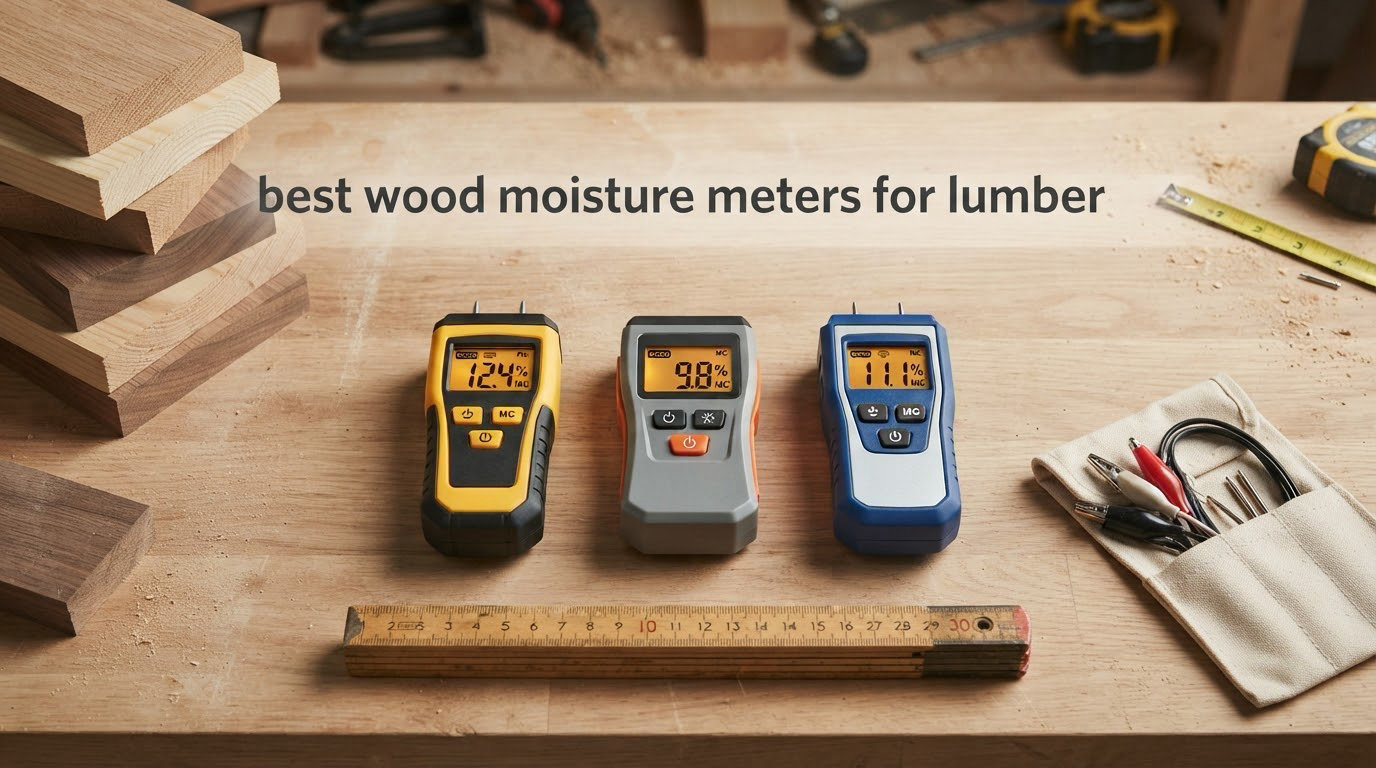
The best wood moisture meters for lumber are the ones that give you a reading you can actually act on at the yard or in the shop. Our pick for most people is the General Tools MMD4E, a pin-type meter with a wide 5-50% wood range, a large backlit display and a hold button that freezes the number while your hands stay on the board.
That matters more than it sounds. Lumber dries from the outside in, so a surface scan on a thick board can read dry while the core is still soaking. A meter that cannot reach past that outer shell gives you confidence you have not earned. We compared 12 wood moisture meters across rough lumber, kiln-dried stock and firewood to find the ones that hold up for each of those jobs.
A note on how we picked: we read the published accuracy specifications, the measurement ranges, the reading depth, the species scales and the warranty on every unit, then weighed those against what owners report back after real use. We are not a calibration lab, so we treat stated accuracy figures as claims rather than measurements. Where owners repeatedly disagree with the specification, we say so.
Disclosure: we may earn a commission from qualifying purchases made through the links on this page. That does not change which products we rank or what we say about them.
If your main interest is wood moisture detection indoors rather than at the sawmill, our wood moisture meter roundup for woodworking covers the finishers’ side of the topic. For flooring work specifically, see our moisture meters for wood flooring guide.
Top 3 Wood Moisture Meters for Lumber for October 2026
The MMD4E wins the top slot on range and evidence. Fifteen thousand owner reviews is a much bigger sample than anything else in this group, and the complaints that do surface are about pin holes and steady pressure, not about the numbers being wrong.
The Klein ET140 takes the non-destructive slot. It scans to 3/4 inch with no puncturing, survives drops, and r/woodworking regularly recommends it as a cheap first scan before you pull out a pin meter for a confirming reading.
The RDINSCOS MT28 rounds out the top three because of the built-in flashlight. Crawl spaces, attics and the dark end of a stack are exactly where lumber gets checked, and owners like that they do not have to hold a second light.
All 12 Wood Moisture Meters Compared in October 2026
| PRODUCT MODEL | KEY SPECS | BEST PRICE |
|---|---|---|
 |
|
Check Latest Price |
 |
|
Check Latest Price |
 |
|
Check Latest Price |
 |
|
Check Latest Price |
 |
|
Check Latest Price |
 |
|
Check Latest Price |
 |
|
Check Latest Price |
 |
|
Check Latest Price |
 |
|
Check Latest Price |
 |
|
Check Latest Price |
 |
|
Check Latest Price |
 |
|
Check Latest Price |
Two things stand out in that lineup. First, most of the pinless meters sit in the entry tier while the pin-type meters carry the accuracy claims, which matches the pattern owner reports describe. Second, several cheap pin meters bottom out at 5% or 6%, meaning they cannot tell you that properly seasoned indoor lumber is dry enough for cabinet work.
Pin Type vs Pinless Meters for Lumber
A pin-type meter pushes two metal pins into the board and measures the electrical resistance between them. Wet wood conducts better than dry wood, so lower resistance means higher moisture content. The measurement is only as good as the depth the pins reach, and a short pin is the single most common reason a cheap meter misses a wet core.
A pinless meter presses a flat sensor pad against the surface and reads the wood’s dielectric properties through a small electromagnetic field. Nothing punctures the board, which makes pinless the right choice for figured maple, live edge slabs and finished surfaces you cannot touch up. The trade is depth: most of the pinless meters in this group work to roughly 3/4 inch, and all of them weight the outer layers of the board more heavily than the core.
That outer-layer weighting is the source of the surface-moisture effect owners complain about. Rain, dew or a damp warehouse floor pushes a pinless reading well above the true core value, and the number comes back down as the face dries. The same bias appears in reverse on cold wood, which reads low.
Both methods trace back to the ASTM D4442 oven-dry reference method, where a sample is weighed, dried in an oven and reweighed. No handheld meter at any price is as accurate as that, which is why professionals cross-check rather than trust a single number.
Most serious woodworkers end up owning both, and that is the pattern the forums describe. r/woodworking recommends a decent pin meter in the affordable tier for real readings and a Klein pinless unit for cheap non-destructive scans first, while SawmillCreek members name Wagner, Lignomat and Delmhorst as the market’s top three lines. None of those three pro lines appear in our lineup, so this roundup is deliberately weighted toward what you can actually get in the affordable and mid tiers.
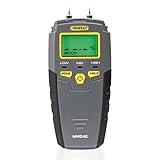
1. General Tools MMD4E – Best Overall Pin Meter for Lumber
General Tools MMD4E Moisture Meter for Wood, Walls & Water Leak Detection
Pin-type resistance meter
Wood 5-50%, building material 1.5-33%
Stated accuracy +/-3%
0.3 inch digits on backlit LCD
+ The Good
- Wide 5-50% wood range covers green and seasoned boards
- Large backlit digits easy to read in a dim shop
- Hold button freezes the reading
- Extra 8mm stainless pins plus a cap that doubles as a calibration check
- Backed by responsive manufacturer support
- The Bad
- Pin probes leave small holes in the wood
- Readings drift if probes are not fully seated and held still
- Awkward to hold flat against a ceiling
- Printed manual no longer in the box
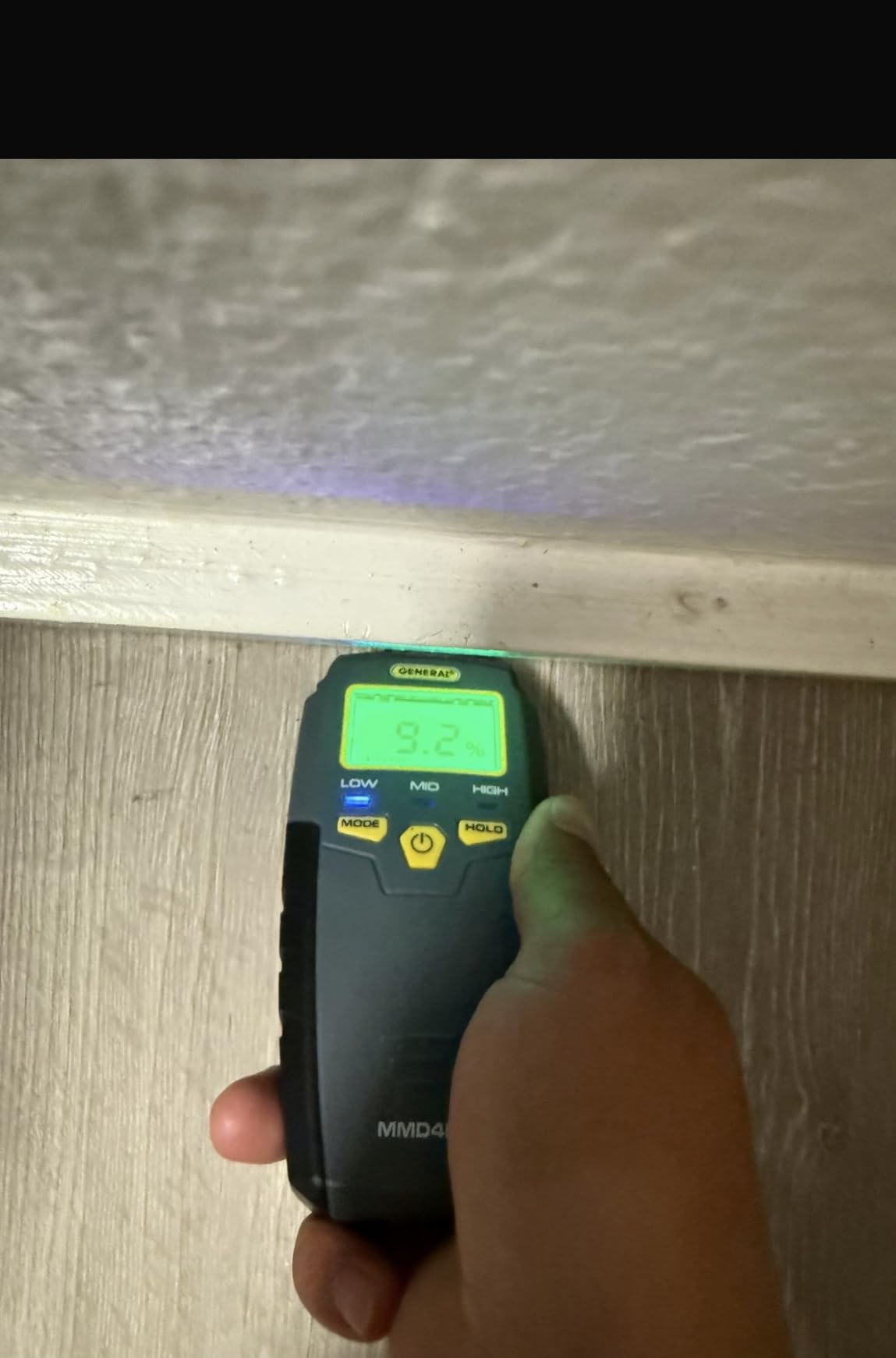
This is the meter I end up handing to people who ask me which one to buy. It is a plain pin-type resistance meter with a 5-50% wood range, a 1.5-33% building material range and a stated accuracy of plus or minus 3%. The range matters more than the accuracy figure: it covers everything from green boards pulled off the pile through air-dried boards well past the point of being furniture dry. That is the most common complaint about budget meters reversed — they run out of range at the wrong end.
In the shop the backlit LCD with 0.3 inch digits is the feature I notice most. Numbers stay readable in a dim corner or with the shop lights off, and the HOLD button lets you keep the meter in position while the number stays frozen on screen for note taking. There is also an audible completion tone, which is genuinely useful when you are sorting firewood with a wheelbarrow in one hand.
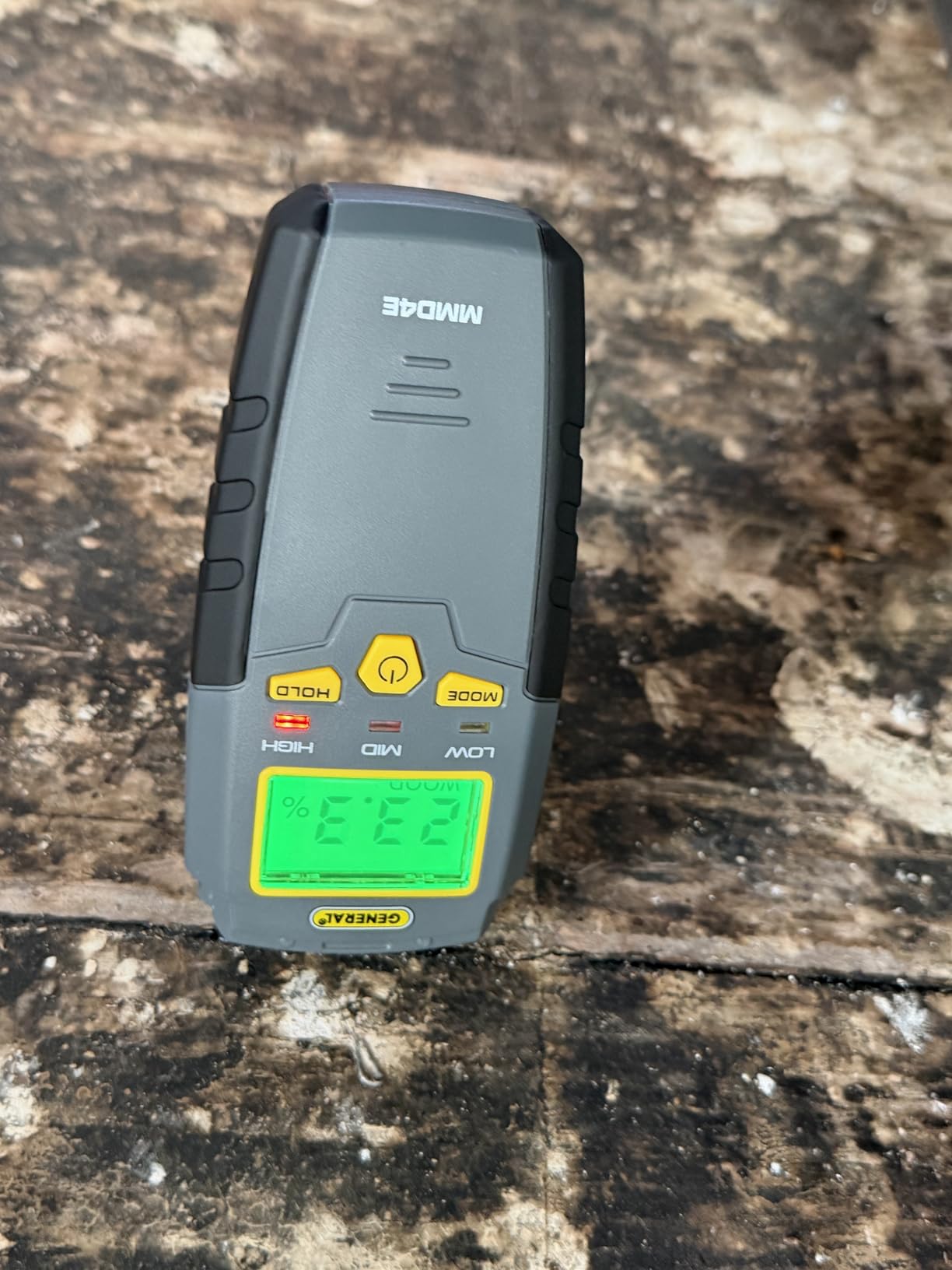
The toggle between wood and construction material modes means the same unit covers drywall and building material checks, and the listed operating range runs from 32 degrees F to 60 degrees C. Owners mention using it to catch wet lumber before an installer does, and to find a hidden leak behind drywall. For our purposes the wood scale is what gets used, but the second mode is a free extra for house work.
The honest weaknesses are the ones every pin meter has. The 8mm stainless steel pins leave visible holes, so I keep it off figured maple, cherry and live edge slabs. And the reading will wander if you do not push in and hold steady, so treat the number as a reading with a tolerance rather than a laboratory value.
Why it takes the top spot for lumber
The evidence base is what separates it. A 4.5 average across 15213 reviews is a far larger sample than any other unit here, and the recurring complaints are about pin holes and probe pressure, not about the meter reading wildly wrong. For most people sorting rough lumber or verifying a stack, that combination of range, readability and track record is what actually matters.
The calibration-check cap is a small touch that adds up. You can sanity-check the unit in a few seconds between boards, which is worth more in practice than extra features you never open.
When to pick something else
Choose a pinless meter instead if your lumber is finished, figured or already cut into furniture parts, because the pin holes cannot be undone. If you are working exclusively on already-dried indoor lumber, look for a model whose range reaches down below 6% so it can confirm dryness rather than just failing to show a number.
The stated plus or minus 3% is a wide band if you are deciding whether a board is at 8% or at 10% for a glue-up. Two meters will disagree by that much and both can be right.
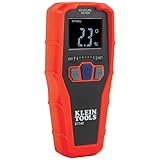
2. Klein Tools ET140 – Best Pinless Meter for Non-Destructive Scans
Klein Tools ET140 Pinless Moisture Meter for Non-Destructive Moisture Detection in Drywall, Wood, and Masonry; Detects up to 3/4-Inch Below Surface
Pinless EMF technology
Detects up to 3/4 inch deep
Reverse-contrast LCD with nine LED bars
2m drop protection
+ The Good
- No probe holes on finished wood or drywall
- Repeatable readings when compared against professional equipment
- Three-button interface anyone can learn
- Thick housing has survived multiple drops
- Useful for confirming flooring has acclimated
- The Bad
- Hardwood setting can read several points low versus a pin meter
- Flat sensor plate is awkward in corners and on uneven surfaces
- Weak readings on rough or unfinished concrete
- No carrying case included
- Must cycle through material modes to reach softwood
The ET140 is the pinless meter that shows up most often in lumber conversations, and for a specific reason: it leaves no holes. You press the sensor flat against the board and it reports out to 3/4 inch, which on rough lumber of ordinary thickness is enough to see a wet zone without marking anything.
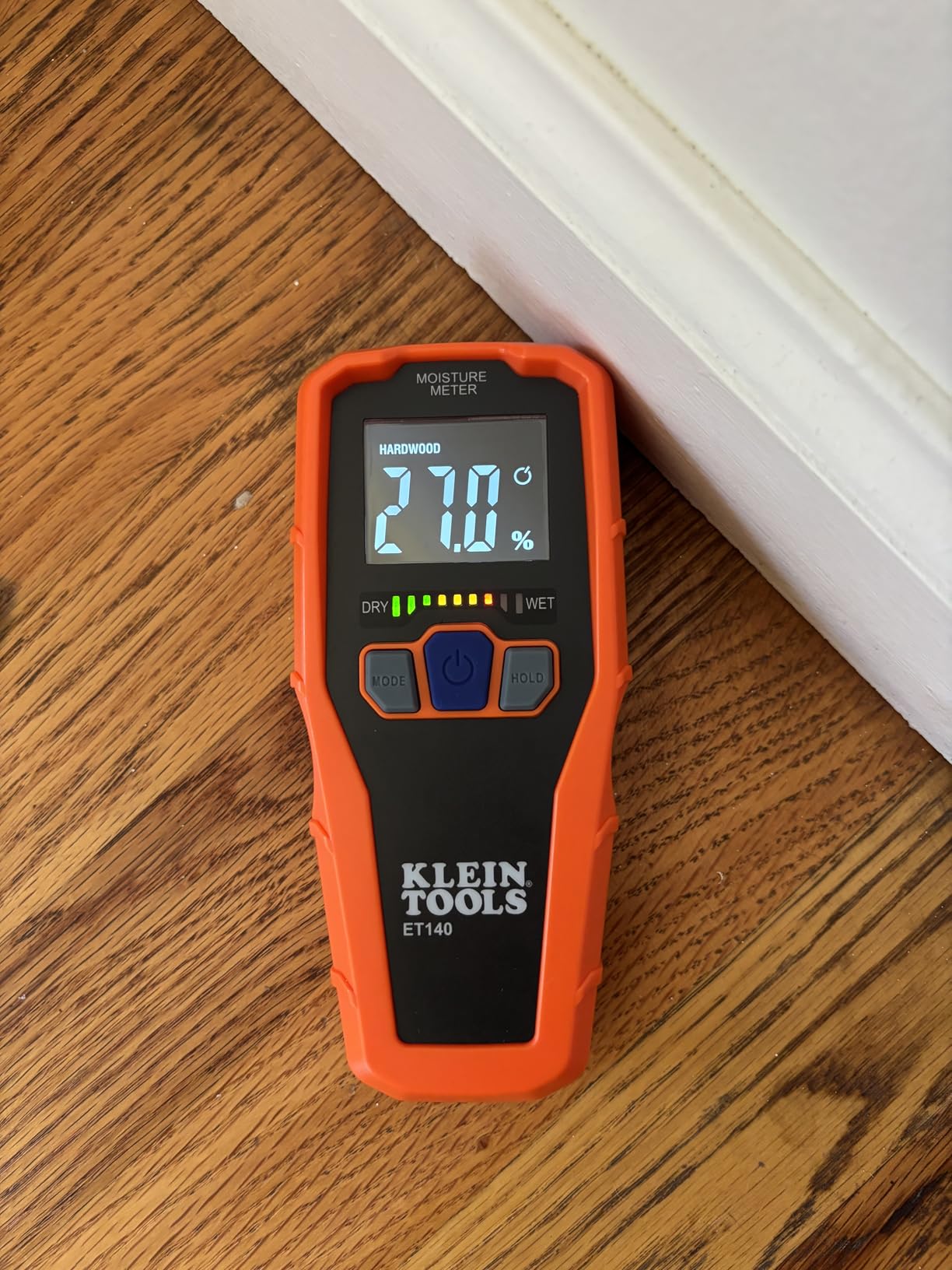
It is also built like a job-site tool. The housing carries 2m drop protection, it weighs 7 ounces, and the reverse-contrast display with nine LED moisture-range bars gives you a color-coded picture rather than a single number to interpret. Hold, low-battery warning and auto power-off are all built in.
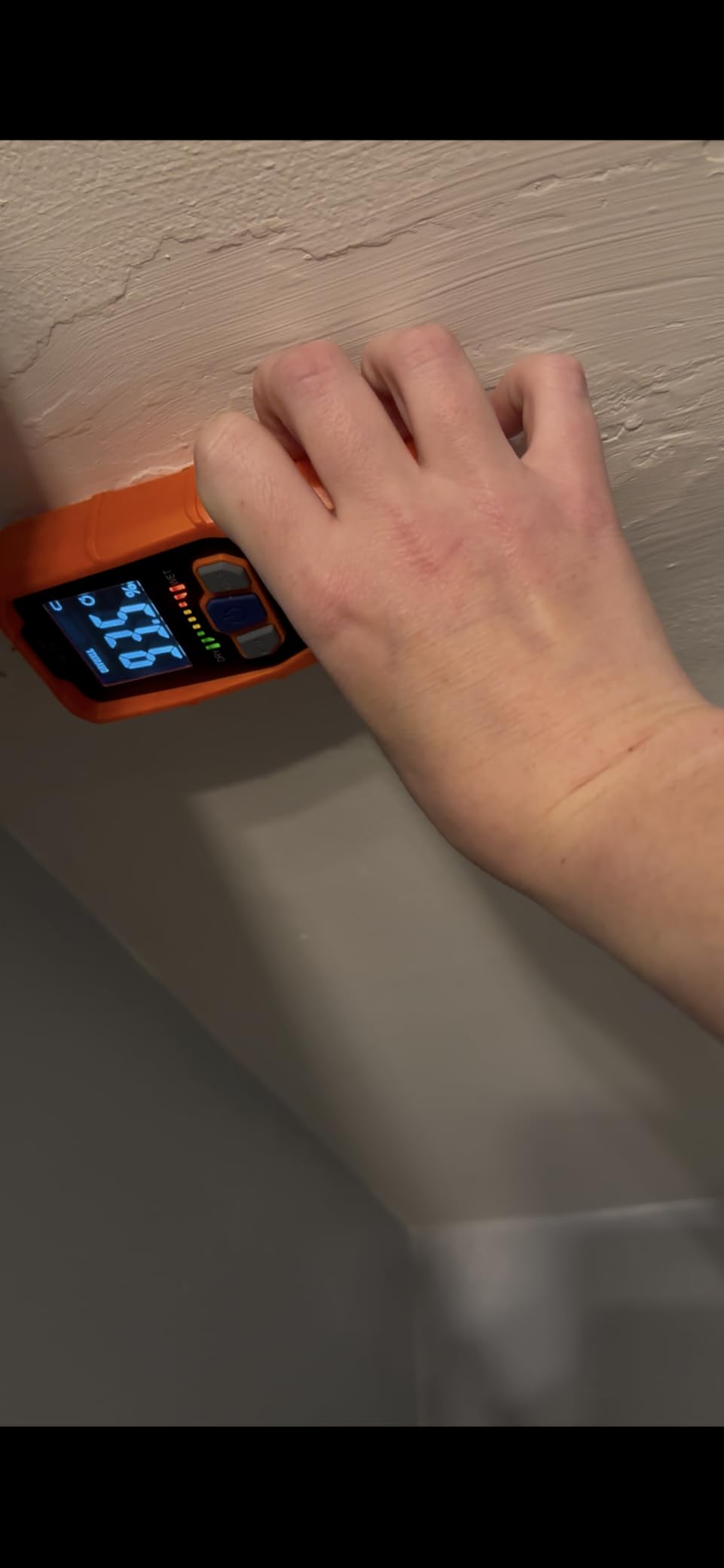
Owners consistently describe it as repeatable rather than laboratory accurate. When checked against professional equipment the softwood setting lands close, and the hardwood setting is the one that can read several points low. That is worth knowing before you pan when a walnut board comes up drier than expected.
One more practical note: the meter is calibrated for drywall, masonry, hardwood and softwood only, and you have to step through the material modes to get to softwood. The flat sensor plate is the other limitation, and it is real on a rough-sawn face or in a corner where a slab meets a wall.
Why it works for lumber sorting
It is fast, it never marks the wood, and the nine LED bars let you scan down a stack in seconds and spot the outlier board. That screening role is exactly how it gets recommended on r/woodworking, as a cheap first pass before a pin meter confirms the number that matters.
The 3/4 inch depth is enough to catch a damp face or a leak in drywall, which covers most of what a lumber buyer wants to know on the spot.
When it is the wrong tool
It is the wrong tool for a wet core in thick stock. A pinless reading is weighted toward the surface, so on an 8/4 board the face can read 9% while the middle sits at 15%. If you need the core number, push a pin into the end grain.
For furniture-grade work where a two-point difference decides whether you cut, treat the output as comparative and confirm with a pin meter. No carrying case is included either, so it lives in a pocket or a glove box until it does not.
3. RDINSCOS MT28 – Best Pinless Meter with a Built-In Flashlight
Pinless Moisture Meter for Wood Digital Wall Moisture Detector
Pinless non-destructive sensor
Wood and masonry modes
Stated measurement accuracy +/-5%
Integrated LED flashlight
+ The Good
- Fast repeatable readings on wood and drywall
- No drilling or pinholes on any surface
- Button selection beats scrolling through menus
- Built-in flashlight for attics and crawl spaces
- Compact 5.2 ounce body
- The Bad
- Concrete readings look overstated even after dehumidification
- Best accuracy is on wood
- Metal objects nearby skew results
- Percentage is more useful for comparing areas than absolute values
The thing that separates the MT28 from the other budget pinless meters is the light. An integrated LED flashlight is not a gimmick when you are checking the bottom of a stack, behind a cabinet or in a crawl space at night, and owners mention it as the reason the meter is easy to live with.
Beyond the light, it is a straightforward pinless detector with a non-destructive sensor, button-based material selection and a color LCD. The body measures 6.69 by 3.54 by 1.57 inches, weighs 5.2 ounces and runs on a single included 9V battery. Readings on wood come back fast and repeatable, and the pinless design means you can scan a wall or a board without marking it.
The specification to know is the stated plus or minus 5% accuracy, which is the loosest figure among the pinless meters here. Owners are candid that the percentage is more useful for comparing one area against another than for trusting an absolute value, and that concrete and basement readings look exaggerated against what a professional assessment reports.
One further caution: the sensor is non-destructive, but metal nearby will skew a reading, so do not scan a nail in a stud or a bracket on a crate.
Why it belongs in a lumber kit
It handles wood well and it holds up as a leak finder, which is what the owner reports describe. Scanning rough boards for a damp face before loading them is a two-minute job with this meter, and the flashlight means you can do it in a shed with no light.
It is also an easy first step into pinless scanning if you have never used one, which makes it a reasonable starter meter for someone who will eventually add a pin meter.
When to look elsewhere
Skip it if you need a trustworthy absolute number on thick stock. A plus or minus 5% band on a board you want to check at 12% versus 16% is not going to settle that question.
Its second mode is less convincing, and the documentation notes readings can be skewed by nearby metal objects. If your work is mostly lumber rather than damp detection, a dedicated pin meter will serve you better.
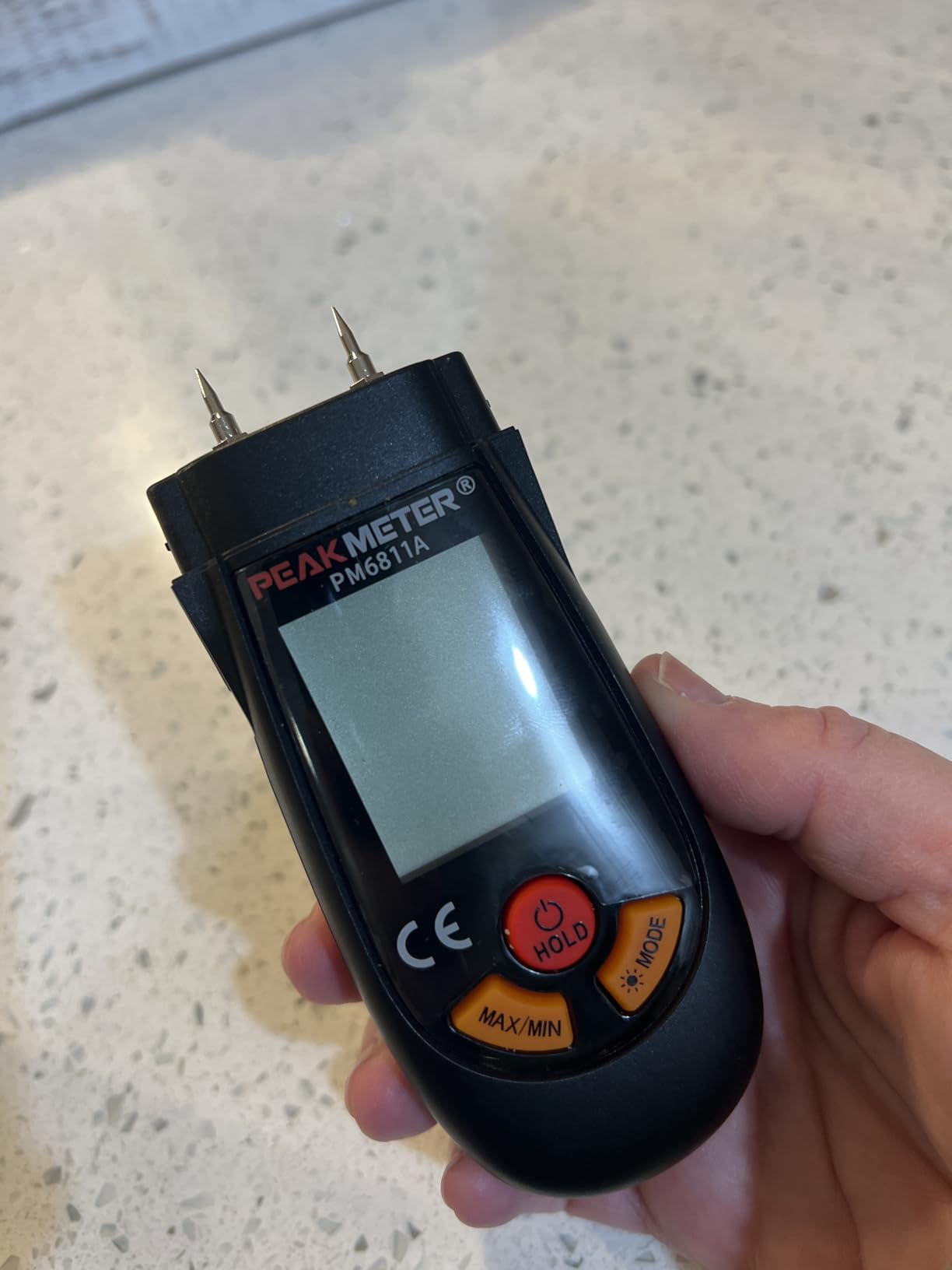
4. coczow PM6811A – Best Budget Pin Meter with Species Scales
Wood Moisture Meter, with Battery and LCD Display, Suitable for Quick Determination of Moisture Content of Many Types of logs, Paper, Plywood, Plaster Walls, Floor coverings, etc.
Two stainless steel pin probes
Wood 2.0-75.0% range
Six calibrated species scales plus approximate
Tricolor backlight
+ The Good
- Entry-level meter that still offers species calibration scales
- Tricolor backlight makes dry
- medium and high obvious
- MAX/MIN and hold functions help with record keeping
- Lightweight at about 130g
- Wide measurement range for this tier
- The Bad
- Species calibration only works if you pick the right scale
- Pins leave small holes
- Printed instructions and species table hard to follow
Wood range of 2.0% to 75.0% gives the coczow PM6811A a floor low enough to matter. That low end is unusual in this tier and it matters more than it looks: many budget meters refuse to show a number on properly seasoned indoor lumber, and this one will. It is the single most useful thing this meter does for anyone working on a project that needs 6-8%.
It uses two high-precision stainless steel pin probes in resistance mode, with six calibrated wood species scales plus an approximate scale, and a building material range of 1.5-30%. The tricolor backlight is the feature owners mention first, switching between green, yellow and red so a green screen reads as a go without decoding a number.
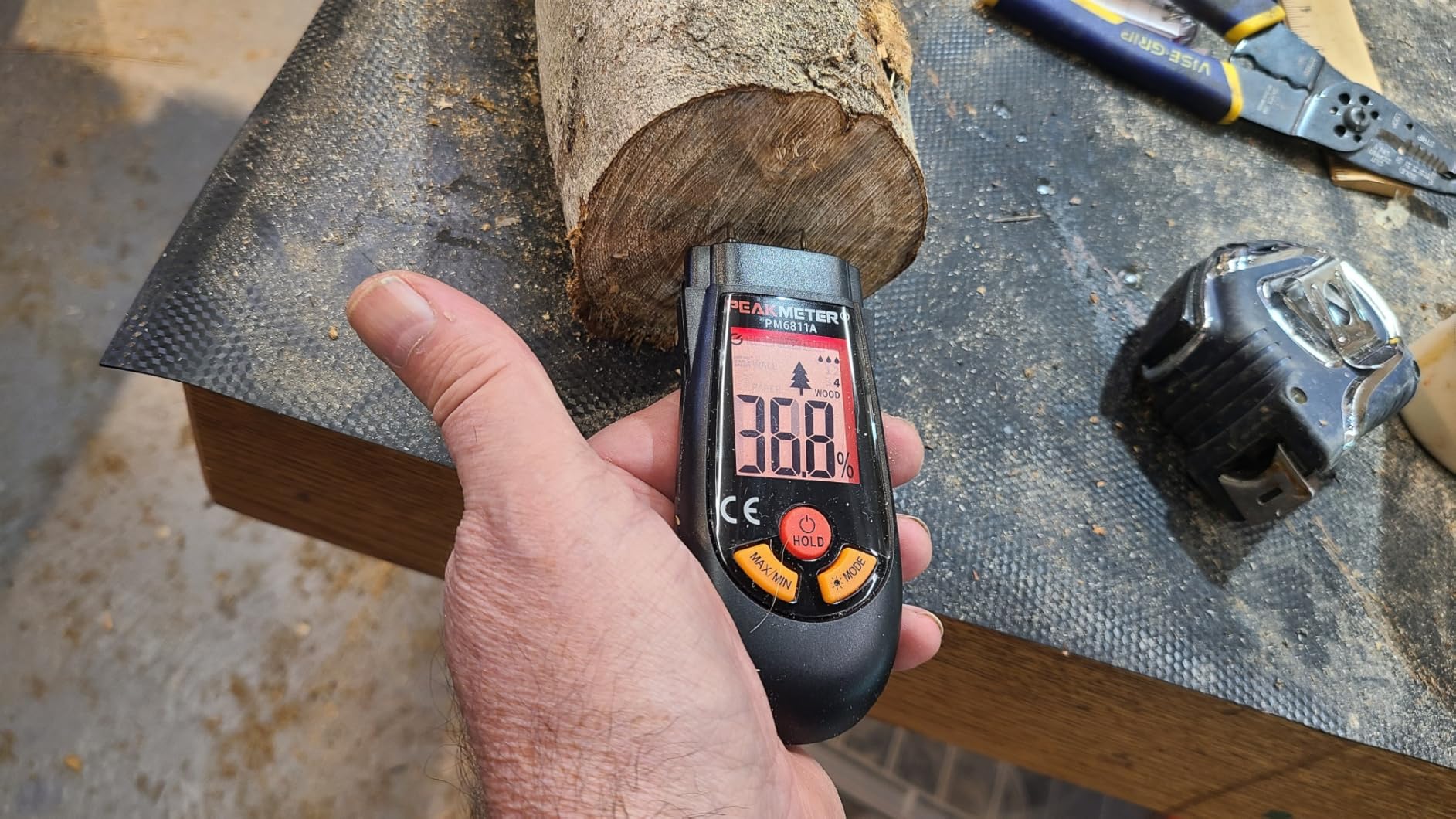
MAX/MIN measurement modes, a reading hold and a 5-minute automatic shutdown round out a feature list that is generous for the tier. At about 130g and 136 by 54 by 28mm, it is small enough to keep in a shirt pocket while you walk a stack.
The catch is species calibration, and it is a real one. If you select the wrong scale the reading shifts, and the printed table that tells you which scale is which is not something reviewers praise. Budget an extra minute per species until you have it memorised.
Why it earns the budget slot
At the entry end of this lineup, this is the one that hands you the most usable measurement. A 2% floor means you can verify acclimated indoor lumber, the six species scales are more than most competitors at this level offer, and the backlight removes the guesswork when you are working in poor light.
For firewood and rough lumber sorting it does everything a first meter needs to do, and it is small enough to leave in the truck rather than pack away.
Where it falls down
It is a pin meter, so the holes are permanent. Keep it off anything you plan to finish with a clear coat or a wipe-on product, and off boards where a pin mark will show.
Accuracy depends on you selecting the correct species scale from a reference table that owners describe as hard to follow, and there is no self-test to confirm the meter has not drifted.
5. TOPTES TS-630 – Best for Firewood and Rough Wood Checks
Wood Moisture Meter, TopTes Digital Moisture Meter TS-630, Handheld Humidity Tester with 2.25-inch LCD Display, Tricolor Backlight, Check The Dampness Level on Firewood/Drywall – Orange
Pin-type stainless steel probes
0.0-57% across seven scales
2.25 inch tricolor LCD
Bar graph plus %RH readout
+ The Good
- Large tricolor display gives an instant dry
- moist or wet verdict
- Fast readings that matched a professional damp check
- Replacement pins
- a mini wrench and a carry pouch in the box
- Batteries included
- Stands upright on a table for hands-free reading
- The Bad
- Low end of the range shows Lo on dry indoor lumber
- Not sensitive enough to trace small leaks in finished surfaces
- Needs firm pressure and leaves small dents
- Instruction booklet does not fit the pouch
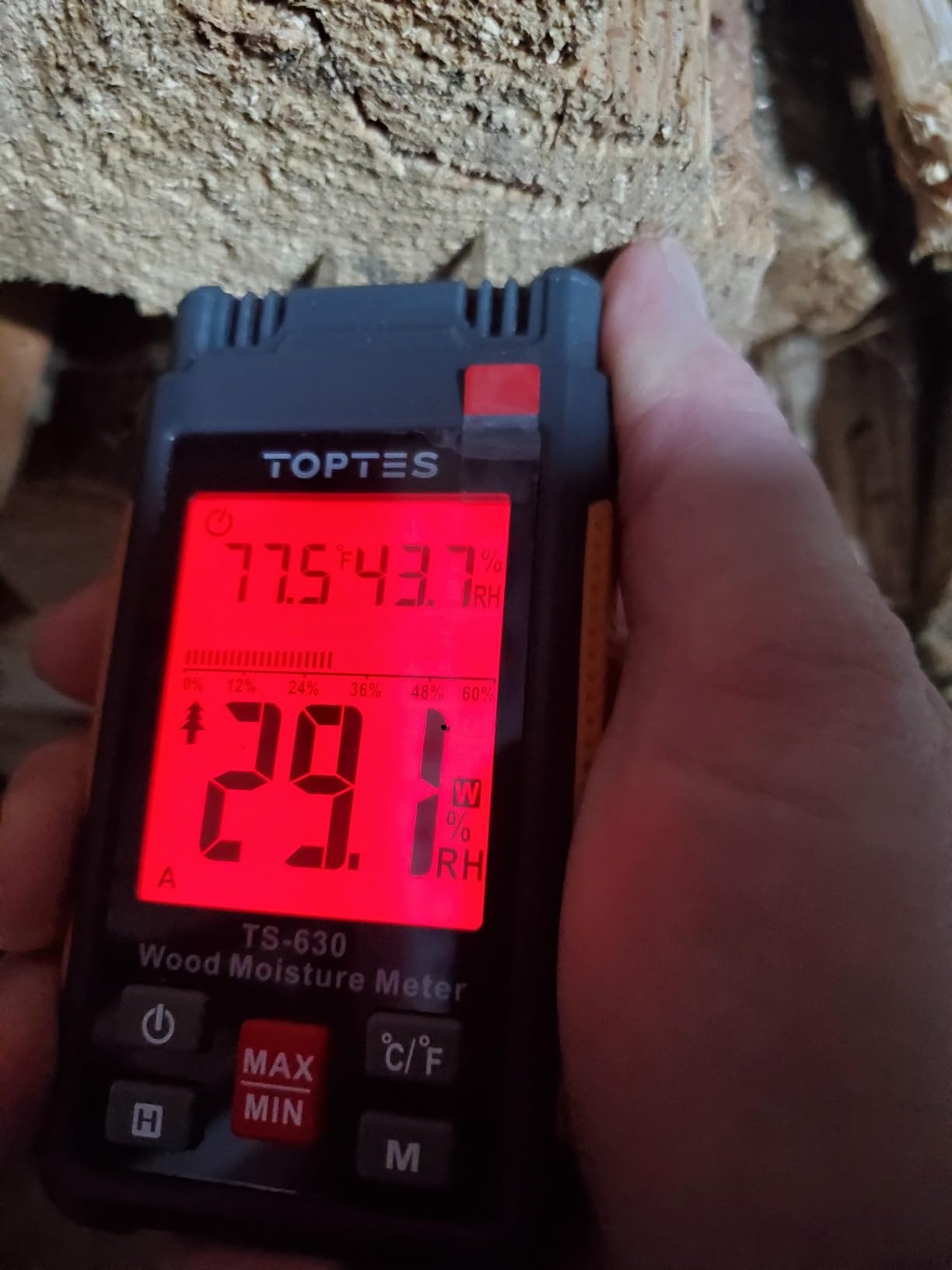
The TS-630 is built around a decision rather than a number. Its 2.25 inch LCD carries a bar graph and a %RH readout alongside the tricolor backlight, so green, orange or red answers the question can I burn this without you thinking about a percentage.
Underneath it is a conventional pin-type resistance meter with stainless steel probes, seven calibration scales spanning wood and building material, and a range that covers everything from 0.0% up to 57%. Data hold, MAX/MIN, a 10-minute auto shut-off and a low battery indicator are all included, and the meter runs on three included AAA batteries.
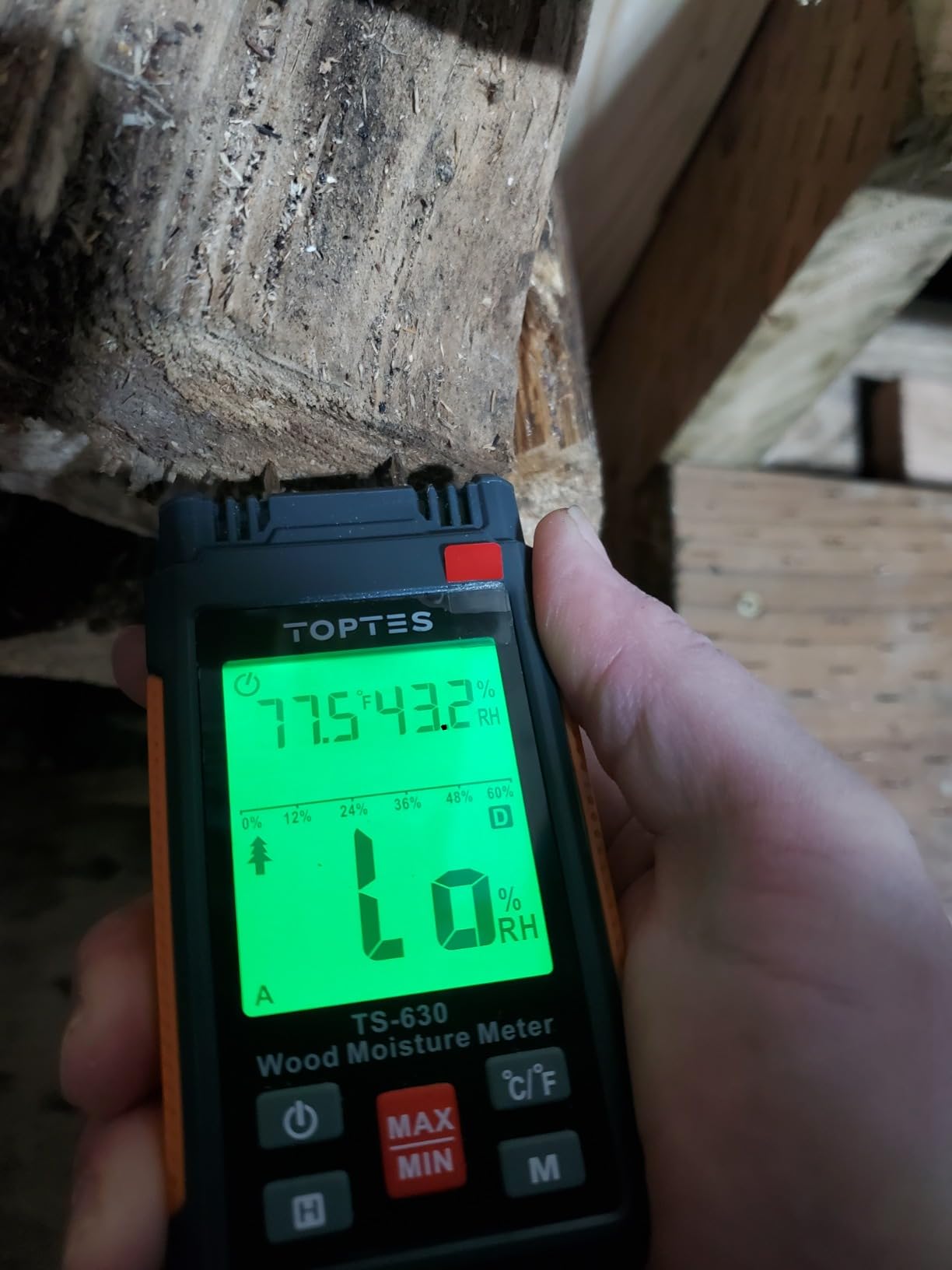
What arrives in the box matters here: meter, three AAA batteries, manual, carry pouch, a spare set of pins and a small wrench for pulling the probes. The three-year warranty is the longest written cover among the budget pin meters here.
The limitation everyone reports is the low end of the range. On properly kiln-dried or fully acclimated indoor lumber it can show Lo instead of a percentage, which means it cannot confirm that properly dried lumber is genuinely ready. Owners rate it very highly for firewood and rough wood and rate it as the wrong tool for finishing work.
Why firewood users like it
Sorting logs is a threshold question, not a precision question, and the tricolor backlight is built for exactly that. Owners report fast repeatable readings that lined up with a professional damp check, and the audible tones plus stand-up capability make it easy to work through a stack without picking it up each time.
It is also genuinely useful on damp framing or new construction lumber, where the 0.0% to 57% range is wide enough to be meaningful.
When it will frustrate you
Do not buy it to verify dried indoor lumber for a furniture build. A Lo reading is not a dryness confirmation, and the meter is not sensitive enough to trace a small leak in a finished surface.
It also needs firm pressure on the pins, which leaves small dents in a soft test surface, and the manual is described as mostly filler pages that do not fit the pouch.
6. Dr.meter MT1905 – Best Dual Mode Pin and Pinless Meter
Dr.meter 2 in 1 Pin & Pinless Wood Moisture Meter for Wood Drywall
Pin and pinless in one body
Pin mode wood 5-50% at +/-2%
Pinless mode wood 0-53% at +/-4%
Beeps above 17% wood moisture
+ The Good
- Both measurement modes in one device
- Pinless mode scans high-end wood without holes
- Audible over-range alert handy when sorting firewood
- Ambient temperature adds context to readings
- Green backlit display with hold and signal bar
- The Bad
- Pinless accuracy is looser than pin mode at about +/-4%
- Readings drift and need repeated presses to stabilize
- 4.3 average rating points to uneven consistency
Two meters in one body is the whole pitch here. The MT1905 has a pin-type mode and a pinless scanning mode, which means you can take a non-destructive look at a high-end board first and then push pins in for a confirming reading on the same boards.
The pin mode covers wood 5-50% and building materials 1.5-33% with an error figure of plus or minus 2%, which is the tighter of the two specifications. The pinless mode reaches 0-53% on wood and 0-35% on building materials at plus or minus 4%, with four scanning modes for softwood, hardwood, masonry and drywall.
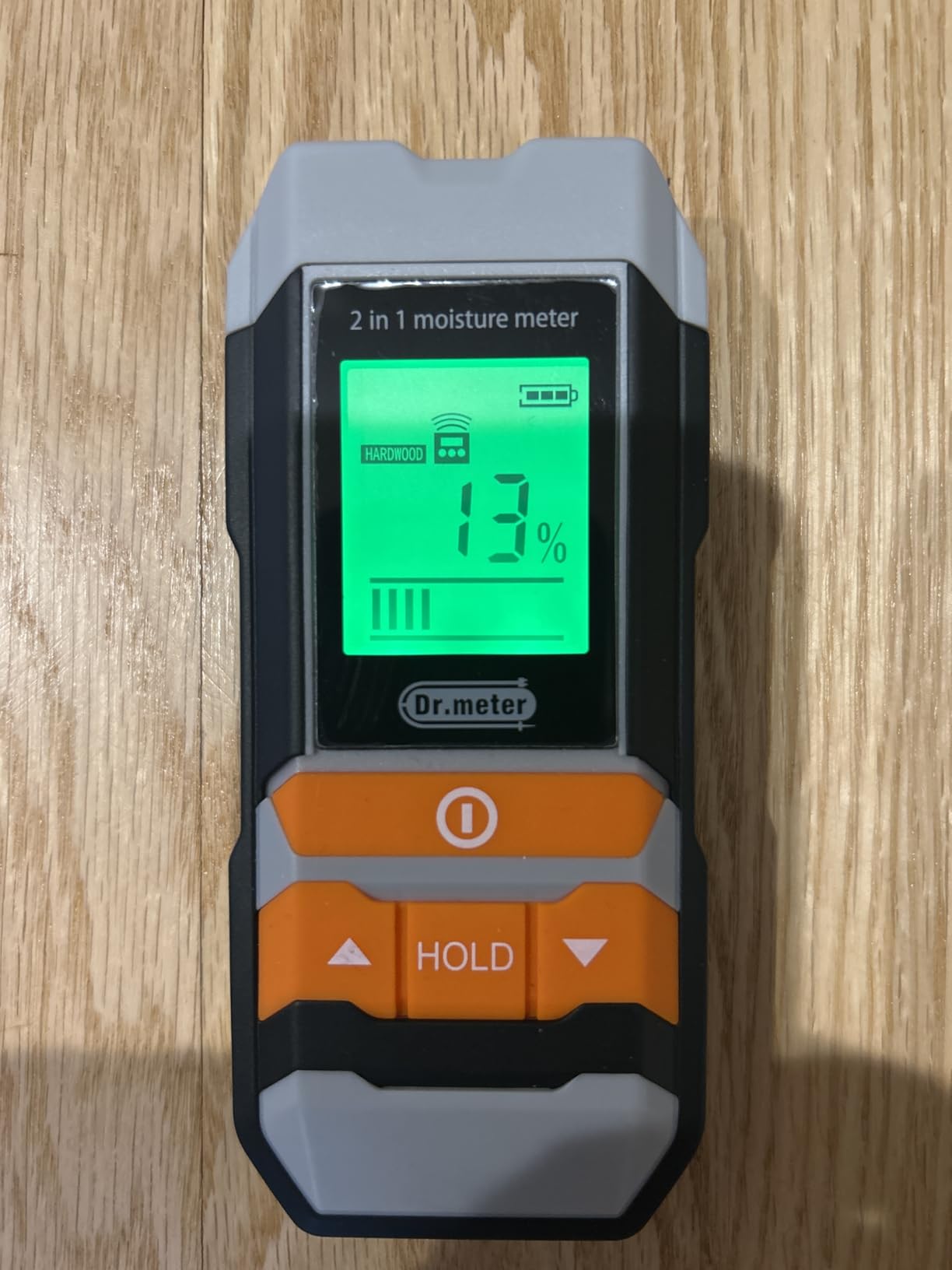
Two features stand out for lumber work. The audible over-range alert beeps when wood passes 17% moisture or wall humidity passes 70%, which is a decent proxy for the burn-ready line on a log. And the ambient temperature measurement from 0 to 40 degrees C gives you the context you need when a reading looks off on cold stock.
Consistency is where the 4.3 average comes from. Owners like the flexibility but report that readings sometimes drift and need repeated presses to stabilize, and that the pinless mode is noticeably looser than the pin mode.
Why the dual mode is worth it
The workflow is the reason. Scan a whole face of a walnut board pinlessly, find the number that looks wrong, then pin it and get a number you can act on. That sequence removes the temptation to drill holes into wood you wanted to keep clean.
For someone who also does any drywall or damp detection at home, the second mode is a bonus that costs nothing extra.
When to buy two separate meters instead
If accuracy is the reason you are buying, one good pin meter beats a compromised combination every time. The 4.3 average and the reports of drifting readings suggest you will be taking repeat measurements and averaging mentally.
It is also worth weighing against a dedicated pinless unit and a dedicated pin unit, which is what several owners do once they realize how much they use each mode.
7. Proster PST199-P – Best Pinless Meter with Visual and Audible Alarms
Proster Pinless Moisture Meter 3/4″ Depth Color Alarm Non-Destructive
Pinless non-invasive sensing
Detects up to 3/4 inch below surface
5-75% wood range
Three-color LED bar with audible alert
+ The Good
- Pinless scanning leaves finished wood and drywall unmarked
- Color LED bar graph plus audible tone highlight wet areas
- Backlit color LCD readable in poor light
- Hold
- auto power off and low battery warning built in
- Storage bag and 9V battery included
- The Bad
- Readings are relative rather than calibrated
- Sensor needs steady flat contact for best results
- Heavier body than some competing pinless meters
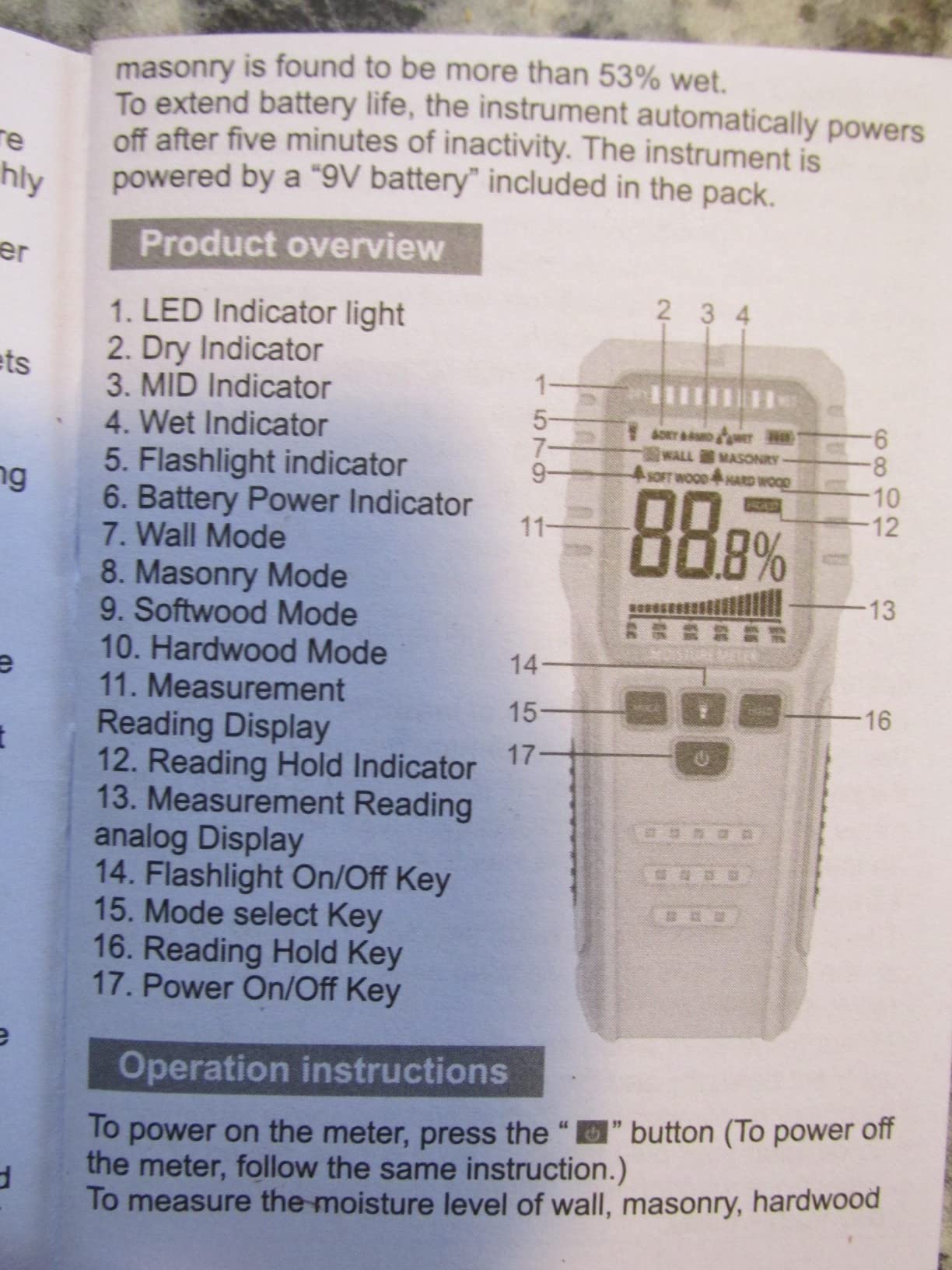
The Proster PST199-P makes noise and light the primary output, which is the right design when you are walking a building rather than sitting at a bench. The three-color LED bar graph and an audible high-pitch alert give you an immediate signal on a wet zone, and the backlit color LCD stays readable in poor light.
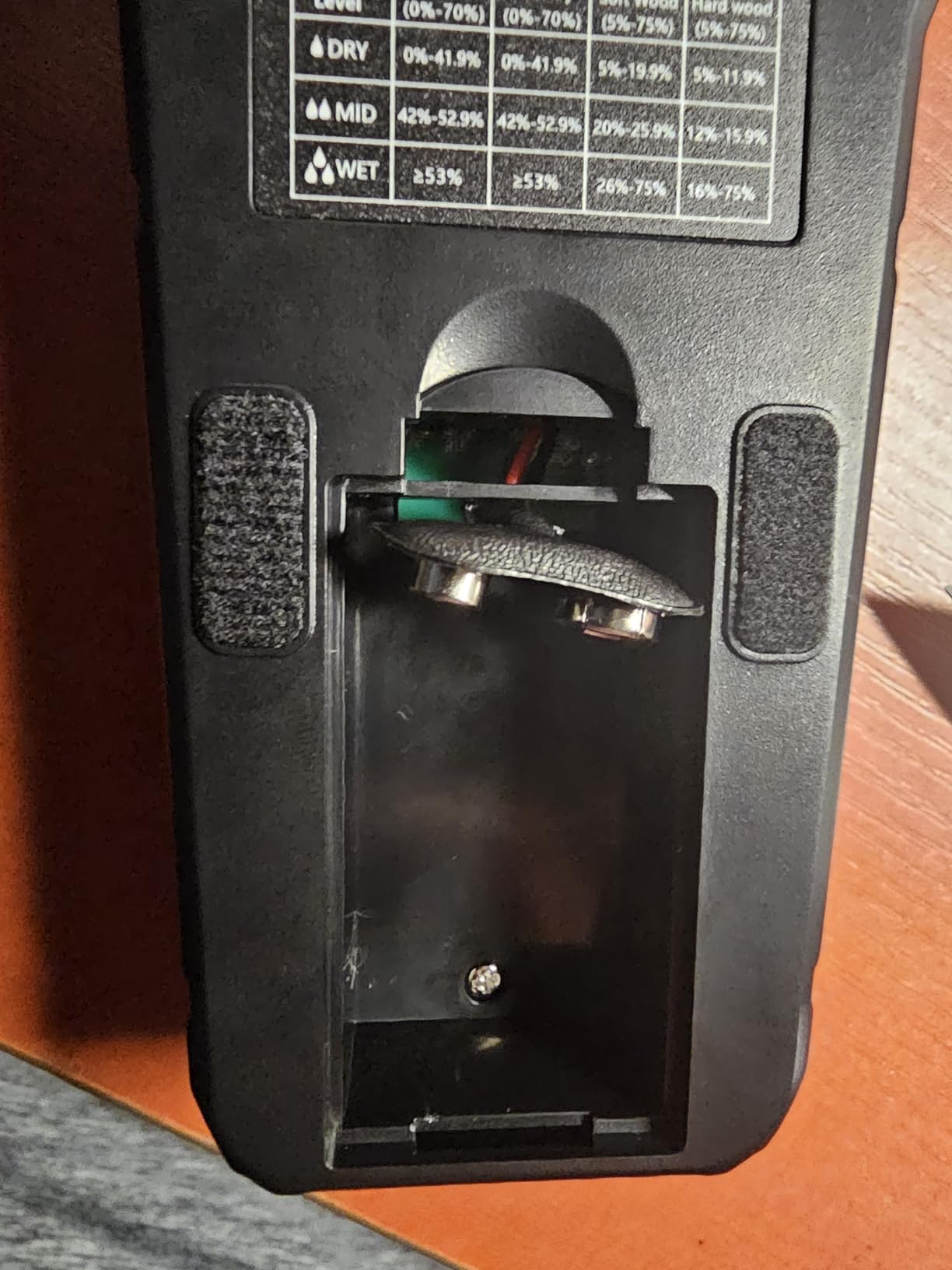
Underneath it is a standard pinless sensor working to 3/4 inch below the surface, with a 5-75% range for softwood and hardwood and 5-70% for wall and masonry. Hold, auto power off, out-of-range and low-battery alarms are all built in, and the operating range is 32 to 104 degrees F. A storage bag and a 9V battery come in the box.
Owners use it mainly to trace the source of a leak behind a finished surface and to confirm whether a water-damaged area has finished drying. That is a screening job, and the dual visual and audible alarms are the standout features for it.
The important qualifier: most reviewers treat the numbers as directional rather than calibrated, and say the readings are strongest when checked against a second meter. Press the sensor flat and hold still, and results settle.
Why the alarms matter on a lumber stack
Sound and color buy you something on a stack that a numeric readout does not. If a bar jumps orange or the tone fires, you have found the wet board and can stop probing, which makes sorting a pallet much faster.
No pinholes also means you can use it on a finished face or a slab you have already finished without a repair.
When it is not enough
Relative readings will not settle a question like whether a board is at 12% or at 16%. If the answer changes what you do next, confirm with a pin meter pushed into the end grain.
At 270g it is one of the heavier pinless units here, and the sensor demands flat, steady contact, which is exactly what a rough-sawn face or a curved edge will not give you.
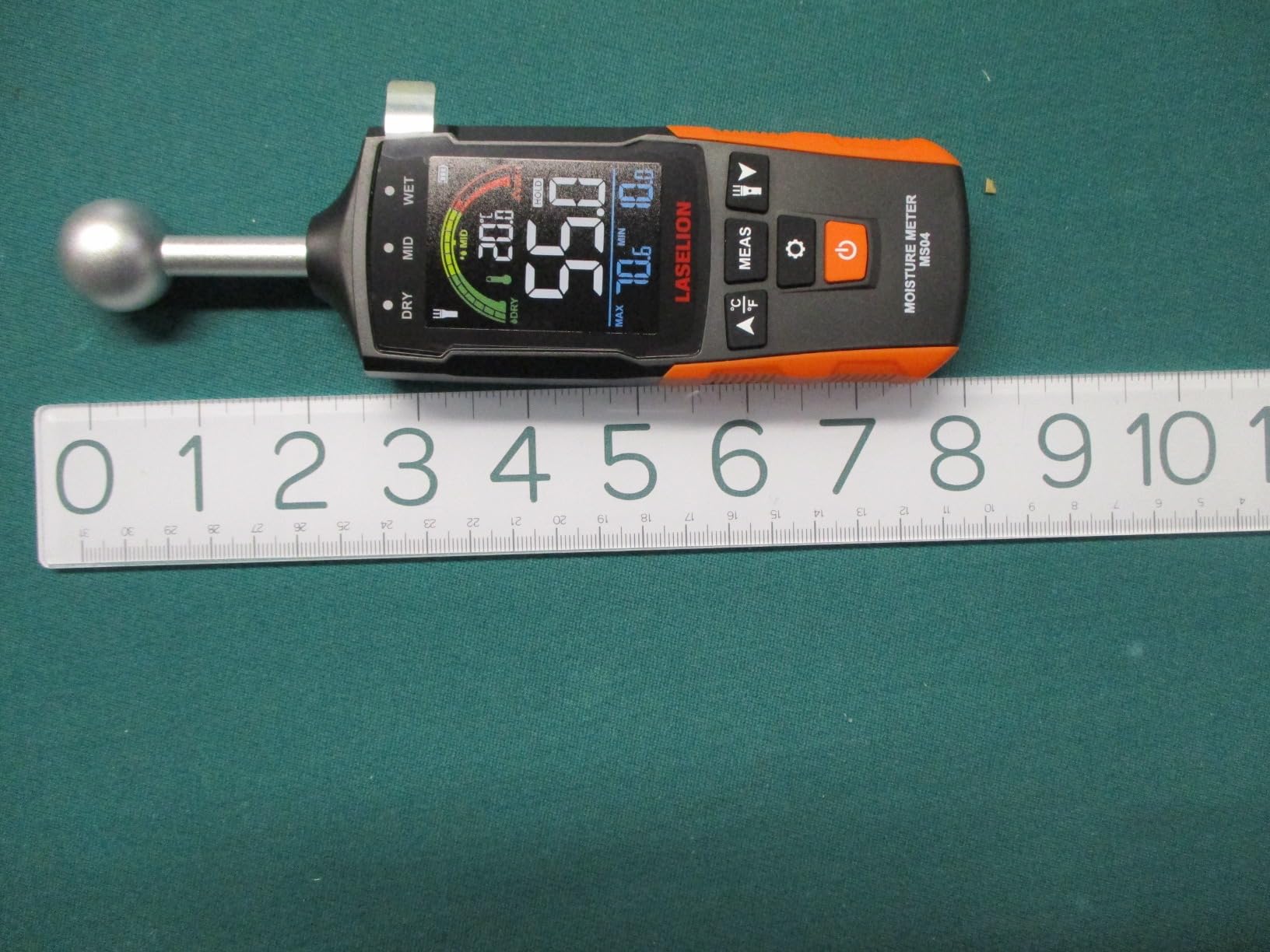
8. LASELION MS04 – Best Ball Probe for Corners and Rough Surfaces
LASELION MS04 Pinless Moisture Meter with Ball Probe for Non-Destructive Area Scans Ideal for Wood Walls and Construction Materials Customizable Humidity Alarms Built-in Flashlight
Ball-shaped probe for area and corner scans
5-40mm measuring depth
Customizable MID and WET alarms
Built-in flashlight
+ The Good
- Ball probe covers a broader area and reaches into corners
- Non-destructive with no puncturing of finished surfaces
- Customizable MID and WET alarm thresholds
- Repeatable readouts that matched real water damage boundaries
- Display stays readable in direct sunlight and a case is included
- The Bad
- Absolute accuracy not independently verified by most buyers
- Recalibration expected after each power-on
- Heavier body than the cheapest pinless meters
The MS04 solves a specific pinless problem: the flat sensor plate. Its ball-shaped probe rolls into corners, follows a curved edge and covers a wider area than a flat pad, which is what you need on a live edge slab sitting against a wall or in an awkward spot on a stack.
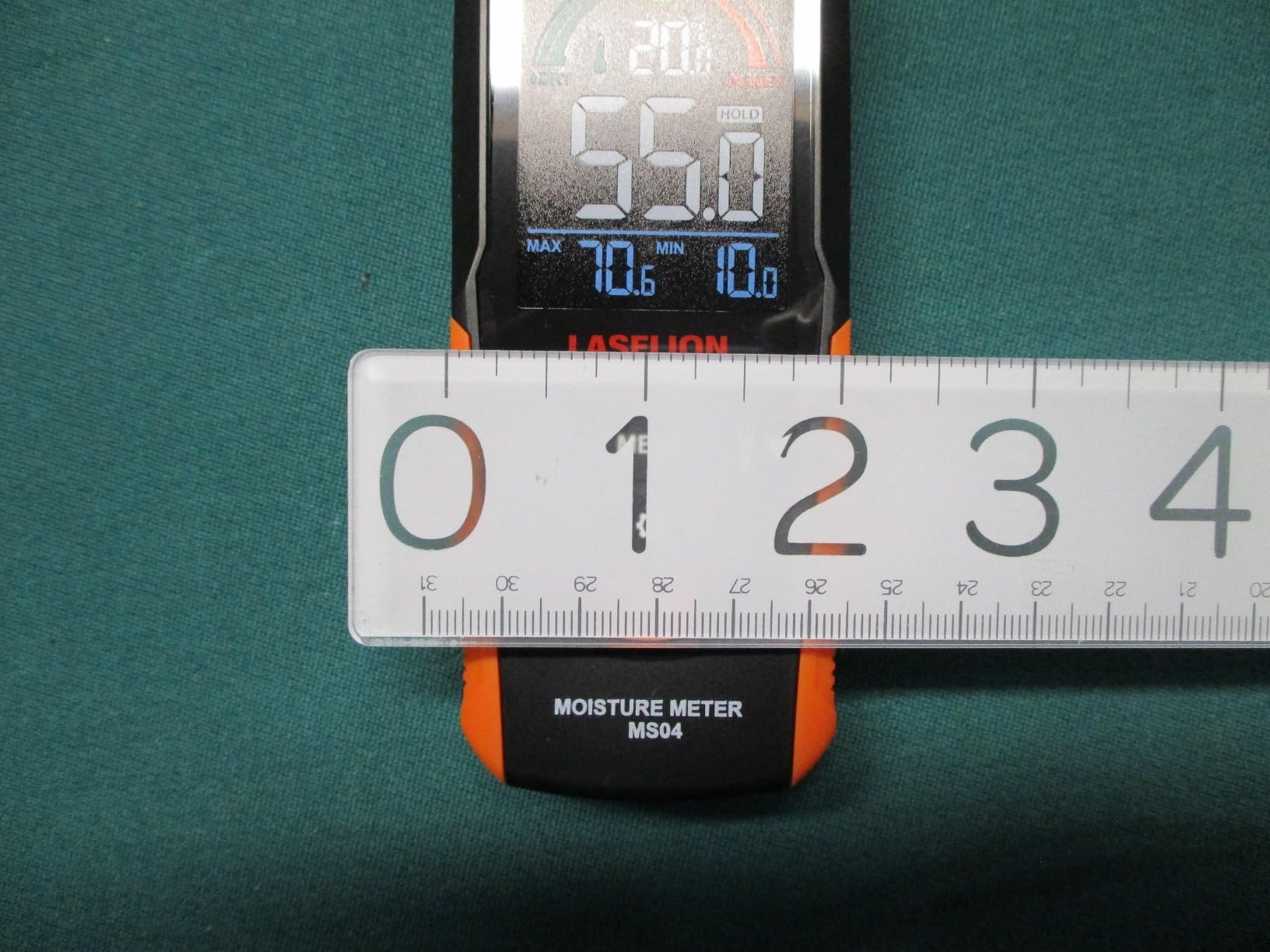
It measures across a 5-40mm depth, adds customizable MID and WET humidity alarm thresholds so you can set your own trip points, and carries a built-in flashlight. Non-destructive sensing means it works on finished wood, drywall and delicate surfaces without marking them, and it comes with three AAA batteries and a carrying case.
The owner reports in remediation and real estate inspection are the strongest thing about this meter. Several buyers say the flagged boundary on the display matched where the drywall actually turned out to be wet, which is the test that matters when you are mapping a damp region.
Skeptics note that absolute accuracy is unproven for most buyers, and that the unit is expected to be re-zeroed after each power-on. At 229g it is heavier than the cheapest pinless meters but well within reason for a full day of scanning.
Why the ball probe earns its place
Corners and irregular geometry are where a flat sensor simply cannot go, and that is where damp wood hides. A probe that rolls into a tight gap between a slab and a wall gives you a reading a flat pad never will.
Customizable alarms are the second win, letting you set a dry threshold and a wet threshold that match your own wood rather than a fixed factory curve.
Where caution is warranted
This is a screening and mapping tool, not a gauge to record numbers in a purchase log. Nobody in the owner base is verifying the absolute accuracy, and repeated re-zeroing after power-up is an extra step to remember.
Confirm anything important with a pin meter, and if your work is mostly straight boards in good light, the flashlight and ball probe are features you may not need.
9. Mecurate WMM – Best Pin Meter with Species Calibration and Self-Test
Mecurate Digital Pin Type Wood Moisture Meter with 3 Colored Indicators, Moisture Detector 2 Mode 8 Calibration Large Backlit for Wood, Wall, Firewall (Orange)
Pin-type resistance with 0.1% resolution
Eight calibrated wood scales
Self-test calibration in the protective cap
Built-in temperature sensor
+ The Good
- Self-test calibration means no reference block needed
- Sensitive sensor that stabilises with light pin insertion
- Three colored indicators plus on-screen icons speed interpretation
- Anti-slip grip and compact one-handed form factor
- Water-resistant pouch and replacement pins included
- The Bad
- Included batteries occasionally dead on arrival
- Pin probes leave holes in the tested material
- Battery leakage risk if left installed long term
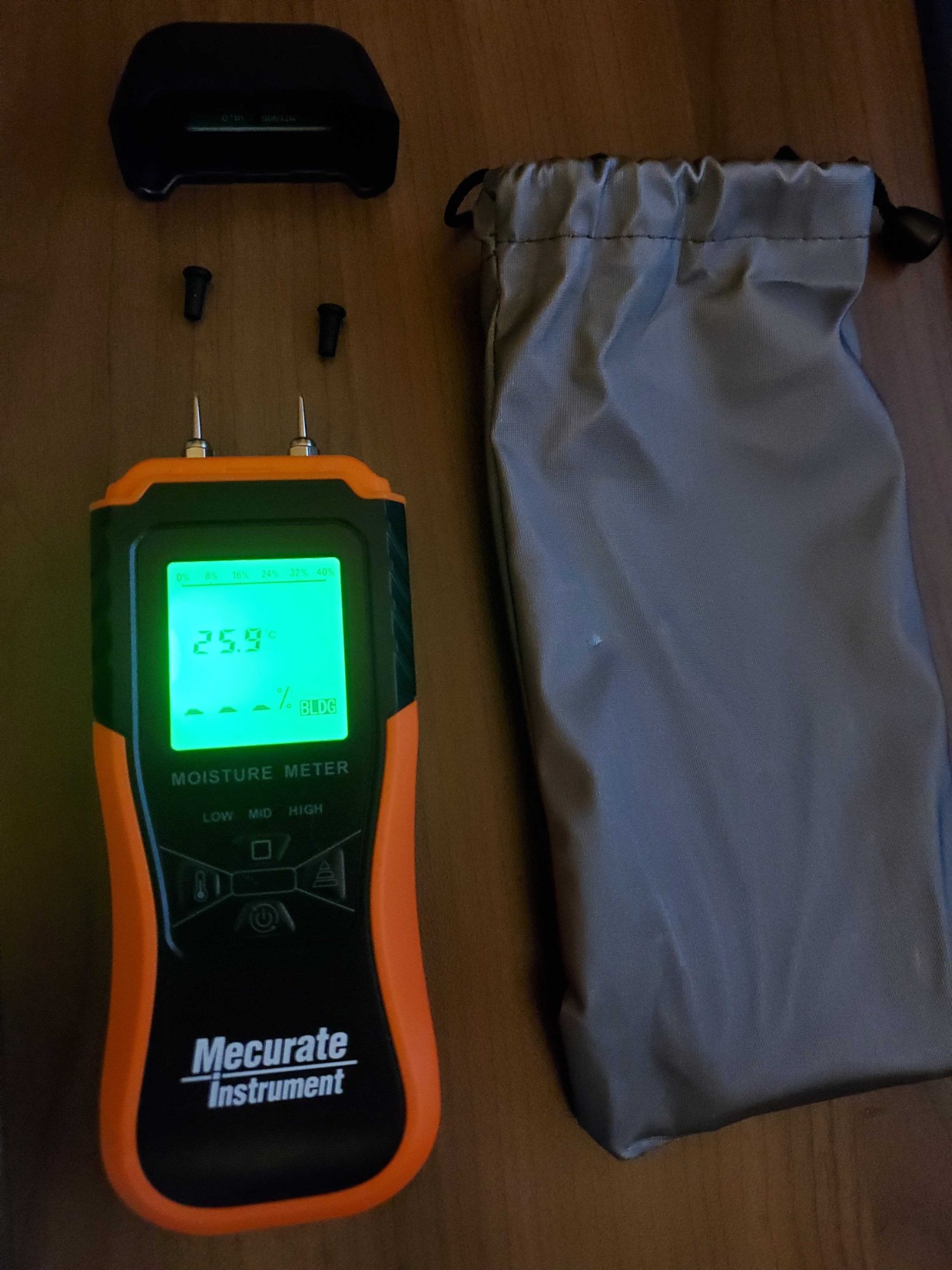
The Mecurate WMM carries the highest average rating in this group at 4.6, and the reason owners give is calibration. It ships with eight calibrated wood scales, a self-testing calibration aid built into the protective cap, and a wood type quick-search index printed on the back of the body. That is more species correction than anything else at this tier.
It is a 0.1% resolution pin-type resistance meter with two modes, wood and building material, and a wood range of 6% to 60%. The three colored indicators with on-screen low, medium and high icons make the reading quick to interpret, and the temperature sensor reports in both degrees C and F with 1 degree C accuracy.
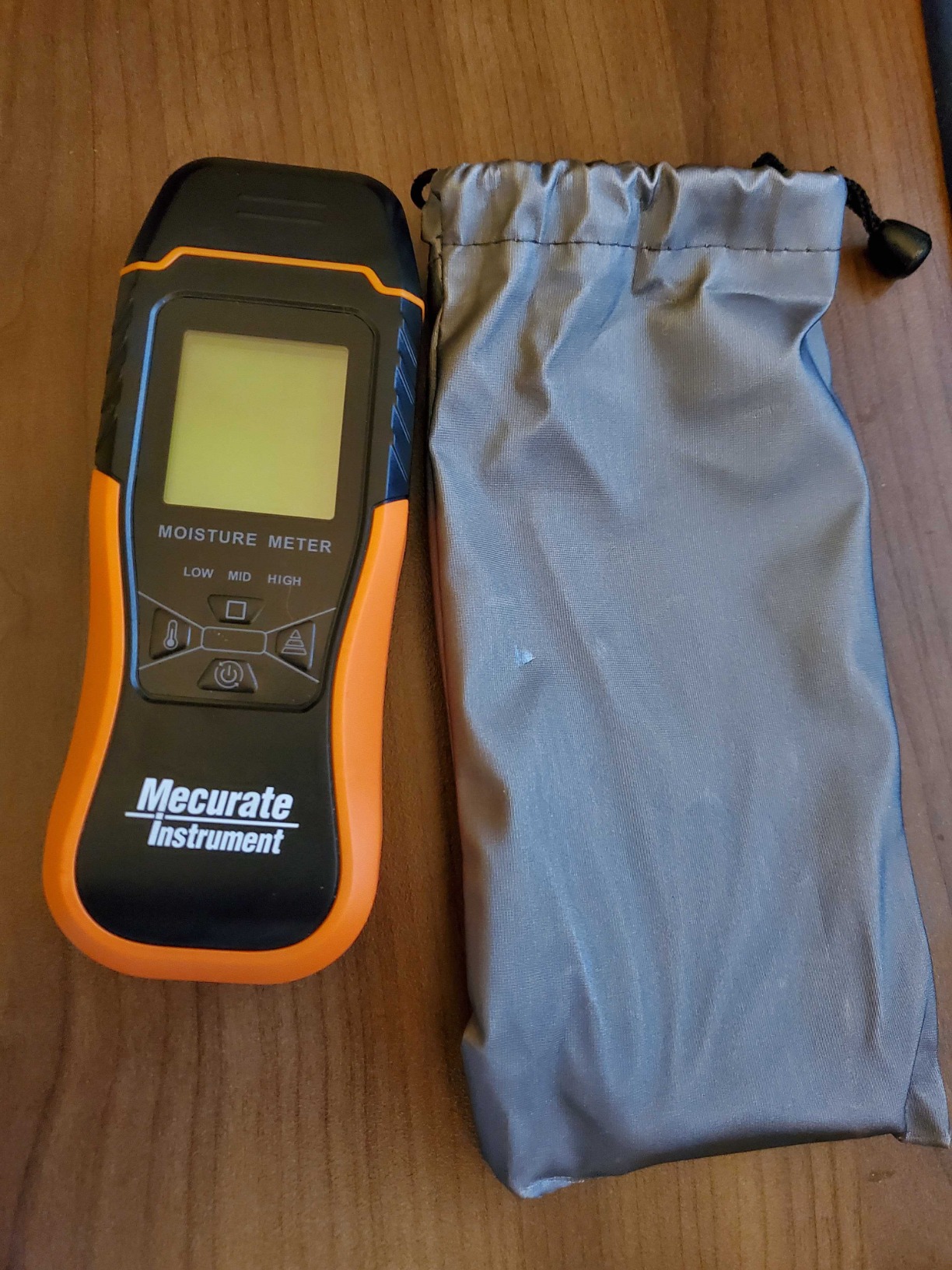
The sensor is sensitive, which is a real advantage when you are pushing pins into hard maple: owners report it stabilises with light insertion rather than needing heavy force. That reduces the denting and the wandering readings that plague cheap pin meters.
Owners also report it measuring within about two percent of the higher-tier models they compared it to. The complaints are practical rather than functional, with dead included batteries and the usual pin-hole trade-off coming up most often.
Why species scales matter on lumber
Reading an oak board on a pine scale can shift the number by two to three points, and on a project targeting 6-8% that is the difference between cutting and waiting. Eight scales plus a printed quick-search index is the most thorough correction set in this lineup.
The self-test in the cap is the underrated part. A thirty-second check between boards tells you whether the unit has drifted, which is exactly the habit experienced users describe having.
When to pick something else
The 6% floor is the constraint. Properly kiln-dried and fully acclimated furniture lumber can sit below that, and this meter will not give you a number there. If your work is exclusively indoor cabinet and furniture stock, look for a lower floor.
Also remove the batteries if you are storing it for months, since owners report leakage risk from units left powered. And keep it off boards where pin holes would show.
10. Povlen MT510-Y – Best Pinless Meter for High-End Lumber
Pinless Moisture Meter, Digital Wood Moisture Meter for Lumber & Drywall
Pinless high-frequency sensing
Four modes: softwood, hardwood, wall, masonry
Stated accuracy +/-4%
Density grade adjustment in softwood mode
+ The Good
- Non-invasive sensing protects high-end wood and finished surfaces
- Four material modes cover wood
- drywall and masonry
- Color LCD with analog bar and audible alarm
- Lightweight at 5.6 ounces with push-button operation
- HOLD function captures a reading in one press
- The Bad
- +/-4% accuracy is looser than pin meters at similar prices
- Softwood readings depend on setting the correct density grade
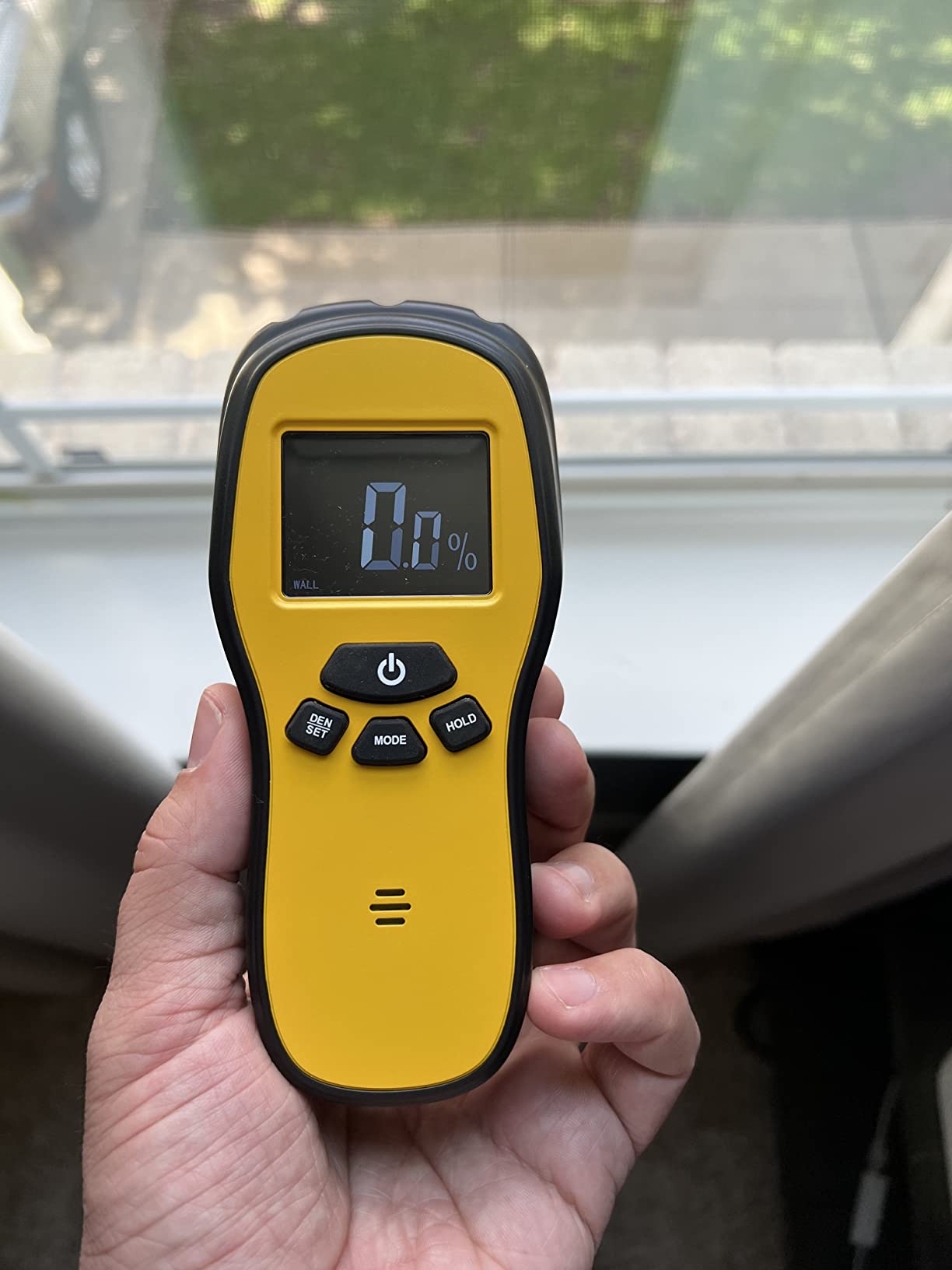
The Povlen MT510-Y is the pinless meter to consider when the wood itself is the expensive part. It uses high-frequency sensing with no pinholes and no scratches, so you can scan a figured slab, a walnut board or an already-finished surface without committing to a repair.
It runs four scanning modes for softwood, hardwood, wall and masonry, and the softwood mode adds density grade adjustment so you can correct for different wood types rather than using one flat curve. The color LCD carries an analog bar with audible and red-flashing alarms, plus a HOLD function, auto power off and a low battery indicator.
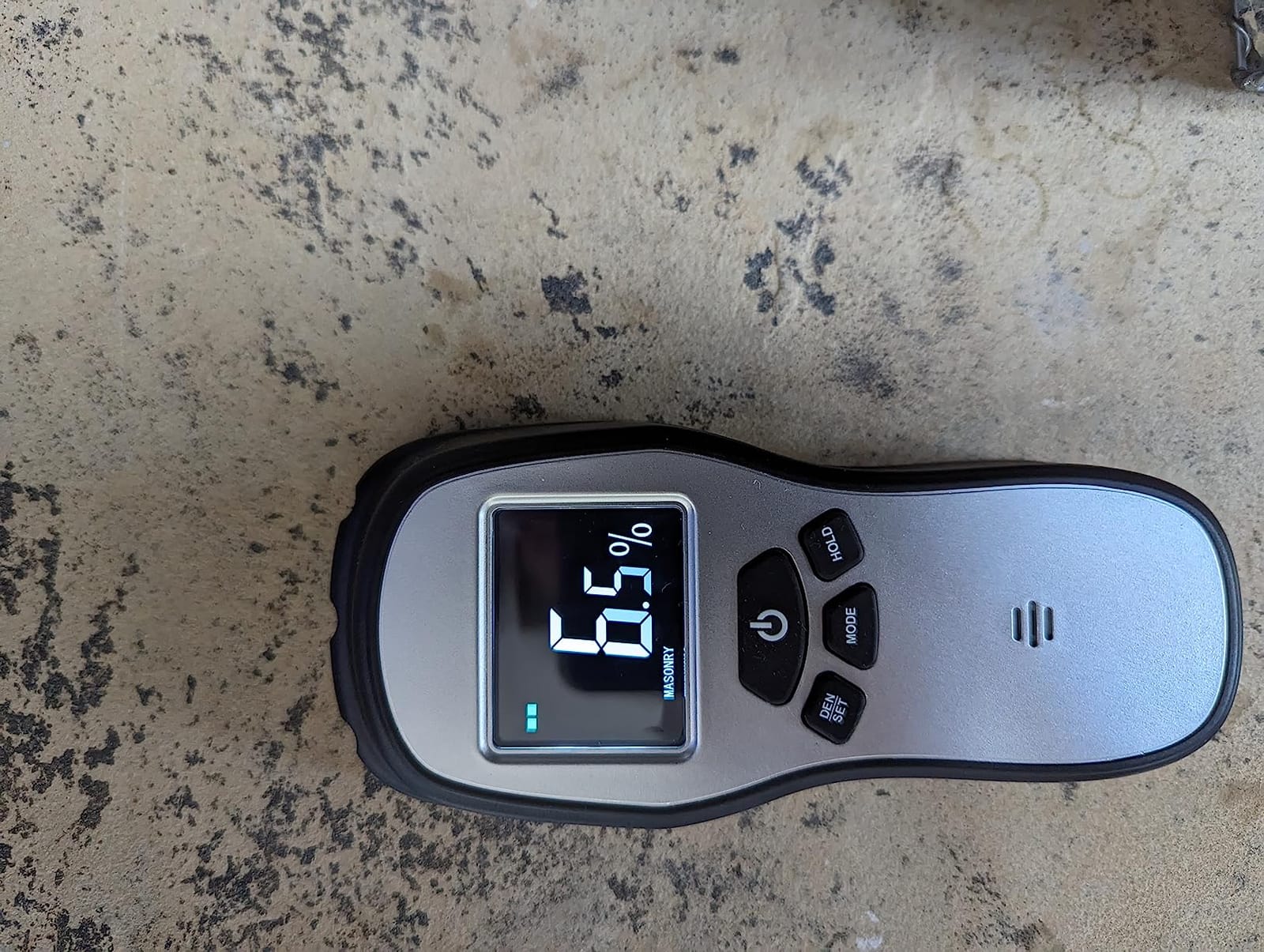
At 5.6 ounces and 6.81 by 2.87 by 1.06 inches, it is one of the more portable pinless meters here, and three AAA batteries are included. Owners who use it for lumber and drywall describe the color display and alarm as effective for early leak detection behind walls.
The stated plus or minus 4% accuracy is looser than most pin meters at comparable prices, and buyers who compare against a reference instrument treat it as a screening and comparison tool rather than a precision gauge. The density grade setting also needs to be right or softwood readings shift.
Why it suits expensive wood
On a board where a single pin hole would mean losing a face, the case for pinless is simple. Scan for the wet zone, mark it, and then either air it out longer or pin a sacrificial offcut to confirm.
The density grade adjustment is a genuine step above the usual softwood or hardwood toggle, and it makes mixed-species stacks more readable.
When a pin meter is the better buy
If a two-point difference changes your decision, this meter will not reliably make that call. Its accuracy band is the widest of the pinless group here, and no owner in the review base claims laboratory-level results.
It is a companion to a pin meter rather than a replacement for one, and the density grade setting is a step you have to take every time the species changes.
11. Calculated Industries 7440 AccuMASTER XT – Best for Inspectors and On-Board Calibration
Calculated Industries 7440 AccuMASTER XT Digital Moisture Meter | Handheld |Pin Type | Backlit LCD Display | Detects Leaks, Damp and Moisture in Wood, Walls, Ceilings, Carpet and Firewood
Pin-type with replaceable stainless steel pins
Firewood bands from 5-11% low to 16-50% high
Built-in calibration test pins
Measures wood, brick, concrete, carpet and plaster
+ The Good
- Built-in calibration test pins verify accuracy before each job
- Solid handheld body that does not flex when pressing pins
- Large backlit screen with moisture icons
- Broad material compatibility including brick
- plaster and carpet
- Replaceable stainless steel pins extend tool life
- The Bad
- Pin style leaves small holes in finished surfaces
- Wood species calibration is less granular than dedicated wood meters
- Carry case not included
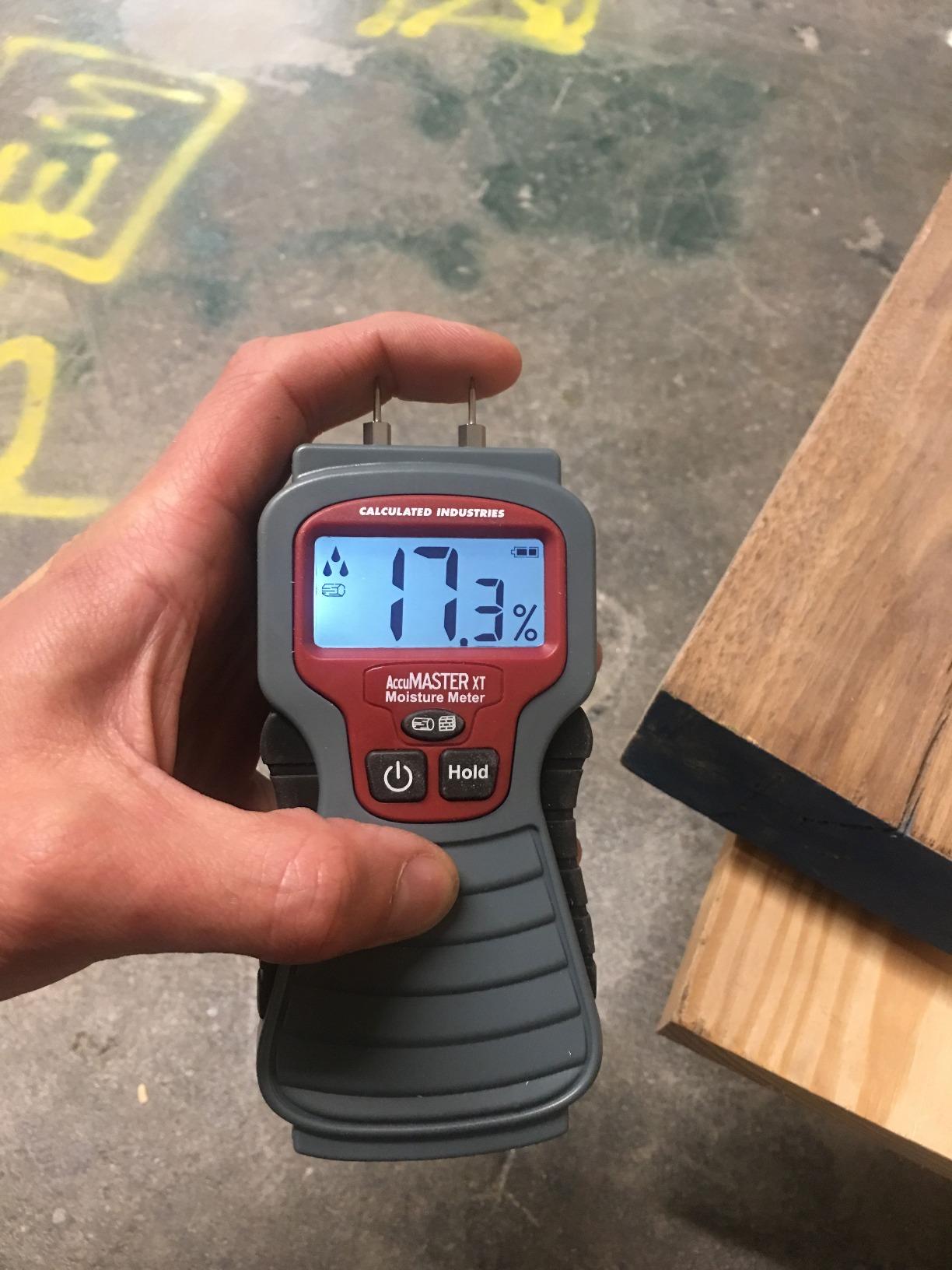
The AccuMASTER XT is the pick if you hand the meter to someone else. Built-in calibration test pins let a new user verify the meter is behaving before a job starts, which removes the single biggest reason people lose confidence in a cheap instrument. An included 9V battery and a one-year limited warranty round out a practical package.
It is a pin-type meter with replaceable sharp stainless steel pins, and its standout feature is a set of firewood interpretation bands built into the display: low from 5-11%, medium 12-15% and high 16-50%. That mapping is why firewood users rate it highly, since it turns a number into a burn-or-wait decision.
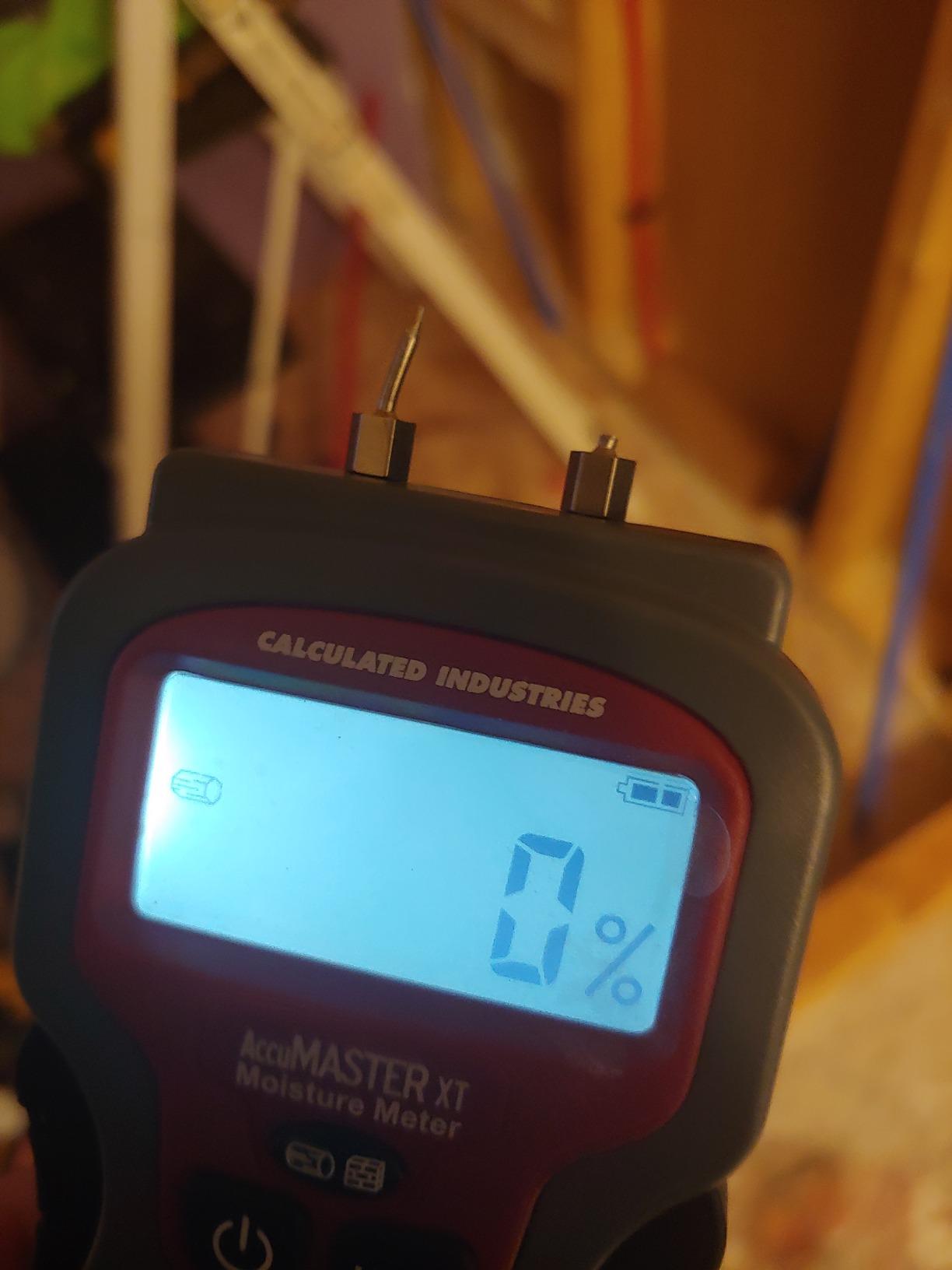
Material coverage is broad for a meter in this class. It measures firewood, lumber, brick, concrete, drywall, plaster, floors, walls and carpet, and it carries a large backlit screen with moisture icons and audio alerts, a hold key that freezes readings, automatic shut off and temperature accuracy of plus or minus 2 to 3 degrees C.
The limitation is species granularity. The built-in wood scale list is shorter than on meters built specifically for wood, so if you work in one or two species heavily and want the correction, this is not the one.
Why inspectors rate it highly
On-board calibration pins are rare at this tier, and they turn a trust problem into a five-second check. Combine that with broad material coverage and audio alerts, and it covers a home inspection or a remediation walk without a second device.
It also weighs 6.4 ounces and measures 2.5 by 1 inch, so it is not a burden on a long walk-through.
When to choose a dedicated wood meter
Coarse species calibration matters when you are chasing a two-point difference in dense hardwood. If your work is furniture-grade lumber in a small number of species, a meter with eight dedicated wood scales serves you better.
No carrying case is included, and as a pin meter it marks every surface it touches, so it belongs on a piece you can afford to mark.
12. VINHMOR MT270 – Best Rugged Pin Meter for Long-Term Firewood Use
Wood Moisture Meter – Digital Moisture Detector Moisture Tester, Pin-Type Water Leak Detector Damp Tester Dampness Meter for Wood Building Material Firewood Walls Paper Floor (Sliver)
Pin-type resistance, two stainless steel pins
Eight wood scales plus building material mode
Wood 6-60% range
Built-in auto-calibration and 10-minute auto off
+ The Good
- Rigid body that does not flex or creak under pin pressure
- Bright display readable without glasses
- Memory
- MAX/MIN and temperature display simplify repeated checks
- 10-minute timeout prevents battery drain
- Consistent readings across years of ownership
- The Bad
- Will not register below 6% so very dry stock shows nothing
- Reads near the surface so green lumber can look falsely dry
- Species calibration table is large and inconsistent
- Instructions contain translation errors
- One pin mount reported to crack out of the plastic
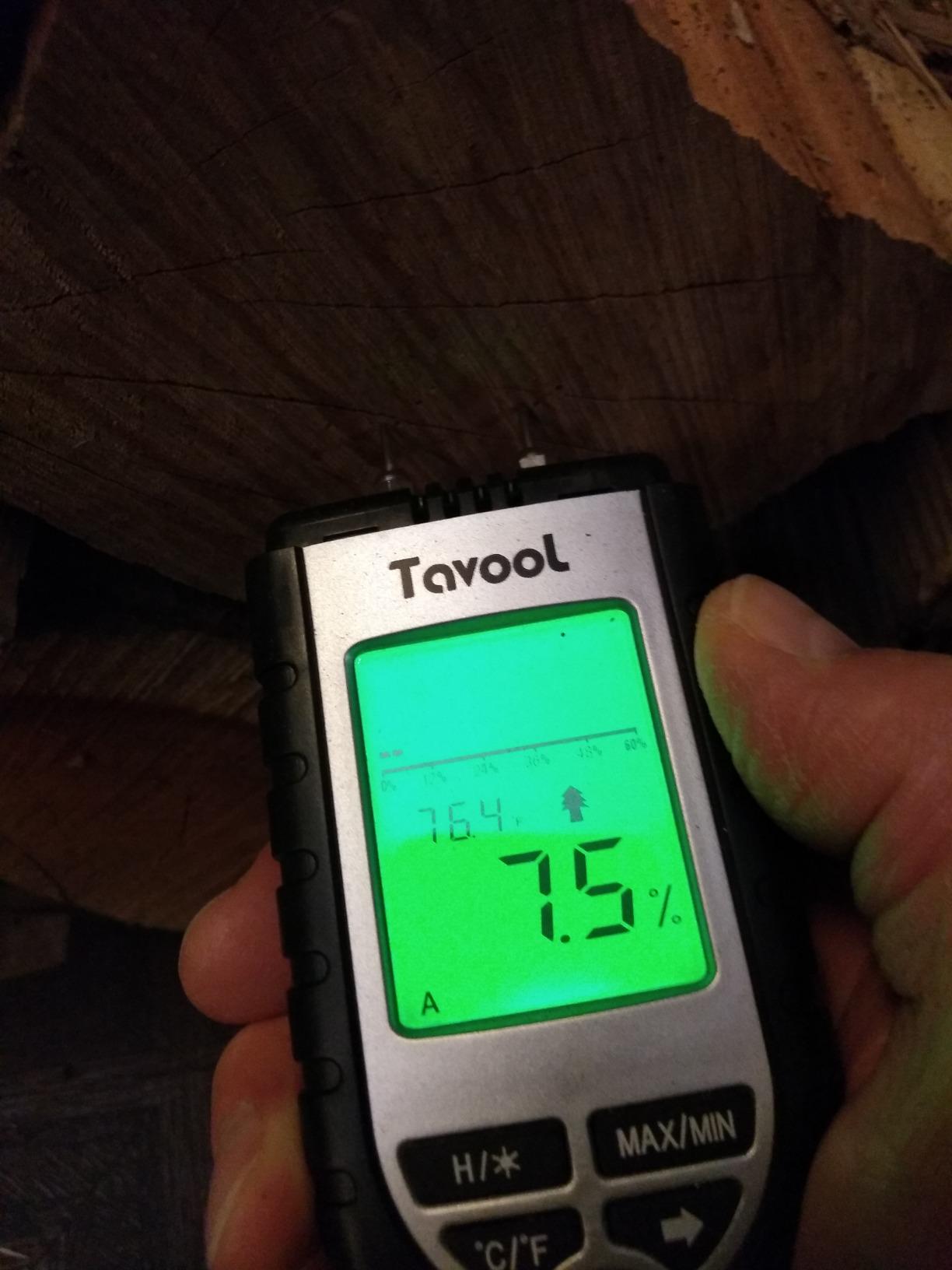
It is the one that shows up in firewood circles with a multi-year track record, and the build is a big part of why. Owners describe a rigid body that does not flex or creak when you press the pins in, which matters when the same meter is driven into end grain of hard oak splits hundreds of times a season.
It runs two high-precision stainless steel pins in resistance mode with eight wood calibration scales plus a building material mode. Wood range is 6-60% and building material range 0-40%, with interpretation bands of low 5-12%, medium 12-17% and high 17-60%. The large backlit LED display carries hold, memory, MAX/MIN and a temperature readout in C or F, and a 10-minute automatic power-off prevents battery drain.
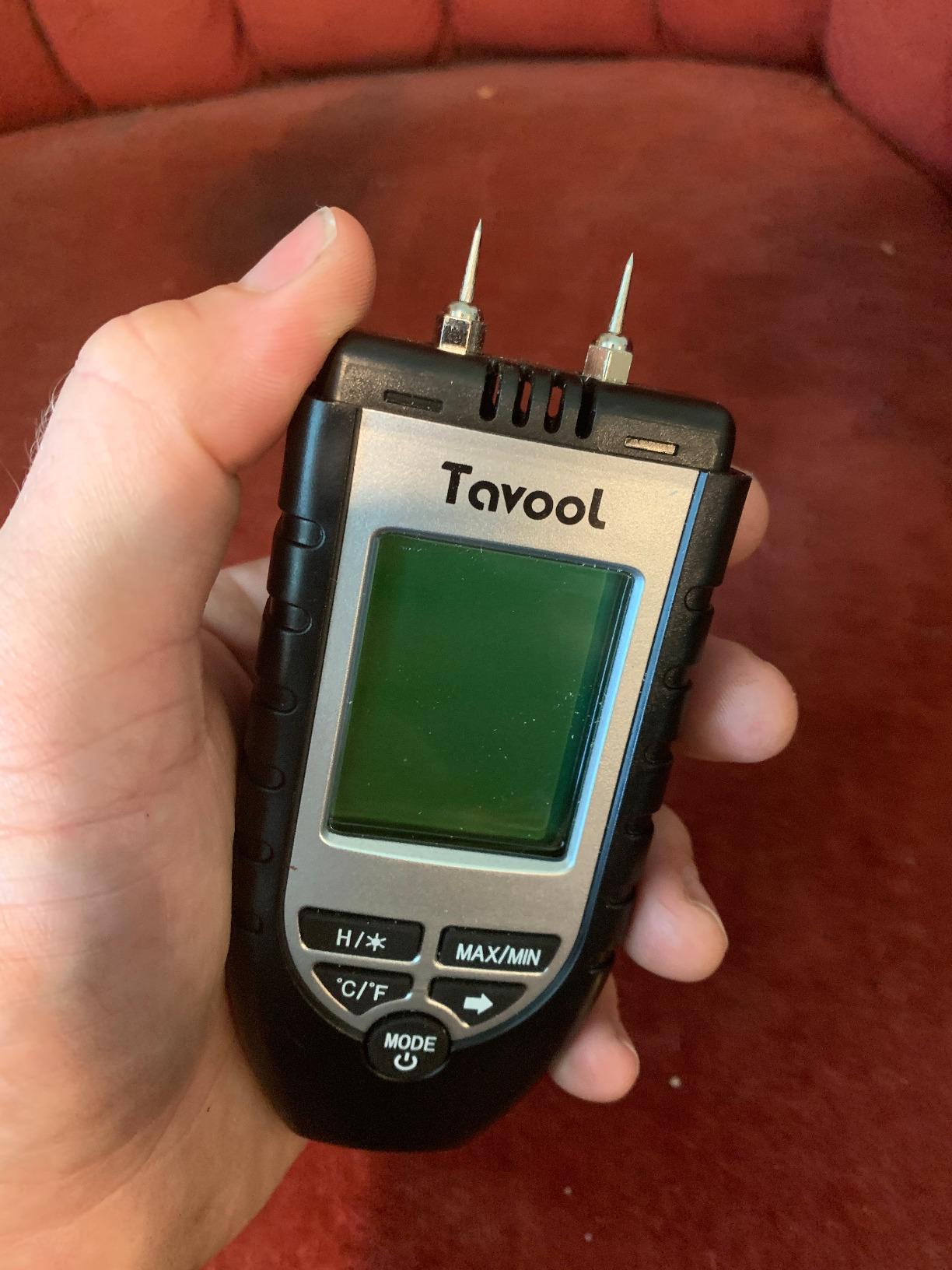
A one-year warranty is included, along with built-in auto-calibration, rubber side grips and a secure probe lid. Consistent readings across repeated tests on the same board, and dependable results after several years, are the reported long-term experience.
Two limits matter if your lumber is indoor-grade. It will not register below 6%, so properly seasoned furniture stock can show nothing at all. And it reads at or near the surface, which means green lumber and pressure-treated wood can read falsely dry.
Why it holds up year after year
Firewood is an abrasive job. A rigid body, replaceable pins, a secure probe lid and a memory function for repeated checks on the same stack add up to a tool that people keep rather than replace. The 5140-review history across firewood users is the strongest consistency signal in this group.
The MAX/MIN and memory functions also make it easy to record a board now and compare it after a week of drying.
When it is the wrong meter
Do not use it to approve lumber for furniture or cabinet work. The 6% floor means it cannot confirm the dryness level those projects demand, and surface-only readings on thick or wet stock can be optimistic.
The species calibration table is also described as large, inconsistent and sometimes missing common species, so budget time for it. One owner has reported a pin mount eventually cracking out of the plastic, which is a durability note rather than a widespread failure.
Target Moisture Content by Lumber Project in 2026
A meter only helps if you know the number you are aiming for. These are the working targets most woodworkers and millers use, and they are worth writing on the wall above the bench.
Cabinet and interior furniture: 6-8% moisture content. This is the standard target for joinery that lives indoors, and it is the level at which glue joints and finishes stay put through a heating season.
Indoor furniture in humid interiors: 9-11%. Wood installed in a humid climate should match the equilibrium moisture content of the room it will live in rather than the national indoor average.
Exterior trim, decking and exterior joinery: 12-15% or close to the local equilibrium moisture content, so the wood is not fighting the weather when it is installed.
Floor planks before install: within 2% to 3% of the subfloor reading. This is the comparison that prevents cupping, and it is why installers read both surfaces on the same day.
Firewood ready to burn: below 20%. Many firewood meters including the TOPTES and Calculated Industries units here map this to a band so you get a go or wait answer instead of a raw number.
Freshly milled green lumber: 30% and above is normal straight off the mill, and there is no useful target until it starts moving toward the fiber saturation point around 25-30%.
Two cautions. Wood dries from the outside in, so a surface reading on an 8/4 board can sit well below the core value. And cold wood reads low, so a reading taken in an unheated shed in winter can make a damp board look dry when it is not.
For the gear side of this, our guide to cantilever lumber racks covers stacking and stickering properly, which is what moves drying along in the first place.
How to Choose a Wood Moisture Meter for Lumber?
Pin or pinless first. If you will measure rough boards you could afford to mark, or you want core readings, choose pin type. If the wood is finished, figured, or already cut, choose pinless. Professionals use both, and the forum consensus is that a decent pin meter in the affordable tier is fine while a pinless unit handles the non-destructive scan first.
Reading depth against board thickness. This is the decision most shoppers get wrong. A short pin reads only the layers right at the surface, and on thick stock that means a wet core stays invisible. If your lumber runs to 8/4 and thicker, use end grain with a single pin or step up to a meter with a longer electrode.
Range floor. Check the bottom of the range before you buy for indoor work. Meters that floor out at 5% or 6% cannot report on properly acclimated cabinet lumber and may just show Lo, which tells you nothing.
Species calibration. Reading an oak board on a pine scale shifts the result by two to three points, which is most of your margin on a 6-8% target. Meters with six to eight dedicated wood scales and a printed quick-reference index are worth the extra step.
Accuracy specification. Stated accuracy in this group runs from plus or minus 2% on the better pin modes to plus or minus 5% on the loosest pinless models. That spread matters only if a small difference changes your decision, which it absolutely does before a furniture glue-up.
Alarms, display and hold. For sorting work a tricolor backlight and an audible over-range tone beat a precise number you have to interpret. A hold button and MAX/MIN capture make it easy to log a board and compare it a week later.
Warranty and calibration checks. Warranties here run from one year to three, and a self-test or calibration-check cap is more useful than a long warranty because it tells you the meter is still honest. Test it between boards, not just when you unbox it.
Frequently Asked Questions
What is the best moisture meter for lumber?
The General Tools MMD4E is the best all-round choice here, with a 5-50% wood range, large backlit digits and a hold button. For non-destructive scans on wood you cannot mark, the Klein Tools ET140 scans to 3/4 inch with no pinholes. Thick slabs and wet cores need a pin meter pushed into end grain.
What is the best moisture content tester for wood?
A pin-type resistance meter is the best moisture content tester when you need a number you can trust on a specific board, because it measures between two inserted pins at a known depth. A pinless meter is the best choice when you cannot mark the surface, such as on figured maple, live edge slabs or finished work.
What type of moisture meter is most accurate?
Pin-type meters are the most accurate of the two technologies. They measure electrical resistance at a defined depth and stated accuracy in this group runs from plus or minus 2% to plus or minus 3%. Pinless meters average the outer 3/4 inch, so they weight the surface and are biased by rain, dew or a damp face. Professional instruments with depth electrodes are accurate still, and all methods trace back to the ASTM D4442 oven-dry reference.
Do moisture meters work for wood?
Yes. Every meter in this roundup is built for wood first. Pin meters measure the electrical resistance between two pins, and wet wood conducts better, so lower resistance means higher moisture content. Pinless meters read the dielectric properties of wood through an electromagnetic field. Accuracy varies with species calibration, board temperature and how close to the surface the reading is taken.
How to test moisture in lumber?
Insert the pins perpendicular to the grain, at least 6 inches from the board end, and take several readings across the face and along the board. Hold steady pressure so the reading stops drifting. On thick stock, push a single pin into the end grain to check the core. Let cold wood warm up first, since cold lumber reads low.
What are acceptable moisture meter readings for wood?
For indoor cabinet and furniture work, 6-8% is the accepted target. In humid interiors, 9-11% matches the room. For exterior work, aim for 12-15% or close to your local equilibrium moisture content. Firewood should be below 20% before burning. Flooring planks should be within a few points of the subfloor reading at install time.
Is 10% moisture in wood bad?
Not for most uses. At 10% a board is fine for exterior work, fine for firewood, and fine for many interior projects in a dry climate. It is too wet for cabinet and furniture joinery, which usually wants 6-8%. The more useful question is whether 10% matches where the wood will live, because wood moves toward the equilibrium moisture content of its surroundings.
Do moisture meters work on firewood?
Yes, and this is the easiest job for them. Split or round wood reads high and falls as it seasons, and most meters here flag the transition with a color band or an audible tone. The Calculated Industries 7440 and the TOPTES TS-630 both map ranges into low, medium and high bands, so you get a go or wait answer rather than a raw number. Aim for below 20% before burning.
Which Wood Moisture Meter Should You Buy
If you want one meter for most lumber work, the General Tools MMD4E is the answer: the widest common-sense range in a proven package, the most readable display we tested, and the largest owner history here. If your wood cannot be marked, the Klein Tools ET140 gives you a 3/4 inch pinless scan you can trust for finding the wet zone. If you work in a dark shed, the RDINSCOS MT28 adds the flashlight no other budget pinless offers.
Work through the alternatives by task. Sorting firewood, the TOPTES TS-630 or the VINHMOR MT270. Confirming dryness on high-cost lumber, the Mecurate WMM, which pairs eight species scales and a self-test. Scanning high-end lumber without marks, the Povlen MT510-Y. Tracing damp inside a house, the LASELION MS04 or the Calculated Industries 7440. One device that does both, the Dr.meter MT1905.
Whichever you choose, use the protocol: pins perpendicular to the grain, away from the end, several readings per board, end grain for the core, and warm wood only. Updated for 2026, the honest truth is that a budget pin meter is genuinely good enough for sorting rough lumber and firewood, and that the meters forums treat as market leaders sit well above this price range.